






Gambling licenses come in many different types, and the differences matter. A remote casino license does not cover sports betting. A B2B supplier license does not authorize direct-to-consumer operations. A Curacao license does not give access to the UK market. Operators choosing the wrong license type can end up licensed for products they do not offer while being unlicensed for products they do offer.
This guide classifies gambling licenses across the dimensions that actually matter for an operating decision: product type, business model (B2C vs B2B), jurisdiction category, remote vs land-based, and duration of authorization. It is a reference guide for operators, investors, and service providers who need to understand what licenses exist and which ones apply to their situation.
For basic concepts about what a gambling license is, start with our what is a gambling license page. For the step-by-step process of getting licensed, see our iGaming licensing guide. For the global regulatory landscape, see our global iGaming regulation guide.
The Five Key Dimensions of License Classification
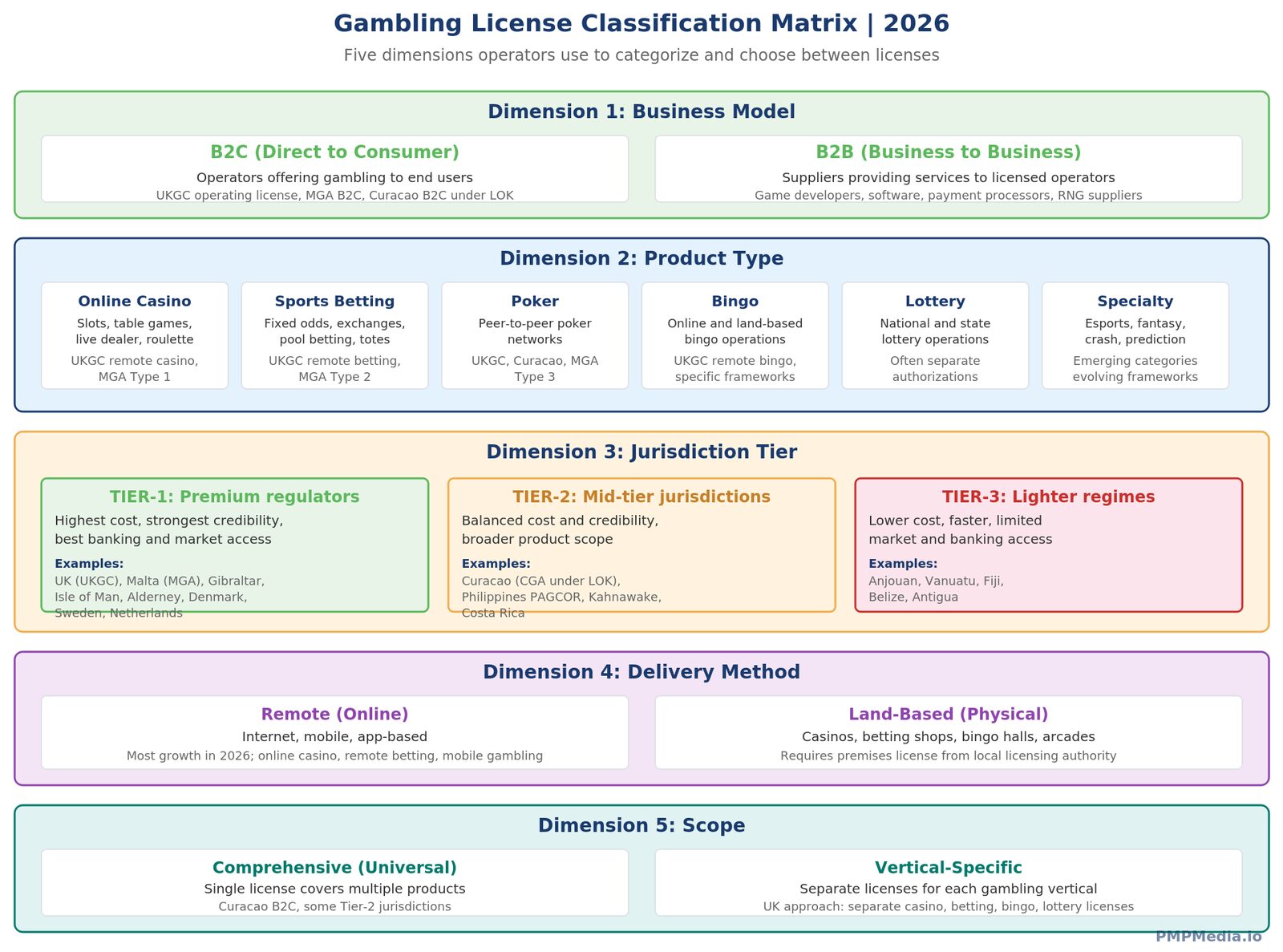
Every gambling license can be classified across five dimensions. Understanding these helps operators identify which licenses they actually need.
- Business model: B2C (direct to consumer) vs B2B (supplier to operators)
- Product type: Casino, sports betting, poker, bingo, lottery, specialty
- Jurisdiction tier: Tier-1 (premium regulators), Tier-2 (mid-tier), Tier-3 (lighter regimes)
- Delivery method: Remote/online vs land-based brick-and-mortar
- Scope: Comprehensive vs vertical-specific
B2C Operator Licenses
B2C licenses authorize direct-to-consumer gambling services. This is what most people think of when they hear “gambling license” — the authorization for a company to run a casino website or sportsbook platform serving end users.
Online casino license
Authorizes operation of online casino games: slots, table games (blackjack, roulette, baccarat), live dealer games, and sometimes crash games or instant-win games. The specific products covered vary by jurisdiction. Some licenses cover everything; others require separate authorization for live dealer or specific game categories.
Typical examples:
- UKGC remote casino operating license
- MGA B2C Type 1 (online gaming)
- Gibraltar remote gaming license
- Curacao B2C gaming license under LOK
- Isle of Man Online Gambling Regulation Act license
Online sports betting license
Authorizes sports betting, including fixed-odds betting, exchanges, and pool betting. Sports contracts on prediction markets are a separate regulatory category in some jurisdictions.
Typical examples:
- UKGC remote betting operating license
- MGA B2C Type 2 (fixed-odds sports betting)
- Gibraltar remote bookmaker license
- State-level US sports betting licenses (New Jersey, Pennsylvania, etc.)
Poker license
For peer-to-peer poker operations. Some jurisdictions have specific poker licenses; others bundle poker into general online gambling authorization.
Bingo and lottery licenses
Separate categories in most jurisdictions, often with distinct regulatory frameworks. National lottery monopolies exist in many countries (Norwegian Norsk Tipping, Swedish Svenska Spel formerly, Finnish Veikkaus). Commercial bingo is usually smaller-scale and more tightly regulated.
Virtual sports and esports
Growing category, often classified under existing sports betting licenses but with specific compliance requirements. Esports betting has emerged as a distinct sub-category with its own integrity considerations.
Crypto casino and sportsbook licenses
No separate “crypto license” exists in most major jurisdictions. Crypto-accepting operators work under standard licenses (Curacao, Anjouan, Kahnawake, smaller regimes) with additional crypto-specific AML requirements. In the EU, MiCA’s transitional period for crypto-asset service providers ended on July 1, 2026, so operators either need CASP authorisation themselves (if they exchange or hold crypto for customers) or must use authorised providers.
Lottery licenses
National and state lotteries often operate under specific authorization separate from general gambling licenses. The UK’s National Lottery is licensed separately from commercial gambling, with Camelot having held the license until 2024 when it was transferred to Allwyn.
B2B Supplier Licenses
B2B licenses authorize companies providing services to licensed operators rather than to end consumers directly.
Gambling software supplier license
For companies developing and supplying gaming software: casino game developers (Microgaming, NetEnt, Evolution, Playtech), sportsbook platform providers, platform aggregators, and RNG providers.
Key licenses in this category:
- UKGC gambling software operating license
- MGA B2B license (critical supply to licensed operators)
- Curacao B2B supplier license under LOK
- Gibraltar software supplier license
Live casino studio license
Operations running live dealer games from physical studios (Evolution Gaming’s operations in Riga, Malta, New Jersey). Often combines B2B software license with specific studio operation authorization.
Payment processing license
Technically not a gambling license per se, but payment processors serving gambling operators often require specific authorization. Some jurisdictions (Curacao, Malta) include payment processing in B2B supplier categories.
Gambling affiliate and media licenses
Most jurisdictions do not specifically license affiliates, but affiliates must work with properly licensed operators and comply with advertising regulations in the markets they target. Some jurisdictions (UK, Sweden, Portugal) have affiliate-specific rules within operator licenses.
Independent test labs and certification
Laboratories like Gaming Laboratories International (GLI), BMM Testlabs, iTech Labs, and eCOGRA need specific certification to serve licensed operators with RNG testing, game fairness verification, and technical audits. This is a specialized supplier category.
Jurisdiction Categories
Gambling jurisdictions fall into informal tiers based on regulatory rigor, cost, credibility, and market access.
Tier-1: Premium regulators
Highest cost, strongest consumer protection, most respected internationally, typically required for specific market access.
- UK Gambling Commission (UKGC): Mandatory for UK customers. Annual fees reach £1.45m+ for operators above £1.6bn GGY after the 25% rise on 1 October 2026. Remote Gaming Duty 40% since April 2026
- Malta Gaming Authority (MGA): EU credibility, gaming tax on revenue from Malta-resident players only (15% casino, 10% other verticals since 1 October 2026), annual fees from €25,000 plus a revenue-based compliance contribution. Strong pathway to EU markets
- Gibraltar Gambling Commission: Historically UK-facing, now targeting US and other markets too. Strong regulatory reputation
- Isle of Man Gambling Supervision Commission: Similar credibility to Gibraltar, distinct market positioning
- Alderney Gambling Control Commission: Smaller but respected
- Denmark (Spillemyndigheden): Specific licensing framework for Danish market
- Sweden (Spelinspektionen): EU-compliant licensing framework
- Netherlands (Kansspelautoriteit): Post-2021 formal remote gambling licensing
- Nordic states in general: Stringent controls, channel-specific regulations
Tier-2: Mid-tier jurisdictions
Curacao under LOK sits firmly in Tier-2, with EUR 70,000-110,000 first-year all-in cost. For the complete Curacao license cost breakdown including application fees, ongoing compliance costs, and GLI certification, see our detailed analysis.
Balanced cost and credibility, broader product scope, faster application times than Tier-1.
- Curacao (CGA under LOK): Post-2024 reformed jurisdiction. EUR 70,000-110,000 first year. No gaming tax, flat EUR 47,450 annual fee, roughly 2% effective profit tax with local substance. Crypto-friendly with AML requirements
- Kahnawake (Canada): Long-established offshore jurisdiction under Mohawk sovereignty. Lower cost, recognized in specific markets
- Philippines PAGCOR: Strong for Asian markets, specific framework
- Costa Rica: Lighter regime (primarily considered data processing license) but with banking challenges
- Tobique First Nation (Canada): Emerging framework
Tier-3: Lighter regimes
Lower costs, weaker regulatory oversight, more limited market access. Often used by startups or for specific markets where payment providers accept these licenses.
- Anjouan (Comoros): EUR 30,000-60,000 first year. Growing adoption for crypto operations, now under FATF pressure to tighten its rules
- Vanuatu: Interactive Gaming Act 2000 framework, permissive
- Fiji: Local licensing option
- Belize: Historical jurisdiction, largely superseded
- Antigua and Barbuda: Post-WTO case, diminished role
US state licensing (special category)
The US operates primarily at state level for gambling regulation. Each state has its own framework. Key states:
- New Jersey: Division of Gaming Enforcement. Mature online casino and sports betting
- Pennsylvania, Michigan, West Virginia: Regulated online gambling markets
- Nevada: Gaming Control Board. Strong land-based history, online evolving
- New York: Sports betting, online casino in progress
- Colorado, Virginia, Arizona: Regulated sports betting states
- California, Texas, Florida: Large populations without full online gambling (yet)
US federal gambling law (Wire Act, UIGEA, PASPA) interacts with state frameworks. Sports betting expansion since 2018 PASPA repeal continues to evolve.
Remote vs Land-Based Licenses
The division between online and physical gambling is fundamental to licensing.
Remote (online) licenses
Cover any gambling service delivered over internet, mobile, or remote communications. Most growth in the gambling industry in 2026 is in remote products. Specific categories:
- Online casino
- Remote sports betting
- Online poker
- Online bingo
- Online lottery
- Mobile-specific gambling
Land-based (non-remote) licenses
Cover physical venues: casinos, betting shops, bingo halls, arcades.
- Land-based casino operating license
- Betting office / bookmaker’s office license
- Bingo hall license
- Arcade and adult gaming centre licenses
- Gaming machine technical and supplier licenses
Combined licenses
Some operators hold both remote and land-based licenses for integrated operations. Betfred, William Hill, Paddy Power all operate integrated remote and land-based businesses in the UK under combined licensing frameworks.
Premises licenses
Separate from operating licenses. Issued by local licensing authorities (often municipalities) for specific physical locations. A casino operator needs both a national operating license and premises licenses for each casino location.
Product-Specific License Categories
Beyond casino and sports, many jurisdictions license specific products separately.
Fixed-odds betting
Traditional sportsbook operations. Usually covered under sports betting licenses.
Betting exchanges
Peer-to-peer betting platforms. Requires specific exchange license in UK and some other jurisdictions. Betfair and Matchbook operate under this model.
Pool betting and tote betting
Pari-mutuel betting systems for horse racing and other events. Specific licensing in UK, France, Germany, and traditional horse racing markets.
Spread betting
Regulated by financial authorities (FCA in UK) rather than gambling regulators. Spread betting is classified as a financial instrument in UK law.
Prediction markets and event contracts
Emerging category. In US, CFTC Designated Contract Market licensing — see our Kalshi review for how CFTC licensing works in practice. In UK, classified as betting intermediary under UKGC. Regulatory classification still evolving globally.
Fantasy sports
Often exempted from gambling classification in US under UIGEA skills-based exceptions. Classified as gambling in some European jurisdictions.
Sweepstakes and promotional gaming
Legal in US without gambling license under specific conditions (no consideration, skill-based, promotional). Distinction is narrow and heavily scrutinized.
Skill-based and dexterity games
Regulatory treatment varies. Some jurisdictions treat skill games as gambling, others do not.
Scope-Based Classification
Licenses also differ in scope.
Comprehensive (universal) licenses
Cover multiple product categories under a single license. Curacao’s B2C license historically covered “all forms of interactive eGaming” including casino, sports betting, exchanges, lottery, skill games under one license. Malta offers multi-product licensing through its Type classification system.
Vertical-specific licenses
Require separate licensing for each product category. UK’s approach — separate operating licenses for casino, betting, bingo, lottery. More granular oversight but higher costs for multi-vertical operators.
Platform vs operation licenses
Some jurisdictions distinguish between licensing the underlying platform/technology and licensing the specific operator using it. This matters for operators using white-label or turnkey solutions.
Duration and Renewal Categories
Short-term licenses
Some jurisdictions issue licences for a year or two at a time so the regulator gets a regular review point. Several US states work on annual or two-year renewals, and supplier registrations in particular are often short-term.
Medium-term licenses
3-5 year terms are standard in most regulated markets. UK operating licenses are indefinite subject to annual renewal. Malta licenses are 10-year terms. Gibraltar licenses run 5 years.
Provisional licenses
Limited-term licenses issued while applicants complete full requirements. Curacao’s 6-month provisional with extension option. Some US states have conditional authorization pending investigation completion.
How to Choose the Right License Type
The right license depends on several factors.
Target markets
Start here. Identify where your customers are. Required licenses follow from geographic target:
- UK customers: UKGC mandatory
- EU member states: usually national licensing (Malta license gives limited access)
- Global non-restricted markets: Curacao or similar mid-tier covers most
- Specific US states: state-by-state licensing
- Canada: Ontario (AGCO / iGaming Ontario) and, since July 2026, Alberta (AGLC)
- Philippines: PAGCOR
- Latin America: country-specific
Product portfolio
Match license categories to products you will offer. Casino-only operators need different licenses than integrated casino + sportsbook operators.
Business model
B2C operators serve consumers directly. B2B suppliers provide services to B2C operators. The license follows the business model, with some businesses holding both.
Budget and scale
Tier-1 licenses (UK, Malta) are serious commitments: EUR 150,000-500,000+ first year. Tier-2 (Curacao) more moderate: EUR 70,000-110,000. Tier-3 (Anjouan) much lower: EUR 30,000-60,000. Scale investment to business stage and projected revenue.
Time to market
Tier-1 licensing typically takes 6-12 months. Tier-2 takes 4-8 months. Tier-3 takes 2-4 months. Operators needing faster launch sometimes use Tier-3 initially and add Tier-1/Tier-2 as they scale.
Banking and payment needs
Major payment processors and Tier-1 banks require recognized licensing. Anjouan license may not work for premium Western banking. Curacao under LOK has improved banking credibility. Malta and UK licensing are bank-friendly.
Multi-Jurisdiction License Portfolios
Many successful operators hold multiple licenses strategically.
Typical combinations
- UK + Malta + Gibraltar: Premium markets with strong brand value
- UK + Malta + Curacao: Premium markets plus global reach
- UKGC + US state licenses: UK and targeted US market expansion
- Malta + Denmark + Netherlands: EU regulated market focus
- Curacao + Anjouan: Global reach with crypto-friendly alternatives
- UKGC + MGA + multi-state US: Largest operators like Flutter Entertainment, Bet365
Operational complexity
Each additional license adds compliance overhead, application costs, ongoing fees, audit requirements, and reporting obligations. The benefit is market access and risk diversification. Operators typically add licenses as revenue scale justifies the overhead.
Typical License Combinations by Business Type
Crypto casino startup
- Anjouan or Curacao B2C for operating license
- Later: Malta or Gibraltar for banking credibility as scale grows
Sports betting platform targeting US
- State-by-state licensing in target states
- Sometimes Gibraltar or Curacao for initial launch while state licenses process
- Integration with data providers who hold their own licenses
Global software provider
- Malta B2B license for EU access
- UKGC gambling software license for UK access
- Curacao B2B for mid-tier markets
- US state vendor registrations as needed
Sportsbook focused on UK
- UKGC remote betting operating license
- GB pool betting license if relevant
- May also hold Gibraltar license for historical reasons
Full-service European operator
- Malta (EU hub)
- UK (UK market)
- Sweden, Denmark, Netherlands (specific markets)
- Portugal, Italy, Spain (specific markets)
- Each with corresponding local taxes and compliance
Emerging License Categories
Prediction market licenses
US CFTC Designated Contract Market (Kalshi, Polymarket via QCX) for event contracts. UK treats prediction markets as betting and lets exchanges run them under their existing UKGC licences (Betfair Predicts went into beta in April 2026). Gibraltar licensed Predict Street Ltd as a betting intermediary on 26 March 2026, which local officials call the territory’s first prediction market licence. Regulatory category continues to evolve.
Esports betting
Specific regulatory treatment emerging in many jurisdictions. Integrity considerations distinct from traditional sports. Licensing typically extends existing sports betting frameworks.
Crypto-native licenses
Anjouan has emerged as preferred jurisdiction for many crypto-focused operators. Curacao under LOK tightening AML for crypto. Future regulatory frameworks may create crypto-gambling-specific licensing categories.
NFT and skin gambling
Regulatory treatment in flux. Some jurisdictions apply existing gambling law to NFT-based wagering; others create specific frameworks. Skin gambling (valuable in-game items) remains a grey area.
Related Guides
- What Is a Gambling License
- iGaming Licensing Guide
- Global iGaming Regulation Guide
- Malta Gaming License
- Curacao iGaming License
- UK Gambling License
- Curacao vs Malta License
- Curacao License Requirements
Bottom Line
Types of gambling licenses can be classified across five main dimensions: business model (B2C vs B2B), product type (casino, sports betting, poker, etc.), jurisdiction tier (premium vs mid-tier vs lighter regimes), delivery method (remote vs land-based), and scope (comprehensive vs vertical-specific).
The right license type depends on target markets, product portfolio, business model, budget, and time-to-market needs. Most successful operators hold multiple licenses strategically, with mid-tier operators typically carrying 2-3 licenses and major multinationals holding 10+ authorizations.
Understanding license types is a foundation for strategic decisions about market entry, operational structure, and growth planning. Getting the classification right before application saves substantial time and cost.
FAQ
What are the main types of gambling licenses?
Gambling licenses are classified across five dimensions: business model (B2C operator licenses vs B2B supplier licenses), product type (casino, sports betting, poker, bingo, lottery), jurisdiction tier (Tier-1 premium like UK/Malta, Tier-2 like Curacao, Tier-3 like Anjouan), delivery method (remote/online vs land-based), and scope (comprehensive vs vertical-specific).
What is the difference between B2C and B2B gambling licenses?
B2C (business to consumer) licenses authorize operators to offer gambling services directly to players. B2B (business to business) licenses authorize suppliers providing services to licensed operators (game developers, software providers, payment processors, testing labs). A company can hold both types, but they are typically separate authorizations.
What are Tier-1 gambling jurisdictions?
Tier-1 jurisdictions are premium regulators with strongest consumer protection, highest credibility, and broadest market access, including the UK Gambling Commission, Malta Gaming Authority, Gibraltar Gambling Commission, Isle of Man, Alderney, Denmark, Sweden, Netherlands, and other EU regulated markets.
What is the difference between remote and land-based gambling licenses?
Remote (online) licenses authorize gambling services delivered over internet, mobile, or remote communications. Land-based licenses authorize physical premises operations including casinos, betting shops, bingo halls, and arcades. Many jurisdictions require separate licenses for each delivery method, though some offer combined authorizations for integrated operations.
Do I need separate licenses for casino and sports betting?
Depends on jurisdiction. Some jurisdictions (UK, EU member states generally) require separate operating licenses for each vertical. Others (Curacao, some Tier-2 jurisdictions) offer comprehensive licenses covering multiple gambling products under one authorization. Check the specific jurisdiction’s license structure before planning.
Can one company hold multiple gambling licenses?
Yes. Most successful operators hold multiple licenses strategically — one for each target market. Typical combinations include UKGC for UK, Malta for EU access, Curacao for global mid-tier markets, plus state-level US licenses. Each additional license adds operational complexity and ongoing costs but extends market access.
What is a universal or comprehensive gambling license?
A comprehensive license covers multiple gambling products (casino, sports betting, poker, bingo) under a single authorization rather than requiring separate licenses for each vertical. Curacao’s B2C license under LOK is an example. This offers operational efficiency for multi-vertical operators but is typically issued by Tier-2 jurisdictions rather than premium regulators.
What is a provisional gambling license?
A provisional license is a limited-term authorization issued while an applicant completes full requirements. Curacao issues 6-month provisional licenses (extendable once for 6 months) to applicants that meet critical requirements but have gaps in some areas. Some US states offer similar conditional authorizations. Provisional status allows operators to launch and generate revenue while finalizing compliance.
What is the difference between an operating license and a personal management license?
An operating license authorizes the company to provide gambling services. A personal management license (PML in UK terminology) authorizes specific individuals within the organization to hold senior positions with gambling responsibility. Operators need both — the operating license for the entity and PMLs for key personnel including CEO, directors, compliance officer, MLRO.
What is a B2B supplier license?
A B2B supplier license authorizes companies that provide services or products to licensed gambling operators rather than to end consumers directly. This includes game developers, sportsbook platform providers, RNG suppliers, platform aggregators, payment processors, and testing laboratories. The supplier license ensures that critical service providers meet regulatory standards appropriate to their role in the ecosystem.
Do affiliates need a gambling license?
Generally no. Most jurisdictions do not require affiliates to hold gambling licenses, but affiliates must work only with properly licensed operators and comply with advertising regulations in target markets. Some jurisdictions (UK, Sweden, Portugal) have specific affiliate rules within operator licenses that affect how affiliates can operate.
What is the difference between a Tier-1 and Tier-3 gambling license?
Tier-1 licenses (UK, Malta, Gibraltar) are premium authorizations with highest regulatory scrutiny, strongest consumer protection, best banking and payment access, and highest costs. Tier-3 licenses (Anjouan, Vanuatu, some smaller jurisdictions) are lighter regimes with lower costs but more limited market access, weaker banking relationships, and less consumer trust. Tier-2 (Curacao, Philippines PAGCOR) sits between these extremes.
 Share
Share


 0 views