






Curacao gaming license requirements changed dramatically in December 2024, and anyone operating under the old framework needs to understand what is now actually required. The National Ordinance on Games of Chance (LOK) replaced the 31-year-old NOOGH framework, abolished the master license system, transferred full licensing authority to the Curacao Gaming Authority (CGA), and introduced substance, compliance, and AML requirements that did not exist under the previous regime.
Curacao’s requirements are specific, but they follow patterns common to all gambling licenses globally. For the foundational concept of what a gambling license is and how it differs from a standard business permit, see our overview.
This guide covers exactly what operators must do to obtain and maintain a Curacao license in 2026. It is written for founders, compliance officers, and legal counsel evaluating Curacao as a jurisdiction for regulated online gaming under the new framework. For how Curacao compares to alternatives, see our Curacao vs Malta license analysis. For cost breakdowns, see our Curacao license cost guide. For an overview of the jurisdiction, start with our Curacao iGaming license page.
The 2024-2026 Regulatory Transformation
Curacao gaming regulation went through the most significant change in its history between 2023 and 2026. Understanding what happened is essential because every requirement below flows from this transformation.
Until December 2024, Curacao operated on the NOOGH (National Ordinance on Offshore Games of Hazard) framework from 1993. Four private master license holders (Antillephone, Cyberluck trading as Curacao eGaming, Gaming Services Provider trading as Gaming Curacao, and Curacao Interactive Licensing) issued sublicenses to operators at their own discretion. An operator could launch a casino with minimal due diligence, no mandatory compliance officer, no local office, and very limited regulatory oversight. The master license holders did most of the work. The Curacao government collected fees but did not directly supervise operators.
The Dutch government demanded reform as a condition for COVID-19 financial aid to Curacao. The Netherlands insisted Curacao modernize its gambling regulation to international compliance standards. The Landsverordening op de kansspelen (LOK) came into force on 24 December 2024 as the result. It created the Curacao Gaming Authority as the sole direct regulator, abolished the master license model, and set substance and compliance requirements in line with global AML and player protection expectations.
All sub-licenses issued under NOOGH expired in January 2025. Every operator that wants to remain licensed in Curacao must now hold a direct LOK license from CGA. No exceptions. Operators who had sub-licenses and did not migrate are operating illegally if they still display a Curacao seal.
The scale of the job is visible in the CGA’s own public register. As of 21 September 2026 it listed 665 license entries, and 281 of them, about 42%, were still marked “Assessment in progress”, most of them past the expiry date printed on the licence itself. The regulator does not publish a rejection rate. The figure of roughly 38% that licensing consultants quote comes from the 2025 conversions of legacy sub-licensees and should be read as an estimate, not a CGA statistic. What is not in doubt is that the CGA is turning away applicants that fail integrity, financial, or substance requirements, and is revoking licences for unpaid fees.
Who Needs a Curacao License
Curacao offers B2C and B2B license categories under LOK. For a comprehensive classification of types of gambling licenses across all jurisdictions, including how Curacao’s categories compare to Malta, UK, and Tier-3 alternatives, see our reference guide.
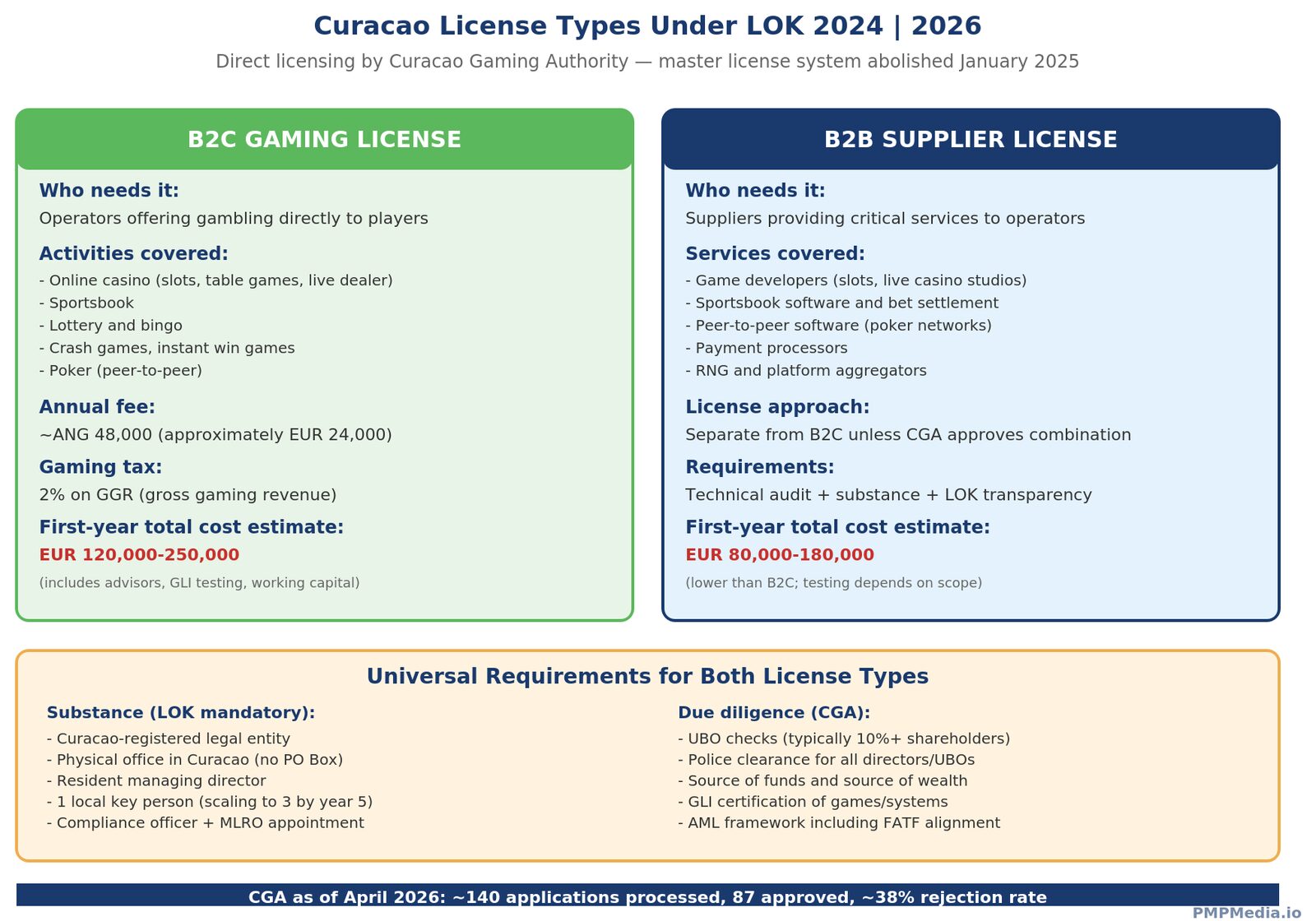
Under the LOK, three license categories exist:
B2C Gaming License (operator license): Required for any entity offering games of chance directly to players. Covers online casinos, sportsbooks, lotteries, bingo, and all forms of consumer-facing gambling. Each operator must hold its own B2C license, not share one.
B2B Supplier License: Required for suppliers providing critical services or goods to licensed operators. This includes game developers (slot providers, live casino studios), sportsbook software suppliers (bet capture and settlement platforms), peer-to-peer software providers (poker networks), payment processors, platform aggregators, and RNG suppliers. A B2B license is separate from a B2C license. Some vertically integrated operators hold both.
Nonprofit Game License: Issued for charitable gaming operations. Not relevant for commercial operators.
Article 4 of the LOK explicitly prohibits offering online gaming in or from Curacao without a CGA license. This prohibition extends to entities that directly or indirectly control player databases and player transactions in or from Curacao, which closes a loophole some operators tried to exploit by locating legal entity elsewhere while running operations through Curacao staff.
Corporate and Substance Requirements
Substance requirements are where the LOK diverges most sharply from the old NOOGH regime. Under the master license system, a Curacao “company” might exist only as a paper entity with no local staff. Under LOK, genuine local presence is mandatory.
Local entity requirement
Only legal entities established under Curacao law, with their statutory seat in Curacao, are eligible to apply for a B2C or B2B license. Operators cannot apply as a foreign company. Typical structures:
- BV (Besloten Vennootschap) — Curacao private limited company
- NV (Naamloze Vennootschap) — Curacao public limited company
- Curacao-registered branch of a foreign entity (less common, more complex)
The entity must be managed by at least one natural person who is a Curacao resident and serves as managing director, or by a corporate entity established under Curacao law with at least one resident managing director. The resident director is not a nominee — they must have actual decision-making authority and accountability.
Physical office
A registered office address in Curacao is mandatory. This is not a PO Box or nominee address. The CGA can visit the premises for inspections, particularly during Phase 2 review.
Local staffing requirements
LOK requires B2C and B2B operators to hire at least one full-time key person in Curacao. The local managing director is not counted toward this headcount (that is a separate requirement). The staffing requirement scales over time:
- Year 1: Minimum 1 full-time local key person (separate from managing director)
- Year 2-3: Scaling additional local staff as operations grow
- Year 5: Minimum 3 local key persons full-time
CGA delayed enforcement of these staffing rules until April 1, 2027, recognizing that the labor market in Curacao could not immediately absorb the hiring demand. Operators licensed before this date must demonstrate a hiring plan and meet the requirement by the deadline.
Compliance officer
Appointment of a dedicated compliance officer is mandatory. This person is responsible for ensuring the operator complies with LOK, AML obligations, responsible gambling requirements, and reporting duties. The compliance officer can be based in Curacao or elsewhere, but must have clear accountability and direct reporting to senior management and the board.
Money Laundering Reporting Officer (MLRO)
Required separately from the compliance officer (though the roles can be combined in smaller operations). The MLRO is responsible for anti-money laundering and counter-terrorism financing obligations, reporting suspicious transactions to the Financial Intelligence Unit of Curacao, and maintaining AML documentation.
Integrity and Due Diligence Requirements
The CGA conducts detailed due diligence on the applicant entity and all relevant individuals. This is the area where the LOK most obviously differs from the old regime, which required only minimal identity checks.
Ultimate Beneficial Owner checks
CGA investigates all ultimate beneficial owners (UBOs). The threshold is typically 10% equity ownership, though this can vary. For every UBO the regulator requires:
- Government-issued identification with notarized copies
- Police clearance certificate from country of residence (and any country of residence in the past 5-10 years)
- Source of funds documentation demonstrating how the applicant acquired the capital to invest
- Source of wealth documentation demonstrating the broader financial background
- Personal History Disclosure (PHD) form, completed personally
- Financial statements for the past 2-3 years
- Bank references and professional references
The CGA must deny a license if any UBO with more than 25% shareholding, or any person determining or co-determining company policy, has been convicted in the past eight years of crimes related to obtaining unlawful gain. This explicitly includes theft, extortion, fraud, money laundering, or terrorism financing.
Director and senior management checks
The same level of scrutiny applies to:
- All managing directors (local and foreign)
- All directors of the board
- Senior management with policy-determining authority (C-suite)
- Anyone holding significant control or influence even without formal title
Corporate transparency
The CGA requires the applicant to fully disclose corporate structure, ownership chain (including any offshore vehicles in the chain), and all related entities. Nominee directors and bearer shares are not permitted. The regulator must be able to trace ownership to natural persons in all cases.
Financial integrity requirements
Applicants must demonstrate sufficient funding to operate and pay player winnings. This typically involves:
- Corporate bank statements showing working capital
- Three-year financial forecast with realistic projections
- Evidence of segregated player funds account arrangements
- Insurance or guarantee arrangements for player protection
- Bank references demonstrating banking relationships
The CGA does not publish a minimum capital requirement as a fixed number, but practical benchmarks from approved applicants suggest €500,000-1,500,000 in demonstrable operating capital for B2C applicants, with more required for larger platforms or sports betting operations with higher payout variance.
Technical and Operational Requirements
The CGA requires operators to meet specific technical standards covering gaming fairness, data security, and operational integrity.
GLI certification
All games and gaming systems must be certified to Gaming Laboratories International (GLI) standards or equivalent. This includes:
- RNG (Random Number Generator) certification for all games of chance
- Game logic testing for each slot, table game, or live dealer game
- Sportsbook platform certification for bet capture and settlement
- Responsible gambling tool certification
- Data integrity and logging verification
Operators can use any GLI-certified independent test lab. The full testing process typically costs €15,000-50,000 depending on the scope of games and systems, and takes 4-8 weeks.
Responsible gambling controls
Mandatory consumer-facing controls include:
- Deposit limits (operator-defined with user ability to set lower)
- Session limits and reality checks
- Self-exclusion tools, temporary and indefinite
- Problem gambling help resources prominently displayed
- Age verification before first deposit and first gameplay
- Loss limit tracking
AML/KYC infrastructure
Operators must implement FATF-aligned anti-money laundering controls. Practical requirements:
- KYC verification of all players before first withdrawal (often before first deposit)
- Enhanced due diligence (EDD) for high-value players
- Transaction monitoring with automated suspicious activity flagging
- Source of funds verification for large deposits
- Chain analysis tools for crypto deposits (mandatory if accepting crypto)
- SAR (Suspicious Activity Report) filing procedures with Curacao FIU
- Annual AML risk assessment
- AML policy documented and regularly updated
Crypto-specific requirements
If the operator accepts cryptocurrency, additional requirements apply:
- Licensed operators hold crypto in entity-owned wallets (not third-party custody without regulatory approval)
- Chain analysis tools (Chainalysis, TRM Labs, Elliptic, or equivalent) mandatory for transaction screening
- Strict wallet provenance checks for incoming deposits
- Compliance with FATF Travel Rule for VASP-to-VASP transfers
- Documented crypto risk policy separate from general AML policy
The CGA is actively rejecting applications from operators that cannot demonstrate robust crypto AML frameworks. Anonymous crypto platforms without player identity verification are not eligible for licensing under LOK.
The Two-Phase Application Process
The Curacao application process fits within a broader pattern that applies to most gambling license applications globally. For the step-by-step overview of what operators need to prepare regardless of jurisdiction, see our practical iGaming licensing guide.
Curacao’s strategic position makes more sense in the context of the global regulatory landscape. For the comprehensive breakdown of how major jurisdictions approach gambling regulation, see our global iGaming regulation guide.
The CGA divides license review into two phases. Each phase targets a specific set of issues, and the applicant cannot proceed to Phase 2 until Phase 1 is cleared.
Phase 1: Integrity and financial review
The regulator audits corporate integrity and financial stability. Documents required:
- Online Gaming Application Form (official CGA form)
- Corporate Information Form (official CGA form)
- Personal History Disclosure (PHD) forms for all UBOs, directors, and key persons
- Certificate of incorporation and articles of association
- Shareholder register and UBO disclosure chart
- Three-year business plan with financial forecast
- Corporate bank statements (last 6-12 months)
- UBO source of funds/wealth documentation
- Police clearance certificates for all UBOs and directors
- Compliance manual and AML policy
CGA aims to process Phase 1 within eight weeks once all documents are submitted. If additional information is needed, the process can extend up to four weeks beyond that.
Phase 2: Regulatory compliance review
Once Phase 1 clears, the applicant proceeds to Phase 2, which focuses on operational readiness and LOK compliance. Documents required:
- GLI certificates for all games and systems
- Technical architecture documentation
- Data protection and privacy policy
- Responsible gambling implementation documentation
- Detailed AML/KYC procedures
- Complaints handling procedures
- Marketing and advertising policy
- Local office lease or ownership evidence
- Managing director residency confirmation
- Staffing plan with timeline for meeting local employee requirements
- MLRO and compliance officer appointment letters and qualifications
CGA aims to process Phase 2 within eight weeks with similar potential extensions.
Provisional license
If an applicant meets critical requirements but has gaps in some areas (typically staffing or operational readiness), the CGA can issue a provisional license valid for 6 months. This can be extended once for an additional 6 months. During the provisional period, the operator can launch and generate revenue while finalizing the remaining requirements. If full requirements are not met by the end of the extension period, the provisional license terminates and the operator must cease operations.
Total timeline
Realistic application timelines in 2026 look like this:
- Preparation: 4-8 weeks (assembling documents, setting up corporate structure, completing GLI testing)
- Phase 1 review: 8-12 weeks
- Phase 2 review: 8-12 weeks
- Total: 5-8 months from start to full license, including your own preparation. The 3-5 months the CGA and most advisers quote covers the review phases only, and the temporary portal in place since October 2026 adds a buffer on top.
Applicants with incomplete documents or integrity issues can expect significantly longer timelines or rejection.
October 2026 Update: Applying Through the Temporary CGA Portal
Everything above about documents assumes a working CGA portal, and since September 2026 that assumption needs a footnote. The regulator discovered on 17 September that its externally managed licensing portal had been accessed without authorisation between December 2025 and September 2026, and that personal and confidential documents of license holders had been published online. On 19 October the CGA confirmed it is abandoning that portal and its provider for good, moving licensing and supervision to a temporary portal while it builds an in-house system, and filing complaints in Curacao, Germany and the Netherlands. We followed the shutdown, the replacement portal and the legal angle as it unfolded.
What this means for an applicant in practice:
- The requirements have not changed. The two-phase review, the document list, the substance rules and the fee schedule all still apply, and existing licences remain valid.
- Expect friction and delay. Files in progress may need to be re-submitted through the temporary portal, and the CGA’s 14-person licensing and supervision team is working through a backlog that was already large before the breach. Add a month to your planning.
- Ask about document handling before you upload. The Phase 1 file contains exactly the material that leaked: passports, Personal History Disclosures, source of wealth evidence, bank statements. Have your Curacao counsel confirm how the temporary portal stores it, and keep your own log of what was submitted and when.
- If you were already in the system, check your exposure. Companies that applied or held a licence before September 2026 should assume their UBO and key person documents may be among the published material, and take advice on notification duties in their home markets.
Ongoing Compliance Obligations
Getting the license is not the end. Licensed operators face ongoing obligations throughout the license term.
Annual regulatory filings
- Annual compliance report to the CGA covering all operations, incidents, and policy changes
- Financial statements audited by approved auditor
- Updated UBO disclosures if ownership changes
- AML risk assessment refresh
- Annual fee payment by January 15: €47,450 for B2C (€24,490 National Treasury fee plus €22,960 CGA supervisory fee), €24,490 for B2B
Incident and change reporting
- Mandatory reporting of security incidents and data breaches to the CGA
- Material changes in ownership, management, or operations
- Material legal proceedings or regulatory actions in other jurisdictions
- Significant financial events (large settlements, insolvency indicators)
Domain management
The CGA issues a dynamic license seal tied to each authorized domain. Licensees must:
- List all operating domains on the CGA portal
- Display the dynamic seal correctly (preferred method: iframe implementation)
- Notify the CGA of domain changes
- Pay €250 for each additional main domain (mirror domains fall under a separate CGA policy)
Player protection audits
Regular audits of responsible gambling tools, player data handling, and game fairness. Operators must retain records of:
- Player self-exclusion requests and implementation
- Deposit and loss limit settings for each player
- Problem gambling interactions and interventions
- Complaint resolution history
Supervisory engagement
The CGA conducts periodic supervisory reviews. Operators must be prepared to host CGA inspectors, provide access to systems and documentation, and respond to regulatory information requests within prescribed timeframes.
Tax Obligations
Curacao’s tax treatment of licensed operators is simpler than Malta’s but still involves multiple layers.
Gaming tax: none. The LOK levies no tax on gross gaming revenue, turnover, or handle. Article 5.19 of the LOK defines the license fee as a flat annual amount, which is why the CGA fee schedule has no percentage anywhere in it. This is one of the biggest differences from Malta, which since 1 October 2026 taxes revenue from Malta-resident players at 15% for casino and 10% for other verticals.
Corporate profit tax: Curacao’s profit tax is tiered, 15% on taxable profit up to XCG 500,000 and 22% above that. In practice most licensed operators pay far less. Curacao runs a territorial profit tax system, and a company that performs its core income-generating activities on the island, with local staff and proportionate local spending, sees its effective rate fall to around 0-2%. That is the same substance the CGA demands under Article 5.13 of the LOK, so the licensing requirement and the tax benefit now point in the same direction. The old e-zone regime is no longer the route to this; substance is.
Dividend withholding: Curacao has double tax treaties with the Netherlands and several other jurisdictions that can reduce dividend withholding tax. Tax structuring is highly case-specific.
Salary tax and social security: Applies to local employees at standard Curacao rates.
Tax efficiency now depends on real substance in Curacao, corporate structure, and treaty positioning rather than on a zone designation. Operators that treat the local office and local hires as a box-ticking exercise tend to lose the reduced rate at the same time as they run into trouble with the CGA.
Where Curacao Fits in the Jurisdiction Landscape
Post-LOK Curacao occupies a specific strategic position in global iGaming licensing. Understanding where it fits helps operators decide whether it is the right choice for their operation.
Curacao is now a premium, mid-tier jurisdiction. The era of cheap sub-licenses with minimal oversight is permanently over. What Curacao still offers:
- Lower costs than Malta, Gibraltar, Isle of Man
- Universal license covering most gambling verticals under one framework
- Crypto-friendly regulatory posture (with proper AML controls)
- Faster time-to-market than Malta for well-prepared applicants
- Banking and payment access that is improving under LOK, though tier-1 banks and premium PSPs still prefer Malta credentials
- Caribbean-time-zone advantage for some operators
- Double tax treaties with key Western jurisdictions
What Curacao does not offer:
- EU market access (Curacao licensees cannot serve regulated EU markets)
- UK market access (UK requires UKGC license)
- US market access (requires state-by-state licensing)
- The regulatory prestige of Malta or Gibraltar for institutional partnerships
- The simplicity of the old master license regime
For operators whose market focus is Latin America, emerging Asia, or global non-restrictive markets, Curacao remains the most efficient choice. For operators targeting EU, UK, or US, Curacao alone is insufficient.
Common Application Failures
Rejections under LOK follow clear patterns. Based on what licensing advisers and the CGA’s enforcement register showed through October 2026, the most common reasons:
Insufficient UBO transparency
Nominees, complex ownership chains ending in unclear beneficial owners, bearer shares in the ownership chain, or incomplete source of wealth documentation are immediate disqualifiers. The CGA will not approve applications where beneficial ownership cannot be fully traced to natural persons.
Financial inadequacy
Applicants without demonstrable operating capital to cover player winnings, marketing spend, and operational costs get rejected at Phase 1. Minimum practical working capital of €500,000-1,500,000 is expected for B2C applicants.
AML framework gaps
Crypto-accepting operators without chain analysis tools, FATF-aligned compliance, or clear wallet provenance procedures face rejection. Anonymous crypto operations are specifically not supported under LOK.
Compliance officer inadequacy
A compliance officer with insufficient experience, no clear reporting line, or conflicts of interest (e.g., also running operations) will trigger Phase 1 concerns. The CGA wants to see a legitimately independent compliance function.
Substance deficiencies
Operators without a real local office, without actual hiring plan for local staff, or with a managing director who is clearly a nominee will face Phase 2 challenges.
Criminal history in UBOs
If any UBO with more than 25% shareholding has a fraud, money laundering, or related conviction in the past eight years, the application must be denied.
Working with Advisors
Most operators engaging with the new LOK framework work with specialized legal and compliance advisors. The complexity is meaningfully higher than the old master license regime.
Typical advisor roles:
- Curacao legal counsel: Handles the application, corporate formation, and local compliance coordination
- Corporate service provider: Manages the registered office, local director services (only if properly structured), and administrative requirements
- AML/compliance consultants: Build the compliance framework, draft policies, and configure transaction monitoring
- GLI-certified test lab: Handles technical testing and certification
- Tax advisor: Structures the corporate and tax arrangements
Legal and advisory fees for a well-prepared application typically run €15,000-30,000 in the first year, more for complex ownership structures or crypto-heavy models. Add CGA fees (€4,592 application plus €47,450 annual for B2C), corporate setup, compliance staff, certification, Tier-IV hosting, and the first audit, and the realistic all-in first-year cost is €70,000-110,000 for a standard B2C operation. Our Curacao license cost guide breaks this down line by line with four worked scenarios.
Related Guides
- Curacao iGaming License
- Curacao License Cost Breakdown
- Curacao vs Malta License
- Malta Gaming License
- UK Gambling License
Bottom Line
Curacao license requirements in 2026 are fundamentally different from what they were three years ago. The jurisdiction has moved from a light-touch, master-license-dominated regime to a direct, regulated framework with substance, AML, and integrity requirements comparable in seriousness (if not in scale) to Malta or Gibraltar.
For operators who are well-capitalized, can demonstrate clean UBO chains, are willing to build real local substance, and have legitimate compliance infrastructure, Curacao remains an excellent choice with clear competitive advantages. For operators who were relying on the old regime’s flexibility to avoid compliance costs, Curacao is no longer the right option. Those operators are increasingly migrating to Anjouan, Kahnawake, or smaller offshore regimes, though most of those alternatives have their own compliance requirements and banking limitations.
The register tells the story: hundreds of files still under assessment in late 2026, licences revoked for unpaid fees, public warnings against fake seals. The CGA is not rubber-stamping applications. Operators who approach the process seriously, prepare properly, and commit to meaningful compliance will succeed. Those who treat it like the old regime will not.
FAQ
Curacao’s B2C license covers traditional gambling products but does not authorize prediction market operations — that category operates under different regulatory frameworks globally. For the legality picture specifically for event contracts and prediction markets, see our are prediction markets legal analysis.
What license types does Curacao offer in 2026?
Three license categories exist under LOK: B2C Gaming License (for consumer-facing operators offering casinos, sportsbooks, lottery, bingo), B2B Supplier License (for game developers, payment processors, platform aggregators, RNG suppliers), and Nonprofit Game License (for charitable gaming). Each category requires a separate application and has different fees and compliance obligations.
How long does it take to get a Curacao license?
Realistic timeline is 5-8 months total: 4-8 weeks preparation, 8-12 weeks Phase 1 (integrity and financial review), 8-12 weeks Phase 2 (regulatory compliance). Well-prepared applicants with complete documentation can reach the faster end. Applications with integrity or financial gaps extend significantly longer or get rejected.
What is the minimum capital requirement for a Curacao license?
The CGA does not publish a fixed minimum. Based on approved applications in 2026, practical working capital expectations are €500,000-1,500,000 for a standard B2C operator, with more required for larger operations or sports betting with higher variance. The regulator assesses sufficiency based on projected operations and player winning coverage.
Do I need to have a physical office in Curacao?
Yes. A registered office address in Curacao is mandatory under LOK. This must be a real physical location, not a PO Box or mere mailing address. The CGA can and does inspect premises, particularly during Phase 2 review and ongoing supervision.
What are the substance requirements for local staff?
Operators must hire at least one full-time local key person (not including the managing director). Staffing scales to 3 local key persons by year 5 of operations. Enforcement of local hiring requirements was delayed by the CGA to April 1, 2027, but applicants must still demonstrate credible hiring plans during application review.
Can I still get a sub-license from a Curacao master license holder?
No. The master license/sub-license system was abolished by LOK in December 2024. All sub-licenses expired in January 2025. Every operator must now hold a direct license from the Curacao Gaming Authority. Any operator still claiming to operate under a sub-license is operating illegally.
What is the total cost of a Curacao license in 2026?
All-in first-year costs for a standard B2C operator realistically run €70,000-110,000. This includes the CGA application fee (€4,592), the first annual fee (€47,450 for B2C), legal and advisory support, corporate setup with a resident managing director, compliance officer and MLRO, certification, Tier-IV hosting in Curacao, and the first audit. Working capital to cover player winnings sits on top of that. From year two the figure drops to roughly €55,000-85,000. See our detailed cost breakdown guide for the full numbers.
Does Curacao accept crypto gambling?
Yes, but with robust AML requirements. Operators accepting cryptocurrency must hold crypto in entity-owned wallets, implement chain analysis tools (Chainalysis, TRM Labs, or equivalent), conduct wallet provenance checks, comply with FATF Travel Rule, and document crypto-specific risk policies. Anonymous crypto operations are not supported. The CGA actively rejects applications from operators lacking proper crypto AML infrastructure.
What happens if my Curacao license application is rejected?
Rejected applicants can file an objection with the CGA or appeal to the Court of First Instance of Curacao. In practice, rejected operators most commonly re-apply after addressing the deficiencies, or seek licensing in alternative jurisdictions such as Anjouan, Kahnawake, or Malta. A second application means paying the €4,592 fee again, so addressing every deficiency completely before re-applying is the only sensible route.
Can I use nominees for UBOs or directors?
No. The CGA requires full UBO transparency traced to natural persons. Nominee directors, bearer shares in the ownership chain, or opaque offshore vehicles without clear beneficial ownership disclosure will result in application rejection. This is one of the most common causes of rejection under LOK.
What are the penalties for operating without a license?
Operating in or from Curacao without a CGA license is explicitly prohibited under Article 4 of LOK. Penalties include regulatory fines, cease and desist orders, and potential criminal prosecution for the responsible persons. The CGA has been actively publishing warnings about unlicensed operators (including a public warning about trumpbet.cc in February 2026 for displaying fake seal images).
How does the annual fee work?
The first invoice is pro-rated for the year of issue and payable within 14 days of the CGA’s notice to the local director. Every year after that the full annual fee is due by January 15. For B2C that is €47,450, made up of a €24,490 National Treasury fee and a €22,960 CGA supervisory fee; B2B suppliers pay €24,490. Extra main domains cost €250 each. An invoice left unpaid for 71 days leads to revocation and removal from the public register, and the CGA has already revoked licences on exactly this ground.
 Share
Share


 0 views