
The Malta gaming license is still the most recognised iGaming credential in Europe, but the conversation around it has shifted. A few years ago operators treated Malta as the automatic choice for any serious European build. Now the decision looks different. The MGA has tightened parts of the framework, compliance has become more resource-intensive, and competitor jurisdictions have closed some of the gap on credibility.
What has not changed is that Malta remains the jurisdiction that unlocks the most commercial doors: tier-1 payment processors, premium software suppliers, and access to regulated EU player pools. For operators who can absorb the cost and compliance load, it still produces a stronger commercial position than any alternative.
This guide walks through what the Malta gaming license actually looks like in 2026, what operators should budget for, how the tax structure really works once you get past the headline rates, and where it fits against the main alternatives.
What Is a Malta Gaming License?
A Malta gaming license is an authorisation issued by the Malta Gaming Authority (MGA) that allows operators to legally offer online gambling services such as casino, sportsbook, poker, and betting platforms.
Malta was one of the first EU member states to build a dedicated iGaming framework, and the MGA has spent the last two decades turning that early-mover position into a genuine regulatory reputation. Other jurisdictions openly model their own frameworks on Malta’s approach, which is part of why MGA-licensed operators travel well in cross-border commercial relationships.
If you want the broader background first, see our guide to gambling licenses.
Types of Malta Gaming Licenses
The MGA restructured its licensing categories in recent years, moving away from the old multi-class system to a simplified B2C and B2B split. Most operators only need to worry about the B2C category, but understanding the distinction matters if your business model involves supplying services to other licensees.
B2C Gaming Service License
This is what the vast majority of operators apply for. It covers online casinos, sportsbooks, lotteries, and poker rooms that serve players directly. The license is segmented by game type, which determines reporting obligations and compliance scope.
B2B Critical Gaming Supply License
Required for companies providing critical software, platforms, or services to licensed operators. Game studios, platform suppliers, and certain payment solution providers fall into this category. The threshold for what counts as “critical” has been the subject of ongoing interpretation, and smaller suppliers have occasionally been caught out by assuming they were below the line when they were not.
Game Types Covered
- Type 1: Games of chance played against the house (casino games, slots)
- Type 2: Games of chance where players bet on outcomes (sports betting, fixed-odds betting)
- Type 3: Peer-to-peer games where the operator takes a commission (poker, exchange betting)
- Type 4: Controlled skill games (fantasy sports, certain skill-based competitions)
Most full-service operators end up holding Type 1 and Type 2 at minimum. Adding Type 3 for poker or Type 4 for skill games is straightforward once the core license is in place.
WHAT THIS MEANS FOR OPERATORS
If your business is a standard casino-and-sportsbook combination, you need a B2C license covering Type 1 and Type 2. Do not over-apply. Adding game types you do not immediately need increases compliance scope and audit complexity without commercial benefit. You can always expand the license later.
Why Operators Still Choose Malta
The commercial case for Malta comes down to what happens after you have the license, not the license itself.
- Tier-1 payment processors accept MGA operators with significantly less friction than offshore licensees
- Premium software providers often prefer or require MGA-licensed counterparties
- Banking relationships are materially easier to establish and maintain
- Affiliates targeting recreational EU markets give MGA sites preferential treatment
- Regulatory disputes can be resolved through an established legal framework rather than ambiguous offshore processes
None of this shows up in a cost comparison spreadsheet, but it shows up in actual operating margins and customer acquisition costs. Operators who have run parallel operations under different licenses consistently report that MGA entities hit conversion and retention benchmarks that their Curacao or Anjouan counterparts cannot match in the same markets.
Who Can Apply for a Malta Gaming License?
Applicants need to operate through a qualifying EU or EEA entity and meet the MGA’s fit-and-proper standards. The ownership and financial scrutiny is substantially more demanding than what operators experience in offshore jurisdictions.
Key Eligibility Requirements
- Incorporated company in Malta or another EU/EEA jurisdiction
- Qualified key personnel, including certain roles that must be based in Malta
- Minimum share capital depending on license type (typically €100,000 for Type 1 and Type 2)
- Clear source of funds documentation covering beneficial owners
- Detailed business plan with realistic financial projections
- Technical infrastructure that meets MGA standards, including audited RNG where applicable
- Adequate substance in Malta, including physical presence and local staff
The substance requirement has become more important. The MGA and Maltese tax authorities have both tightened their view of what constitutes genuine economic activity in Malta, and shell-style arrangements that might have worked five years ago now attract unwanted attention.
How to Get a Malta Gaming License
The application process runs through five distinct stages, each with its own timeline and common failure points. Operators who treat these as sequential milestones rather than a single compressed sprint tend to navigate the process substantially faster.
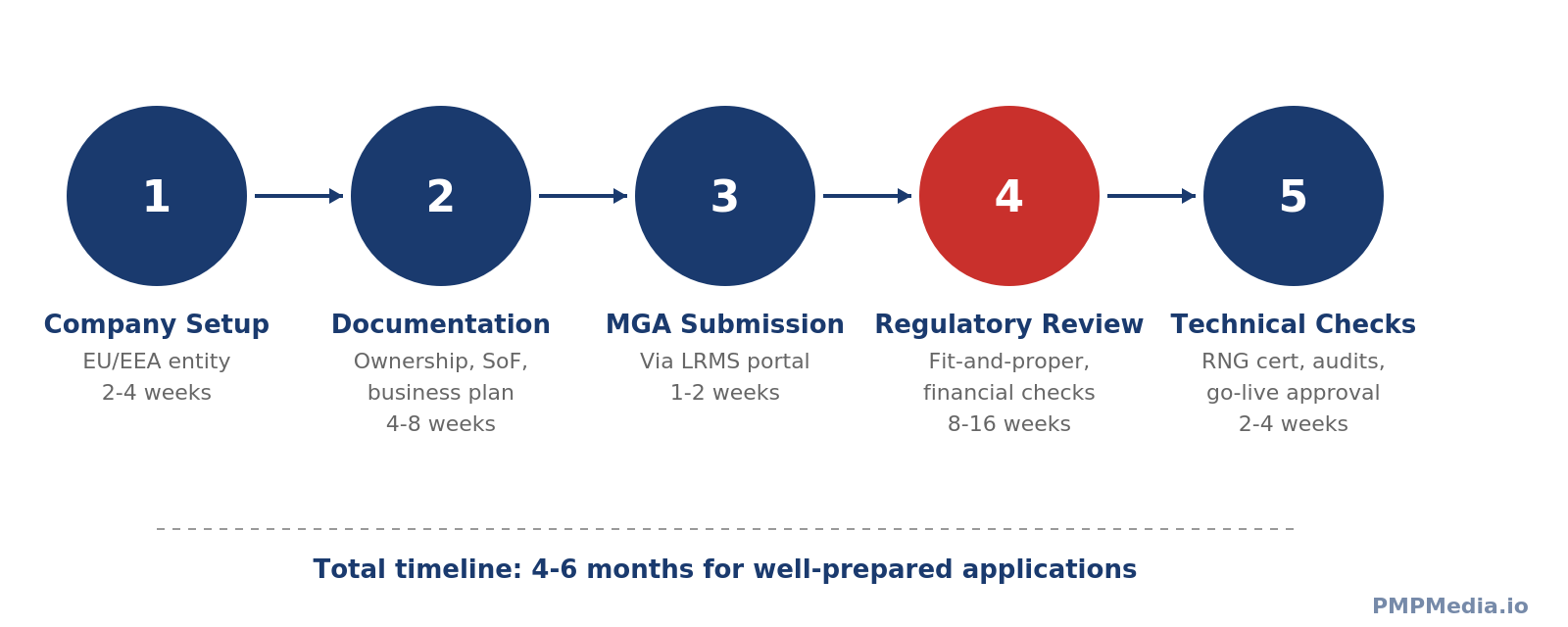
1. Set up an eligible company
Most operators incorporate directly in Malta rather than using another EU entity. This simplifies the regulatory relationship and makes the substance requirements easier to satisfy. Incorporation itself is routine, but the structuring of share capital, director appointments, and local presence should be done with iGaming-specialist advisors rather than generic corporate lawyers.
2. Prepare documentation
This is where most applications slow down. The MGA expects detailed ownership structure documentation, comprehensive source of funds evidence for all ultimate beneficial owners, a realistic business plan with financial projections, AML and responsible gambling policy frameworks, and technical architecture documentation. Thin or inconsistent documentation is the single biggest cause of application delays.
3. Submit application via MGA portal
All submissions go through the Licensee Relationship Management System (LRMS). The portal itself is functional but not forgiving. Errors in submission formatting can bounce applications back without being reviewed, which costs weeks.
4. Pass regulatory review
The MGA conducts fit-and-proper checks on beneficial owners, directors, and key personnel. They also assess the business model, financial viability, and operational readiness. Expect questions, not just silence followed by a decision. Applicants who respond promptly and thoroughly to MGA queries tend to move through review significantly faster than those who treat each question as an unexpected interruption.
5. Complete technical and compliance checks
Before going live, operators must demonstrate system readiness. This includes RNG certification, platform audits by approved testing laboratories, integration with Malta’s regulatory reporting systems, and sign-off on responsible gambling tools.
For a broader overview of the licensing landscape, see our iGaming licensing guide.
WHAT THIS MEANS FOR OPERATORS
Plan for a 4 to 6 month timeline from submission to approval, and start the company setup and documentation preparation 2 to 3 months before you plan to submit. Operators who try to compress this into a 60-day launch window almost always end up regretting it. The MGA process rewards preparation and penalises rushed applications.
How Long Does It Take?
The Malta licensing process is significantly slower than Curacao or Anjouan. Realistic timelines run from four to six months for well-prepared applications, and longer where ownership structures are complex or documentation needs multiple rounds of clarification.
Operators should treat Malta as a long-term regulatory investment rather than a quick launch solution. If you need to be live in 90 days, Malta is not the right answer regardless of the commercial case for it.
Malta Gaming License Costs
Malta is one of the more expensive licensing jurisdictions when you add up the full cost picture. Application and annual fees are only part of what operators actually spend.
Regulatory costs
- Application fee: around €5,000
- Annual license fee: around €25,000
- Compliance contribution: variable, tied to gaming revenue
Operational costs
- Compliance staff, including key function holders
- AML monitoring systems and responsible gambling tools
- Annual audits and regulatory reporting infrastructure
- Substance-related costs including office space and local staff
Business costs
- Company setup and corporate services
- Legal and advisory fees during application
- Platform hosting and technical infrastructure
- Ongoing legal and tax advisory
Realistic first-year total cost including licensing, compliance setup, substance, and advisory fees typically lands in the €100,000 to €200,000 range for a mid-sized operator. Ongoing annual costs after the first year settle at around €60,000 to €120,000 before factoring in gaming tax and compliance contributions.
Compare with Curacao licensing costs, where the all-in number is a fraction of this but the commercial offering is correspondingly different.
Malta Gaming Tax Guidelines
Malta’s tax structure is where a lot of the commercial case actually lives. The headline 5% gaming tax is competitive, but it is the interaction between gaming tax, compliance contribution, corporate tax, and the imputation refund system that makes Malta work financially for many operators.
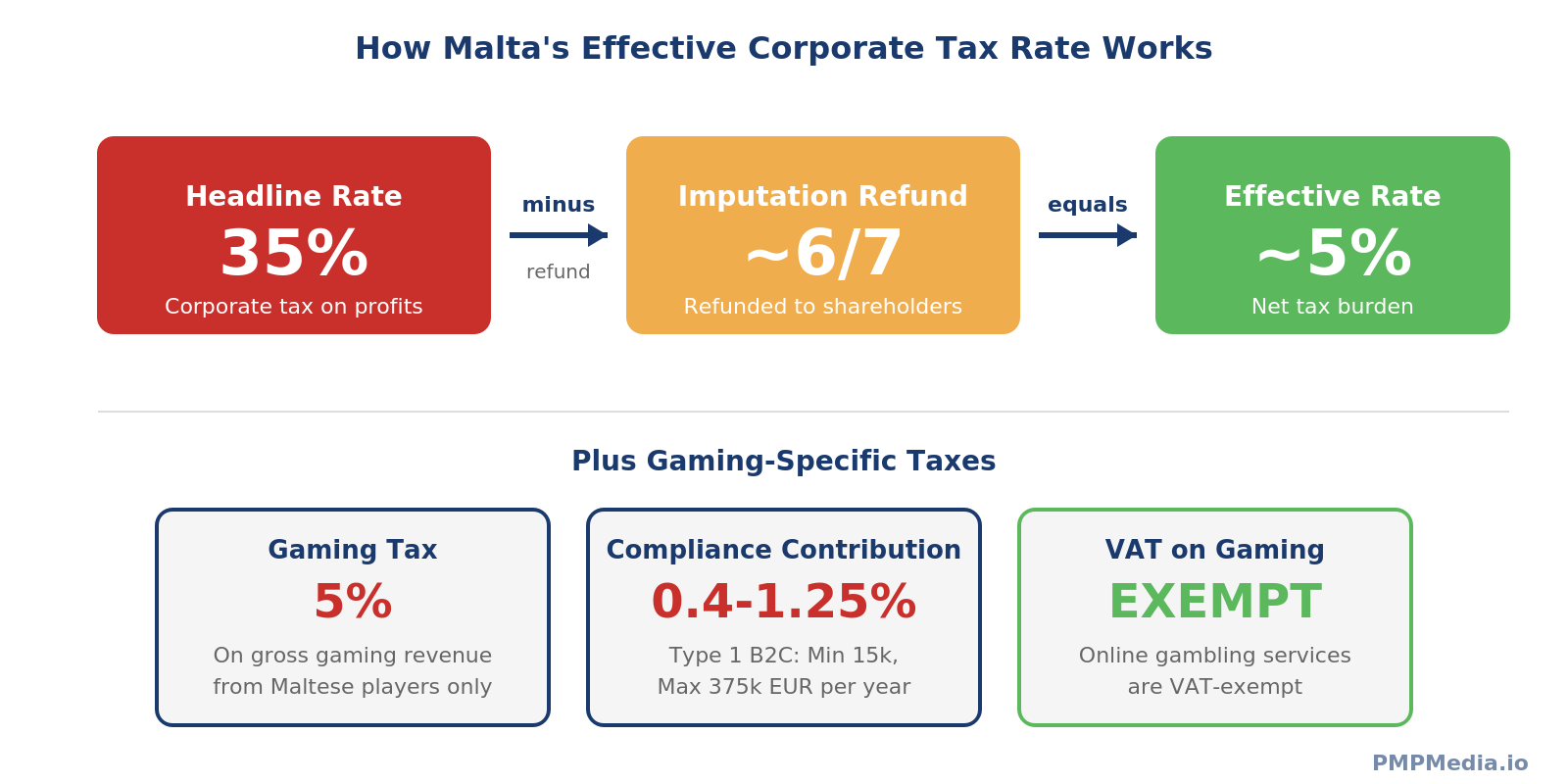
Gaming Tax Rates
Malta applies a 5% gaming tax on gross gaming revenue generated from Maltese players. That rate is one of the most competitive in the EU and is a meaningful reason why operators with significant Maltese player activity choose Malta.
The key detail that often gets missed: gaming revenue from players outside Malta is not subject to Maltese gaming tax. For operators whose player base is overwhelmingly non-Maltese (which describes most MGA licensees), the effective gaming tax exposure is much lower than the headline 5% suggests.
Compliance Contribution
The compliance contribution is an additional revenue-based payment that varies by license type and revenue tier. For a B2C Type 1 license, it typically ranges from 0.4% to 1.25% of gaming revenue, subject to annual minimums around €15,000 and maximums up to approximately €375,000. Type 2 licenses have higher thresholds (€25,000 minimum, €600,000 maximum), and Types 3 and 4 have their own tiered structures. Each license type carries its own compliance contribution scale, so operators holding multiple types pay separately for each.
The contribution structure is tiered, so operators pay progressively lower percentages as revenue grows. For larger operators this produces a blended rate meaningfully below the top tier percentage.
Corporate Tax Structure
The headline corporate tax rate is 35%, which sounds uncompetitive until you understand how the Maltese imputation system works. When profits are distributed to shareholders, the shareholders can claim a refund of most of the tax paid at company level. For qualifying gaming operators, the effective corporate tax rate after refunds typically settles at around 5%.
This is not a loophole. It is a deliberate structural feature of Maltese tax law designed to attract international business while maintaining the appearance of a standard corporate tax rate. The refund mechanism has survived EU scrutiny and has been in place long enough to be treated as stable tax planning rather than aggressive avoidance.
VAT Considerations
Online gambling services are exempt from VAT in Malta. This removes a cost layer that operators in some other jurisdictions must plan around. The exemption applies to core gaming services, not to ancillary services like consulting arrangements or certain software licensing structures, so contracts need to be structured carefully to ensure the exempt treatment actually applies.
Tax Planning and Compliance
Operators should plan for quarterly tax filings, annual audited accounts, and ongoing regulatory reporting. The tax and regulatory calendars are separate but overlap significantly, and most operators engage specialised Malta iGaming advisors rather than generic accountants. Non-compliance with tax reporting can affect license standing, which is an expensive way to discover that the two frameworks are more connected than they appear.
WHAT THIS MEANS FOR OPERATORS
The effective tax rate for a typical MGA operator with mostly non-Maltese players works out to around 5% to 7% blended, once you account for gaming tax exposure, compliance contribution, and corporate tax after imputation refunds. That is competitive with most offshore jurisdictions on a net basis, and substantially more attractive than regulated markets like the UK (40% remote gaming duty on gross profits, doubled from 21% in April 2026) or Germany (5.3% turnover tax on stakes). This is the financial argument for Malta that rarely makes it into headline comparisons.
Why Malta Is More Expensive Upfront
The higher upfront cost reflects the regulatory investment that produces the commercial benefits. The MGA funds substantial supervision, enforcement capacity, and international cooperation through licensing fees and compliance contributions. Operators pay for this through the fee structure and benefit from it through credibility that offshore licenses cannot replicate.
For operators whose business case depends on that credibility, the cost is justified. For operators who do not need it, the cost is a genuine burden without corresponding return.
Pros and Cons
Advantages
- Strongest commercial credibility of any online gambling license
- Tier-1 payment processor and banking access
- Preferential treatment from premium software suppliers
- Competitive effective tax rate after imputation refunds
- VAT exemption on gaming services
- Established regulatory framework with predictable enforcement
- EU regulatory recognition for certain cross-border arrangements
Disadvantages
- Higher upfront and ongoing costs
- Application timeline of 4 to 6 months minimum
- Substance requirements create real operational cost
- Compliance load is substantially heavier than offshore alternatives
- Detailed reporting and audit obligations year-round
- Regulatory scrutiny of ownership and source of funds is thorough
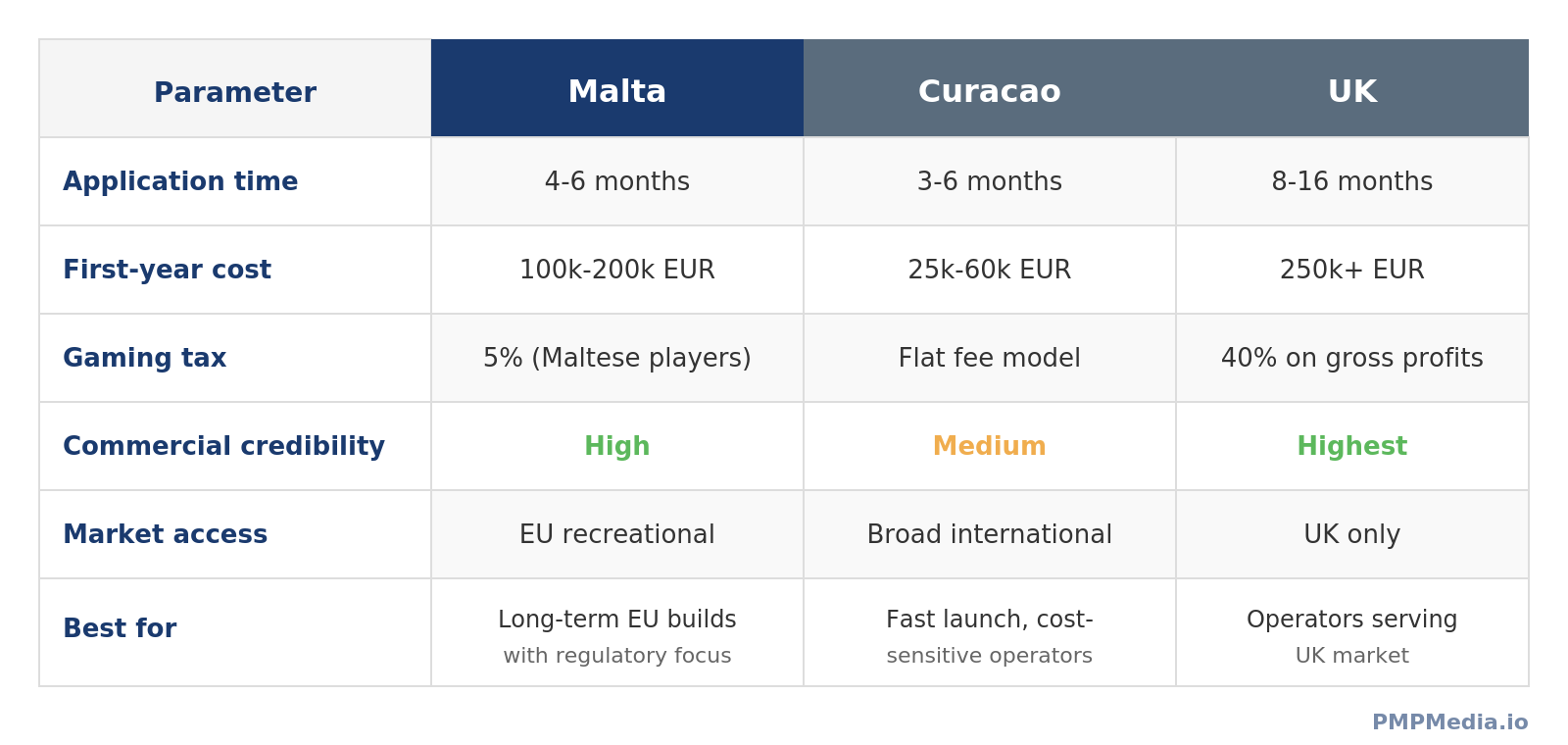
Malta vs Curacao vs UK
The three jurisdictions solve different problems. Malta is the regulated-market play. Curacao is the fast-launch play. UK is mandatory if you want UK players and tolerable only if the rest of your economics justify the compliance load.
Malta has been monitoring innovation in gambling product categories. Gibraltar licensed the first dedicated prediction market operator in Europe (PredictStreet) in March 2026, and Malta is expected to develop its own framework for this category. For the current state of prediction markets regulation globally, see our prediction markets regulation guide.
See also:
Is a Malta License Worth It?
For operators targeting EU recreational players, building for the long term, and able to absorb the cost structure, Malta remains the strongest available option. The combination of commercial recognition, competitive effective tax rate, and EU access delivers value that offshore alternatives cannot match.
For startups with limited capital, operators targeting markets where MGA recognition adds no commercial value, or businesses that need to launch inside 90 days, Malta is the wrong answer regardless of its reputation. There is no shame in using a Curacao license for the business model that actually fits, and plenty of successful operators have built substantial businesses without ever holding an MGA license.
Who Should Choose Malta?
- Established operators targeting regulated European markets
- Businesses that can support the compliance and substance investment
- Groups that can benefit from the corporate tax refund structure
- Operators whose banking and payment needs require tier-1 relationships
- Brands building for long-term value rather than short-term market entry
Who Should Avoid Malta?
- Early-stage startups without runway for the application and compliance costs
- Operators targeting markets where MGA recognition adds no commercial value
- Businesses that need to be live in 90 days
- Operators without the resources to meet substance requirements properly
Related Licensing Guides
- Curacao iGaming License
- UK Gambling License
- Types of Gambling Licenses
- Global iGaming Regulation Guide
- iGaming Licensing Guide
- Curacao vs Malta License Comparison
Final Verdict
The Malta gaming license remains the jurisdiction of choice for operators serious about building in regulated European markets. It is not the fastest or cheapest route, but no other license delivers the same combination of commercial credibility, effective tax efficiency, and long-term business stability.
The operators who regret choosing Malta are usually the ones who underestimated the compliance load or overestimated how quickly they needed to be live. The operators who regret not choosing Malta are usually the ones who found out too late that their Curacao license was closing doors they needed open.
FAQ
How much does a Malta gaming license cost?
The headline fees are a €5,000 application fee and €25,000 annual fee. Realistic first-year total cost including compliance setup, substance, and advisory typically runs €100,000 to €200,000 for a mid-sized operator. Ongoing annual costs after year one settle at €60,000 to €120,000 before gaming tax and compliance contributions.
What is the gaming tax in Malta?
Malta applies a 5% gaming tax on gross gaming revenue from Maltese players. Revenue from non-Maltese players is not subject to Maltese gaming tax but remains within scope for corporate income tax rules.
What are the Malta gaming tax guidelines?
Operators pay a 5% gaming tax on Maltese player revenue, a compliance contribution of 0.4% to 1.25% of gaming revenue depending on license type and revenue tier, and corporate tax at 35% with an imputation refund system that typically reduces the effective corporate rate to around 5%. Gaming services are VAT-exempt.
How are online casinos taxed in Malta?
Online casinos pay the 5% gaming tax on Maltese player revenue, the applicable compliance contribution, and corporate income tax with the imputation refund reducing the effective rate. The blended effective tax burden for a typical operator with mostly non-Maltese players sits around 5% to 7%.
How long does it take to get a Malta license?
Realistic timelines run 4 to 6 months from submission to approval for well-prepared applications. Complex ownership structures or incomplete documentation extend this significantly.
Is Malta better than Curacao?
Better for what. Malta delivers stronger commercial credibility, better payment processing access, and a more favourable effective tax position for operators who can use the structure. Curacao is faster, cheaper upfront, and more appropriate for operators whose markets do not require MGA credibility. Neither is universally better.
Who should get a Malta license?
Operators targeting regulated EU markets, building long-term brand value, and able to support the compliance and substance requirements. Not appropriate for early-stage startups with limited runway or operators whose business models do not benefit from MGA recognition.
What is the corporate tax rate for Malta iGaming operators?
The standard rate is 35%, but Malta’s imputation system allows shareholders to claim refunds on distributed profits, typically reducing the effective corporate tax rate to around 5% for qualifying operators. This refund mechanism is the key to understanding Malta’s commercial positioning.
Are Malta gaming services subject to VAT?
Online gambling services are VAT-exempt. The exemption covers core gaming services but not all ancillary services, so contracts involving consulting, software licensing, or shared services need to be structured carefully to ensure the exempt treatment applies where intended.
 Share
Share


 0 views