







The UK gambling license is the gold standard for operators targeting the world’s most sophisticated regulated gambling market. It is also one of the most expensive, most regulated, and most scrutinized licensing frameworks globally. The UK Gambling Commission (UKGC) operates under the Gambling Act 2005 and now enforces a compliance stack that reflects the 2023 White Paper reforms, heavy-handed AML expectations, and the 2026 budget changes that raised Remote Gaming Duty to 40%.
Before diving into UKGC specifics, operators new to the industry should understand what a gambling license involves as a general concept — the UK license represents the high end of regulatory intensity, but the underlying structure is common across all major frameworks.
This guide covers what operators actually need to know to obtain and maintain a UKGC operating license in 2026: the compliance framework, fees and duties, application process, the ongoing obligations that trip up new entrants, and how the regulatory landscape is changing. Written for operators, compliance officers, and legal counsel seriously evaluating UK market entry. For comparison with other jurisdictions, see our Malta gaming license guide, the Curacao iGaming license overview, or the Curacao vs Malta license comparison.
The UK’s position in global iGaming regulation is distinctive: strictest enforcement among Tier-1 markets, highest gambling duties from April 2026, and the largest single regulated market by GGY.
Why UKGC Licensing Matters
The UK is the largest regulated online gambling market in the world, with gross gambling yield (GGY) exceeding £15 billion annually. Legal operators must hold a UKGC operating license, and there are no shortcuts. Every operator accepting UK customers must be licensed regardless of where the business is headquartered, where servers are located, or where the corporate parent is domiciled. This point-of-consumption approach makes the UKGC license non-negotiable for anyone targeting British customers.
The UK’s classification of emerging products matters here. Prediction markets like Matchbook Predictions (launched January 2026) and Betfair Predicts (April 2026) operate under UKGC betting intermediary authorization, not as separate prediction market licenses. For how this regulatory choice compares to CFTC classification in the US, see our prediction markets vs betting analysis.
The UKGC has one of the strongest enforcement reputations among gambling regulators. Since 2020, the regulator has issued over £200 million in fines and compliance penalties, often targeting large multinational operators for AML failures, responsible gambling breaches, or source of funds control inadequacies. The license is not just a legal permission to operate — it is an ongoing supervisory relationship with financial consequences for getting compliance wrong.
Operators considering UK entry in 2026 face a market that is more expensive than ever before. The November 2025 Chancellor’s Budget raised Remote Gaming Duty from 21% to 40% effective 1 April 2026, and a new 25% General Betting Duty rate applies to remote bets. The government is also consulting on a 30% increase in UKGC operating license fees that would take effect October 2026. These are compounding costs that make UK market entry financially meaningful only for operators with genuine scale or strong strategic reasons.
The UK Regulatory Framework
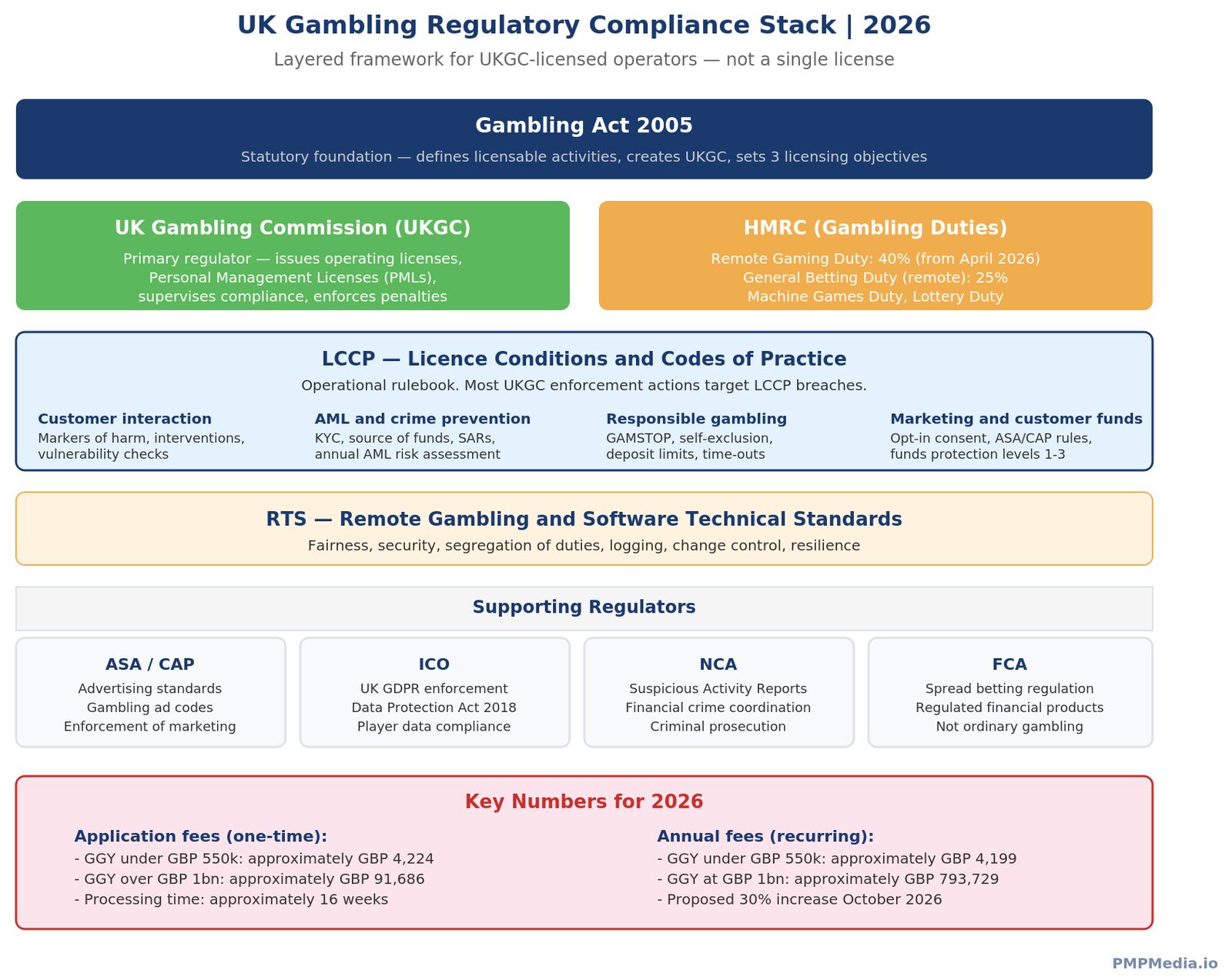
UK gambling regulation is not a single license — it is a compliance stack of interconnected legal and regulatory requirements.
Gambling Act 2005
The statutory foundation. Defines licensable activities, establishes the UK Gambling Commission, sets out the three licensing objectives (preventing crime, ensuring fairness and openness, protecting children and vulnerable people), and creates the architecture for operating, personal, and premises licensing. Every UKGC license exists under authority of this Act.
UK Gambling Commission (UKGC)
The primary regulator, an independent non-departmental public body. Issues operating and personal licenses, supervises compliance, publishes the public register of licensees, takes enforcement action, and reports to the Department for Culture, Media and Sport (DCMS). The UKGC’s 2024-2027 corporate strategy prioritizes illegal market disruption, White Paper implementation, and data capabilities investment.
Licence Conditions and Codes of Practice (LCCP)
This is the operational compliance backbone. The LCCP sets out binding licence conditions (breaches can lead to suspension or revocation) and social responsibility code provisions (enforceable obligations around customer interaction, AML, complaints, marketing, reporting). Most UKGC enforcement actions are for LCCP breaches rather than for failures in the application process itself. Operators cannot treat LCCP compliance as a tick-box exercise — the framework expects genuine internal controls, documented procedures, and evidence of effective implementation.
Remote Gambling and Software Technical Standards (RTS)
Detailed technical standards for remote gambling including fairness, security, segregation of duties, logging, change control, and resilience. RTS compliance must be demonstrated through technical audit before licensing.
Supporting regulators and frameworks
- HMRC: Administers gambling duties (Remote Gaming Duty, General Betting Duty, Machine Games Duty, Lottery Duty). Licensing does not remove tax obligations
- ASA and CAP: Advertising Standards Authority enforces gambling advertising codes. UKGC-licensed operators face meaningful reputational and enforcement risk for advertising breaches
- ICO: Information Commissioner’s Office enforces UK GDPR and Data Protection Act 2018. Any operator processing UK player data must comply
- NCA: National Crime Agency receives Suspicious Activity Reports and coordinates on financial crime. Operators must file SARs through NCA processes
- FCA: Financial Conduct Authority regulates spread betting, which is not licensed by UKGC as ordinary gambling. Relevant if a gambling product strays into regulated financial derivatives
UKGC License Types
The UK’s license structure follows the vertical-specific model where each gambling vertical requires separate authorization. For how this compares to the comprehensive license approach used by Curacao and others, see our types of gambling licenses globally reference.
The UKGC issues three license categories. Most commercial operators need the first two; premises licenses are primarily for land-based venues.
Operating License
Required for any business providing gambling facilities in Great Britain. The operating license covers the company’s activities and must be held before the business commences licensed gambling. Operating licenses are further subdivided by activity type:
- Remote casino operating license: Online casino games, slots, table games
- Remote betting operating license: Online sports betting, virtual sports, pool betting
- Remote bingo operating license: Online bingo
- Remote lottery operating license: Online lottery operations
- Non-remote (land-based) operating licenses: Casinos, betting shops, bingo halls, arcades, adult gaming centres
- Gambling software operating license: For B2B suppliers providing gambling software to licensed operators
- Ancillary licenses: Manufacturing, supplying, installing gaming machines
Personal Management License (PML)
Required for individuals in senior positions at licensed operators. A PML demonstrates that the individual is fit and proper to hold the role. Typically required for:
- Chief Executive Officer and senior executives with gambling responsibilities
- Directors responsible for licensed activities
- Heads of compliance, risk, finance, and marketing
- MLRO (Money Laundering Reporting Officer)
Operators must ensure all relevant personnel hold valid PMLs. Operating a business with an unqualified senior role is an operating license breach.
Personal Functional Licence (PFL)
Required for certain operational roles below senior management. Typically applies to staff with direct consumer interaction or handling player funds in specific contexts.
Premises License
For land-based gambling premises (casinos, betting shops). Issued by local licensing authorities rather than the UKGC directly, though UKGC standards apply.
UKGC Fees Structure
UKGC fees are structured in bands based on Gross Gambling Yield (GGY) — the amount players lose to the operator. Higher GGY means higher application and annual fees. As of 2026 (before the proposed October 2026 increase), the fee structure looks like this.
Application fees (one-time)
Non-refundable, even if the application is unsuccessful or withdrawn. Typical amounts:
- Small operators (GGY under £550k): application fee approximately £4,224
- Medium operators (GGY £1m-10m): application fees scale with projected GGY
- Large operators (GGY £100m-1bn): mid-range application fees
- Major operators (GGY over £1bn): application fee approximately £91,686
- Initial GB gambling software licence application: approximately £370 (lower base fee)
Annual fees (recurring)
Annual fees are significantly higher than one-time application fees and must be paid on the anniversary of license issuance. Failure to pay on time results in license revocation. Current annual fees range:
- GGY under £550k: approximately £4,199
- GGY £1m-10m: typically £10,000-100,000 range
- GGY £100m-500m: hundreds of thousands in annual fees
- GGY £1bn: approximately £793,729 per year
- GGY above £1bn: additional £125,000 for each £500m tranche above £1bn
Proposed 2026 fee increases
DCMS consulted on three fee increase options in early 2026:
- Option 1 (UKGC-preferred): 30% average rise in annual operating licence fees
- Option 2: 20% increase
- Option 3 (government-preferred): 30% increase with one-third ring-fenced for illegal market enforcement
The consultation closed 30 March 2026. Any approved changes are expected to come into force from October 2026 via secondary legislation. Operators should model a 30% annual fee increase in 2026 budgeting for UK operations.
Fee calculator
The UKGC provides an online fees calculator at the Licensees Hub that estimates fees based on projected GGY and licence activities. Serious applicants should run exact calculations using this tool before committing to UK application.
UK Gambling Taxes (2026)
Licensing fees are separate from tax. UK operators pay substantial gambling duties administered by HMRC, and these were significantly raised in the November 2025 Chancellor’s Budget effective April 2026.
Remote Gaming Duty (RGD)
Previously 21%, raised to 40% from 1 April 2026. This applies to operators offering remote gaming (online casino-style games) to UK customers regardless of where the operator is located. This is the single largest cost change for UK iGaming in 2026.
Effective calculation: if an operator generates £10 million GGY from UK remote gaming, the RGD owed is £4 million, up from £2.1 million under the previous 21% rate. Combined with licence fees (potentially £200,000+ annually for mid-sized operators) and operating costs, the UK remote casino business is materially less profitable in 2026 than in 2025.
General Betting Duty (GBD)
General Betting Duty applies to betting operations. The 2026 Budget introduced a higher rate of 25% for remote bets (previously 15%), while retaining lower rates for on-course and other categories. This specifically targets online sports betting at higher tax levels than pre-2026.
Machine Games Duty (MGD)
Applies to gaming machines in land-based venues. Multi-tier rate structure from 5% to 25% depending on stake levels. Not directly relevant to remote operators.
Lottery Duty
12% of lottery revenues. Applies to licensed lottery operations including online lotteries.
Bingo Duty
10% on bingo receipts. Planned for removal entirely, though timing is unclear as of April 2026.
POCT (Point of Consumption)
The UK tax framework follows point-of-consumption principles. An operator based in Malta, Gibraltar, or Curacao serving UK players still owes UK gambling duties. This prevents offshore structuring from avoiding tax. Only the application of license and duty rules varies by where consumption occurs, not where the operator is located.
The Application Process
The UK application process follows patterns that apply to serious gambling licenses globally. For the full step-by-step iGaming licensing guide covering preparation, application, and post-approval compliance across multiple jurisdictions, see our practical playbook.
UKGC applications are submitted through the UKGC eServices portal. The process is document-heavy and transparency-focused. Applicants should allocate substantial time for preparation.
Pre-application preparation
Before applying, operators should have in place:
- UK-registered company (subsidiary or parent, not a foreign entity directly applying)
- Three-year business plan with detailed financial projections
- UBO disclosure and corporate structure documentation
- Policies covering AML, responsible gambling, customer complaints, marketing, data protection, responsible advertising
- Customer interaction policy
- Fit-and-proper checks for all directors, senior managers, and PML holders
- Technical documentation for gaming systems
- Banking arrangements including segregated player funds account
- Marketing plans and promotional approach documentation
Many operators engage UK-based gambling lawyers and compliance consultants for pre-application preparation. Typical professional fees for full preparation support range £50,000-150,000 depending on complexity.
Application submission
Online through UKGC eServices. The application itself requires:
- Company details and ownership structure
- Details of all directors and key persons
- Declarations of fit-and-proper status
- Business plan and GGY projections
- Policies and procedures documentation
- Financial information including source of funds for business capital
- Technical information about gaming systems and supplier arrangements
- Proof of application fee payment (non-refundable)
UKGC review process
The UKGC aims to process complete applications within approximately 16 weeks, though complex applications or those with integrity concerns can take longer. The review covers:
- Identity verification: Are the applicant and associated persons who they claim to be?
- Honesty and integrity: Any history of dishonest business conduct, fraud, or regulatory violations?
- Competence: Does the applicant have the expertise to operate licensed gambling safely?
- Financial stability: Can the applicant support operations and meet player payout obligations?
- Fit and proper persons: All directors, senior managers, and key personnel undergo individual fitness assessment
- Systems and controls: Are policies, procedures, and technical systems adequate?
Decision and post-approval
If the application succeeds, the UKGC issues the operating license. Annual fees become due 30 days after issuance, and the license commences. The operator is then subject to ongoing LCCP compliance and supervisory engagement from day one.
If the application is rejected
Application fees are non-refundable. Rejected applicants can appeal to the First-tier Tribunal (General Regulatory Chamber), though the success rate is low for applications rejected on integrity or competence grounds. Most rejected operators either address the deficiencies and re-apply, or seek licensing elsewhere.
LCCP Compliance Requirements
The LCCP is where day-to-day compliance lives. It has four main components: general licence conditions, specific licence conditions, social responsibility code provisions, and ordinary code provisions. Breaches of licence conditions or social responsibility code provisions can trigger enforcement action.
Customer due diligence and AML
Operators must conduct identity verification before customer play (age verification) and enhanced due diligence for higher-risk transactions. Key requirements:
- Age verification before first wagering
- Identity verification before first withdrawal (though in practice most operators verify before or at deposit)
- Source of funds checks for customers depositing above risk-based thresholds
- Ongoing monitoring for unusual activity patterns
- Enhanced due diligence for politically exposed persons and high-risk customer profiles
- Suspicious activity reporting to the National Crime Agency
- Annual AML risk assessment and policy updates
- Customer risk profiling
The UKGC has been particularly aggressive in enforcing AML failures. Operators including William Hill, Entain, and 888 have received multi-million-pound fines for source of funds control failures.
Responsible gambling
Customer interaction is heavily regulated. Operators must:
- Offer self-exclusion across all products (GAMSTOP integration mandatory)
- Provide deposit limits that customers can set and reduce
- Monitor for markers of harm and intervene when observed
- Provide time-out functions (24 hours to 6 weeks)
- Display responsible gambling messaging and helpline information prominently
- Document customer interactions including concerns raised, interventions made, and outcomes
Financial vulnerability checks became effective in 2024-2025. These require operators to assess affordability concerns before customers sustain losses at specific thresholds. Implementation details have evolved through UKGC guidance, and operators continue to adjust approaches.
Marketing and advertising
Marketing is constrained by multiple layers: LCCP marketing rules, ASA/CAP advertising codes, Advertising Standards Authority enforcement, and the UKGC’s specific approach to direct marketing consent. Key requirements:
- Opt-in consent required for direct marketing (from 2024 onwards)
- Clear opt-out mechanisms on every marketing communication
- No targeting of individuals in vulnerable categories (self-excluded, in treatment)
- No implying gambling can be a source of income
- No exploiting player concerns about missed opportunities or urgency
- Advertising content must not particularly appeal to minors
Customer funds protection
Operators must hold customer funds in separate, identifiable accounts from operating funds. The LCCP defines three levels of customer funds protection, and the operator must display which level applies. Most operators use Level 1 (basic protection in the event of insolvency) or Level 2 (supplementary insurance). The protection level must be clearly disclosed to customers.
Reporting obligations
- Regulatory returns due on regular schedule (changed in July 2024 for data requirements)
- Licence holder changes reports for material events
- Annual assurance statements from the PML holders
- Incident reports for security breaches, fraud, or operational failures
The White Paper Reforms
The 2023 Gambling Act Review White Paper drove extensive reforms that are still being implemented through 2026. Operators entering the UK market need to understand the direction of travel.
Key White Paper reforms implemented or in progress:
- Online slot stake limits: £5 per spin for adults 25+, £2 per spin for 18-24 year olds (operational 2024-2025)
- Financial vulnerability checks: Mandatory assessment before losses at specific thresholds
- Financial risk (affordability) checks: Phased implementation ongoing, scope debated
- Statutory levy: Industry-wide levy for research, prevention, and treatment of gambling harm (implementation in progress)
- Enhanced advertising restrictions: Continued tightening of marketing rules
- Gambling ombudsman: New industry ombudsman for complaints handling (in development)
April 2026 also introduced a phased approach to LCCP adherence to the Digital Markets, Competition and Consumers Act 2024, tightening consumer law alignment across the UK gambling sector.
Compliance Failures and Enforcement
UKGC enforcement has been aggressive and costly. Understanding recent enforcement patterns helps operators focus compliance investment where it matters.
Most common enforcement drivers
- AML failures: Inadequate source of funds checks, missed SAR triggers, failure to apply EDD to risky customers
- Responsible gambling failures: Missed markers of harm, inadequate customer interactions, failure to act on self-exclusion
- Customer interaction failures: Inadequate systems for identifying at-risk customers
- Marketing breaches: Misleading promotional terms, targeting vulnerable customers
- Governance failures: Board-level compliance oversight inadequate
Penalty structure
The UKGC can impose financial penalties up to an effective cap based on turnover, though in practice penalties are proportionate to the nature of the breach and the operator’s scale. Settlement agreements are common. Major enforcement actions since 2020 include multi-million-pound penalties against William Hill, Entain (LeoVegas), 888, Flutter, and others. The pattern suggests the UKGC is willing to pursue the largest operators if compliance fails, not just smaller licensees.
License suspension and revocation
In serious cases the UKGC can suspend or revoke licenses, not just fine. This has happened for operators that continued to allow play by self-excluded customers, operators with systemic AML failures, or operators with integrity concerns about senior management.
Strategic Considerations for UK Market Entry
Given the cost structure and compliance intensity in 2026, who should pursue UK licensing?
UK licensing makes sense for operators who:
- Already have scale (projected UK GGY £5m+ within 18 months)
- Have strong compliance infrastructure or can invest in building it
- See the UK as strategic market access, not a cost center
- Are prepared for the 40% RGD and 25% remote GBD tax rates
- Have time horizon for 12-18 month licensing process (including preparation)
- Have access to compliant banking and payment infrastructure
- Can afford total first-year costs of £250,000-500,000 (fees + advisors + compliance infrastructure)
UK licensing is probably wrong for operators who:
- Are early-stage without proven traction
- Have limited capital and cannot absorb ongoing compliance costs
- Target UK customers as a minor revenue stream rather than a core market
- Have previous regulatory issues or integrity concerns in any market
- Cannot demonstrate competent senior management for PML positions
- Are not prepared for the ongoing 40% RGD tax drag
Alternatives to direct UKGC licensing
Some operators target the UK indirectly through B2B relationships with UK-licensed operators. A software supplier with a gambling software operating license can provide games to UK-licensed casinos without the full B2C compliance burden. This is a common pathway for game studios and platform providers. Direct-to-consumer B2C access requires the full operating license.
Related Guides
- Malta Gaming License
- Curacao iGaming License
- Curacao License Requirements
- Curacao vs Malta License
- Curacao License Cost
Bottom Line
The UK Gambling Commission license remains the most respected, most scrutinized, and in 2026 one of the most expensive gambling licenses in the world. The 40% Remote Gaming Duty, proposed 30% increase in UKGC operating license fees, and the ongoing White Paper compliance evolution make 2026 the most challenging year for UK market entry in a decade.
For serious operators with scale, capital, and compliance infrastructure, UKGC licensing is essential to access the UK’s £15 billion regulated market. For smaller or less-prepared operators, it may be more efficient to focus on markets with lower compliance overhead until scale justifies UK entry.
Whatever the strategic decision, UK licensing should never be approached as a box-ticking exercise. The UKGC expects genuine compliance, backs it with aggressive enforcement, and treats regulatory commitments as ongoing obligations. Operators who understand this and invest accordingly succeed. Those who treat the license like a passport to the UK market without internal controls to support it face significant enforcement risk.
FAQ
What does a UK gambling license cost in 2026?
Application fees range from £4,224 (small operators under £550k GGY) to £91,686 (large operators at £1bn GGY). Annual fees are significantly higher, from approximately £4,199 to £793,729+ based on GGY bands. Additional professional and compliance costs typically add £50,000-200,000 for preparation and first-year implementation. The October 2026 proposed 30% fee increase would raise these numbers further.
How long does it take to get a UKGC license?
The UKGC aims to process complete applications in approximately 16 weeks. In practice, most licenses take 4-9 months total including preparation time. Applications with integrity concerns, complex ownership structures, or inadequate documentation take significantly longer. Operators should budget 6-12 months for the full process from decision to launch.
What is Remote Gaming Duty and how much is it?
Remote Gaming Duty is the tax on remote gaming (online casino-style) revenue for operators serving UK customers. Previously 21%, it increased to 40% from 1 April 2026 as part of the November 2025 Chancellor’s Budget. It applies regardless of where the operator is located, based on UK consumption. An operator generating £10 million UK GGY from remote gaming owes £4 million in RGD annually.
Do I need a UKGC license if I’m based outside the UK?
Yes, if you accept UK customers. The UK operates on a point-of-consumption basis. Any operator targeting or accepting UK players must hold a UKGC operating license, regardless of where the business is headquartered or where servers are located. Operating without a license while accepting UK customers is a criminal offense.
What is the Personal Management License (PML)?
A PML is required for individuals in senior positions at licensed operators. This typically includes CEOs, directors responsible for licensed activities, compliance heads, CFOs, and MLROs. The PML confirms the individual is fit and proper to hold a senior gambling role. Each PML is assessed individually, and an operator with key personnel who cannot obtain PMLs will face licensing or retention issues.
What does LCCP stand for and why does it matter?
LCCP is the Licence Conditions and Codes of Practice. It is the binding rulebook that every UKGC licensee must comply with. Most UKGC enforcement actions are for LCCP breaches rather than initial licensing issues. The LCCP covers customer interaction, AML, responsible gambling, marketing, customer funds protection, reporting, and more. Compliance is an ongoing operational commitment, not a one-time application requirement.
How does the financial vulnerability check work?
Financial vulnerability checks require operators to assess affordability concerns before customers sustain specific loss thresholds. The framework has evolved through 2024-2025 and continues to be refined through UKGC guidance. Key elements include loss threshold monitoring, affordability evidence gathering for higher-risk customers, and intervention procedures. Implementation details vary by operator, but the core obligation is substantive protection of vulnerable customers.
Can I advertise gambling freely with a UKGC license?
No. UK advertising is heavily constrained by LCCP marketing rules, ASA/CAP advertising codes, and specific restrictions on direct marketing consent. From 2024 onwards, direct marketing requires opt-in consent. Advertising cannot target vulnerable individuals, imply gambling as income, or exploit urgency concerns. The advertising restrictions in the UK are among the strictest in any regulated market.
What happens if my UKGC application is rejected?
Application fees are non-refundable. Rejected applicants can appeal to the First-tier Tribunal (General Regulatory Chamber). Success rates for appeals on integrity or competence grounds are low. Most rejected operators address deficiencies and re-apply, or seek licensing in Gibraltar, Malta, or other jurisdictions. UKGC rejection does not necessarily prevent licensing elsewhere, but other regulators may inquire about the rejection.
Is GAMSTOP required for UKGC licensees?
Yes. All UKGC-licensed remote gambling operators must participate in GAMSTOP, the UK multi-operator self-exclusion scheme. Customers who self-exclude through GAMSTOP must not be permitted to access or play at any UKGC-licensed remote gambling site during the exclusion period. Failure to honor GAMSTOP exclusions is a serious LCCP breach with significant enforcement risk.
What are customer funds protection levels?
The LCCP defines three levels of customer funds protection (Level 1 basic, Level 2 medium, Level 3 high). Operators must disclose their protection level clearly. Level 1 provides basic protection in the event of insolvency. Level 2 adds supplementary insurance. Level 3 provides the strongest protections, typically through trust arrangements. Most mid-sized operators use Level 1 or Level 2. Protection level is one factor in customer decision-making about which operator to trust with funds.
Can I hold a UKGC license alongside other jurisdiction licenses?
Yes, and most large operators do. Multi-jurisdiction licensing is common — many operators hold UKGC, MGA (Malta), Gibraltar, and Curacao licenses simultaneously, each applicable to different customer geographies. The UKGC license covers UK customers. Other licenses cover other markets. The UKGC does not restrict operators from holding other licenses, though material regulatory issues in other jurisdictions can affect UK fit-and-proper assessments.
 Share
Share


 0 views