






Prediction markets and sports betting look similar on the surface — both let you stake money on future events, both pay out when you are right, both use probabilities. But structurally they are very different products, and the difference matters for how you trade, how much you pay in fees, how you get out of positions, which events you can touch, and what happens when the outcome is disputed.
This guide is the structural comparison. It is not a legal guide (for that, see our are prediction markets legal page) or a regulatory deep-dive (see the prediction markets regulation overview). It is the practical breakdown for someone who currently uses sportsbooks and wants to know whether moving some activity to a prediction market actually changes the experience. In most cases, the answer is yes, and the differences compound over time.
The Structural Difference: Book vs Exchange
The single most important difference is who is on the other side of your trade.
At a traditional sportsbook (DraftKings, FanDuel, Bet365, Caesars), the house takes the other side of every bet. You bet on the Chiefs to cover, the sportsbook bets on the Chiefs not to cover. The book sets the price, the book collects your stake, and if you win, the book pays you out of its own pocket. This is called bookmaking. It has been the dominant model for betting for about 200 years.
At a prediction market (Kalshi, Polymarket, DraftKings Predictions), there is no house taking the other side. Instead, another user is. When you buy a “Chiefs win” contract at $0.55, someone else is selling it to you at $0.55. The platform is just the matching venue — it runs the order book, takes a commission, and resolves the contract when the event settles. This is the exchange model. Financial markets have worked this way for a century. Prediction markets adapted the structure to event outcomes.
Betting exchanges like Betfair Exchange, Smarkets, and Matchbook are the hybrid case. They use the exchange model like prediction markets, but they are regulated as gambling products like sportsbooks. Matchbook Predictions (launched January 2026) and Betfair Predicts (April 2026) are what happens when the same company runs both a betting exchange and a prediction market branded product on top of it. Structurally they are identical. Legally they are the same license category. The branding difference is mostly marketing.
Pricing: Fixed Odds vs Dynamic Probability
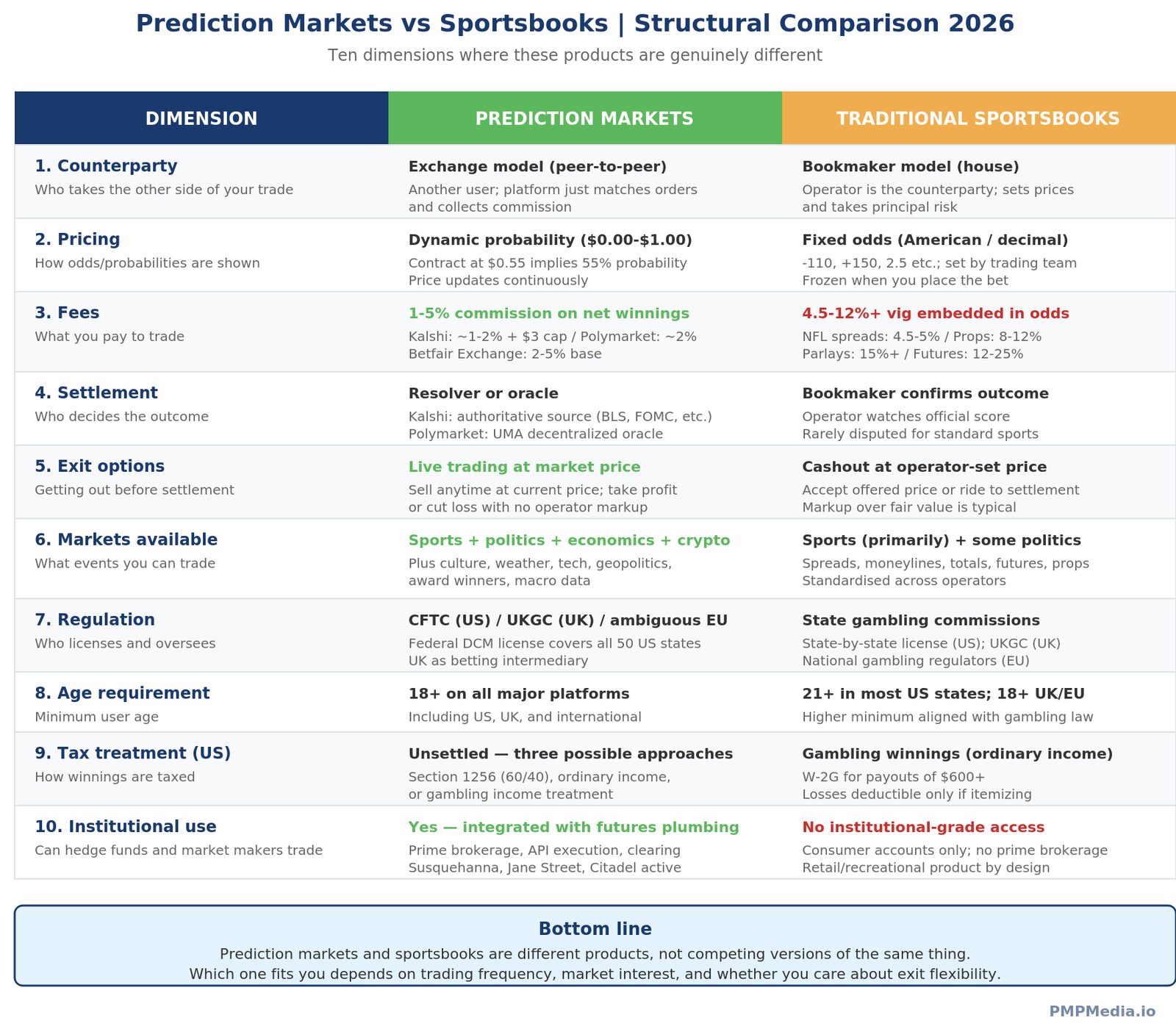
Sportsbooks price in odds. You see “Chiefs -3.5 (-110)” and you understand that you are risking $110 to win $100 if the Chiefs cover the spread. The odds are set by the sportsbook’s trading team, moved by incoming money, and frozen when you place your bet. You get the price you clicked, for better or worse.
Prediction markets price in probability. A contract trades between $0.00 and $1.00. If a contract on “Chiefs win the game” trades at $0.55, the market thinks the Chiefs have a 55% chance of winning. If it resolves yes, the contract settles at $1.00 and you profit $0.45 per contract. If it resolves no, you get $0.00 and lose your $0.55 per contract.
The difference is not just presentation. It affects how you think about the trade. Sportsbook odds make you think about payout ratios (2:1, 3:1, +250). Prediction market prices make you think directly about probability. Research from behavioural finance consistently shows that people reason about probability more accurately when it is displayed as a percentage than when it is displayed as a decimal or fractional odd. This is one reason prediction market pricing has become increasingly popular as a forecasting tool, even in the news media where Kalshi and Polymarket data now appears on CNN, CNBC, and Fox News broadcasts.
The other key pricing difference: prediction market prices update continuously as buyers and sellers trade. A sportsbook spread might move three times before kick-off. A Kalshi contract price changes every few seconds during a live event. The market is always telling you what the current crowd estimate of the probability is.
Fees: Vig vs Commission
This is where the structural difference shows up in your P&L.
Sportsbooks make money through the vig (also called juice, vigorish, or hold). It is the margin built into the odds. A standard -110/-110 point spread carries about 4.55% vig on the two-way market. That means if you bet $110 to win $100 on both sides, the book keeps $10 out of the $220 wagered. The vig is not a transparent fee that shows up on your statement. It is embedded in the odds themselves.
The vig varies dramatically by market type:
- NFL and NBA spreads/totals: 4.5-5% (reduced juice books offer 2-3%)
- Player props: 8-12%
- Same-game parlays: 15%+ effective
- Futures (Super Bowl winner, league MVP): 12-25%, sometimes 30%
- Multi-way futures: Rarely below 12%, often higher
Prediction markets and betting exchanges charge explicit commission instead. The rates are usually 1-5%, charged on net winnings (not on every trade). Concrete examples from 2026:
- Kalshi: Dynamic fee formula, effective rate usually 1-2% per trade, cap of $3 per contract
- Polymarket International: Maker orders free, taker fees ~2% with market-specific variance
- Polymarket US (via QCX): 1-2% commission structure
- Betfair Exchange (UK): 2-5% on net winnings, with Expert Fee of 20-40% applying to users with £25k+ annual profit
- Smarkets: Flat 2% commission on net winnings
- Matchbook: 1.5-2% commission depending on markets
- Matchbook Predictions and Betfair Predicts: Same fee structure as the underlying exchanges
The practical impact: a $100 bet on an NFL game at a sportsbook costs you roughly $4.50 in vig. The same $100 bet on a prediction market or exchange costs you roughly $1-2 in commission. Over a year of 500 bets, that difference compounds to several thousand dollars for an active user. For recreational bettors placing occasional wagers, the fee difference matters less. For anyone betting seriously, it is the dominant factor in long-term return.
There is one important caveat. Successful exchange users face additional charges the sportsbook world does not have. Betfair’s Expert Fee charges winners who generate more than £25k gross profit over a rolling 52 weeks at 20%, rising to 40% over £100k. Smarkets and Matchbook do not have this structure. Prediction markets like Kalshi do not have a profitability surcharge. For most users the base commission is what matters, but users winning six figures should be aware of the Betfair-specific structure.
Settlement: Bookmaker vs Resolver
Who decides whether your bet won?
At a sportsbook, the operator itself settles the bet. The book watches the game, checks the official score, and pays out or not. This works reliably for standard sports markets because the outcomes are verified by the sports leagues themselves. Disputes are rare and usually resolved by reference to the league’s official ruling.
At a prediction market, settlement is more complicated because the markets are more varied. Kalshi uses an authoritative resolution source specified at market creation — for example, a Kalshi market on the CPI reading settles at the Bureau of Labor Statistics release, a market on a Fed rate decision settles at the FOMC announcement. Polymarket uses the UMA oracle protocol, which resolves disputes through a decentralized voting mechanism where UMA token holders stake tokens on the correct outcome.
The difference matters in edge cases. Sports markets rarely have settlement disputes because the outcomes are binary and verified. Prediction market categories like politics, economics, or culture can have genuine ambiguity about what counts as the correct resolution. Polymarket’s UMA resolution has produced several contested outcomes over 2024-2026, typically where the contract language was ambiguous or where real-world events did not fit cleanly into the yes/no binary. The most notorious case involved the Ukraine uniform market in February 2025, where UMA voters resolved against the intuitive reading of the contract.
The practical implication: if you trade prediction markets, read the resolution criteria carefully before committing serious capital. A market that sounds clear can resolve in unexpected ways if the literal contract language diverges from the intuitive reading. This risk does not exist at sportsbooks, which is a genuine advantage of the traditional model.
Liquidity: House vs Peer
Sportsbooks have effectively unlimited liquidity. If you want to bet $10,000 on the Chiefs moneyline, the book will take it (subject to account limits). The house is the counterparty, and the book has capital to cover any position.
Prediction markets and exchanges depend on peer liquidity. Your trade has to match another user’s trade on the other side. If you want to buy 10,000 “Chiefs win” contracts at $0.55, there has to be someone else willing to sell 10,000 contracts at that price. In deep markets like Super Bowl outcomes or US presidential election results, liquidity is abundant. In thin markets — obscure politics, niche sports, cultural predictions — liquidity can be thin and spreads can be wide.
Kalshi and Polymarket both address this with professional market makers who provide liquidity on most listed markets. This means you can almost always trade at some price on major markets, but the spread between buy and sell may be wider than on a sportsbook. In exchange for paying less in commission than you would in vig, you sometimes pay in execution quality.
For NFL markets on Polymarket and Kalshi in 2026, spreads are typically competitive with or better than sportsbooks. For cultural or niche markets, sportsbooks often have no market at all, so the comparison is moot — prediction markets are the only venue offering the product.
Exit: Cashout vs Live Trading
One of the biggest structural differences shows up when you want out of a position before the event ends.
At a traditional sportsbook, your bet is locked once placed. Most sportsbooks offer a “cashout” feature, but the cashout value is set by the operator and typically includes a significant markup over the true implied value. You can accept the offered cashout or ride the bet to settlement. You do not get to set your exit price.
At a prediction market or exchange, you can trade out at any time at the current market price. If you bought a Chiefs contract at $0.40 and the price moves to $0.70 during the game, you can sell at $0.70 and lock in the $0.30 profit. You do not have to wait for the game to end. If the price drops to $0.20, you can sell at $0.20 to cut your losses. This is identical to how equities or futures trading works.
This matters more than it sounds. The ability to trade out of positions in real time changes the risk profile of event-based speculation significantly. You can hedge, you can take profits, you can cut losses, you can roll positions forward. Sportsbook users who want this flexibility typically have to use multiple accounts and manually hedge across books. Prediction market users do it natively.
Markets Available: Sports Only vs Everything
Sportsbooks cover sports. Some cover a small number of non-sports markets like US presidential election outcomes, but the overwhelming majority of their product is sports. Even within sports, the markets are standardised: spreads, moneylines, totals, futures, props.
Prediction markets cover anything that resolves to a verifiable binary outcome. Current market categories at major platforms include:
- Sports: Same markets as sportsbooks (game winners, season totals, playoff berths)
- Politics: Elections (global), legislation, appointments, executive actions
- Economics: CPI, Fed rate decisions, GDP readings, employment data, recession probability
- Crypto: Bitcoin price levels, ETH milestones, token listings
- Culture: Award winners (Oscars, Grammys, Nobel), TV show outcomes, sporting event bizarreness
- Weather and climate: Hurricane season totals, temperature records, AMOC tipping points
- Technology: Product launches, corporate milestones, AI benchmark outcomes
- Geopolitics: Ceasefire timing, peace agreements, regime outcomes
This range is not just about variety. It fundamentally changes what prediction markets are useful for. A sportsbook is a leisure product. A prediction market, at its best, functions as an information aggregator about real-world uncertainty. Kalshi economic contracts are increasingly used by hedge funds as cheap hedges against macro events. Polymarket political contracts are cited by political analysts as sentiment indicators. Neither usage exists at sportsbooks, and neither usage was possible before the exchange-based prediction market product became available.
Regulation: Gambling vs Financial Instrument
This is the policy-level difference that drives most of the other differences. Sportsbooks are regulated as gambling products under state gambling commissions (US), the UK Gambling Commission, or equivalent national regulators. Prediction markets are regulated (in the US) as financial instruments under the Commodity Futures Trading Commission as Designated Contract Markets, or as gambling products in the UK and most of the EU depending on jurisdiction.
Regulatory classification affects everything: fees, customer verification, fund protection, tax treatment. The UK treats prediction markets as betting intermediaries, so platforms like Matchbook Predictions and Betfair Predicts operate under the UK gambling license framework rather than as financial instruments. In the US, Kalshi operates as a CFTC Designated Contract Market, which is a different regulatory category entirely.
The difference has big consequences:
- Licensing: Sportsbooks need state-by-state licenses (US) or national licenses (UK, EU). CFTC-regulated prediction markets operate federally across all 50 US states
- Age limits: Sportsbooks require 21+ in most US states. Prediction markets require 18+
- Tax treatment: Gambling vs financial instrument treatment differs by jurisdiction (details below)
- Advertising: UK sportsbooks face strict UKGC advertising restrictions. UK-licensed prediction markets face the same under UKGC framework
- Responsible gambling: Sportsbooks must provide deposit limits, self-exclusion, reality checks. CFTC-regulated prediction markets are not required to offer these tools (though some do voluntarily)
This regulatory divergence is the central battle playing out in US courts in 2026. The Third Circuit ruled in April 2026 that federal commodities law preempts state gambling law for sports event contracts. The Ninth Circuit is expected to rule differently. A Supreme Court case by 2027 will likely define whether prediction markets can continue operating outside state gambling frameworks for sports contracts specifically.
Tax Treatment
Tax treatment varies by jurisdiction and product classification. This section is general information, not tax advice.
United States
Sportsbook winnings are taxed as ordinary income. Sportsbooks issue Form W-2G for payouts of $600 or more on qualifying bets. Net losses can be deducted only if you itemize, and only up to the amount of your winnings.
Prediction market tax treatment is genuinely unsettled. The IRS has not issued specific guidance. Three possible treatments exist: Section 1256 contracts (60% long-term / 40% short-term capital gains treatment), ordinary income, or gambling income. Kalshi’s CFTC DCM status makes it the strongest candidate for Section 1256, but many CPAs recommend ordinary-income reporting as the more conservative approach. Kalshi issues 1099-INT on interest and 1099-MISC on bonuses; 1099-B on event contract trades varies by source. Robinhood explicitly does not issue 1099s for event contracts.
United Kingdom
Sportsbook winnings are tax-free for UK residents. Betting exchange winnings are also tax-free. UKGC-licensed prediction markets (Matchbook Predictions, Betfair Predicts) follow the same tax-free treatment because they are classified as betting intermediaries under UKGC framework. The operator pays gambling tax, not the user.
Other jurisdictions
Australia, New Zealand, Canada: most gambling winnings are tax-free for individual recreational gamblers. EU member states vary — Germany and France tax gambling winnings in certain circumstances, Ireland and Belgium typically do not for recreational gamblers. Always check local rules.
When to Use Which
The practical question for most users is when to use a prediction market and when to stick with a sportsbook. The answer depends on what you are trying to do.
Use a sportsbook when:
- You want to bet on standard sports markets (spreads, moneylines, totals, game props) with the simplest possible experience
- You care about promotions, boosted odds, and parlay options that prediction markets don’t offer
- You place occasional recreational bets where the fee difference is marginal
- You need the regulatory clarity of a state-licensed operator in your jurisdiction
- You want fast, frictionless cashouts at predictable prices
- You live in a jurisdiction where prediction markets are not legally accessible
Use a prediction market when:
- You trade frequently enough that the fee difference between vig and commission matters
- You want exposure to non-sports outcomes (politics, economics, culture, crypto) that sportsbooks don’t cover
- You want to exit positions at market price before the event settles
- You live in a US state without legal sportsbook access (California, Texas, Florida for traditional sports betting) but where CFTC-regulated prediction markets operate federally
- You are hedging a macro position professionally and need a liquid binary contract on an economic outcome
- You are treating event speculation as a financial instrument rather than recreational gambling
Use a betting exchange (Betfair, Smarkets, Matchbook) when:
- You are in the UK or a betting exchange-legal jurisdiction
- You want the exchange structure (peer liquidity, low commission, exit flexibility) for sports specifically
- You are not yet large enough to trigger the Expert Fee threshold
- You want tax-free treatment of winnings that UK betting provides
Institutional Participation
A structural difference often missed in consumer-focused comparisons: institutional money participates differently.
Hedge funds, market makers, and quantitative trading firms do not participate in sportsbook betting at meaningful scale. The product is not structured for them — no API-based execution at institutional size, no prime brokerage relationships, no clearing, no margin. A handful of professional syndicates work around this through consumer accounts, but the scale is capped and the activity is operationally complex.
Prediction markets, particularly CFTC-regulated ones like Kalshi, are institutional-ready. Kalshi has direct prime brokerage relationships. Institutional traders can onboard through standard futures industry infrastructure. Market makers like Susquehanna, Jane Street, and Citadel provide liquidity on major contracts. March 2026 trading volume on Kalshi was $12.35 billion, much of it institutional, and this could not happen at any sportsbook because the plumbing does not exist.
This matters to retail users because it affects liquidity and pricing efficiency. Markets where professional capital is active tend to be more efficiently priced, with tighter spreads and faster price discovery. Prediction markets are increasingly these kinds of markets. Sportsbooks are not, by design.
Where the Product Categories Are Converging
The boundary between prediction markets and traditional betting is blurring in 2026, and this is worth understanding.
On one side, major sportsbook operators are launching prediction market products. DraftKings Predictions launched in 2025. FanDuel supported the launch of FanDuel Predicts in 2025, where Betfair parent Flutter Entertainment provided technical infrastructure. Fanatics and others have entered the space. The economic logic: prediction markets open up user acquisition in states where sports betting is not legal (California has 40 million people with no legal sportsbook; Texas is similar), and they offer a product category that is structurally interesting to existing bettors.
On the other side, betting exchanges are launching “prediction market” branded products. Matchbook Predictions (January 2026) and Betfair Predicts (April 2026) are essentially the existing exchange infrastructure with updated branding and interface. The underlying trading model is identical to what Betfair has offered since 2000.
The implications for users: the choice is no longer clean between “sportsbook or prediction market.” Increasingly, the same company runs both products, and the choice is more about which interface and which fee structure fits your trading style. DraftKings users can now choose DraftKings sportsbook or DraftKings Predictions depending on what they want. Betfair users can choose the Exchange or Predicts. The distinction that matters is structural (book vs exchange, state license vs federal DCM, gambling tax vs capital gains), not brand.
Related Guides
- What Are Prediction Markets
- Prediction Markets Guide
- Are Prediction Markets Legal
- Prediction Markets Regulation
- Best Prediction Markets Platforms
- Polymarket Review
- Kalshi Review
Bottom Line
Prediction markets and sportsbooks share the same surface goal — they both let you stake money on uncertain future events. Structurally they are genuinely different products. Prediction markets are exchanges with commission fees, dynamic probability pricing, live trading out of positions, and coverage far beyond sports. Sportsbooks are bookmakers with vig-based margins, fixed odds at bet placement, limited exit options, and sports-focused catalogs.
For recreational sports bettors, the differences are interesting but not critical — sportsbook user experience remains cleaner and the regulatory picture in the US is simpler. For active users, non-sports interests, or anyone caring about execution costs, prediction markets are a materially better tool than sportsbooks on most dimensions. For institutional and professional participants, prediction markets are the only option that scales.
The category boundary is dissolving. The same companies are offering both products. The question is not whether prediction markets replace sportsbooks (they do not and probably will not), but whether users and operators adapt to a landscape where both products coexist and serve different needs.
FAQ
Are prediction markets better than sportsbooks for sports betting?
For fees, yes — commission of 1-5% on prediction markets is significantly lower than sportsbook vig of 4.5-12%. For experience, sportsbooks remain simpler and more polished. For sports coverage and liquidity on major US leagues, both are competitive in 2026. For market variety beyond sports, prediction markets win decisively. The answer depends on what you value.
Do prediction markets pay out faster than sportsbooks?
Roughly the same. Sportsbook settlements are usually available within hours of game end. Prediction market settlements depend on the resolution source and oracle. Kalshi and Polymarket US settle sports contracts within hours. Polymarket International settlements via UMA oracle can take 24-72 hours in disputed cases. Funds are available for withdrawal on similar timelines.
Why is the vig higher on parlays than straight bets?
Parlays combine multiple bet legs into one. The sportsbook embeds vig on each leg, and the margins compound. A typical two-team parlay priced at +260 should theoretically pay +300 if fair, and that $40 difference represents roughly 15% effective vig. Sportsbooks accept that users like parlays for the payout upside and price them accordingly. Prediction markets do not natively offer parlays, though users can manually create equivalent positions across multiple contracts.
Can I use the same strategies on prediction markets that work on sportsbooks?
Partially. Fundamental sports analysis transfers directly. Line shopping is replaced by spread shopping and understanding maker vs taker pricing. Arbitrage becomes easier on exchanges because you can lay positions in a way traditional sportsbooks do not allow. Hedging is structurally cleaner because you can trade out of positions live. The learning curve is real but not steep for anyone comfortable with sportsbook concepts.
Do betting exchanges count as prediction markets?
Yes structurally, no legally. Betfair Exchange, Smarkets, and Matchbook work on the same exchange-based model as Kalshi and Polymarket. They let users trade peer-to-peer at market prices with commission on net winnings. The difference is regulatory classification — betting exchanges hold gambling licenses, CFTC-regulated prediction markets hold financial licenses. For user experience, the difference is mostly interface and fee structure.
Is Betfair Exchange the same as Betfair Predicts?
Structurally yes, with some interface differences. Betfair Predicts launched in April 2026 as a prediction market-branded product using Betfair Exchange infrastructure. It uses the same liquidity pool and fee structure. The Predicts product displays contracts as Yes/No percentages rather than fractional odds, which is the prediction market convention. Users on either product trade against the same counterparties.
Why do sportsbooks limit winning bettors but prediction markets do not?
Because of the structural difference. A sportsbook that loses money to skilled bettors loses house capital. Limiting winners protects the book’s balance sheet. Prediction markets and exchanges don’t take principal positions — they match user trades and collect commission. A winning user generates the same commission as a losing user, so there is no incentive to limit winners. This is one of the bigger structural advantages of the exchange model for sharp users.
Are prediction markets safer than sportsbooks?
Different kinds of risks. Sportsbooks in regulated jurisdictions have deposit protection rules, problem gambling tools, and clear dispute resolution. CFTC-regulated prediction markets have segregated account rules under Designated Contract Market framework and federal regulatory oversight, but do not have the full consumer protection apparatus sportsbooks do. UK-licensed prediction markets (Matchbook, Betfair Predicts) have the same UKGC consumer protections as betting exchanges. Offshore prediction markets (Polymarket International) have weaker user protections than licensed alternatives.
Can I bet on the Super Bowl on a prediction market?
Yes on Kalshi, Polymarket US, DraftKings Predictions, and Robinhood Predictions for US users (subject to state-level restrictions for sports contracts in Massachusetts, Nevada, Arizona, Connecticut, Illinois, Maryland, Washington State, Michigan). Polymarket International offers the same markets for non-US users. UK users can trade Super Bowl contracts on Matchbook Predictions and Betfair Predicts.
Do prediction markets offer cashout like sportsbooks?
Something better. On prediction markets you can trade out at the current market price at any time, which is more flexible than sportsbook cashout (where the operator sets the exit price). If a contract moves from $0.40 to $0.70, you can sell at $0.70 directly. No marked-up cashout offer from the house. The trade-off is that you need enough liquidity on the other side to execute the exit trade at size, which is usually fine on major markets but can be tight on thin ones.
Why do institutional investors participate in prediction markets but not sportsbooks?
Infrastructure and regulatory fit. CFTC-regulated prediction markets integrate with the existing institutional futures market plumbing (prime brokerage, API execution, clearing, margin). Sportsbooks do not. An institutional trader can connect to Kalshi through a standard Futures Commission Merchant relationship. The same trader cannot connect to DraftKings sportsbook at any institutional scale because the product is not built for that access model. This is a structural difference that makes prediction markets a different category of financial venue, even if the retail user experience looks similar.
Are prediction market contracts real financial instruments?
In the US, yes. CFTC-registered prediction market contracts are legally classified as swaps under the Commodity Exchange Act. They trade on Designated Contract Markets, which are the same regulatory category as CME-listed futures. A Kalshi contract is legally equivalent to a CME-listed event contract for regulatory purposes. In the UK, prediction market contracts are regulated as betting, not as financial instruments — structurally they behave like derivatives, but the legal classification is gambling.
Will sportsbooks be replaced by prediction markets?
Unlikely in the near term. Sportsbooks have decades of consumer experience optimisation, state-by-state licensing relationships, and product features (boosted odds, parlays, live in-game) that prediction markets do not match. Prediction markets have fee structure, market variety, and institutional participation that sportsbooks do not match. The likelier outcome is product coexistence, with many operators offering both sides under one brand (DraftKings, FanDuel, Flutter/Betfair, Fanatics) and users choosing based on specific use case. The question “which wins” is less important than “which one fits what you are trying to do right now.”
 Share
Share


 0 views