Polymarket is the largest prediction market in the world by trading volume. In March 2026 alone, the platform processed $10.15 billion, second only to Kalshi’s $12.35 billion. For a product that was officially blocked from the US market until early 2026 and still operates primarily through a crypto wallet on the Polygon blockchain, those numbers tell you most of what you need to know about where the category is heading.
This review covers Polymarket as it actually works in April 2026: the dual-platform structure after the QCX acquisition, the dynamic fee model that replaced the old zero-fee promise, how UMA oracle resolution actually plays out in disputed markets, and the real trade-offs versus Kalshi for users deciding where to trade.
If you just want the verdict, here it is: Polymarket is the strongest prediction market available to non-US users, and the second-strongest option for US users now that Polymarket US is live. The fee structure has become more complex than it used to be, but it remains materially cheaper than Kalshi on most categories and dramatically cheaper than traditional sportsbooks. The main friction is the crypto onboarding, which still turns away users who would otherwise be happy to trade.
Quick Verdict
Polymarket works best for users who understand how pricing behaves in thin and thick markets, care about fees on frequent trades, and are either outside the US or willing to use the invite-only Polymarket US product for sports. The platform is less ideal for complete beginners, users who want full fiat onboarding, or anyone who needs FDIC-level regulatory protection on their balances.
What Polymarket Is in 2026
Polymarket launched in 2020 as a decentralised prediction market on Polygon, using USDC as the collateral for every contract. It built its reputation during the 2024 US election cycle, processing over $3.5 billion in election-related volume and becoming the reference price for political outcomes that mainstream media started citing alongside traditional polls.
In late 2025, the company acquired QCX (a CFTC-registered Designated Contract Market) and relaunched in the US as Polymarket US in February 2026. That means there are now two Polymarket products running in parallel:
- Polymarket International: the global platform available in 160+ countries, unregulated, runs on Polygon with USDC, covers politics, crypto, sports, economics, culture, and geopolitics
- Polymarket US: the CFTC-regulated exchange currently in invite-only beta, limited to sports contracts, uses dollar deposits, and operates as a traditional derivatives exchange
The two products share the Polymarket brand and some infrastructure, but they are genuinely different experiences with different rules, different fees, and different user bases. For most of this review, when the distinction matters, it will be explicit. When I say “Polymarket” without qualification, I mean the international platform, which is what most users are interacting with.
WHAT MOST REVIEWS GET WRONG
The common shorthand that “Polymarket is blocked in the US” is outdated as of February 2026. The international platform is still blocked, but Polymarket US exists, is CFTC-regulated, and accepts US users through an invite waitlist that is slowly expanding. Users researching Polymarket should know which product they are reading about, because the fee structure, KYC requirements, and market selection differ significantly between the two.
Volume and Market Position
Polymarket’s March 2026 volume of $10.15 billion puts it second globally behind Kalshi, but the composition of that volume matters. Polymarket leads in two categories where its crypto-native user base gives it a structural advantage: political markets ($2.97 billion in March) and crypto-adjacent contracts ($2.72 billion). Kalshi dominates sports, particularly following March Madness, which accounted for 87% of Kalshi’s March volume.
The practical read is that Polymarket and Kalshi are increasingly specialising rather than competing head-to-head. For politics and crypto narratives, Polymarket has deeper liquidity. For American sports, Kalshi is the stronger venue. For global users, Polymarket is effectively the only serious option.
Liquidity on major markets is genuinely deep. The most actively traded contracts on Polymarket routinely show millions of dollars in open interest and spreads of 1-2 cents, which is comparable to institutional-grade financial markets. On smaller markets, liquidity drops off quickly, and this is one of the few areas where the old “Polymarket feels thin outside the top markets” critique remains accurate.
How Polymarket Works: Mechanics and Settlement
Polymarket is built on the Polygon blockchain and uses USDC as the settlement asset for every contract. When you deposit funds, your USDC is held in a smart contract wallet associated with your account. When you trade, you are buying and selling contract shares priced between $0.01 and $0.99, and settlement happens on-chain.
Contract Pricing
Every Polymarket contract has two sides: Yes and No. Prices represent the market’s estimate of probability. A Yes contract at $0.65 implies a 65% chance the event resolves in the affirmative. At resolution, the winning side pays $1.00 per share and the losing side pays $0.
This is the same binary-contract model used by Kalshi and most other regulated prediction markets. The difference is in the settlement infrastructure, not the user-facing mechanics.
Resolution via UMA Oracle
Polymarket does not decide market outcomes itself. Resolution is handled by UMA’s Optimistic Oracle, a decentralised protocol where any user can propose an outcome for a closed market by posting a $750 USDC bond. If no one disputes the proposal within a 2-hour challenge period, the proposed outcome becomes final.
If the proposal is disputed (by another user posting a matching bond), the question is re-proposed once. A second dispute escalates to UMA’s Data Verification Mechanism, where UMA token holders vote on the correct outcome. The voting period typically runs 48-96 hours.
This matters because it is the single biggest source of user frustration when markets are ambiguous. UMA voters do not interpret resolution criteria the way lawyers or product managers would. They tend to follow the spirit of the market and broad public consensus rather than strict technical reading of the rules. In most markets this is fine, but in edge cases it produces outcomes that feel inconsistent to traders who expected a more rule-based decision. The RFK Jr. dropout market in 2024 is a frequently cited example: UMA resolved it Yes based on public perception even though primary sources at the time said otherwise.
WHAT THIS MEANS FOR TRADERS
Before committing serious capital to any Polymarket contract, read the exact resolution criteria and think about how a general audience would interpret them, not just how a technical reading would play out. UMA resolution favours the intuitive outcome over the legally correct one when the two diverge. This is a feature if you think like the crowd and a bug if you think like a lawyer.
Fees: What You Actually Pay in 2026
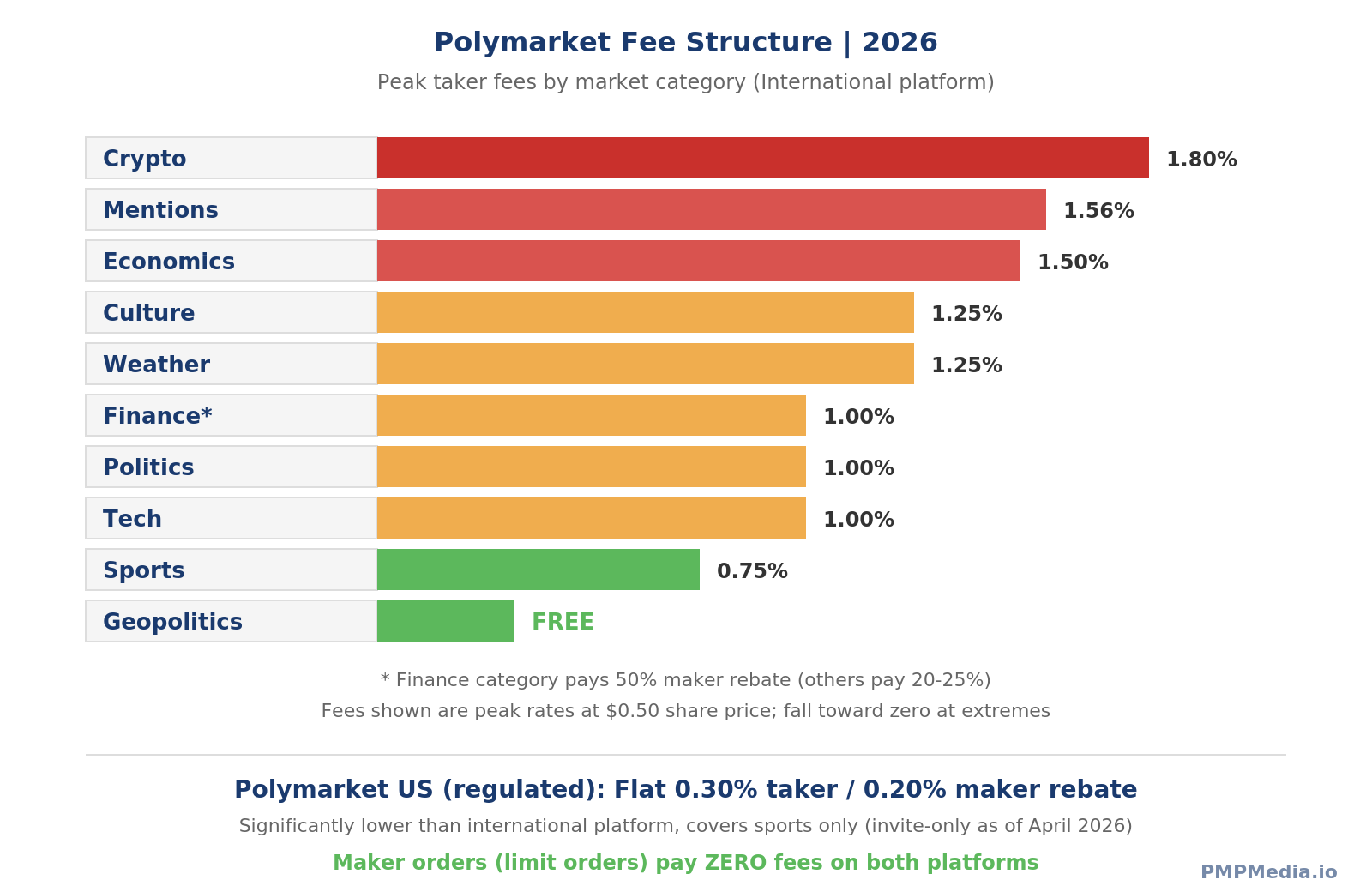
Polymarket has evolved significantly from its original zero-fee model. Through 2025 and 2026, the platform rolled out taker fees across ten market categories, with the current fee structure active as of April 2026.
International Platform Fees
Polymarket International uses a dynamic taker fee that depends on two factors: market category and share price. Fees peak when contracts trade near $0.50 (maximum uncertainty) and fall toward zero at the extremes. Here are the peak rates by category:
- Crypto: 1.80% peak
- Economics: 1.50% peak
- Mentions: 1.56% peak
- Culture: 1.25% peak
- Weather: 1.25% peak
- Finance: 1.00% peak
- Politics: 1.00% peak
- Tech: 1.00% peak
- Sports: 0.75% peak
- Geopolitics and world events: 0% (permanently fee-free)
Maker orders (limit orders that add liquidity) remain free on all categories, and makers receive rebates from the taker fee pool. Most categories pay a 25% rebate share. Crypto pays 20%. Finance, uniquely, pays 50%, likely because Polymarket wants to attract market makers into a newly fee-bearing category.
Polymarket US Fees
The US exchange uses a simpler flat-rate model:
- Taker fee: 0.30% on contract notional value
- Maker rebate: 0.20% paid back to liquidity providers
- Temporary 50% taker rebate through April 30, 2026 (paid weekly)
This is meaningfully cheaper than the international platform on most categories and dramatically cheaper than Kalshi’s fee formula. For active US sports traders with the Polymarket US invite, the fee advantage is the strongest argument for using the platform.
Deposit and Withdrawal Costs
Polymarket itself charges nothing for deposits or withdrawals. The real costs come from third parties:
- Polygon gas fees: under $0.01 per transaction, effectively negligible
- MoonPay debit card deposits: 2-3% processing fee
- USDC to fiat conversion on withdrawal: typically 1.5% through partner rails, or whatever your exchange charges if you off-ramp elsewhere
The cheapest route is buying USDC on a major exchange (Coinbase, Kraken) and sending it directly to your Polymarket wallet. This bypasses the MoonPay markup entirely and costs under a cent in gas.
Polymarket vs Kalshi: Where Each Platform Wins
For users choosing between the two market leaders, the decision comes down to specific trade-offs rather than one platform being universally better.
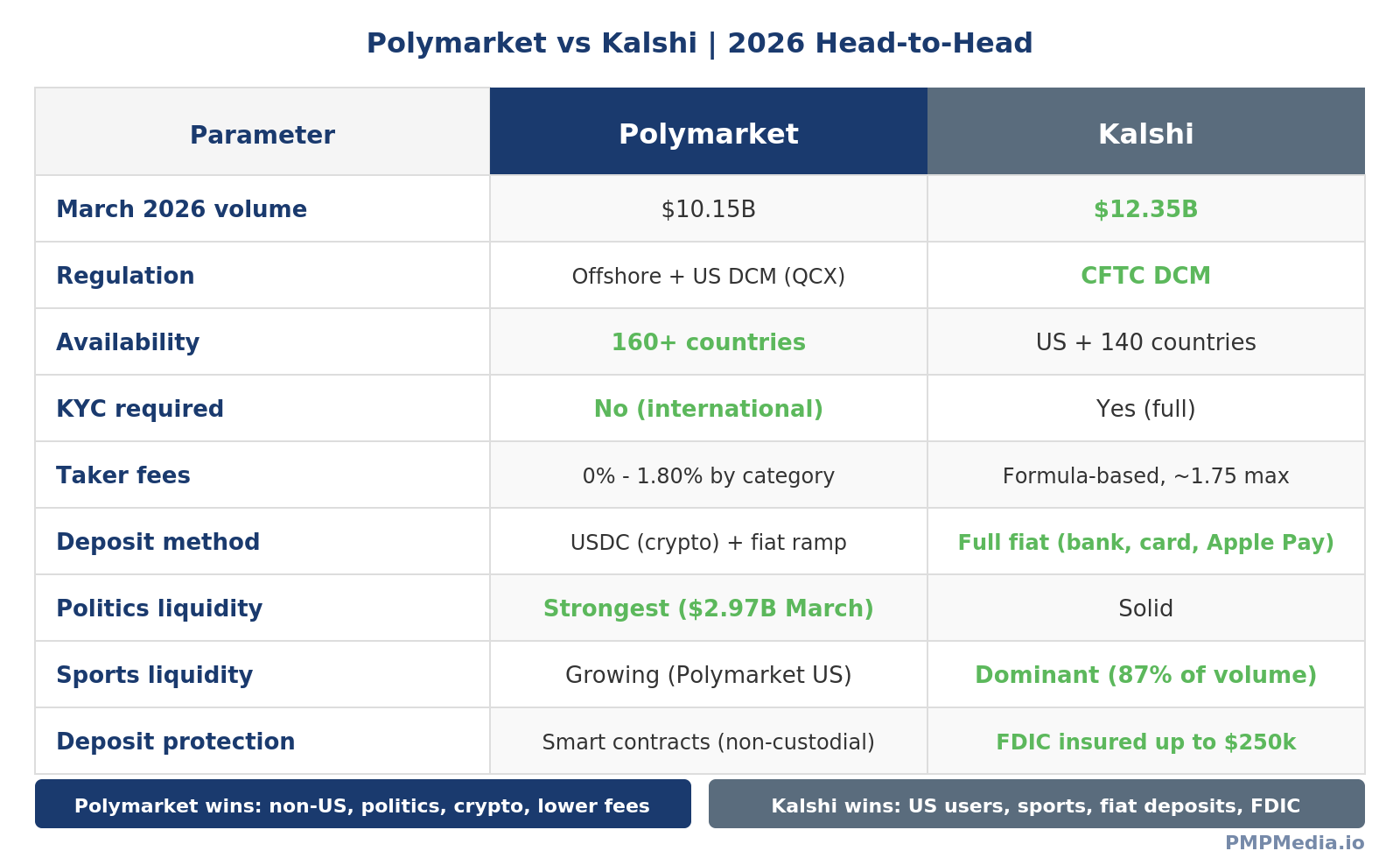
Where Polymarket Wins
- Global availability: 160+ countries vs Kalshi’s US-plus-140 countries
- No KYC on international platform: signup in under 2 minutes with email or crypto wallet
- Lower fees on most categories: Polymarket US flat 0.30% vs Kalshi’s formula-based fees
- Politics and crypto liquidity: deeper order books in categories where Kalshi’s user base is thinner
- On-chain transparency: every trade and settlement is publicly verifiable on Polygon
- Geopolitics markets: permanently fee-free on international platform
Where Kalshi Wins
- US regulatory protection: CFTC oversight and FDIC insurance up to $250,000
- Sports liquidity: 2.5x Polymarket’s sports volume in March 2026
- Fiat onboarding: bank transfer, wire, debit card, Apple Pay, no crypto required
- Mobile app maturity: more polished native app experience
- Market selection in the US: full product catalogue vs Polymarket US’s sports-only beta
My honest read: if you are outside the US, Polymarket is the default choice and there is no real contest. Inside the US, Kalshi is the practical answer for most users until Polymarket US opens past the waitlist and expands beyond sports.
Who Polymarket Is Best For
- Non-US users who want the deepest global liquidity in prediction markets
- Active traders who care about fee efficiency and are comfortable with limit orders
- Users focused on politics, macro, or crypto-adjacent event markets
- Traders comfortable with crypto wallets and USDC workflows
- Anyone who wants on-chain transparency and verifiable settlement
- Users who want to earn maker rebates by providing liquidity
Who Should Think Twice
- Complete beginners who are new to both prediction markets and crypto
- Users who want bank-level regulatory protection on their balances
- US residents without access to the Polymarket US waitlist
- Traders focused primarily on American sports markets
- Users in jurisdictions that restrict crypto-based financial products
Common Mistakes Polymarket Users Make
A few patterns come up repeatedly among newer users, and they are worth flagging explicitly because they show up in the community support channels constantly.
Using market orders on crypto and economics categories. Peak fees on crypto reach 1.80% and on economics 1.50%. Using a limit order instead makes you a maker, pays zero fees, and earns a rebate. The difference on a $1,000 trade is roughly $18 versus a small positive rebate.
Depositing via MoonPay. The 2-3% processing fee is unnecessary for anyone with a crypto exchange account. Buy USDC on Coinbase or similar, withdraw to Polygon, send to your Polymarket address. Total cost: sub-cent gas.
Ignoring resolution criteria on politically charged markets. UMA resolves based on public consensus. If the market title implies one outcome and the fine print implies another, the public interpretation usually wins. This has caught out sophisticated traders who thought they were arbitraging ambiguity.
Over-sizing positions on thin markets. Polymarket’s top markets have Kalshi-level liquidity. The long tail does not. A $5,000 position in a market with $30,000 of total volume will move prices against you meaningfully on entry and exit.
Treating Polymarket like a sportsbook. The mental model that works is options trading, not fixed-odds betting. Prices move continuously, you can exit before resolution, and the economics reward traders who think in probabilities rather than outcomes.
Pros and Cons
Pros
- Deepest global liquidity in prediction markets
- Lower fees than Kalshi on most categories
- No KYC required on international platform
- On-chain transparency and verifiable settlement
- Permanent fee-free trading on geopolitics markets
- Maker rebates reward liquidity providers
- Fast reaction to news and breaking events
- Polymarket US expanding access for American users
Cons
- Crypto onboarding still intimidates casual users
- UMA resolution can produce unexpected outcomes on ambiguous markets
- Liquidity uneven outside top markets
- International platform blocked for US residents
- Polymarket US currently limited to sports and invite-only
- 1.5% fee for converting USDC back to fiat via partner rails
- MoonPay debit card deposits cost 2-3%
- No FDIC or equivalent deposit protection on international platform
Is Polymarket Safe to Use?
Safety has several dimensions, and the honest answer depends on which one matters to you.
Technical safety: Polymarket’s smart contracts have operated for years without a major exploit, and the USDC held against your positions is in a standard Polygon-based architecture. This is not materially more risky than using any reputable DeFi protocol.
Regulatory safety: The international platform operates offshore and is not covered by US-style consumer protections. If you have a dispute that cannot be resolved through UMA, there is no regulator to appeal to. Polymarket US, being CFTC-regulated, has standard derivatives exchange protections.
Settlement safety: UMA has resolved millions of markets without significant integrity problems, but occasional ambiguous resolutions do happen. The Barron Trump DJT market in 2024 was the only case where Polymarket overrode UMA and refunded both sides of a bet.
Operational safety: The company has been around since 2020, has raised significant venture funding, and has survived regulatory scrutiny including the 2022 CFTC settlement. It is not a fly-by-night operation.
For most users, the practical risk is not fraud or exchange failure. It is entering ambiguous markets without reading the resolution criteria carefully, or putting funds into a crypto wallet for the first time without understanding the basics of wallet security.
Availability and Restrictions
Polymarket International is available in over 160 countries but is geo-blocked for US residents. The platform uses IP detection and wallet geolocation to enforce this, and attempts to circumvent the block through VPNs can result in frozen accounts. For users in restricted jurisdictions, Polymarket US (when invites open) or Kalshi are the legitimate alternatives.
Polymarket is blocked in over 30 jurisdictions, and the list has been expanding since 2025. Argentina banned the platform in March 2026. Australia’s ACMA blocked it in August 2025. New Zealand’s DIA ruled prediction markets illegal under Gambling Act 2003 in February 2026. For the full country-by-country gambling regulation picture affecting platforms like Polymarket, see our comprehensive guide.
Polymarket US is currently limited to US residents with waitlist access. The company has not published a timeline for opening the platform to the general public or for expanding beyond sports contracts, but both are expected in 2026.
Some countries restrict access to crypto-based financial products in ways that affect Polymarket even in regions where gambling itself is legal. Users should check local rules before depositing funds, particularly in jurisdictions with active crypto regulation like the EU under MiCA or the UK under FCA guidance.
Final Verdict
Polymarket in 2026 is a genuinely different product than it was even 12 months ago. The US launch through QCX, the dynamic fee structure, the expansion of UMA-resolved markets across new categories, and the growth of the maker rebate program have all changed the calculation for serious users.
For non-US users, Polymarket is the default answer for prediction markets, and the competitive position is getting stronger rather than weaker. For US users, Kalshi remains the practical choice until Polymarket US expands, but the trajectory is clear: Polymarket is going to be a meaningful US competitor within the next 12-18 months.
The platform’s weaknesses are real but addressable. Crypto onboarding remains the biggest friction point, and the fee structure has become complex enough that new users need to learn which markets are fee-free and how the maker-taker dynamic works. Neither is a dealbreaker for users willing to spend 15 minutes understanding the mechanics.
If you are choosing a prediction market platform in 2026 and you are outside the US, start with Polymarket. If you are in the US and the Polymarket US waitlist is open to you, try it for sports. For everything else, Kalshi is the default. And if you are comparing to traditional sportsbooks, the prediction market economics favour Polymarket by a wide margin for anyone who trades frequently enough for fees to matter.
Back to full comparison of prediction market platforms
FAQ
Is Polymarket legal in the US in 2026?
Polymarket International remains blocked for US residents. Polymarket US, the CFTC-regulated exchange launched in February 2026 after the QCX acquisition, is legal for US users on the waitlist. The US product is currently limited to sports contracts and invite-only access, with broader rollout expected in 2026.
How much does Polymarket charge in fees?
Fees vary significantly by platform and category. Polymarket US charges a flat 0.30% taker fee and pays a 0.20% maker rebate. Polymarket International charges dynamic taker fees ranging from 0% on geopolitics to 1.80% peak on crypto markets, depending on category and share price. Maker orders are always free on both platforms.
How do I avoid fees on Polymarket?
Use limit orders exclusively. Limit orders that rest on the order book before filling make you a maker, which pays zero fees and earns rebates from the taker fee pool. On Polymarket US, makers receive a 0.20% rebate. On the international platform, makers receive 20-25% of the taker fees collected on their filled liquidity.
What is UMA and why does it matter for Polymarket?
UMA is the decentralised oracle protocol that resolves disputed markets on Polymarket. Any user can propose an outcome by posting a $750 USDC bond, and the proposal becomes final if not disputed within 2 hours. Disputed markets escalate to UMA token holders, who vote on the correct resolution. UMA voters tend to interpret markets based on public consensus rather than strict technical reading of the rules.
Can you lose money on Polymarket?
Yes. Every contract you buy can go to zero if the event resolves against your position. Prediction markets are a form of speculation with real financial risk, and many users lose money, particularly those who trade based on gut feelings rather than genuine analysis. Manage position sizes accordingly.
How do I withdraw from Polymarket?
On Polymarket International, you withdraw USDC directly from your smart contract wallet to any Polygon-compatible address. Gas fees are under a cent. To convert USDC to fiat, you can use Polymarket’s partner rails (approximately 1.5% fee) or send the USDC to a crypto exchange you already use and off-ramp there. Polymarket US supports standard fiat withdrawals through regulated banking rails.
Is Polymarket better than Kalshi?
Better for what. Polymarket has deeper liquidity on politics and crypto, lower fees on most categories, and global availability. Kalshi has stronger US regulatory protection, better sports liquidity, fiat onboarding without crypto, and FDIC insurance on balances. For non-US users, Polymarket is usually the better choice. For US users, Kalshi is usually the better choice until Polymarket US expands its product range.
Do I need a crypto wallet to use Polymarket?
For the international platform, yes, although Polymarket provides a smart contract wallet automatically at signup that you can use without installing MetaMask or similar. For Polymarket US, no, the platform uses standard fiat deposits through regulated banking rails.
How long does it take for a Polymarket market to resolve?
Most markets resolve within hours of the underlying event concluding. An approved proposer submits the outcome to UMA, the 2-hour challenge period runs, and if no dispute is filed the market finalises. Disputed markets take 48-96 hours to resolve through UMA’s DVM voting process. Polymarket’s own automated proposers handle the submission on most markets within minutes of market close.
What happens if a Polymarket market resolves incorrectly?
Once UMA finalises an outcome, it is immutable on-chain. Polymarket is non-custodial and cannot reverse resolutions. In very rare cases where the resolution is catastrophically wrong, Polymarket has occasionally refunded both sides of a market, but this is not standard practice and should not be assumed as a backup. The practical protection is reading resolution criteria carefully before entering any market.
 Share
Share


 0 views