
Global iGaming regulation in 2026 is more fragmented, more active, and more consequential for operators than ever before. The coordinated enforcement push by major European regulators in late 2025, a circuit split over prediction markets that is now in front of the US Supreme Court, Brazil’s sudden ban on online betting in September 2026, and continued tax and compliance tightening across most mature markets make this a genuinely transitional period in how online gambling is governed worldwide. This guide was last fact-checked in late October 2026.
This guide provides a comprehensive country-by-country analysis of iGaming regulation in 2026. It covers the major regulated markets, emerging frameworks, restricted jurisdictions, and the regulatory trends shaping operator decisions globally. Written for legal counsel, compliance professionals, investors, and operators evaluating international market strategy. For foundational concepts, see our what is a gambling license guide. For practical licensing process, see our iGaming licensing guide. For license category classification, see types of gambling licenses.
The Global Regulatory Picture in 2026
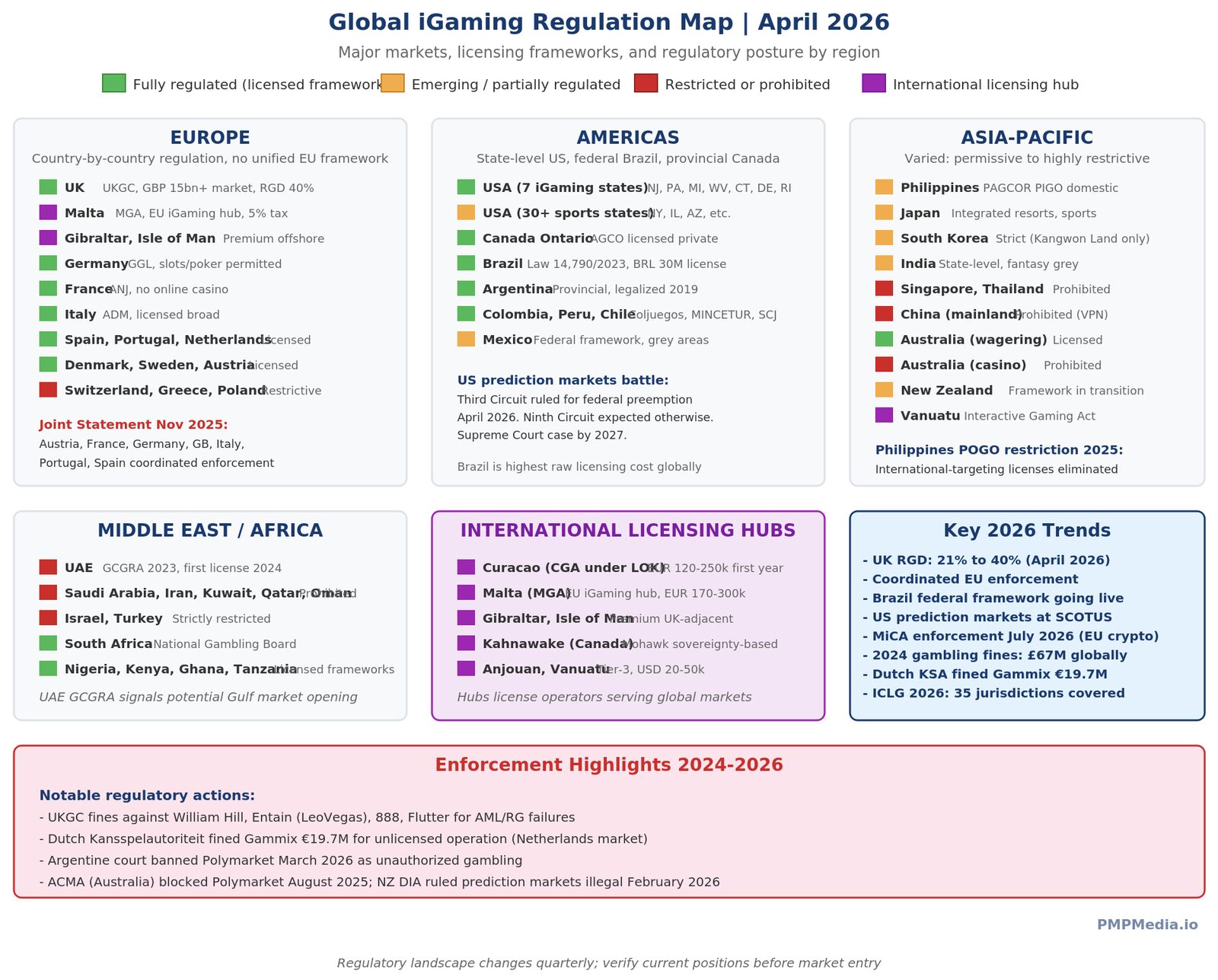
Four broad regulatory categories exist globally in 2026:
Fully regulated markets: National or state frameworks with licensed operators, active supervision, and enforcement. Most of Europe, major US states, UK, Canada Ontario. Operators need local licensing to serve these markets.
International licensing hubs: Jurisdictions that license operators serving global markets but where local populations may or may not participate. Curacao, Malta, Gibraltar, Isle of Man, Anjouan, Kahnawake.
Partially regulated or developing markets: Countries with emerging frameworks where licensing exists but is still establishing, or has proved fragile. Argentina, Peru, Philippines, UAE, and Brazil, whose licensed market was suspended by a ban in September 2026.
Restricted or prohibited markets: Countries where online gambling is either explicitly banned (Saudi Arabia, Iran, China) or tightly restricted (Singapore, Thailand, Taiwan).
The regulatory picture has been consolidating around stricter enforcement in fully regulated markets while emerging markets develop their own frameworks. Unlicensed operation increasingly faces enforcement pressure. The November 25, 2025 joint enforcement statement by Austria, France, Germany, Great Britain, Italy, Portugal, and Spain explicitly committed these jurisdictions to coordinated action against unlicensed operators targeting their consumers.
Europe: Fragmented but Tightening
Europe has no unified iGaming regulation. Each EU member state regulates gambling at the national level, producing a patchwork of frameworks that operators must navigate country-by-country. The EU provides horizontal frameworks (GDPR, AML Directives, MiCA for crypto) but individual gambling regulation is national.
United Kingdom
One of the largest regulated gambling markets in the world: GBP 17.5 billion in total GGY for April 2025 to March 2026, of which GBP 8.3 billion came from online casino, betting and bingo. Regulated under the Gambling Act 2005 by the UK Gambling Commission. Point-of-consumption taxation means any operator serving UK customers needs a UKGC license.
Major 2026 changes: Remote Gaming Duty raised from 21% to 40% effective April 1, 2026, with HMRC receipts up 108% in the months that followed. A new 25% General Betting Duty rate for remote bets follows on April 1, 2027 (UK horseracing excluded). UKGC licence fees rose 25% on October 1, 2026. White Paper reforms keep landing: £5/£2 online slot stake limits since spring 2025, the statutory levy since April 2025, a 10x cap on bonus wagering since January 2026, and a staged rollout of financial risk assessments approved in July 2026. The Autumn Budget on October 28, 2026 may move land-based Machine Games Duty next.
The UK remains mandatory for UK customers with no practical alternative. See our detailed UK Gambling License guide.
Malta
EU iGaming hub. Malta Gaming Authority (MGA) regulates online gambling with the most established EU-wide recognized license. Malta licenses are respected globally and often required for serving multiple EU markets indirectly.
Framework: gaming tax charged only on revenue from players who live in Malta, raised on October 1, 2026 from a flat 5% to 15% for Type 1 (casino) and 10% for Types 2-4. Four licence types (Type 1-4). Application fee EUR 5,000, annual fee EUR 25,000 (EUR 10,000 for Type 4) plus a revenue-based compliance contribution. Strong AML requirements, responsible gambling obligations, and ongoing compliance supervision.
Malta continues to position as the EU premium jurisdiction with strong banking relationships and institutional credibility, but 2026 was a hard year for its cross-border model. On April 16, 2026 the EU Court of Justice ruled in Case C-440/23 that member states can ban online casino services licensed elsewhere in the EU and that players can sue to recover losses, and an Advocate General opinion a week later called Malta’s Bill 55 “manifestly incompatible” with EU rules on enforcing judgments. See our Malta Gaming License guide.
Germany
The largest EU economy with one of the most complex gambling frameworks. The Interstate Treaty on Gambling (Glücksspielstaatsvertrag, GlüStV 2021) establishes unified framework across all 16 federal states.
Regulator: Gemeinsame Glücksspielbehörde der Länder (GGL), the Joint Gambling Authority of the German Federal States. Virtual slots and online poker are licensed federally under strict deposit limits and stake caps, and taxed at 5.3% of stakes, as is sports betting. Online casino table games (blackjack, roulette) are left to the individual states: Baden-Württemberg, Bavaria, Brandenburg, Hesse, Saxony and Thuringia run them as state monopolies, while Schleswig-Holstein licensed four private operators in September 2024 and North Rhine-Westphalia plans up to five concessions.
2026 enforcement focus: In March 2025 the Federal Administrative Court ruled (8 C 3.24) that the treaty gave the GGL no legal basis to order internet access providers to block illegal sites. The states answered with a second amending treaty, signed by all of them by March 2026, which extends blocking and removal orders to intermediaries; it takes effect once the last state has ratified it. Joint enforcement statement signatory.
France
Autorité Nationale des Jeux (ANJ) regulates online gambling. Sports betting, horse racing, and poker are permitted; casino games remain prohibited for online operators. A government amendment to legalise online casino at a 55.6% GGR tax was floated for the 2025 budget and withdrawn, and nothing has replaced it since. ANJ has been aggressive in enforcement against unlicensed prediction markets and offshore operators serving French consumers.
Joint enforcement statement signatory. Prohibitive posture toward unlicensed operations.
Italy
Agenzia delle Dogane e dei Monopoli (ADM), part of the Ministry of Finance, oversees Italian gambling. Regulates online casino, poker, sports betting, and lotteries. The 2024-2025 reorganisation of online licensing replaced the old system with 52 nine-year licences held by 46 operators, each costing EUR 7 million.
Joint enforcement statement signatory. Italian tax rates for online gambling are among the highest in Europe: 25.5% of GGR on online casino and 24.5% on sports betting, plus an annual fee of 3% of net gaming revenue.
Spain
Dirección General de Ordenación del Juego (DGOJ) regulates online gambling. Licensed casino, poker, sports betting, and bingo. Strong marketing restrictions (limits on advertising, promotional activities).
Joint enforcement statement signatory. Some operators explicitly choose Spain for regulatory clarity, others find compliance costs challenging.
Netherlands
Kansspelautoriteit (KSA) regulates Dutch online gambling. Framework went into effect in 2021 with online casino and sports betting licensing. Known for aggressive enforcement action: the Dutch regulator keeps raising its own record for fining unlicensed operators, from about EUR 19.6 million against Gammix in 2024 to EUR 24.9 million against Novatech in March 2026 and EUR 37 million against EOD Code SRL (Instant Casino and a dozen other sites) in October 2026.
Remote gambling operators need local Dutch license; international licenses do not suffice. The gambling tax rose to 37.8% of GGR on January 1, 2026, up from 34.2%. Strict advertising restrictions.
Denmark
Spillemyndigheden (Danish Gambling Authority) regulates online gambling. Framework established in 2012 with licensed operators serving Danish customers. Gambling tax is 28% of GGR, with no deduction for bonuses. Fees are indexed every year; for 2026 the application fee is about DKK 343,000 for one product (DKK 481,000 for casino and betting together) and the annual fee runs from about DKK 73,000 to over DKK 6.4 million depending on GGR. Strong reputation for player protection and responsible gambling.
Sweden
Spelinspektionen regulates Swedish gambling under Gambling Act 2018. Licensed framework including casino, sports betting, and lotteries. Application fee SEK 230,000 for online gaming or betting, annual supervision fee SEK 240,000 per licence since March 2026. Gambling tax 22% of GGR since July 1, 2024 (up from 18%).
Sweden has seen operator exits and re-entries as regulatory costs and commercial reality aligned. Current framework stable.
Austria
Gambling regulation under Glücksspielgesetz (GSpG). Lotteries and casino under federal framework; sports betting regulated by the nine Federal Provinces (Bundesländer) because Austria classifies it as skill-based, not chance. Federal Ministry of Finance (BMF) oversees federal licensing.
Joint enforcement statement signatory. Notable for distinctive treatment of sports betting separate from gambling law.
Portugal
Serviço de Regulação e Inspeção de Jogos (SRIJ) of Turismo de Portugal regulates online gambling. Casino, sports betting, and poker permitted with licensing. Marketing restrictions apply.
Joint enforcement statement signatory. On January 19, 2026, the day after the first round of the presidential election, SRIJ ordered polymarket.com blocked: Polymarket has no Portuguese licence and Portuguese law does not allow betting on political events. Vodafone, MEO and NOS blocked it at DNS level, after reports of heavy betting before results were known.
Belgium
Gaming Commission regulates Belgian gambling. Framework requires operators to have Belgian physical establishment to offer certain products (restrictive for international operators). Strict regulation with lower tolerance for offshore operators.
Ireland
The Gambling Regulation Act 2024 created the Gambling Regulatory Authority of Ireland (GRAI). Licensing is opening in stages: applications for remote betting, in-person betting and betting intermediary licences opened on February 9, 2026, remote betting and intermediary licences took effect on July 1, 2026, and gaming, casino, lottery and B2B licences follow across 2027 and 2028. Until each stage opens, operators continue under the old regime. Ireland also holds the EU Council presidency in the second half of 2026, and its draft of the EU budget left out the proposed EU-level online gambling levy, though the European Parliament still wants new revenue sources.
Gibraltar
Long-established jurisdiction serving the UK market historically, now moving from the Gambling Act 2005 to a new Gambling Act 2025 framework. Strong banking and payment infrastructure. Annual B2C fees under the 2026 fee regulations: GBP 50,000 for betting or gaming licensees with GGR under GBP 20 million, GBP 100,000 for GBP 20-300 million, GBP 200,000 above that, and GBP 100,000 for a betting intermediary, plus a 0.15% duty.
On March 26, 2026 Gibraltar licensed Predict Street Ltd as a betting intermediary, which local officials describe as the territory’s first prediction market licence and Europe’s first formally licensed prediction market operator.
Smaller and emerging EU markets
- Poland: Totalizator Sportowy and Ministry of Finance regulate. Strict restrictions; most foreign operators blocked
- Romania: ONJN (National Gambling Office) regulates. Moderately open licensing framework
- Czech Republic: Ministry of Finance regulates. Established framework with moderate licensing costs
- Bulgaria: National Revenue Agency regulates. Framework tightening since 2020
- Greece: Hellenic Gaming Commission. Restrictive framework; most offshore operators blocked
- Finland: Veikkaus monopoly ends with a licensed market from July 1, 2027. Applications opened March 1, 2026 (EUR 29,000 fee), around 75 have been filed, and Wildz announced the first licence in October 2026
- Norway: Norsk Tipping monopoly; EU-adjacent but not EU member
- Switzerland: Swiss Federal Gaming Board regulates. Restrictive; online casinos must be land-based casino operators
- Estonia, Latvia, Lithuania: Licensed frameworks with varied levels of strictness
North America
United States (federal framework)
US federal gambling law is fragmented. Three main federal statutes:
- Wire Act (1961): DOJ interpretation has shifted; 2019 reinterpretation applies only to sports betting; earlier interpretations applied to all gambling
- Unlawful Internet Gambling Enforcement Act (UIGEA, 2006): Prohibits processing payments for unlawful internet gambling
- Professional and Amateur Sports Protection Act (PASPA, 1992): Struck down by Supreme Court Murphy v. NCAA 2018, giving states authority over sports betting
State-by-state licensing dominates. Tribal gaming operates under Indian Gaming Regulatory Act (IGRA) framework with state-tribal compacts.
US iGaming states (as of October 2026)
Seven states have live online casino (iGaming) markets: New Jersey, Pennsylvania, Michigan, West Virginia, Connecticut, Delaware, and Rhode Island. Maine became the eighth to legalize it when LD 1164 became law in January 2026 (effective July 29, 2026), with up to four platforms, one per Wabanaki Nation, and an 18% tax; launch is expected in early 2027. Virginia’s 2026 bills failed. According to the AGA, US iGaming revenue topped USD 10.7 billion in 2025, up 27.6% year on year.
New Jersey is the largest and most established iGaming market, with Division of Gaming Enforcement (DGE) as regulator. USD 400,000 casino license fee. Pennsylvania Gaming Control Board (PGCB) has higher fees (up to USD 10 million for casino operators). Michigan Gaming Control Board (MGCB) fast-growing.
US sports betting states
39 states plus Washington DC now have legal sports betting, after Missouri went live on December 1, 2025. The AGA puts 2025 sports betting revenue at USD 16.9 billion. Largest by revenue: New York, New Jersey, Pennsylvania, Illinois, Arizona. Some states offer full online operation; others restrict to in-person registration or retail-only.
US prediction markets regulatory battle
CFTC-registered prediction markets (Kalshi, Polymarket US via QCX) claim federal exclusive jurisdiction over event contracts. State regulators argue sports contracts are gambling regardless of CFTC status, and the federal appeals courts have now split. The Third Circuit sided with Kalshi on April 6, 2026 (KalshiEX v. Flaherty, New Jersey), holding that sports event contracts are swaps under exclusive CFTC jurisdiction. The Ninth Circuit (Nevada, August 28, 2026) and the Sixth Circuit (Ohio and Tennessee, September 25, 2026) went the other way. New Jersey asked the Supreme Court to take the case on September 2, 2026, and Robinhood and Crypto.com filed petitions against the Ninth Circuit ruling. Meanwhile states keep acting on their own: Ohio sent cease-and-desist letters to ten platforms in October 2026, and Connecticut and Michigan have taken Kalshi to court.
Canada
Federal Criminal Code prohibits gambling unless authorized by provincial law. Provincial-level regulation:
- Ontario: AGCO (Alcohol and Gaming Commission of Ontario) regulates private online gambling through iGaming Ontario. Model for other Canadian provinces. 48 operators running 83 sites as of mid-2026
- Alberta: Became the second open market on July 13, 2026, with 22 sites live on day one and more than 50 approved by October. The AGLC regulates; grey-market operators had to leave by October 13, 2026, and Stake secured its licence just ahead of that deadline
- British Columbia, Quebec: Crown-corporation models (BCLC, Loto-Québec) with monopoly status
- Other provinces: Mixed approaches, Atlantic Lottery Corporation serves several eastern provinces
Ontario and now Alberta run open, private-operator markets. The other provinces keep monopoly structures.
Mexico
The Ministry of the Interior (Segob) regulates gambling under the Federal Games and Raffles Law of 1947, which is still in force; a reform draft reached the federal Security Cabinet in 2026 but had not been introduced in Congress by October. Online operators typically work through permits held by Mexican land-based groups. From January 1, 2026 the special tax (IEPS) on gambling rose from 30% to 50%, and it now applies to online platforms, including foreign ones serving Mexican players, on the same footing as land-based venues.
Latin America
Brazil
October 2026 status: suspended by presidential decree. On September 25, 2026 President Lula signed Provisional Measure 1.394/2026, which bans fixed-odds betting and online casino games in Brazil. Deposits stopped the same day, sites and apps went dark on October 6 after a withdrawal window, and the five-year licences expired on October 25 with no refund of the BRL 30 million fee. Industry bodies ANJL and IBJR have challenged the measure at the Supreme Federal Court, where Justice Luiz Fux is due to rule after the presidential run-off, and Congress still has to vote on it. Operators are already cutting: Flutter has closed Betfair Brazil and KTO has laid off more than 200 staff.
Until the ban, Brazil was the most important new regulated market in global iGaming. Federal Law 14,790/2023 established the licensing framework that went live on January 1, 2025, supervised by the SPA (Secretaria de Prêmios e Apostas) under the Ministry of Finance, with at least 84 operators licensed before the measure. The framework below is what operators were working under, and what they would return to if the courts or Congress overturn the ban.
Key framework elements:
- License fee: BRL 30 million (approximately USD 5.5-6.1 million) for 5-year federal authorization
- Monthly supervisory fee based on GGR, up to BRL 1.9 million per month for largest operators
- .bet.br domain mandatory for Brazilian-licensed operators
- GGR tax of 12% in 2025 and 13% in 2026 under Complementary Law 224/2025, scheduled to reach 14% in 2027 and 15% in 2028
- Integration with official government monitoring system required
- Responsible gambling obligations including AML and KYC aligned with FATF
- Corporate presence in Brazil required
Brazil had the highest raw licensing cost in global iGaming, and the September 2026 ban turned that cost into the clearest example yet of political risk in a newly regulated market: operators paid for five years and got under two.
Argentina
Legalized online gambling in 2019; licenses issued from 2021. Regulated at provincial level with most activity in Buenos Aires, Mendoza, Santa Fe. Argentine Lottery (Lotería de la Ciudad) and provincial lottery agencies regulate.
Significant 2026 development: on March 11, 2026 a Buenos Aires City criminal and contravention court, acting on a complaint from the city lottery (LOTBA), ordered telecoms regulator ENACOM to block Polymarket nationwide as an unauthorised gambling operation.
Colombia
Coljuegos (National Gambling Regulator) regulates. Licensed online gambling including casino, poker, and sports betting. First Latin American country with national iGaming regulation (2016). Stability took a hit in 2025: an emergency 19% VAT on online deposits was followed by a 19% VAT on GGR, which was suspended in January 2026 and then struck down as unconstitutional, with refunds ordered. Operators are back on the standard 15% GGR levy, though a July 2026 bill would make the VAT permanent.
Peru
Ministry of Foreign Trade and Tourism (MINCETUR) through DGJCMT (General Directorate of Games of Chance) regulates. Law 31557 (2022) and its regulation have licensed online gambling since February 2024, with a tax of 12% of monthly net revenue plus a 1% tax on each player’s bet. About 60 platforms were authorised by mid-2025.
Chile
Superintendence of Casinos of Games (SCJ) regulates land-based casinos. Online gambling operates in a regulatory grey area. The bill to license it is in its second stage in the Senate, and the debate has swung back towards restriction: in October 2026 one senator filed an amendment to ban online betting platforms outright, another to toughen penalties for illegal ones.
Other LATAM markets
- Mexico, Panama, Costa Rica: Mixed frameworks, often lighter regulatory touch
- Ecuador, Bolivia: Largely restrictive
- Uruguay: State-run monopoly
- Venezuela: Significant operational challenges despite legal framework
Asia
Asia has the most varied regulatory landscape globally, with strict prohibition in some markets and open commercial markets in others.
Philippines
Philippine Amusement and Gaming Corporation (PAGCOR) is the regulatory and licensing authority. The offshore sector is gone: the Anti-POGO Act of 2025 (Republic Act 12312) made the ban on offshore gaming permanent and revoked the remaining licences. PAGCOR still licenses online gambling for local players, but under pressure: it banned outdoor gambling ads in July 2025, is weighing a TV and radio ban, and a Senate bill to outlaw online gambling entirely (SB 686) was filed in 2025 but has not passed. PAGCOR is also building a mobile app for players to verify licensed sites.
Japan
Integrated Resort Implementation Act (2018) allows up to three integrated resorts with casino gaming, but only one, MGM and Orix’s Osaka project, has been approved so far, with opening targeted for 2030. Horse racing, boat racing, motorcycle racing, bicycle racing, and sports lottery are permitted. Other gambling is generally restricted. A second IR application window runs from May 6 to November 5, 2027. Online casino is a crime under the Penal Code, and since September 25, 2025 an amended gambling addiction law also bans offering online casino sites or apps to Japanese users and publishing material that steers people to them, which takes aim directly at affiliates and ranking sites.
South Korea
Strict prohibition on gambling for Korean citizens. Only Kangwon Land casino permits Korean nationals. Foreign-targeted casinos operate (Paradise, Grand Korea Leisure). Online gambling is prohibited but enforcement varies.
India
India went from grey market to national ban. The Promotion and Regulation of Online Gaming Act 2025, passed in August 2025 and in force since May 1, 2026, prohibits all online real-money games, whether skill or chance decides the outcome, including fantasy sports. E-sports and free social games are allowed. Challenges have been consolidated before the Supreme Court (lead case Head Digital Works v Union of India) with no ruling yet, and in June 2026 the same court upheld Tamil Nadu’s and Karnataka’s state-level restrictions. Offshore enforcement is active: Polymarket’s site was blocked in May 2026 and its X account was withheld in India in October.
Singapore
Strict Remote Gambling Act. Prohibited except for exempt operators (Singapore Pools for lottery and sports betting). Aggressive enforcement including geoblocking of unlicensed operators. Not a market for offshore operators.
Thailand
Prohibition on all forms of gambling except state lottery and horse racing at specific venues. The Entertainment Complex Bill that would have legalised casinos was withdrawn in July 2025, and Prime Minister Anutin Charnvirakul has since ruled out legalisation. Online gambling remains illegal, and enforcement is moving into payments, with authorities probing crypto exchanges over gambling funds.
Taiwan
Gambling generally prohibited under Criminal Code. Offshore operators geoblocked. Not a licensed market for commercial iGaming.
China
Mainland China prohibits all gambling except state lotteries and sports lottery. Macau and Hong Kong have separate regulatory regimes (Macau has world’s largest gaming revenue through land-based casinos). Online gambling geoblocked across mainland.
Other Asia
- Vietnam: Limited legal gambling; foreigners-only policy for most venues
- Cambodia: Land-based casinos for foreigners only. No new online licences since 2019, and in September 2026 the government ordered casinos to stop online betting altogether, with 24 confirmed to have halted by October 1
- Laos: Casino-friendly for tourism; online gambling not licensed
- Malaysia: Strictly prohibited except at Genting Highlands
- Indonesia: Prohibited
Oceania
Australia
Interactive Gambling Act 2001 prohibits most online gambling by Australians. Licensed online wagering (sports betting, lotteries) permitted. Online casino games are illegal for Australian customers. Strict advertising restrictions.
ACMA (Australian Communications and Media Authority) enforces illegal online gambling provisions including ISP-level blocking. On August 13, 2025 ACMA blocked Polymarket for serving Australian customers, and by June 2026 it had ordered blocks on 1,751 illegal gambling and affiliate sites since November 2019. It is now going after promoters too, including ex-AFL players advertising illegal sites.
New Zealand
Department of Internal Affairs (DIA) regulates under Gambling Act 2003. TAB holds monopoly over online sports betting. On February 16, 2026 the DIA wrote to Kalshi and Polymarket, told them their products are gambling under New Zealand law and asked both to withdraw.
The Online Casino Gambling Act passed its third reading on April 23, 2026 and has been in force since May 1, 2026. It caps the market at 15 licences, one brand each and no more than three per company. The auction ran from September 29 to October 12, 2026 at a final price of NZ$15 million per licence, and 11 bidders won the right to apply, including Entain, SkyCity, Stake and Betway. Offshore operators without a pending application must stop serving New Zealand from December 1, 2026, and the licensed market is expected to be fully running in 2027.
Pacific Islands
- Fiji: Local licensing for online gambling operators serving Fiji market
- Vanuatu: Interactive Gaming Act 2000 provides permissive regulatory framework; used as licensing jurisdiction for international operators
- Cook Islands, Samoa: Small licensing roles
Middle East and Africa
United Arab Emirates
Historically prohibited gambling under Islamic law. The General Commercial Gaming Regulatory Authority (GCGRA), set up in 2023, has since licensed a national lottery (The Game LLC, July 2024), the first casino resort (Wynn Al Marjan Island, October 2024, now due to open in September 2027) and, in 2026, its first online brand: Play971, which holds internet gaming and sports wagering licences and launched before the 2026 World Cup. It remains a tightly controlled, single-digit-licence market, not an open one.
Saudi Arabia, Iran, Kuwait, Bahrain, Qatar, Oman
Gambling prohibited under Islamic law. Strict enforcement. Not markets for commercial iGaming operations.
Israel
Monopoly through state lotteries. Private commercial gambling prohibited. Online gambling not legally available for Israeli citizens.
Turkey
Gambling generally prohibited outside state lotteries. Enforcement includes ISP blocking of offshore gambling sites.
Africa
- South Africa: Provincial licensing under the National Gambling Board framework; online betting is licensed, online casino is not. National Treasury has proposed a 20% national tax on online GGR, with the final design due in the February 2027 Budget
- Nigeria: Since the Supreme Court’s November 2024 ruling, gaming is a state matter and the federal regulator covers only Abuja. Lagos, Enugu and other states license operators separately
- Kenya: The Gambling Control Act 2025 replaced the Betting Control and Licensing Board with a new Gambling Regulatory Authority; operators needed new licences by June 30, 2026. Since July 2026, 5% excise applies to betting deposits and 5% to withdrawals of winnings
- Ghana: Gaming Commission regulates. Moderate framework
- Tanzania: Gaming Board of Tanzania regulates sports betting and lottery
- Egypt, Tunisia, Morocco: Limited gambling legality; mostly tourism-oriented land-based
Major Regulatory Themes in 2026
Coordinated enforcement against unlicensed operators
The November 25, 2025 Joint Statement by Austria, France, Germany, Great Britain, Italy, Portugal, and Spain committed these jurisdictions to coordinated action against unlicensed operators. Key elements include information sharing, calls on digital platforms to limit advertising of unauthorized operators, and commitment to strengthen ISP and payment blocking. Individual regulators continue to issue substantial fines.
Rising compliance expectations
Regulators increasingly expect substantial compliance infrastructure: robust AML, KYC, transaction monitoring, responsible gambling tools, affordability checks, and detailed reporting. Template policies that satisfied earlier regulators no longer suffice.
Advertising restrictions intensifying
Most mature markets have been tightening advertising rules. UK requires opt-in consent for direct marketing. Spain, Italy, and Germany have increasingly restrictive advertising frameworks. Belgium introduced near-total advertising ban. Netherlands restricts times when gambling ads can air. Affiliate marketing regulation is also tightening.
Tax rate increases
Multiple mature markets have raised gambling tax rates. UK Remote Gaming Duty increased from 21% to 40% in April 2026, the Netherlands went to 37.8% of GGR in January 2026, Malta raised its local gaming tax to 15% for casino in October 2026, and Mexico lifted its special gambling tax to 50%. Italy charges 25.5% on online casino GGR, Denmark 28%, Sweden 22%. This trend of raising tax rates while tightening compliance is making some markets less attractive for operators while benefiting larger established players who can absorb the cost.
Financial crime focus
AML and enforcement action has been aggressive, with significant UK cases against Entain, William Hill, 888 and others in recent years. The Dutch regulator has broken its own fine record twice in 2026, ending at EUR 37 million against EOD Code SRL in October. UK, Dutch, and German regulators have been particularly active.
Crypto gambling regulatory tightening
Crypto-accepting gambling operators face increasing AML scrutiny. Curacao under LOK requires chain analysis tools and FATF-aligned compliance. In the EU, MiCA’s transitional period for crypto-asset service providers ended on July 1, 2026, so the exchanges and custodians a crypto casino relies on must now be authorised. Anonymous crypto casino operations increasingly restricted.
Prediction markets emergence
US CFTC-regulated prediction markets (Kalshi, Polymarket US) have created new category bridging gambling and financial markets, and the US appeals courts are split on whether states can regulate them. UK treats these as betting under UKGC, with exchanges running them under existing licences (Betfair Predicts in beta since April 2026). EU member states mostly classify them as gambling: Portugal blocked Polymarket in January 2026, and Argentina, India, New Zealand and Australia have all acted against it. A Supreme Court decision on whether to hear the US case is pending. For the complete analysis of this emerging category, see our dedicated prediction markets regulation guide.
State-level US regulatory complexity
US operations face 50+ separate state regulatory ecosystems. Multi-state operators manage substantially different requirements in each state. Geolocation compliance, KYC thresholds, responsible gambling rules, and reporting cadence vary by state. Operational complexity is high and compliance costs scale with state count.
Brazil: from flagship to warning
Brazil’s 2025 framework rollout was the most significant new regulatory development in Latin America, until Provisional Measure 1.394/2026 banned online betting and casino games on September 25, 2026. Licences that cost BRL 30 million for five years expired after less than two. Whatever the Supreme Federal Court and Congress decide, every operator now prices political risk into new-market entry in a way it did not a year ago.
ICLG 2026 coverage
The International Comparative Legal Guide to Gambling Laws and Regulations (ICLG) publishes an annual jurisdiction-by-jurisdiction comparison written by local law firms. It is a useful second reference, but in a year like 2026, with bans in Brazil and India and tax changes in half a dozen markets, check any annual guide against the regulator’s own site before acting on it.
Strategic Implications for Operators
For new market entrants
Target market selection drives everything else. Match license strategy to target customer geography. Budget for local licensing in each target market; do not assume international licenses will work. Compliance costs are rising faster than revenue in many markets.
For established operators
Portfolio review is increasingly important. Some jurisdictions that made sense 3 years ago have become less attractive due to tax increases or tightening compliance. Others (Alberta, Finland from 2027, New Zealand, specific US states) offer new opportunities with high barriers to entry, and Brazil’s 2026 ban is a reminder to price political risk into every new market.
For investors and acquirers
Regulatory posture materially affects valuation. Operators with clean multi-jurisdiction licensing trade at premiums to offshore-only operators. Regulatory issues in one market can affect access to others. Due diligence must include detailed regulatory review.
For service providers and B2B
Compliance partner opportunities continue to expand as operators need help meeting rising standards. Technical certification labs, compliance consultancies, legal advisors, and technology providers serve the entire ecosystem.
The 2026-2027 Outlook
Several developments will shape global iGaming regulation over the next 12-24 months.
US prediction markets Supreme Court ruling
With the Third Circuit for Kalshi and the Ninth and Sixth Circuits against, the Supreme Court is likely to take up federal preemption for CFTC-registered event contracts; New Jersey’s petition was filed in September 2026, so a decision on the merits would most likely come in 2027. Either outcome is consequential. Pro-federal ruling unlocks nationwide expansion. Pro-state ruling forces compliance with state gambling frameworks.
UK tax impact
The full-year impact of the 40% Remote Gaming Duty, the 25% licence fee rise from October 2026 and the 25% remote betting duty from April 2027 will reshape UK profitability. The restructuring has started, with Flutter putting up to 1,400 roles at risk, and the October 28, 2026 Budget may add a Machine Games Duty rise for land-based venues.
Brazil’s ban in the courts
The Supreme Federal Court ruling on Provisional Measure 1.394/2026, expected after the October 2026 presidential run-off, and the congressional vote on the measure will decide whether Brazil’s licensed market comes back at all. If it does, expect tougher rules than the 2025 framework; if it does not, expect the volume to move offshore.
EU MiCA impact
MiCA’s transitional period for crypto-asset service providers ended on July 1, 2026. A gambling operator that only accepts crypto is not automatically a CASP, but one that exchanges, holds or transfers crypto for customers needs its own authorisation, and everyone else has to work through authorised providers.
Joint enforcement action escalation
The November 2025 joint statement signatories likely to escalate coordinated enforcement against unlicensed operators through 2026-2027. Payment blocking, ISP blocking, and advertising restrictions expected to tighten.
Additional US state markets
New York iGaming legislation, California and Texas sports betting expansion all possible through 2026-2027. Each unlocks substantial market opportunity with state-specific licensing.
Philippines domestic market consolidation
With offshore gaming permanently banned since the 2025 Anti-POGO Act, the fight is now over the domestic online market: tighter advertising rules are coming, and the Senate bill to ban online gambling outright is the risk every local licensee is watching.
UAE market development
GCGRA framework continues development. Additional license types may emerge through 2026-2027 representing significant regulatory change in the Gulf region.
Related Guides
- What Is a Gambling License
- Types of Gambling Licenses
- iGaming Licensing Guide
- Malta Gaming License
- Curacao iGaming License
- UK Gambling License
- Curacao License Requirements
- Curacao License Cost
- Curacao vs Malta License
Bottom Line
Global iGaming regulation in 2026 is characterized by fragmentation, active enforcement, and rising compliance expectations. No single framework applies globally. Operators serving international markets need jurisdiction-specific strategies, multiple licenses, and substantial compliance infrastructure.
The regulatory direction of travel is clearly toward stricter enforcement, higher taxes in mature markets, and reduced tolerance for unlicensed operation. Markets that historically operated in regulatory grey areas are moving in both directions: towards formal regulation (Alberta, New Zealand, Finland, UAE) or towards outright bans (India in 2025, Brazil in 2026), while mature markets tighten enforcement against offshore operators (EU coordinated action, UK, Netherlands).
The winners in this environment are operators who treat regulation as core strategic infrastructure rather than as a cost center. Sustained investment in compliance, legal advisors, and multi-jurisdiction licensing supports long-term business value. Operators trying to arbitrage regulatory weaknesses face increasing enforcement pressure and commercial limitations from banking and payment partners.
FAQ
Which countries allow online gambling in 2026?
Major regulated online markets in 2026 include: United Kingdom, Malta, Germany, France (no online casino), Italy, Spain, Netherlands, Denmark, Sweden, Portugal, Austria, Gibraltar, Isle of Man, Ireland (betting), Argentina, Colombia, Peru, Mexico, Philippines (domestic only), South Africa (betting), Kenya, Ontario and Alberta in Canada, and seven US states with live online casino (NJ, PA, MI, WV, CT, DE, RI; Maine has legalized but not launched), plus 39 states and DC for sports betting. Brazil licensed online betting in 2025 but suspended it by provisional measure in September 2026. Each has its own licensing framework.
Which countries prohibit online gambling?
Major prohibition jurisdictions include Saudi Arabia, Iran, Kuwait, Bahrain, Qatar, Oman (Islamic law), Thailand, China mainland, Indonesia, Singapore, Taiwan, and India, which banned all online real-money games with effect from May 1, 2026. Brazil suspended its licensed market by provisional measure in September 2026, pending court and congressional decisions. Some allow limited state-operated gambling (lotteries) but prohibit commercial operators. Enforcement varies but is generally strict.
Do I need separate licenses for each country?
In most cases yes. Most countries operate point-of-consumption regulation, requiring local licensing for any operator serving local consumers. International licenses (Malta, Curacao) provide access to some markets but cannot replace national licensing in most regulated jurisdictions. Operators serving multiple markets typically hold multiple licenses.
Which is the most respected gambling license in the world?
UK Gambling Commission (UKGC) is generally considered the most rigorous and respected globally, due to strict enforcement, detailed regulatory framework, and mature market. Malta Gaming Authority (MGA) is considered the leading EU-wide recognized license. Gibraltar, Isle of Man, and Alderney are also highly regarded. These Tier-1 licenses carry strongest banking credibility and institutional recognition.
What is the Joint Statement on illegal gambling?
On November 25, 2025, gambling regulators for Austria, France, Germany, Great Britain, Italy, Portugal, and Spain issued a joint statement committing to coordinated action against illegal online gambling. The statement calls for information sharing on illegal operators, pressure on digital platforms to restrict advertising of unauthorized operators, and strengthened enforcement mechanisms. Signals increasing coordination among European regulators.
How is Brazil regulating iGaming?
Brazil licensed online betting and casino from January 1, 2025 under Law 14,790/2023: BRL 30 million for a five-year authorization, a mandatory .bet.br domain, and a GGR tax of 12% in 2025 and 13% in 2026. On September 25, 2026 Provisional Measure 1.394/2026 banned fixed-odds betting and online games; sites went offline on October 6 and licences expired on October 25 without refunds. The ban is being challenged at the Supreme Federal Court and still needs congressional approval, so the market’s future depends on those two decisions.
What is happening with prediction markets regulation globally?
US: CFTC-regulated prediction markets (Kalshi, Polymarket) claim federal jurisdiction, and the appeals courts are split: the Third Circuit ruled for federal preemption in April 2026, the Ninth and Sixth Circuits against in August and September 2026. New Jersey has asked the Supreme Court to hear the case. UK: treated as betting, with exchanges such as Betfair running prediction products under existing UKGC licences. EU: mostly classified as gambling requiring national licensing; Portugal blocked Polymarket in January 2026. Gibraltar licensed Predict Street Ltd as a betting intermediary in March 2026, its first prediction market licence.
What countries have the highest gambling taxes?
Among major regulated markets, the UK’s Remote Gaming Duty is now one of the highest at 40% of gross profits (since April 2026), followed by the Netherlands at 37.8% of GGR (since January 2026). Denmark charges 28%, Italy 25.5% on online casino and 24.5% on betting, Sweden 22%. Germany taxes stakes rather than GGR (5.3%), which on a GGR basis is heavier still, and France’s stake-based betting taxes work out at similar levels. Mexico’s special tax rose to 50% in 2026. Curacao levies no gaming tax at all, only a flat annual fee and a profit tax that falls to roughly 2% with local substance. US state taxes vary widely, from the mid-teens to over 50% for online casino in some states.
Is China planning to legalize online gambling?
No indications of changes to current prohibition. Mainland China prohibits all gambling except state lotteries. Hong Kong and Macau have separate regimes (Macau has the world’s largest gaming revenue market through land-based casinos). No federal-level movement toward online gambling legalization in 2026.
What is the status of iGaming in the United Arab Emirates?
The UAE set up the General Commercial Gaming Regulatory Authority (GCGRA) in 2023. It licensed The Game LLC as national lottery operator in July 2024, Wynn Al Marjan Island as the first casino resort in October 2024 (opening now set for September 2027), and in 2026 its first online brand, Play971, with internet gaming and sports wagering licences. It is a tightly controlled market with very few licences, not an open one.
How does EU MiCA affect iGaming operators?
MiCA (Markets in Crypto-Assets) has applied in full since December 30, 2024, and the transitional period for existing crypto-asset service providers ended on July 1, 2026. Accepting crypto does not by itself make a gambling operator a CASP. An operator that exchanges, holds or transfers crypto for customers needs CASP authorisation; others must route deposits and withdrawals through authorised providers. Either way, it sits on top of the gambling licence in each member state, it does not replace it.
What is happening in the Philippines iGaming market?
The Anti-POGO Act of 2025 (Republic Act 12312) made the ban on offshore gaming permanent and revoked remaining licences, so international-facing operators must look elsewhere. PAGCOR still licenses online gambling for local players, but restrictions are tightening: outdoor ads were banned in July 2025, a TV and radio ban is under consideration, and a Senate bill to ban online gambling entirely has been filed but not passed.
 Share
Share


 0 views