




Before breaking down specific Curacao fees, it helps to understand what a gambling license in general actually entails — the license itself is just one cost component among many.
The honest answer to “how much does a Curacao gaming license cost?” in 2026 is that the €47,450 annual fee you see everywhere is roughly half the real number. The other half is the compliance stack, substance costs, technical infrastructure, and advisory support that the LOK framework now actually requires. Operators who budget only for the headline CGA fee end up in cash flow trouble by month 4 of their first year, and this is easily the most common mistake I see in the applications I review.
This guide breaks down every cost component of running a Curacao-licensed operation in 2026: official government fees, corporate setup, compliance stack, technical infrastructure, and the recurring costs that are rarely discussed in vendor marketing. All figures are in EUR and reflect the actual market rates as of October 2026, checked against the CGA’s published fee schedule (v2.0), not the pre-LOK numbers that still circulate in outdated guides.
If you are looking for the broader context of how the Curacao license actually works, read our full Curacao iGaming license guide. If you are comparing Curacao to Malta specifically, see our Curacao vs Malta comparison. This page is specifically about the money.
Quick Answer: What Does a Curacao License Actually Cost?
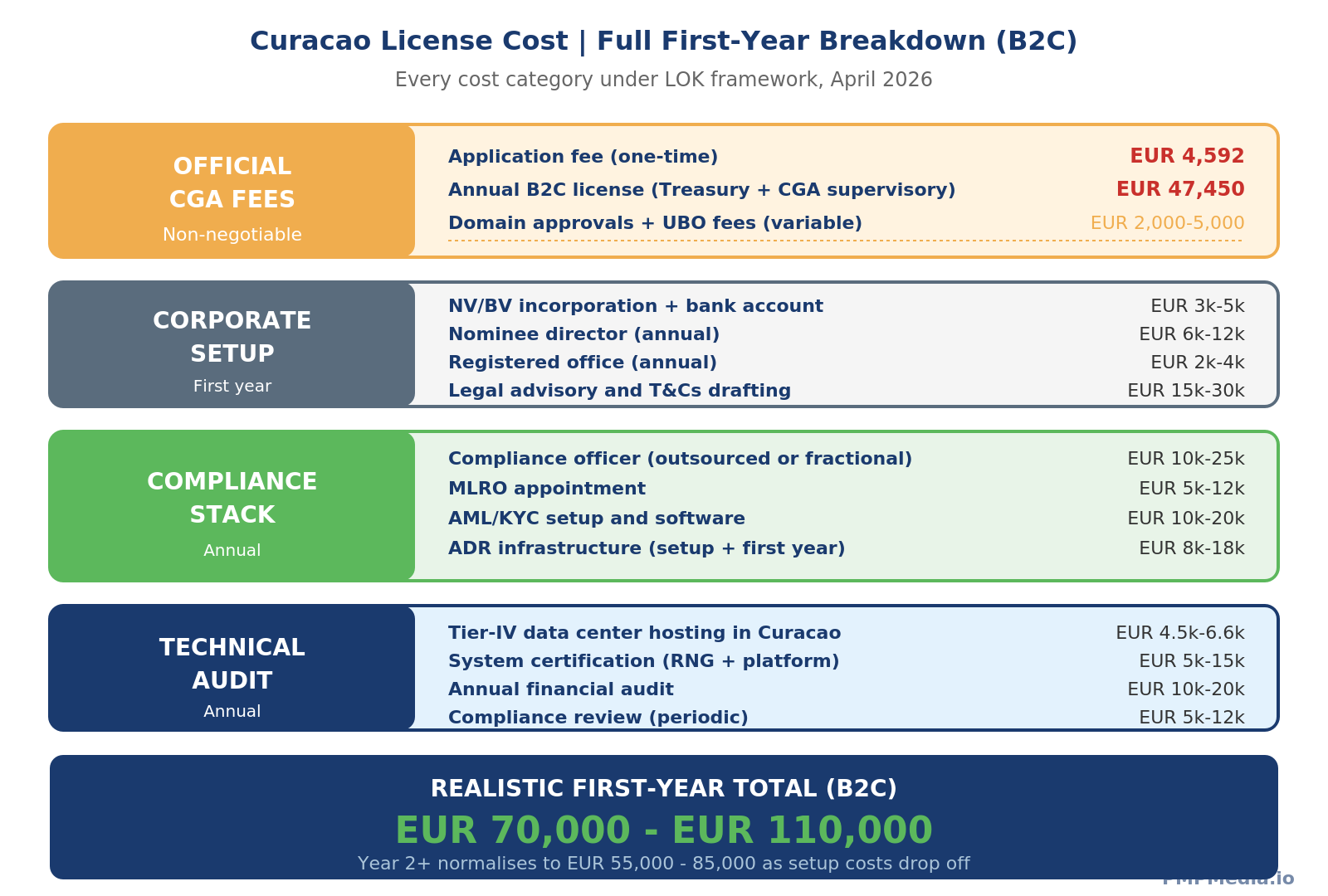
For a B2C operator applying under LOK in 2026, the realistic numbers are:
- Official CGA application fee: €4,592 (one-time, non-refundable)
- Official CGA annual B2C fee: €47,450 (split €24,490 Treasury + €22,960 supervisory)
- Realistic first-year all-in cost: €70,000-€110,000
- Ongoing annual cost from year two: €55,000-€85,000
B2B suppliers pay less. The B2B application fee is also €4,592, but the annual supervisory fee is €24,490 without the Treasury component. First-year B2B total typically runs €40,000-€65,000, and ongoing costs drop to €30,000-€50,000 annually.
These numbers are materially higher than pre-LOK estimates and materially lower than Malta’s equivalent. For context, a Malta Type 1 B2C license runs €150,000-€250,000 in the first year before variable taxes and €100,000-€180,000 annually thereafter. Curacao is roughly 40-50% of Malta’s cost, not the “fraction” that pre-LOK marketing suggested.
WHY THE OLD NUMBERS ARE WRONG
If you are reading guides that quote “Curacao license costs €20,000-€30,000,” those numbers are from the pre-LOK era when operators bought sub-licenses from master license holders. That entire system was abolished. All master licenses expired by January 2025. The current CGA fee of €47,450 alone is higher than most old sub-license packages, and that is before any compliance or setup costs. Anyone quoting sub-license pricing in 2026 is either working from outdated marketing or selling something that no longer legally exists.
Official CGA Fees in Detail
The government-side fees are the cleanest part of the cost picture because they are published, predictable, and unavoidable.
Application Fee
The application fee is €4,592 and applies equally to B2C and B2B licenses. This fee is:
- Paid at submission through the official CGA portal
- Non-refundable regardless of outcome
- Covers the CGA’s review work across both Phase 1 and Phase 2
- Does not include the due diligence charge of €150 per UBO or qualified interest holder, or €2,551 per listed-company UBO entity
If your application is rejected, you forfeit the €4,592. If you reapply later with corrected documentation, you pay another €4,592. This is why getting the application right the first time matters. The CGA does not publish an official rejection rate, but the figure of roughly 38% that circulates among licensing consultants, drawn from the legacy sub-licensee conversions of 2025, is a fair indication that the penalty for poor preparation is real.
Annual B2C License Fee
The B2C annual fee is €47,450, split into two invoices:
- €24,490 National Treasury fee: paid directly to the government of Curaçao
- €22,960 CGA supervisory fee: paid to the Curaçao Gaming Authority for ongoing oversight
Both components must be paid within 14 days of the CGA’s notice and annually thereafter by January 15. Unpaid invoices trigger escalating reminders, and an invoice still unpaid after 71 days leads to revocation of the license and removal from the public register. The fee structure is fixed regardless of your gross gaming revenue, which is one of Curacao’s genuine advantages over jurisdictions that scale fees with revenue.
Annual B2B License Fee
B2B suppliers (game developers, platform providers, payment processors) pay:
- €24,490 annual supervisory fee only
- No Treasury fee component
- Same payment schedule (within 14 days of notice, annually by January 15)
B2B licenses are materially cheaper because the CGA applies less intensive ongoing supervision to suppliers than to consumer-facing operators. The application cost, technical certification, and substance requirements are broadly similar, so the cost savings show up primarily in the annual renewal.
Additional CGA Fees
Beyond the headline numbers, the CGA charges smaller fees that add up over time:
- Addition of a main domain: €250 per domain (operators typically need 3-8 domains; mirror domains are covered by a separate CGA policy)
- Certificate application: €383 per certificate
- UBO or qualified interest holder due diligence at application: €150 per person
- Change or addition of a UBO or qualified interest holder after licensing: €128 per person
- Listed-company UBO addition: €2,551 per entity
- Change of license type: to be set by the CGA, not yet published
There is no per-game fee in the CGA schedule. These charges are small individually but can add up to €1,500-€4,000 in the first year for operators with several domains, a wide shareholder base, or a listed parent.
Corporate Setup Costs
The CGA only licenses Curaçao-incorporated entities with a resident managing director, which means every applicant needs real corporate infrastructure on the island. This is one of the cost categories where pre-LOK numbers are most out of date.
Company Incorporation
- NV or BV incorporation: €3,000-€5,000 one-time
- Notary fees and government registrations: €1,000-€2,000 included in the above or charged separately
- Bank account opening: typically included in corporate service packages but can take 4-8 weeks independently
Most operators incorporate an NV (Naamloze Vennootschap), which is the standard Curaçao public limited company structure. The BV (Besloten Vennootschap) is a private limited alternative used less often for gaming operations.
Local Managing Director
At least one Curaçao-resident managing director is required from day one. Options:
- Professional director services: €6,000-€12,000 annually through local trust companies
- Hiring your own director in Curaçao: typically €40,000-€70,000 annual salary plus benefits
The vast majority of operators use professional director services through Curaçao trust companies. This is standard market practice and fully compliant with LOK requirements. The cost varies based on the level of involvement expected (nominee vs. active director) and the trust company’s reputation.
Registered Office and Local Point of Contact
- Registered office services: €2,000-€4,000 annually
- Local point of contact for CGA correspondence: usually included in corporate services packages
- Mail forwarding and document handling: typically included
A registered office is enough while the CGA’s enforcement pause on Article 5.12 substance lasts. That pause ends on 1 April 2027, a date the CGA confirmed on 23 January 2026, and from then on a physical office in Curacao plus at least one full-time local key person become conditions of the licence. Operators planning to be around in 2027 should budget €15,000-€30,000 annually for office space from the start of that year.
Legal and Advisory Support
- Application preparation and legal advisory: €15,000-€30,000 first year
- Corporate documentation (AoA, T&Cs, privacy policies): €5,000-€10,000 one-time
- Ongoing legal support: €10,000-€20,000 annually
This is the cost category most likely to be underestimated. Experienced Curaçao gaming lawyers typically charge €300-€500 per hour, and a complex application can consume 40-80 hours of legal time before submission. Budget accordingly rather than cutting corners, because the rejections the market has seen so far cluster around poorly prepared applications.
Compliance Stack Costs
LOK requires a real compliance infrastructure that goes well beyond what existed under the old sub-license system. Budget for all of these items, not just the ones that look cheapest on paper.
Compliance Officer
- Dedicated compliance officer: €10,000-€25,000 annually
- Options include: outsourced compliance officer through a professional services firm, part-time local compliance hire, or full-time compliance director at scale
Most operators start with outsourced or fractional compliance officer arrangements (€10,000-€15,000 range) and hire internally as they scale. The CGA requires a named compliance officer who can respond to regulatory queries and maintain the operator’s compliance documentation.
MLRO (Money Laundering Reporting Officer)
- MLRO appointment: €5,000-€12,000 annually
- Can be the same person as the compliance officer for smaller operations
- Must be appropriately trained and documented with the CGA
- Responsible for AML/CFT reporting and suspicious transaction escalation
AML/KYC Infrastructure
- Policy development (first year): €10,000-€20,000
- KYC software and verification services: €5,000-€25,000 annually depending on volume
- Transaction monitoring systems: €5,000-€15,000 annually
- Chain analysis tools (for crypto operations): €10,000-€30,000 annually
The CGA requires FATF-aligned AML/CFT frameworks, which means proper policy documentation, trained staff, active transaction monitoring, and documented escalation procedures. For crypto-native operators, chain analysis capability is mandatory, and this is a cost that pre-LOK guides typically missed entirely.
ADR Infrastructure
- Alternative Dispute Resolution setup: €5,000-€10,000 one-time
- Ongoing ADR operations: €3,000-€8,000 annually
Every LOK licensee must have a functional ADR mechanism for handling player complaints. This is either built in-house or contracted through a third-party ADR provider. The third-party route is cheaper for smaller operators and is the standard path for new licensees.
Technical Infrastructure Costs
Tier-IV Data Centre Hosting
LOK requires player data storage in a Tier-IV certified data centre in Curaçao. This is one of the most commonly missed costs in pre-LOK budgets:
- Dedicated server in Curaçao Tier-IV facility: €1,140-€1,650 per quarter
- Annual cost: €4,560-€6,600
- Setup and migration: €2,000-€5,000 one-time
The Tier-IV requirement ensures data is hosted in facilities with enterprise-grade redundancy (99.995% uptime), full power backup, and physical security. Willemstad has several qualified providers, and most operators select one based on price, support quality, and integration with their broader tech stack.
Gaming System Certification
- RNG certification: €5,000-€15,000 per system
- Game certification: variable, typically €500-€2,000 per game title
- Platform certification (if self-developed): €15,000-€40,000
Operators using established B2B suppliers typically inherit existing GLI certifications for the games themselves, but still need to certify the overall platform integration. Operators building their own platforms face substantially higher certification costs.
Annual Audit and Compliance Reviews
- Annual financial audit: €10,000-€20,000
- Compliance review: €5,000-€12,000
- Technical re-certification (periodic): €5,000-€15,000
LOK requires audited financial statements, and the CGA may request compliance documentation or conduct spot reviews. Budget for these as predictable annual costs rather than one-off exceptions.
Ongoing Operational Costs (Not Regulatory)
These are not CGA requirements but are realistic operational expenses that most operators face. They are worth including in your total cost picture because they affect whether the licensing strategy is economically viable.
Payment Processing
- High-risk merchant account setup: €5,000-€10,000
- Transaction fees: 2-5% per transaction (tier-2 PSPs), 8-12% (high-risk processors)
- Chargeback handling: €20-€50 per chargeback
- Monthly PSP maintenance: €500-€2,000 depending on volume
Payment processing is Curacao’s biggest practical weakness compared to Malta. Tier-1 banks and premium payment providers prefer MGA over CGA credentials, so Curacao operators typically work with tier-2 PSPs at meaningfully higher rates. This gap is narrowing as the LOK reform builds CGA credibility, but it remains real in 2026.
Software and Game Providers
- Platform licensing: €5,000-€30,000 monthly for turnkey solutions
- Game content revenue share: 15-35% of GGR depending on provider quality
- Premium content integration fees: €5,000-€20,000 one-time per major provider
Game providers typically charge Curacao operators 20-30% higher revenue share rates than Malta-licensed equivalents. Tier-1 game studios (Evolution, Pragmatic Play premium content, etc.) work with CGA operators but at worse commercial terms than MGA operators receive.
Taxes
The cost picture is incomplete without the tax layer, and this is where Curacao genuinely wins:
- Corporate income tax: 2% flat on net profits (E-Zone companies)
- Gaming tax on GGR: 0%
- VAT on gaming services: 0%
- Withholding tax on dividends to non-residents: 0%
- OECD Pillar Two 15% minimum tax: only applies to multinational groups with €750M+ consolidated revenue
For a properly structured Curacao operator, effective total tax burden lands around 2% of net profits. Compare to Malta’s blended 5-7% effective rate (5% gaming tax on Maltese players, ~5% corporate tax after 6/7 refund, 0.4-1.25% compliance contribution on gaming revenue). On pure tax, Curacao wins by a wide margin.
Realistic Cost Scenarios
The all-in cost depends heavily on your operational model. Here are three realistic scenarios based on typical operator profiles.
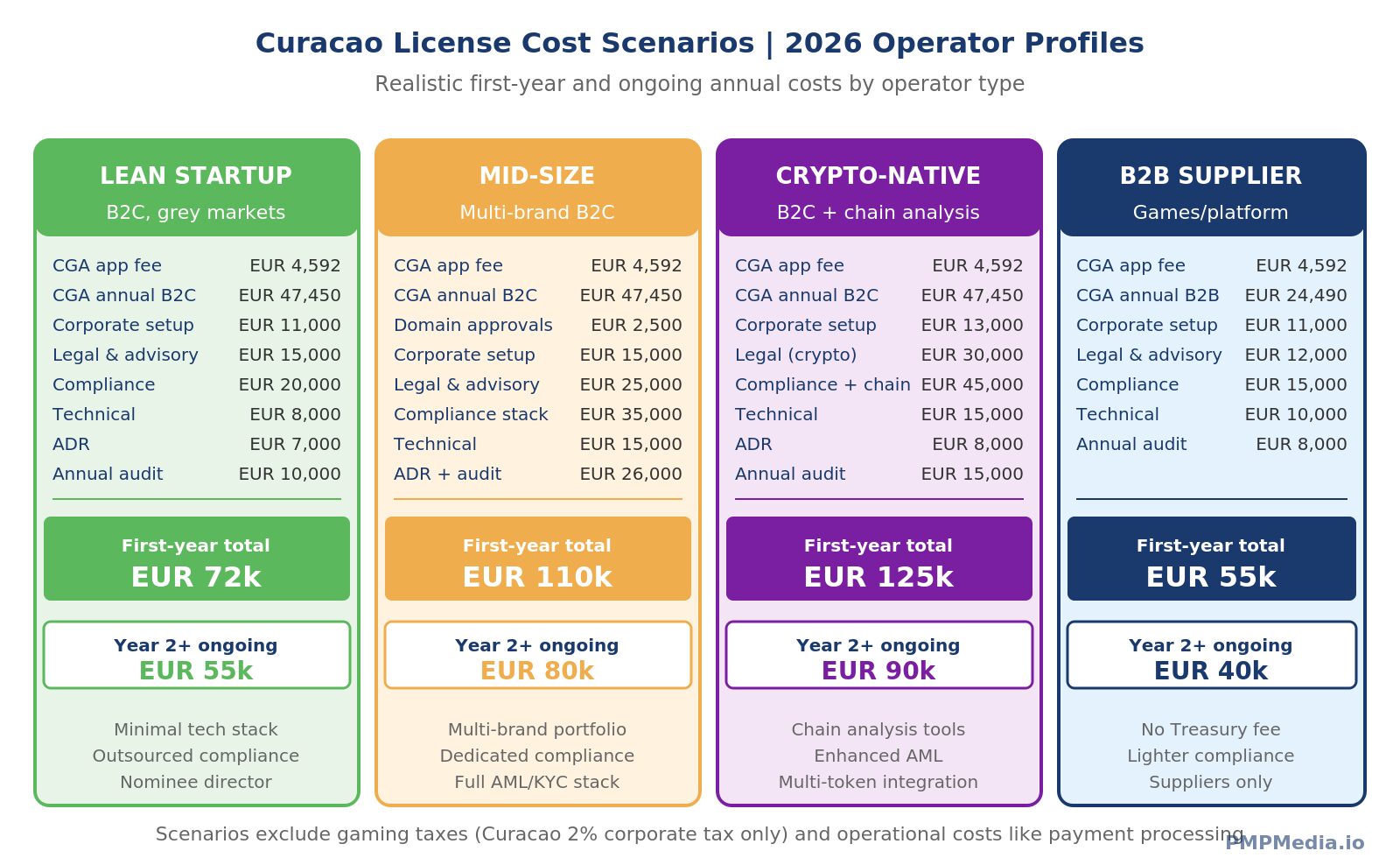
Scenario 1: Lean Startup Operator (B2C)
Small operator targeting specific grey markets, minimal tech stack, outsourced compliance.
- CGA application fee: €4,592
- CGA annual B2C fee: €47,450
- Corporate setup (incorporation + nominee director + office): €11,000
- Legal and advisory (first year): €15,000
- Compliance (outsourced officer + MLRO + basic AML/KYC): €20,000
- Technical infrastructure (Tier-IV hosting + basic certification): €8,000
- ADR setup and first year: €7,000
- Annual audit: €10,000
- First-year total: ~€72,000
- Year two ongoing: ~€55,000
Scenario 2: Mid-Size Operator (B2C)
Multi-market operator with multiple brands, proper compliance team, crypto payment options.
- CGA application fee: €4,592
- CGA annual B2C fee: €47,450
- Additional domain approvals (5 domains at €250): €1,250
- Corporate setup (enhanced): €15,000
- Legal and advisory (first year): €25,000
- Compliance (dedicated officer + MLRO + full AML/KYC stack): €35,000
- Technical infrastructure (Tier-IV + multi-platform certification): €15,000
- ADR infrastructure: €8,000
- Annual audit and compliance review: €18,000
- First-year total: ~€110,000
- Year two ongoing: ~€80,000
Scenario 3: Crypto-Native Operator (B2C)
Crypto-focused operator with chain analysis requirements, higher AML scrutiny, multiple token integrations.
- CGA application fee: €4,592
- CGA annual B2C fee: €47,450
- Corporate setup: €13,000
- Legal and advisory (crypto-specific): €30,000
- Compliance with chain analysis tools: €45,000
- Technical infrastructure (Tier-IV + crypto wallet infrastructure): €15,000
- ADR infrastructure: €8,000
- Annual audit: €15,000
- First-year total: ~€125,000
- Year two ongoing: ~€90,000
Scenario 4: B2B Supplier
Game developer or platform provider serving licensed operators.
- CGA application fee: €4,592
- CGA annual B2B fee: €24,490
- Corporate setup: €11,000
- Legal and advisory: €12,000
- Compliance (lighter stack than B2C): €15,000
- Technical infrastructure: €10,000
- Annual audit: €8,000
- First-year total: ~€55,000
- Year two ongoing: ~€40,000
Cost Comparison with Other Jurisdictions
Curacao’s cost-efficiency is one of its main value propositions, but the numbers are not as dramatic as pre-LOK marketing suggested. Here is how it compares to the main alternatives.
| Jurisdiction | First-Year Total (B2C) | Ongoing Annual | Gaming Tax | Corporate Tax |
|---|---|---|---|---|
| Curacao (LOK) | €70k-€110k | €55k-€85k | 0% | 2% |
| Anjouan | €40k-€60k | €25k-€40k | 0% | 0% |
| Tobique | €50k-€75k | €35k-€55k | 0% | 0-10% |
| Malta (MGA) | €150k-€250k | €100k-€180k | 5% on Maltese players | ~5% effective |
| Isle of Man | €180k-€280k | €120k-€200k | 1.5%-1.75% GGR | 0% (standard), 10% banking |
| United Kingdom | €300k+ | €200k+ | 40% remote gaming duty (from April 2026) | 19-25% |
For operators focused on pure cost efficiency, Anjouan and Tobique undercut Curacao by 30-50%. The trade-off is weaker regulatory credibility, harder banking relationships, and less acceptance from tier-2 payment processors, and Anjouan in particular is under FATF pressure to tighten its rules, which tends to push costs up over time. Curacao occupies the middle ground — meaningfully cheaper than Malta but with materially better commercial credibility than the cheapest offshore alternatives.
Cost-Saving Strategies
A few patterns consistently save money without creating compliance risk. These are worth knowing before you start the application.
Use bundled turnkey packages
Most Curaçao corporate service providers offer bundled packages that combine company incorporation, registered office, nominee director, compliance officer, MLRO, and application support. Bundles typically save 15-25% versus buying components separately, and they reduce coordination overhead substantially. Budget €40,000-€60,000 for a good turnkey package in year one.
Start with outsourced compliance
Full-time compliance hires are rarely economic until you have €3-5M in annual GGR. Outsourced or fractional compliance officers through professional services firms cost €10,000-€15,000 annually versus €40,000-€60,000 for an internal hire. Scale internally only when you have the revenue to justify it.
Negotiate director services
Nominee director rates vary widely across Curaçao trust companies. Tier-1 providers charge €10,000-€12,000 annually, tier-2 providers €6,000-€8,000. For early-stage operators, tier-2 providers are typically sufficient and save €4,000+ annually. The difference shows up when you need genuine director involvement (board decisions, regulatory interactions) rather than pure nominee services.
Optimise domain strategy
Each approved main domain costs €250 at the CGA. Operators running 10+ brands can spend €2,500+ on domain approvals alone, before the compliance work each brand generates. Consolidating into fewer brand domains early saves this cost without limiting operational flexibility.
Plan substance costs early
The 1 April 2027 substance deadline (one full-time local key person plus a physical office, rising to three key persons by the fifth year of operation) is closer than it looks. Curacao’s labour market is small, and operators who only start looking for local hires in early 2027 will find the good candidates already taken. Starting the search in late 2026 lets you lock in quality hires at reasonable rates.
Common Cost Mistakes to Avoid
Budgeting only for CGA fees. The €47,450 annual fee is roughly half your real ongoing cost. Operators who plan around the headline number run into cash flow problems in month 3-6 of year one when the compliance and technical costs start hitting.
Ignoring Tier-IV hosting. The €4,500-€6,500 annual hosting cost is not negotiable under LOK. Operators who try to host elsewhere and migrate later face application delays, compliance issues, and emergency migration costs.
Underestimating legal costs. Experienced Curacao gaming lawyers charge €300-€500/hour. A proper application consumes 40-80 hours. Operators who try to save on legal end up with rejected applications, which means losing the €4,592 and starting over.
Skipping annual audits. LOK requires audited financials. Operators who skip or delay audits face license suspension risk. Budget €10,000-€20,000 annually for audit services as a non-negotiable cost.
Buying from vendors quoting pre-LOK prices. If a provider is quoting “€20,000-€30,000 total cost” in 2026, they are either selling expired sub-license arrangements or hiding costs elsewhere. The minimum realistic all-in first-year cost for a compliant B2C operator in 2026 is around €65,000, and anything significantly below that should be treated with scepticism.
Treating provisional licenses as permanent cost-savers. Provisional licenses are 6-month arrangements (extendable by 6 months) designed to let you start generating revenue during Phase 2. They do not reduce your total cost obligations. Operators who drift into provisional status without closing the Phase 2 gaps end up paying for both the provisional period and a fresh application later.
October 2026 Update: The CGA Portal Breach and What It Means for Your Budget
In September 2026 the CGA found that its externally managed licensing portal had been accessed without authorisation between December 2025 and September 2026, and that personal and confidential documents belonging to license holders had been published online. The regulator took the portal offline, confirmed on 19 October that it will never go back to that provider, and moved licensing and supervisory work to a temporary portal while it builds an in-house system. We covered the shutdown, the replacement, and the legal fallout as the story developed.
For the cost picture, three things matter:
- Fees and deadlines have not changed. The fee schedule above still applies, existing licenses remain valid, and the January 15 annual payment date stands. The CGA has said the portal closure does not affect regulatory obligations.
- Expect slower processing for new applications in Q4 2026 and early 2027. Applications and supervisory tickets now run through a temporary system, and documents already submitted may need to be re-uploaded. If your launch date depends on the license, add a month to the 3-5 month timeline in your planning.
- Budget for a data-breach response of your own. If your company applied or held a license before September 2026, your corporate documents, passports of UBOs and key persons, and financial statements may be among the leaked material. Legal advice on notification duties in your own markets and credit monitoring for the people involved is a real, if modest, line item: €2,000-€5,000 for most operators.
The breach does not change the economics of the license, but it does change the risk profile of the application file itself. Operators applying from now on should ask their advisers how the temporary portal handles document storage before uploading anything.
What Changes in Year Two and Beyond
Year one is the most expensive, as expected. The picture shifts significantly from year two onwards:
- No more €4,592 application fee
- Setup costs (incorporation, initial legal, policy development) drop out
- Legal costs normalise to €10,000-€20,000 annually for ongoing support
- Compliance costs remain steady or grow as the business scales
- Substance costs start hitting from 1 April 2027 (one local key person plus a physical office) and grow as the headcount rises to three key persons by year five
A typical mid-size operator licensed in 2026 sees year one at €110,000, year two (which now includes the office and first local hire from April 2027) at €100,000-€120,000, and years four to five at €130,000-€160,000 as the headcount reaches three key persons. Factor this curve into long-term financial modeling rather than assuming year-two costs continue indefinitely.
Is the Curacao License Cost Worth It?
The honest answer depends on your target markets and revenue expectations. Here is how I would frame it.
Curacao costs are justified when:
- Your expected GGR in year 1-2 is €2M+ (where the fixed-fee structure becomes efficient)
- You operate in markets that accept CGA licenses (not UK, DE, NL, FR, AU, USA)
- You value the 2% tax rate and 0% GGR tax
- You can absorb 3-5 month timelines without business impact
- You have €70,000+ budget for first-year compliance and setup
Curacao costs are hard to justify when:
- Your expected GGR is under €500K annually (fixed fees dominate economics)
- Your target markets require EU licensing (Malta makes more sense)
- You need tier-1 payment processors urgently
- You are seriously capital-constrained (Anjouan at €40K-€60K all-in might fit better)
For most operators serving international grey markets or looking for a first license before upgrading to Malta, the €70,000-€110,000 first-year cost is reasonable for what you get. For very small operators or those targeting regulated EU markets, the economics work out differently.
Related Guides
- Curacao iGaming License Complete Guide
- Curacao License Requirements
- Curacao vs Malta Gaming License
- Malta Gaming License
- UK Gambling License
- Types of Gambling Licenses
- iGaming Licensing Guide
- Global iGaming Regulation Guide
Final Verdict
The real cost of a Curacao license in 2026 is €70,000-€110,000 in year one for a B2C operator running a proper compliance stack, dropping to €55,000-€85,000 in year two onwards. That number is materially higher than pre-LOK marketing suggests but materially lower than Malta, which remains the premium alternative at €150,000-€250,000 first year.
The money goes where you would expect: €52,000 to the CGA in fees, €25,000-€50,000 to corporate setup and legal advisory, €20,000-€50,000 to compliance infrastructure, and €10,000-€20,000 to technical infrastructure and audits. None of these categories are avoidable if you want a properly licensed operation. Operators who try to cut corners on compliance or legal typically end up paying more in the long run through rejected applications, regulatory sanctions, or operational problems.
For the right operator — properly capitalised, targeting markets where CGA credentials work, comfortable with 3-5 month timelines — the cost is reasonable for the commercial flexibility, broad operational scope, and genuine tax efficiency that Curacao provides. For operators looking for the cheapest possible offshore option, Anjouan at €40,000-€60,000 all-in is worth considering. For operators targeting regulated EU markets, Malta’s premium is usually worth paying despite the 2-3x cost differential.
FAQ
What is the total cost of a Curacao gaming license in 2026?
Realistic first-year total for a B2C operator is €70,000-€110,000 including CGA fees (€52,042), corporate setup, legal advisory, compliance stack, technical infrastructure, and first audit. Year two drops to €55,000-€85,000 as setup costs fall away. B2B suppliers pay less: €40,000-€65,000 in year one, €30,000-€50,000 ongoing.
What is the CGA application fee?
€4,592 non-refundable, paid at submission through the official CGA portal. The fee is the same for B2C and B2B applications and covers the CGA’s review work across Phase 1 and Phase 2. Rejected applicants forfeit the fee and must pay again for any reapplication.
How much is the annual Curacao license fee?
€47,450 annually for B2C licenses (€24,490 National Treasury + €22,960 CGA supervisory). €24,490 annually for B2B licenses (supervisory only, no Treasury component). Both must be paid within 14 days of the CGA’s notice and annually thereafter by January 15.
Are there hidden costs in a Curacao license?
Not hidden exactly, but frequently underestimated. The most commonly missed costs are Tier-IV data centre hosting (€4,500-€6,500 annually), ADR infrastructure (€5,000-€10,000 setup plus €3,000-€8,000 annually), chain analysis tools for crypto operators (€10,000-€30,000 annually), and annual audits (€10,000-€20,000). Budget all of these as predictable costs, not exceptions.
How much does a Curacao local director cost?
Professional nominee director services through Curaçao trust companies run €6,000-€12,000 annually depending on the provider tier and level of involvement. Hiring your own resident director in Curaçao costs €40,000-€70,000 annual salary plus benefits. Most operators use nominee director services as the standard market practice, fully compliant with LOK requirements.
What does Tier-IV data centre hosting cost?
€1,140-€1,650 per quarter (€4,560-€6,600 annually) for a dedicated server in a Curaçao Tier-IV certified facility. This is a LOK requirement for player data storage, not optional, and cannot be circumvented by hosting elsewhere. Setup and migration adds €2,000-€5,000 one-time.
Can I save money with bundled packages?
Yes. Most Curaçao corporate service providers offer turnkey packages combining incorporation, nominee director, registered office, compliance officer, MLRO, and application support. Good bundles cost €40,000-€60,000 first year and save 15-25% versus buying components separately. The savings compound through reduced coordination overhead and faster application processing.
How does Curacao cost compare to Malta?
Curacao runs €70,000-€110,000 first year and €55,000-€85,000 ongoing. Malta runs €150,000-€250,000 first year and €100,000-€180,000 ongoing before variable taxes. Malta is roughly 2-3x Curacao’s cost. For a full comparison of the two jurisdictions, see our Curacao vs Malta guide.
Are there cheaper alternatives to Curacao?
Yes. Anjouan runs €40,000-€60,000 first year and €25,000-€40,000 ongoing. Tobique runs €50,000-€75,000 first year and €35,000-€55,000 ongoing. Both are meaningfully cheaper than Curacao but come with weaker regulatory credibility, harder banking relationships, and less acceptance from tier-2 payment processors. For pure cost efficiency they work; for commercial credibility Curacao is better.
What are Curacao taxes in 2026?
2% corporate income tax on net profits for E-Zone companies. 0% gaming tax on GGR. 0% VAT on gaming services. 0% withholding tax on dividends to non-residents. The OECD Pillar Two 15% minimum tax applies only to multinational groups with €750M+ consolidated revenue, which excludes virtually all iGaming operators considering Curacao.
When do Curacao substance costs start hitting?
Current requirements (Curaçao-resident managing director, compliance officer, MLRO) already apply. The CGA paused enforcement of the Article 5.12 local substance rules and confirmed on 23 January 2026 that no operator has to meet them before 1 April 2027. From that date a physical office in Curaçao and at least one full-time local key person (the managing director does not count) are required, rising to three local key persons by the fifth year of operation. Substance costs add €30,000-€60,000 annually from 2027 and €80,000-€150,000 annually once three key persons are on the payroll, depending on hiring choices.
How much do I need for a minimum Curacao launch?
Realistic minimum first-year cost for a compliant B2C operator under LOK is around €65,000-€72,000 (the lean startup scenario). Anyone quoting substantially less is either selling expired sub-license arrangements, hiding costs in revenue share, or cutting compliance corners that will cause problems later. The €65,000 floor reflects the actual CGA requirements, not marketing pitches.
 Share
Share


 0 views