








Before choosing between Curacao and Malta, operators should understand what a gambling license actually is — it’s not just paperwork but an ongoing compliance relationship that shapes banking access, customer trust, and operational constraints.
The Curacao vs Malta decision is not what it used to be. A year ago, this comparison was easy: Malta was the expensive premium option, Curacao was the cheap fast option, and the gap between them was obvious. In 2026, that framing no longer holds. Curacao’s National Ordinance on Games of Chance (LOK) came into force on December 24, 2024, replacing the old master-and-sub-license system with a direct government licensing regime that now costs €47,450 per year for a B2C license and comes with office and local hiring requirements enforced from 1 April 2027.
The gap has narrowed, but the two jurisdictions still serve fundamentally different business models. Malta is for operators who want EU credibility, tier-1 payment processing, and long-term brand value. Curacao is for operators who want speed, low tax, broad operational scope, and access to grey markets where MGA credentials add no commercial benefit.
This guide compares the two jurisdictions across the factors that actually affect an operator’s bottom line: regulatory frameworks, real total costs, tax structures, timelines, substance requirements, and market access. I have tried to keep it practical rather than abstract, because most operators deciding between Curacao and Malta are doing so with real capital on the line.
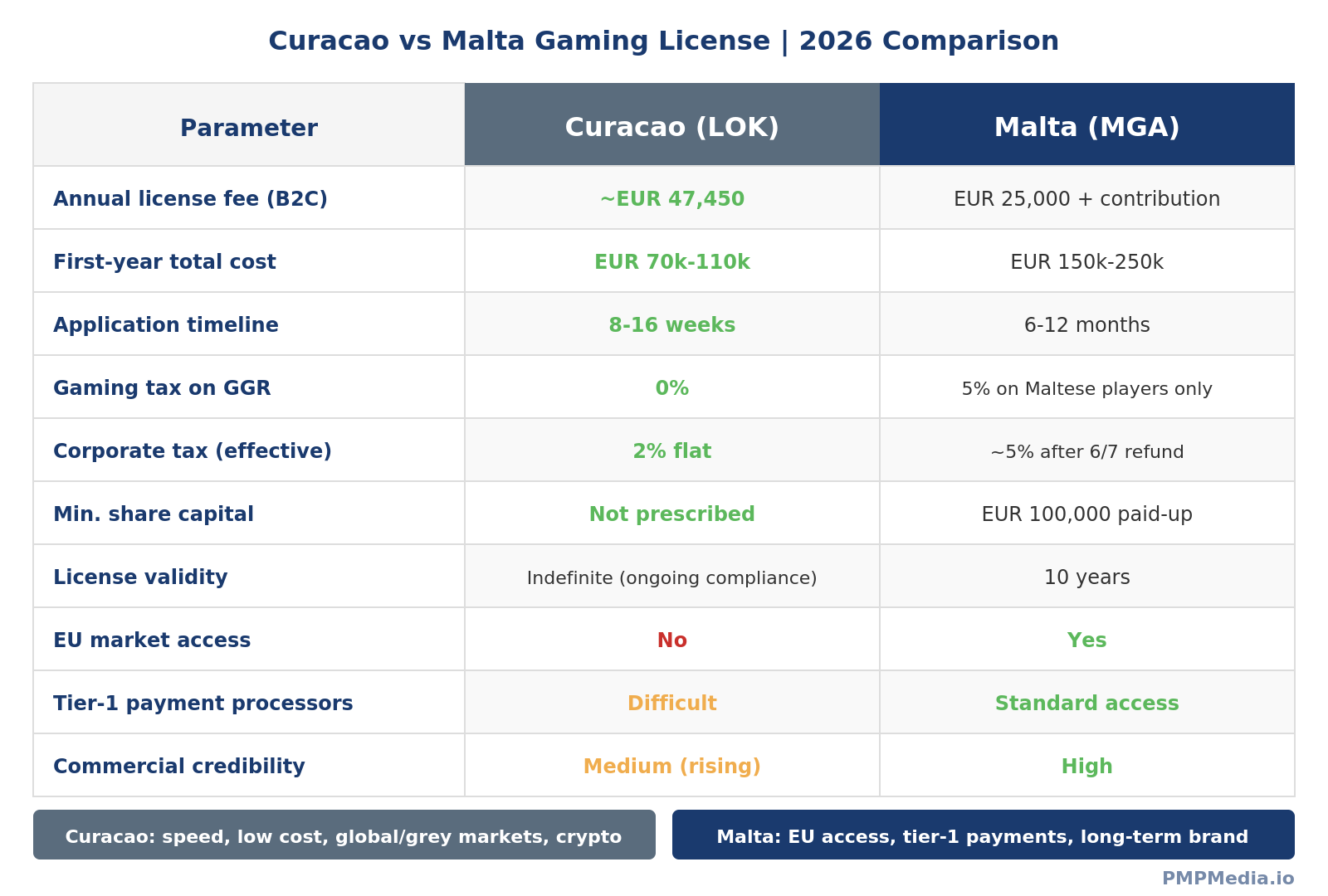
Quick Comparison at a Glance
If you want the one-sentence version: Malta costs roughly 2-3x more per year but opens doors that Curacao cannot, while Curacao gets you to market in three to five months rather than six to twelve, with a lighter (but no longer light) compliance burden. The right answer depends on where your players actually are and how much regulatory credibility your business model requires.
The Fundamental Difference: Regulatory Philosophy
Before getting into costs and timelines, it is worth understanding what each jurisdiction actually optimises for. This is where most comparisons go wrong.
Malta runs a tightly supervised EU member-state gaming framework. The Malta Gaming Authority (MGA) conducts full fit-and-proper checks on beneficial owners, requires detailed business plans with multi-year financial projections, audits technical infrastructure, and enforces ongoing compliance through regular reporting and on-site inspections. The philosophy is that the license itself is a signal of quality, which is why MGA licensees get preferential treatment from banks, payment processors, software suppliers, and affiliates.
Curacao under the new LOK framework runs a direct state-issued licensing regime through the Curaçao Gaming Authority (CGA). Since the old master-and-sub-license system was abolished in 2024-2025, operators apply directly to the CGA for a B2C or B2B license. The regulatory bar has risen significantly from the pre-LOK days, but it remains materially lighter than Malta, with faster processing, lower costs, and less intrusive pre-approval scrutiny. The philosophy is that good compliance can be enforced through ongoing monitoring rather than extensive pre-approval due diligence.
Neither approach is inherently superior. Malta’s regulatory depth creates real commercial value for operators who need it. Curacao’s operational flexibility creates real commercial value for operators who do not.
WHAT’S CHANGED IN 2026
The lazy version of this comparison treats Curacao as “lightly regulated offshore jurisdiction” and Malta as “serious EU regulator.” That framing is obsolete. The LOK reform has fundamentally tightened Curacao: mandatory AML/CFT policies aligned with FATF standards, KYC requirements, Alternative Dispute Resolution for player complaints, responsible gambling obligations, and local substance requirements the CGA will enforce from 1 April 2027. The regulator also spent the autumn of 2026 dealing with a breach of its licensing portal that exposed licence holders’ documents, which says something about how young the new system still is. Curacao in 2026 is a materially different product than Curacao was in 2023. Anyone making this decision based on pre-LOK assumptions is working with outdated information.
Real Cost Comparison
Costs are where most operators start the comparison, and for good reason. The total cost picture is one of the few things that can be quantified precisely. Here is what each jurisdiction actually costs in 2026.
Curacao (under LOK)
- Application fee: €4,592 (non-refundable)
- Annual B2C license fee: €47,450 (split between €24,490 to the National Treasury and €22,960 supervisory fee to the CGA)
- Annual B2B license fee: €24,490 (supervisory fee only)
- Extra main domain: €250 each; UBO due diligence €150 per person; no per-game fee
- Compliance setup (AML, KYC, ADR): €15,000-€30,000 first-year depending on complexity
- Local director and corporate services: €10,000-€20,000 annually
- Total realistic first-year cost: €70,000-€110,000
- Ongoing annual cost after year one: €55,000-€85,000
Malta (MGA)
- Application fee: €5,000 (non-refundable)
- Annual license fee: €25,000 for Type 1 and Type 2 B2C (€10,000 for Type 4)
- Compliance contribution (Type 1 B2C): 0.4%-1.25% of gaming revenue, minimum €15,000, maximum €375,000
- Share capital requirement: €100,000 paid-up for Type 1 and Type 2 (€40,000 for Types 3 and 4)
- Compliance audits: €5,000-€15,000 annually per license
- Substance (local office, staff, key function holders): €50,000-€100,000 annually
- Total realistic first-year cost: €150,000-€250,000 (excluding gaming tax and compliance contribution)
- Ongoing annual cost after year one: €100,000-€180,000 before variable taxes
The raw numbers show Malta costing roughly 2-3x Curacao annually, but the comparison is more nuanced once you factor in the compliance contribution (which scales with revenue on Malta) and the effective corporate tax rate on both sides.
Tax Structures: Where the Real Money Lives
Gaming tax is often where operators discover that the headline license fees were only half the story. The two jurisdictions approach taxation completely differently.
Curacao Tax Regime
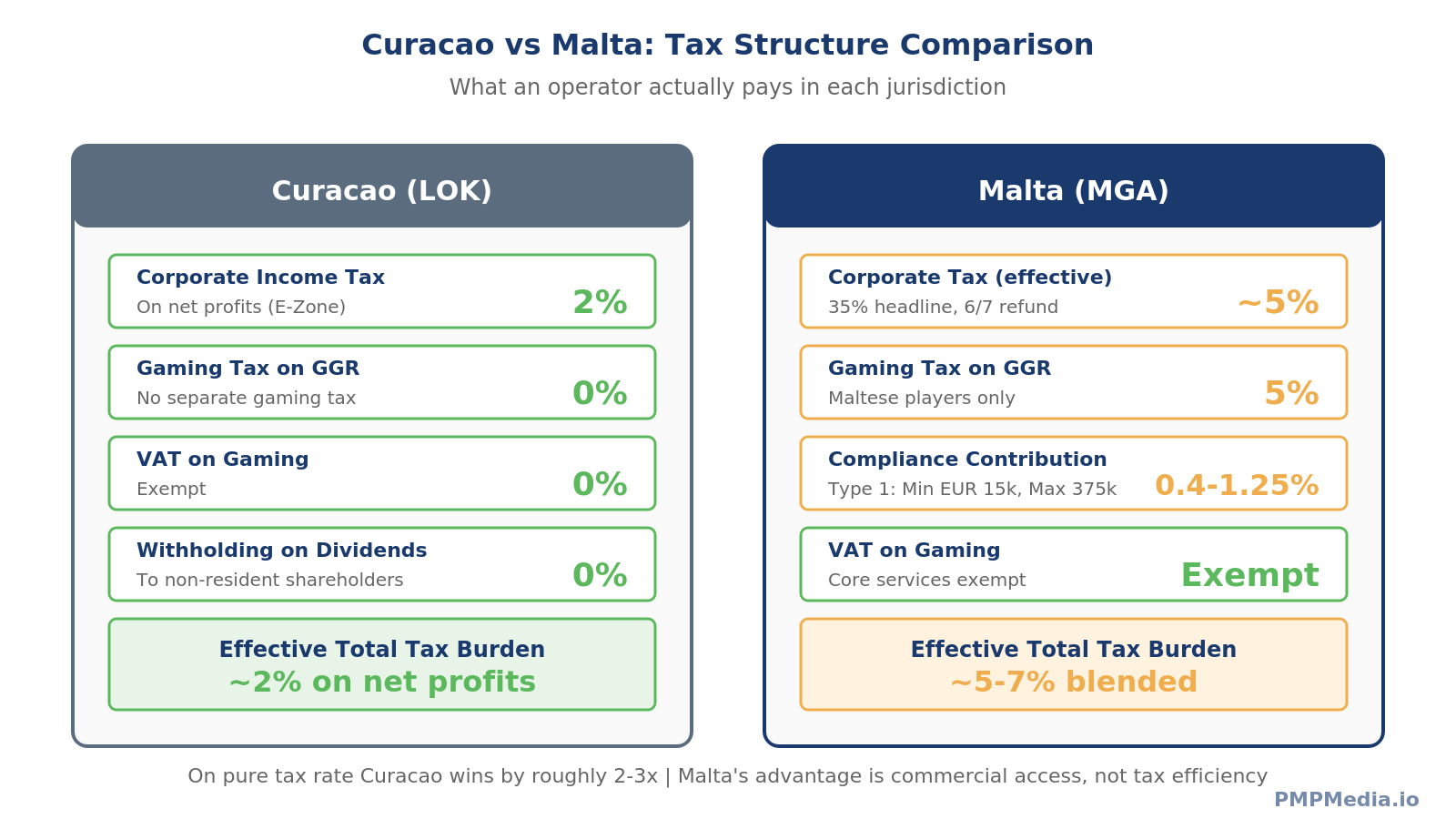
Curacao applies a simple tax structure that has remained attractive despite the LOK reform:
- Corporate profit tax: 15% on profit up to XCG 500,000 and 22% above, but under Curacao’s territorial system a company with real substance on the island pays an effective 0-2%
- Gaming tax on GGR: 0% (no separate gaming tax)
- VAT on gaming services: 0%
- Withholding tax on dividends to non-residents: 0%
- Sales tax, import duties, bet turnover tax: 0%
Curacao’s OECD Pillar Two ordinance was submitted to parliament on 23 December 2025 and is meant to apply retroactively, but it only touches multinational groups with consolidated annual revenue above €750 million. Virtually no iGaming operator considering Curacao will hit that, so for practical purposes the roughly 2% effective rate continues to apply. The catch is that the low rate depends on the same local substance the CGA requires from April 2027, so it is earned, not automatic.
Malta Tax Regime
Malta’s tax structure is more complex but economically competitive once you understand how the pieces fit together:
- Gaming tax: 15% for Type 1 (casino) and 10% for Types 2-4 since 1 October 2026, up from a flat 5%, on revenue from Malta-resident players only (revenue from players elsewhere is not subject to Maltese gaming tax)
- Compliance contribution: 0.4%-1.25% of gaming revenue for Type 1 B2C, scaling with revenue tier
- Corporate income tax: 35% headline rate, reduced to ~5% effective through the 6/7 imputation refund system, or an elective flat 15% final tax with no refund (FITWI, available since 2025)
- VAT on gaming services: exempt
For a typical MGA operator with mostly non-Maltese players, the blended effective tax rate works out to roughly 5%-7% once gaming tax, compliance contribution, and post-refund corporate tax are combined. Competitive, but not as clean as Curacao’s roughly 2% with substance.
The Honest Tax Comparison
On pure tax rate, Curacao wins. A Curacao-licensed operator generating €5 million in net profit pays roughly €100,000 in corporate tax and nothing else. A Malta-licensed operator with the same profit pays approximately €150,000 in gaming tax (assuming 3% of GGR) plus €250,000 in post-refund corporate tax plus €10,000-€50,000 in compliance contribution, landing somewhere around €400,000-€450,000 in total tax.
That said, the Malta operator in this scenario is likely generating revenue from regulated EU markets with higher player lifetime value and lower customer acquisition costs, so the gross revenue advantage may offset the tax disadvantage. This is where the comparison stops being a spreadsheet exercise and starts being a strategic decision about where your players actually are.
Timeline to Launch
Speed to market is often the deciding factor for operators who cannot wait 6 months for approval.
Curacao Timeline
- Company incorporation: 1-2 weeks
- Application preparation and submission: 2-4 weeks
- CGA Phase One review (integrity and financial stability): 8 weeks, up to 12 with extension
- CGA Phase Two review (technical and regulatory compliance): 8 weeks, up to 12 with extension
- Technical setup and launch: 2-4 weeks
- Total realistic timeline: 3-5 months from application to live operation, 5-7 months end-to-end once banking is included
The CGA may issue a provisional license valid for 6 months (extendable once) during Phase Two, allowing operators to start generating revenue while the full license is being finalised. This is one of Curacao’s most valuable practical features. Since October 2026 applications run through a temporary portal while the CGA rebuilds its system after the breach, so add a month of buffer to any launch plan.
Malta Timeline
- Company incorporation and substance setup: 4-8 weeks
- Documentation preparation (business plan, policies, etc.): 6-12 weeks
- MGA application review with multiple rounds of queries: 4-6 months
- Technical audits and compliance verification: 4-8 weeks
- Total realistic timeline: 6-12 months from start to live operation
Malta applications with complex ownership structures or incomplete initial documentation can extend to 12-18 months. This is not unusual and should be assumed as the worst-case scenario when planning.
WHAT THIS MEANS FOR OPERATORS
If your launch timeline is less than 6 months, Malta is essentially off the table regardless of how attractive its other features look. The MGA application process cannot be meaningfully accelerated, and trying to compress it produces either a rejected application or an approval that arrives after your market window has closed. Operators who need speed should not even consider Malta as a starting point. Get Curacao (or Anjouan for even faster launch), build revenue, and then upgrade to Malta later when the business case justifies the wait.
Substance and Local Presence
This is where the two jurisdictions have historically differed most, though the gap is narrowing under LOK.
Curacao Substance Requirements (2026)
- Curacao-incorporated legal entity
- At least one Curacao-based director (from day one)
- Local compliance officer
- Designated MLRO (Money Laundering Reporting Officer)
- Tier-IV data centre in Curacao for player data storage
- Independent accounting and audit arrangements
- From 1 April 2027: a physical office in Curacao and at least one full-time key person residing on the island, in addition to the managing director
- By the fifth year of operation: three Curacao-based full-time key persons
The obligation (Article 5.12 of the LOK) formally started on 1 January 2026; the CGA paused enforcement and confirmed on 23 January 2026 that nobody has to comply before 1 April 2027. That is the only concession on the table, so operators applying now should be hiring in late 2026.
Malta Substance Requirements
- Malta-incorporated company (or qualifying EU/EEA entity)
- Physical office in Malta from day one
- Local key function holders: CEO, Compliance Officer, MLRO (some roles must be resident in Malta)
- Substantial local operational presence with real economic activity
- Player data and transaction records hosted in Malta
- Annual audited financial statements
Malta’s substance requirements are deeper and more immediate than Curacao’s. The MGA and Maltese tax authorities have both tightened their views on what constitutes genuine economic activity in Malta, and shell-style arrangements that might have worked 5 years ago now attract unwanted scrutiny.
Market Access and Payment Processing
The differences here are real but not as dramatic as payment provider marketing suggests.
Curacao Market Access
A Curacao license allows operation in unregulated and grey markets globally, with some specific prohibitions under LOK:
- Permitted: most Asian markets, Latin America, parts of Africa, and many grey-market jurisdictions
- Prohibited: USA, Netherlands, France, Australia, Curacao itself (CGA licensees cannot serve Curacao citizens)
- Prohibited: UK and Germany (explicit restriction under LOK)
- Prohibited: all FATF high-risk jurisdictions (list updates quarterly)
Payment processing has historically been harder with Curacao, though the LOK reform is slowly changing that. Most tier-2 PSPs accept Curacao operators without issue. Tier-1 banking and payment relationships still prefer Malta, but the gap is narrowing as the CGA builds international credibility through cooperation with the Netherlands Gambling Authority and FATF alignment.
Malta Market Access
Malta opens doors that Curacao cannot:
- EU regulatory recognition for cross-border arrangements
- An MGA track record that local regulators in Spain, Denmark, Sweden and other EU markets treat as a credible starting point when you apply for their own licences (there is no passporting, but the due diligence file travels well)
- Tier-1 payment processors and acquirers (Worldpay, Adyen, Nuvei and the major European acquiring banks) onboard MGA licensees as standard
- Premium software suppliers often require or prefer MGA counterparties
- Banking relationships with major European banks are materially easier
- Google Ads and other major ad networks treat MGA as default-acceptable
This commercial access is the real reason operators pay Malta’s premium. The license itself is only the headline cost. The value comes from what happens afterwards: lower payment processing fees, better retention through tier-1 payment options, and partnership terms that Curacao operators cannot replicate.
For operators targeting UK customers specifically, neither Malta nor Curacao is sufficient — the UK requires local UK gambling license from UKGC, which operates on point-of-consumption principles regardless of where the operator is based.
Which License Fits Which Business
The honest way to make this decision is to be specific about what your business actually needs in the next 12-24 months. Here is how I would frame it.
Curacao makes sense when:
- Your target markets are Latin America, Asia, Africa, or grey-market jurisdictions globally
- You need to launch in under 6 months
- Your budget for licensing and compliance is under €150,000 first year
- You run a crypto-first or hybrid operation where MGA’s banking advantage matters less
- You are validating product-market fit and want to preserve capital for marketing
- Your revenue model does not depend on tier-1 European payment processors
- You plan to upgrade to Malta or another regulated license later
Malta makes sense when:
- Your target markets are regulated European jurisdictions where MGA creates real access
- You can absorb a 6-12 month pre-launch timeline
- Your first-year budget for licensing and compliance is €200,000+ with substance
- Your economics depend on tier-1 payment processors and premium software suppliers
- You are building long-term brand value and the license itself is part of your marketing
- You have existing revenue streams or institutional backing to fund the extended timeline
- Your business model benefits from the 6/7 imputation refund structure at scale
Common Pitfalls in the Curacao vs Malta Decision
After watching operators make this decision repeatedly, a few patterns come up that cost people real money.
Choosing Malta for prestige when the business does not need it. If your players are in Brazil and you have no plan to expand to regulated EU markets, paying Malta’s premium is a luxury not an investment. The commercial advantages only materialise if you actually operate in markets where MGA recognition matters.
Underestimating Curacao’s new compliance load. The LOK reform is real. Operators who apply expecting the old light-touch Curacao will be surprised by the AML, KYC, and ADR requirements, plus the upcoming substance obligations. Budget €50,000-€80,000 for first-year compliance setup, not €20,000 like it used to be.
Comparing headline fees instead of total cost. Malta’s €25,000 annual license fee sounds reasonable until you add the €100,000 share capital requirement, €50,000-€100,000 substance costs, compliance contribution, and €50,000-€100,000 advisory fees. The all-in number is what matters, not the regulator’s invoice.
Treating the decision as permanent. Most successful operators switch jurisdictions as their business scales. Starting with Curacao to validate and generate revenue, then adding Malta (or UK, or specific EU local licenses) once the economics justify the investment, is a standard and proven path. You are not committing to one jurisdiction forever.
Ignoring the Curacao substance date. The 1 April 2027 office-plus-key-person requirement is one hiring cycle away, and Curacao’s labour market is small. Operators applying now should factor local hiring into their first-year plan, not treat it as a problem for later.
Head-to-Head Summary
Here is the practical summary of how the two jurisdictions compare on the factors that actually drive the decision.
| Factor | Curacao (LOK) | Malta (MGA) |
|---|---|---|
| Annual license fee | ~€47,450 B2C | €25,000 B2C + compliance contribution |
| First-year total cost | €70,000-€110,000 | €150,000-€250,000 |
| Application timeline | 3-5 months | 6-12 months |
| Gaming tax | 0% | 15% casino / 10% other, Malta-resident players only |
| Corporate tax | 15%/22% headline, ~0-2% effective with substance | 35% headline, ~5% effective after 6/7 refund |
| VAT on gaming | 0% | Exempt |
| Share capital | Not prescribed | €100,000 paid-up (Type 1/2) |
| License validity | Indefinite under ongoing compliance | 10 years |
| EU market access | No | Yes |
| Tier-1 payment processors | Difficult | Standard |
| Credibility rating | Medium (improving under LOK) | High |
| Best for | Global operators, grey markets, speed | Regulated EU markets, long-term brand |
Related Guides
- Curacao iGaming License
- Malta Gaming License
- Curacao License Cost Breakdown
- Curacao License Requirements
- Types of Gambling Licenses
- iGaming Licensing Guide
- Global iGaming Regulation Guide
Final Verdict
The Curacao vs Malta decision in 2026 is genuinely harder than it was two years ago. Curacao has grown up through the LOK reform and now offers a credible regulatory framework at a fraction of Malta’s cost. Malta remains the gold standard for operators who need EU access and tier-1 commercial relationships, but the value of that positioning depends entirely on whether your business model actually uses it.
For most operators I see making this decision, the honest answer is: start with Curacao if you need speed and capital efficiency, move to Malta when your revenue justifies the operational weight. Neither is universally better, and the smart operators treat the choice as a function of where their business is right now rather than where they hope it will be in five years.
The biggest mistake is treating this as a binary credibility decision (“Malta = legitimate, Curacao = dodgy”). That framing is a decade out of date. Curacao under LOK is a materially different product than Curacao under NOOGH, and the perception lag is slowly catching up to the regulatory reality. Malta remains the premium option but not the only legitimate option.
Neither Malta nor Curacao currently offers a dedicated prediction market license category, but both are watching the development of this space. For operators considering event contracts alongside traditional casino or sportsbook products, our prediction markets regulation guide covers the current frameworks globally.
FAQ
Is Curacao cheaper than Malta in 2026?
Yes, but by less than most comparisons suggest. Realistic first-year total cost for Curacao is €70,000-€110,000 versus €150,000-€250,000 for Malta. Ongoing annual costs run €55,000-€85,000 for Curacao versus €100,000-€180,000 for Malta, before variable taxes in either jurisdiction.
How long does each license take to get?
Curacao: 3-5 months from application to launch, 5-7 months end-to-end with banking. Malta: 6-12 months realistic, with complex cases extending to 18 months. Curacao can issue a provisional license allowing earlier market entry; Malta does not offer provisional licensing.
Which license has better market access?
Malta has better access to regulated European markets, tier-1 payment processors, and premium software suppliers. Curacao has broader access to unregulated and grey markets globally. Neither jurisdiction allows legal operation in the USA, Netherlands, France, or Australia, and Curacao explicitly prohibits UK and Germany under LOK.
What is the tax difference between Curacao and Malta?
Curacao levies no gaming tax and no VAT on gaming, no withholding on dividends, and a profit tax of 15-22% that falls to roughly 0-2% effective for companies with real substance on the island. Malta applies gaming tax only on revenue from Malta-resident players (15% for casino, 10% for other verticals since 1 October 2026), a 0.4%-1.25% compliance contribution on gaming revenue, and a 35% corporate tax rate that reduces to approximately 5% effective through the 6/7 imputation refund system. On pure tax rate, Curacao wins.
What changed in Curacao with the LOK reform?
The LOK (Landsverordening op de kansspelen) came into force on December 24, 2024. It replaced the old master-and-sub-license system with direct government licensing through the Curaçao Gaming Authority (CGA). All old master licenses expired by January 2025. Annual fees increased, AML/CFT requirements were tightened, Alternative Dispute Resolution became mandatory, and local office and staffing requirements are enforced from 1 April 2027.
Can I start with Curacao and switch to Malta later?
Yes, and this is a common path for growing operators. Many successful iGaming businesses start with Curacao for speed and capital efficiency, then add Malta (or UK, or specific EU local licenses) once their revenue and market positioning justify the investment. The two licenses can coexist during a transition period.
Does Curacao still have substance requirements?
Yes, and they are expanding. Current requirements include a Curacao-incorporated entity, at least one Curacao-based director, a local compliance officer, MLRO, and Tier-IV data centre hosting. From 1 April 2027, when the CGA’s enforcement pause ends, operators must have a physical office in Curacao and at least one full-time key person residing there, rising to three local key persons by the fifth year of operation.
Is a Malta license worth the premium cost?
For operators whose business model depends on regulated EU markets, tier-1 payment processors, and premium commercial relationships: yes, the premium cost is typically justified by superior commercial access. For operators targeting Latin America, Asia, or grey markets: no, Malta’s commercial advantages mostly do not apply and the premium becomes a burden without corresponding return.
What share capital is required for each jurisdiction?
Malta requires €100,000 paid-up share capital for Type 1 and Type 2 B2C licenses (€40,000 for Types 3 and 4). Curacao under LOK does not prescribe a specific minimum share capital but requires demonstrated financial solvency and a realistic business plan with multi-year projections.
Do players trust Curacao licenses?
Increasingly, yes, though the gap versus Malta persists. The LOK reform has materially improved Curacao’s regulatory credibility, with the CGA now cooperating with the Netherlands Gambling Authority, issuing public warnings against fraudulent operators, and aligning with FATF standards. Perception lags reality in the broader market, but informed players and operators recognise that Curacao in 2026 is a fundamentally different jurisdiction than it was in 2022.
 Share
Share


 0 views