
Getting licensed is the hardest part of launching an online gambling business, and it is where most operators either make strategic mistakes or simply underestimate the complexity. Application fees are the smallest part of the equation. The bigger investments are in choosing the right jurisdiction, preparing ownership and compliance documentation, building the operational infrastructure, and managing the regulator relationship through a process that typically takes 6-12 months from decision to launch.
This guide walks through the actual steps of obtaining an iGaming license in 2026: jurisdiction selection, pre-application preparation, document requirements, the application itself, ongoing compliance, and what to do after approval. It is written as an actionable playbook for operators seriously planning licensed market entry. For background on what a gambling license is, start with our what is a gambling license guide. For classification of license types, see types of gambling licenses. For the global regulatory landscape, see our global iGaming regulation guide.
The Realistic Timeline
Before getting into process, set realistic expectations. Here is what the full licensing journey actually looks like for each major jurisdiction category.
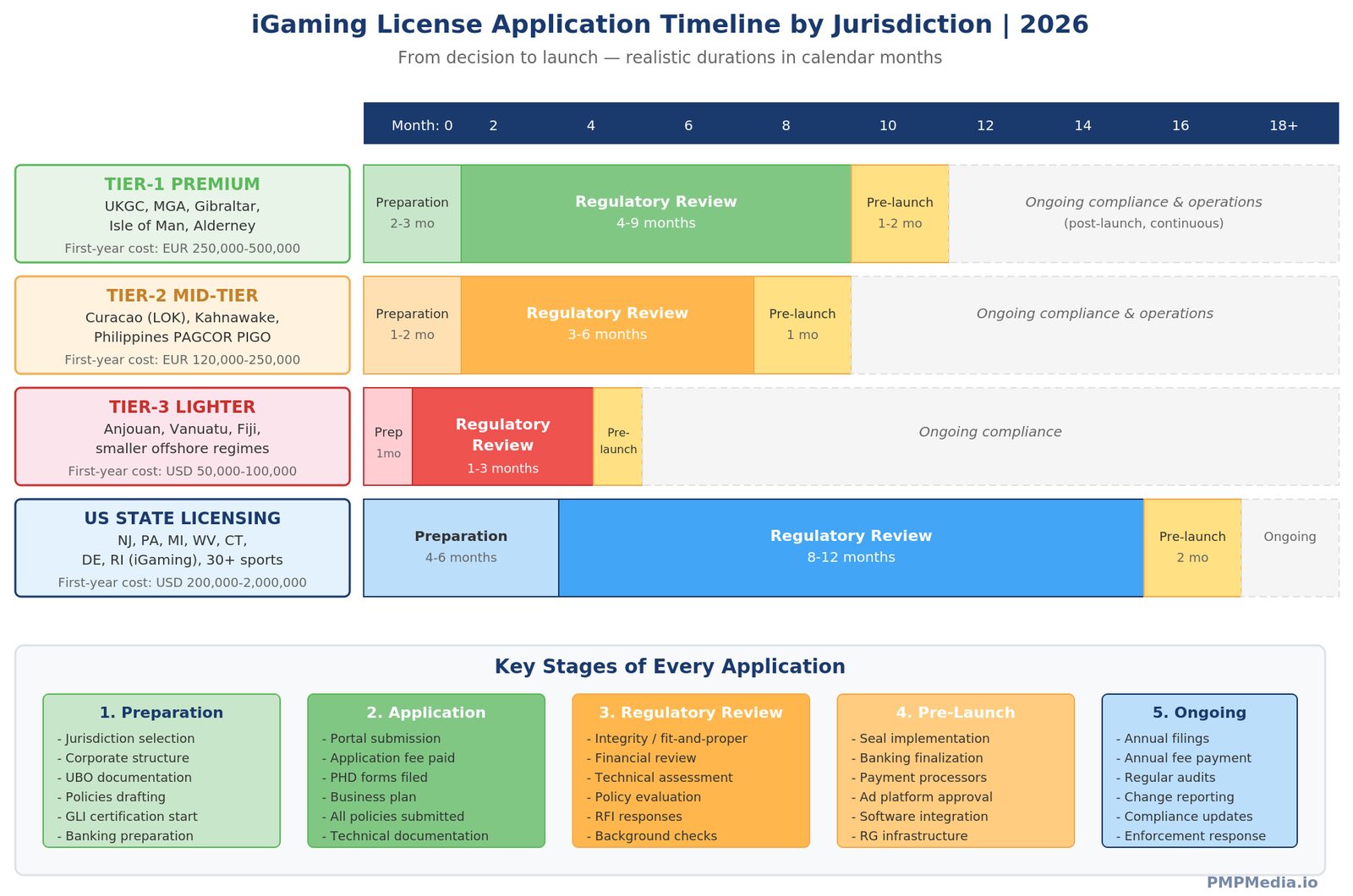
Tier-1 jurisdictions (UKGC, MGA, Gibraltar, Isle of Man): 6-12 months total, including 2-3 months pre-application preparation and 4-9 months regulatory review.
Tier-2 jurisdictions (Curacao under LOK, Philippines PAGCOR, Kahnawake): 4-8 months total. Faster than Tier-1 but substantially more rigorous than old Curacao master license days.
Tier-3 jurisdictions (Anjouan, Vanuatu, smaller regimes): 2-4 months total. Lowest cost and fastest path but with banking and market access limitations.
US state licenses: 12-18 months or longer, varies dramatically by state. New Jersey is the most established and fastest; Pennsylvania and newer markets take longer.
Brazil (new federal framework): 6-9 months following the BRL 30 million license fee framework under Law 14,790/2023.
Add 3-6 months if your operation involves complex ownership structures, multi-jurisdiction operations, or specific compliance challenges. The timeline almost never shrinks, and it often expands.
Step 1: Strategic Jurisdiction Selection
Operators considering emerging product categories like prediction markets and event contracts face different licensing routes than traditional gambling products. For the current regulatory picture for prediction markets specifically — including CFTC DCM process in the US and UKGC intermediary classification — see our prediction markets regulation guide.
The most important decision in the entire licensing process is which jurisdiction to apply to. Get this wrong and you waste six to twelve months plus application fees pursuing a license that does not fit your business model or target markets.
Match licensing to target markets
Start with where your customers will be:
- UK market: UKGC is mandatory. No alternative works. Budget £250,000-500,000 first year.
- EU regulated markets (individual member states): Generally national licensing. Malta license does not provide automatic EU access. Plan country-by-country.
- Global mixed markets (LatAm, emerging Asia, grey markets): Curacao under LOK, or Anjouan for lower-cost alternative.
- US states (New Jersey, Pennsylvania, Michigan, etc.): State-by-state licensing required. Plan for multi-state strategy from the start.
- Brazil: Federal license under Law 14,790/2023. BRL 30 million license fee for 5-year authorization.
- Philippines domestic: PAGCOR PIGO license. POGO/OGI for international was restricted significantly through 2025.
Consider banking and payment access
The license alone does not give you banking. Some licenses carry banking credibility with Tier-1 banks (MGA, UKGC, Gibraltar, Isle of Man). Others face banking friction that can limit operations regardless of legal authorization.
Practical consequences of banking-challenged licenses include payment processor termination risk, higher merchant processing fees, limited acquirer bank options, and difficulty with institutional banking relationships. Anjouan and some Tier-3 licenses carry these limitations. Curacao under LOK has improved banking credibility meaningfully but still faces friction at the largest banks.
Match licensing to product portfolio
Some licenses cover multiple products (Curacao’s B2C license under LOK is comprehensive). Others require separate licensing for each vertical (UK requires separate operating licenses for casino, betting, bingo). This matters for multi-vertical operators planning casino + sports betting + poker.
Consider time-to-market pressure
If you need to launch in 3 months, you need a Tier-3 jurisdiction. If you can wait 12 months for prestige licensing, Tier-1 is the better long-term investment. Operators sometimes start with Tier-3 and add Tier-1 or Tier-2 as they scale.
Budget realistically
The license fee is not the total cost. Plan for:
- Application fees and first-year annual fees
- Legal advisors and compliance consultants (EUR 50,000-150,000 typical)
- GLI or BMM Testlabs technical certification (EUR 15,000-50,000)
- Corporate setup and substance costs
- Working capital to cover player winnings and operating expenses
- AML and KYC technology infrastructure
For Tier-1 licensing, budget EUR 250,000-500,000 all-in for first year. For Tier-2, EUR 120,000-250,000. For Tier-3, USD 50,000-100,000. US state licensing can run USD 200,000-2,000,000+ depending on state and operator scale.
Step 2: Pre-Application Preparation
Before you can apply, you need to have several pieces in place. Skipping preparation leads to rejected applications or delays that exceed the original regulatory review time.
Corporate structure
Most jurisdictions require a locally-registered legal entity. Plan corporate structure carefully — it affects tax efficiency, substance requirements, and long-term strategic flexibility.
- For Malta: Maltese private limited company (Ltd.) with local directors
- For UK: UK-registered company or registered branch of a foreign entity
- For Curacao: Curacao BV or NV with resident managing director
- For US states: US-domiciled entity (often Delaware LLC or C-Corp)
- For Brazil: Brazilian entity (SA or LTDA) with local management
- For Gibraltar: Gibraltar private limited company
Budget 4-8 weeks for corporate formation, director appointment, and registered office setup. Tax planning advisors should be engaged before incorporation to optimize structure.
Ownership clarity
Regulators require full Ultimate Beneficial Owner (UBO) disclosure traced to natural persons. Opaque corporate structures, bearer shares, and nominees cause immediate problems.
Pre-application checklist for ownership:
- Clear ownership chain from legal entity to ultimate human owners
- No bearer shares anywhere in the chain
- No nominee directors or nominee shareholders (the regulator will see through these)
- Complete shareholder register
- UBO identification documents for all owners with 10%+ stake (threshold varies by jurisdiction)
- Source of funds documentation for investment capital
- Source of wealth documentation showing broader financial history
- Police clearance certificates for all UBOs
If your ownership structure involves multiple entities in different jurisdictions, plan for additional scrutiny. Corporate governance advisors can help with restructuring before application if needed.
Key personnel
Most jurisdictions require specific personnel in specific roles:
- Managing Director (often with residency or local office requirements)
- Compliance Officer (must have relevant qualifications)
- Money Laundering Reporting Officer (MLRO)
- Chief Technology Officer or technical lead
- Customer due diligence / onboarding lead
- Responsible Gambling Officer (in some jurisdictions)
In tier-1 jurisdictions like the UK, key individuals need their own Personal Management Licenses (PMLs). This adds 4-8 weeks to the timeline and requires individual fitness assessment of each person.
Business plan
Regulators want to see a realistic business plan including:
- Three-year financial forecast with revenue, cost, and EBITDA projections
- Market analysis and competitive positioning
- Marketing plan and customer acquisition strategy
- Product roadmap
- Technology architecture overview
- Staffing plan with timeline for meeting local substance requirements
- Risk assessment covering market, operational, and regulatory risks
- Responsible gambling strategy
The business plan is not a sales document — it is a document demonstrating you have thought through the business. Regulators test whether financial projections are plausible and whether the operator understands their market.
Policies and procedures
Draft comprehensive policies before applying:
- AML policy: FATF-aligned, covering customer due diligence, transaction monitoring, suspicious activity reporting, risk assessment
- KYC procedures: Identity verification, proof of address, source of funds checks, PEP screening
- Responsible gambling policy: Self-exclusion, deposit limits, reality checks, problem gambling interactions, customer harm markers
- Customer interaction policy: How the operator detects and responds to problem gambling indicators
- Marketing and advertising policy: Compliant advertising, opt-in consent where required, vulnerable customer protection
- Customer complaints procedure: Formal complaint handling process, escalation, ADR integration
- Data protection policy: GDPR or local equivalent compliance
- Fraud prevention policy: Chargeback handling, account takeover prevention, payment fraud
- Game fairness policy: RNG testing, supplier oversight, game integrity
- Technical and operational security: Cybersecurity, data integrity, logging, change control
These policies are not optional paperwork — regulators examine them carefully and assess whether the operator can actually implement them. Template policies from consultancies often fail review because they are generic rather than tailored to the operator’s specific business.
Financial preparation
Demonstrate financial capacity to operate. This typically includes:
- Corporate bank statements showing working capital
- Evidence of segregated player funds account arrangements
- Insurance or guarantee arrangements for player protection (required in some jurisdictions)
- Bank references demonstrating banking relationships
- Personal financial statements for UBOs in some cases
Minimum practical working capital: EUR 500,000-1,500,000 for serious operators. Less than this triggers capacity concerns at most regulators.
Technical infrastructure
Get technical certification started early. GLI or BMM certification takes 4-8 weeks and is required before most licenses can be issued. Key technical items:
- RNG (Random Number Generator) testing for all games
- Game logic testing for each slot, table game, live dealer game
- Sportsbook platform certification if offering sports betting
- Responsible gambling tool testing
- Data integrity and logging verification
- Platform security assessment
Step 3: Application Submission
The application itself is largely administrative if preparation is solid. The main risk is missing documents or inconsistencies that trigger delays.
Application packages vary by jurisdiction
Each regulator has its own forms and document requirements. Typical packages include:
- Operator application form
- Corporate information form
- Personal History Disclosure forms for all UBOs and directors
- Financial statements for the operator and UBOs
- Business plan and projections
- All policies and procedures
- Certificates of incorporation and corporate governance documents
- Proof of office lease or ownership
- Key personnel CVs and qualifications
- Technical documentation
- Payment of application fee (non-refundable)
Submission method
Most regulators use online portals for application submission. Examples: UKGC eServices, MGA online portal, CGA licensing portal. Some require hard copy supplementary submissions for certain documents.
Fee payment
Application fees are usually non-refundable, including if the application is withdrawn or rejected. Budget this as a sunk cost — if rejected, the money is gone. Major application fees in 2026:
- UKGC: GBP 370 base, scaled up to GBP 91,686 for largest operators
- MGA: EUR 5,000 application fee
- Gibraltar: GBP 25,000 one-time license fee
- Curacao: Variable with corporate setup
- New Jersey: USD 400,000 casino license fee
- Pennsylvania: USD 10,000,000 (higher for casino licenses)
- Brazil: BRL 30,000,000 for 5-year authorization
- Philippines PAGCOR: Varies by license type, including minimum paid-up capital ~PHP 25 million
- Anjouan: USD 20,000-50,000 depending on setup
Step 4: Regulatory Review
This is where time moves slowly. Regulators review in phases, and each phase can produce requests for additional information.
Initial review
The regulator first checks that the application is complete. Missing documents or basic errors result in immediate requests for clarification. This phase usually takes 2-4 weeks.
Integrity and fit-and-proper assessment
Deep review of UBOs, directors, and key personnel. Background checks, source of wealth verification, and integrity assessment. This is where most rejections happen. Typical time: 4-12 weeks depending on complexity.
Technical and operational review
Assessment of the operator’s technical infrastructure, policies and procedures, and operational readiness. GLI certification is reviewed. Security and integrity controls are assessed. Typical time: 4-8 weeks.
Financial review
Assessment of financial capacity, working capital, and ability to meet player payout obligations. Source of funds checked again. Typical time: 2-6 weeks.
Regulator questions and responses
Most applications receive Requests for Information (RFIs) during review. Respond quickly and thoroughly. Every RFI round adds 2-4 weeks to the timeline. Well-prepared applications have 1-2 RFI rounds; poorly-prepared applications can have 4-6 rounds.
Decision and issuance
If successful, the regulator issues the license. First-year annual fee becomes due 30 days after issuance in most jurisdictions.
Step 5: Pre-Launch Preparation
The license is issued, but you cannot immediately launch. Several things need to happen first.
Seal and display implementation
Most jurisdictions require display of regulatory seal or license number on the operator’s website. Curacao requires dynamic seal tied to authorized domains. Malta requires MGA seal. UKGC requires license information display.
Payment processor onboarding
Now that you have a license, you can approach payment processors with proof of licensing. PSPs typically want 2-6 weeks to complete their own due diligence. Plan for this before launch.
Banking relationships
Either continue with banking established during corporate setup or add additional banking relationships now that licensing is confirmed. Banking can take 4-12 weeks to finalize fully.
Advertising platform approval
Google, Meta, and other advertising platforms require proof of licensing before allowing gambling ads. Submit applications with license information. Expect 1-4 weeks for platform approval.
Software integrations
Final integration testing with game suppliers, payment processors, KYC providers, and other vendors. Each supplier typically has its own certification process.
Responsible gambling infrastructure
Implement all required tools: deposit limits, self-exclusion (including GAMSTOP integration for UK), reality checks, time-out functions, problem gambling resources. Test thoroughly before going live.
Regulatory reporting readiness
Ensure systems can produce required regulatory reports. Some jurisdictions require daily reporting (New Jersey), others monthly or quarterly.
Step 6: Launch and Initial Operations
Opening day is not just about traffic. It is about demonstrating compliance to the regulator who is watching.
Soft launch phase
Many operators start with limited customer volumes to validate operations before full scale. This can identify AML, responsible gambling, or technical issues before they become larger problems.
Regulatory engagement
Expect regulator engagement in the first weeks. Inspections, questions about specific transactions, verification of policies in practice. Respond promptly and document everything.
Initial reporting
First regulatory returns due within 30-60 days of launch depending on jurisdiction. Ensure systems capture all required data from day one.
Step 7: Ongoing Compliance
The license is not the end. Ongoing compliance is where most operators face enforcement risk.
Annual regulatory filings
- Annual compliance report covering all operations
- Financial statements audited by approved auditor
- Updated UBO disclosures if ownership changes
- AML risk assessment refresh
- Annual fee payment
Regular audits
- Technical audits (RNG, game logic, security) — usually annual
- AML audits (policies, procedures, transaction monitoring)
- Responsible gambling audits (policy implementation, customer interactions)
- Financial audits (player funds segregation, corporate finances)
Change reporting
Material changes require notification to the regulator:
- Ownership changes (often requires regulatory approval)
- Management changes (new directors, key persons)
- Material changes in business model or operations
- Security breaches or serious operational failures
- Major legal or regulatory issues in other jurisdictions
Responsible gambling continuous compliance
Markers of harm identification, customer interactions documentation, self-exclusion management, deposit limit setting. Errors here are among the most common enforcement triggers.
AML continuous compliance
Transaction monitoring, enhanced due diligence for high-risk customers, source of funds checks, suspicious activity reporting. The UKGC specifically enforces AML failures aggressively.
Marketing compliance
Ongoing compliance with advertising regulations in target jurisdictions. Restrictions continue to tighten globally.
Common Mistakes That Delay or Kill Applications
Applying too early
Incomplete preparation is the most common cause of application problems. Regulators reject applications that lack clear ownership, tested policies, technical certification, or realistic business plans. Spend time on preparation — it shortens the total timeline.
Choosing the wrong jurisdiction
Some operators chase the cheapest license without considering whether it gives them the market access they need. Anjouan license is cheap but may not work for Western banking. Curacao under LOK has good banking now but costs more than pre-LOK. Match license to market and banking needs.
Opaque ownership
Nominees, complex chains, opaque offshore vehicles cause immediate problems. Fix ownership structure before applying, not during regulatory review.
Inadequate working capital
Operators with thin capital fail financial review. Plan for EUR 500,000-1,500,000 operating capital at minimum for serious regulated operations.
Generic policies
Template AML and responsible gambling policies from consultancies often fail because they are not customized to the operator’s specific business. Pay for tailored policies that actually reflect how the business will operate.
Ignoring personal licenses (PMLs)
UK and several other jurisdictions require key personnel to hold individual licenses. Start these applications in parallel with the operator license, not after.
Underestimating banking timelines
Payment and banking relationships take weeks or months to establish. Start early. Confirmed banking is part of preparation, not post-approval.
Not reading the LCCP (or equivalent)
In the UK, the Licence Conditions and Codes of Practice is where day-to-day compliance lives. Most enforcement actions target LCCP breaches. Similar operational codes exist in other jurisdictions. Operators that ignore this documentation get into enforcement trouble quickly.
Working with Advisors
Very few operators complete licensing without specialized advisors. The complexity is real and the cost of mistakes is high.
Typical advisor roles
- Gambling-specialist legal counsel: Handle application, corporate structure, and local coordination
- Compliance consultants: Build policies, configure AML and responsible gambling infrastructure
- Corporate service providers: Registered office, director services, administration
- Technical certification labs: GLI, BMM, iTech Labs, eCOGRA for RNG and platform certification
- Tax advisors: Structure corporate and tax arrangements
- Banking consultants: Facilitate banking and payment processor relationships
Advisor fees
Full support for a Tier-1 license typically runs EUR 100,000-200,000 in advisor fees. Tier-2 licensing EUR 50,000-100,000. Tier-3 licensing EUR 20,000-50,000. These are investments that usually pay back through shorter timeline and fewer rejections.
Choosing the right advisors
Look for specialists with specific jurisdiction experience and recent successful applications. Generic corporate legal firms rarely have the depth of knowledge. Ask for references from operators who completed licensing recently.
Post-Launch Strategic Considerations
When to add additional licenses
Most operators that grow add licenses over time. Typical progression: start with one jurisdiction, add second jurisdiction at EUR 2-5 million revenue, add third at EUR 10+ million. Each additional license adds operational complexity but extends market access.
When to migrate licenses
Some operators eventually move from Tier-2 to Tier-1 jurisdictions as they scale. The old license does not automatically transfer — it is a separate application. Plan for overlap period where both licenses run.
Compliance team build-out
Initial licensing can be handled with small compliance team. As operations scale, compliance becomes a larger function — 5-10% of operational staff in mature regulated operators. Plan for this growth.
Related Guides
- What Is a Gambling License
- Types of Gambling Licenses
- Global iGaming Regulation Guide
- Malta Gaming License
- Curacao iGaming License
- UK Gambling License
- Curacao License Requirements
- Curacao License Cost
- Curacao vs Malta License
Bottom Line
iGaming licensing is a 6-12 month process that requires serious preparation, realistic budget, and strategic jurisdiction selection. Shortcuts rarely work. Operators who treat licensing as a strategic investment (with proper legal support, compliance infrastructure, and capital reserves) succeed. Those who approach it casually face rejection, delays, or enforcement problems post-launch.
The good news is the process is well-established. Every successful operator has gone through it. The path is navigable with proper preparation. The bad news is the complexity has been increasing, not decreasing, as regulatory expectations rise globally. A license obtained in 2020 with minimal preparation would not pass the same jurisdiction’s review in 2026.
For operators planning market entry, start with jurisdiction selection based on target markets and banking needs. Build from there. Budget realistically, prepare thoroughly, and engage specialized advisors. The result is a functional license that opens markets, supports banking, and positions the business for sustainable growth.
FAQ
How long does it take to get an iGaming license?
Timelines vary by jurisdiction tier: Tier-1 (UKGC, MGA, Gibraltar) takes 6-12 months; Tier-2 (Curacao, Kahnawake, Philippines PAGCOR) takes 4-8 months; Tier-3 (Anjouan, Vanuatu) takes 2-4 months. US state licensing takes 12-18 months or longer. Plan realistically for the full duration from preparation to launch.
Which iGaming license is the easiest to get?
“Easiest” depends on what you need. Anjouan and smaller Tier-3 regimes have lighter requirements and faster processing (2-4 months), but banking and market access are limited. Curacao under LOK is more demanding but provides better banking access. The easiest license that actually works for your business model depends on your target markets.
How much does iGaming licensing cost in 2026?
Budget ranges for first-year all-in costs: Anjouan USD 50,000-100,000, Curacao EUR 120,000-250,000, Malta EUR 170,000-300,000, Gibraltar EUR 250,000-400,000, UK GBP 250,000-500,000, US state licensing USD 200,000-2,000,000+ depending on state, Brazil BRL 30 million (approximately USD 5.5-6.1 million) for 5-year federal license.
Do I need a local office for my iGaming license?
Most jurisdictions require physical office presence. Curacao under LOK requires real office in Curacao. Malta requires physical office in Malta. Gibraltar requires local presence. UK requires substantial operational presence if serving UK customers. Anjouan and some Tier-3 jurisdictions have lighter requirements. Confirm office requirements for your target jurisdiction before applying.
What documents do I need for an iGaming license application?
Typical document package includes: certificate of incorporation, articles of association, shareholder register and UBO disclosure, Personal History Disclosure forms for all UBOs and directors, police clearance certificates, source of funds documentation, three-year business plan with financial projections, corporate bank statements, GLI or BMM technical certification, complete compliance policies (AML, KYC, responsible gambling, customer interaction, data protection), evidence of segregated player funds account, and office lease documentation.
What is the minimum capital requirement for an iGaming license?
Varies by jurisdiction. Serious regulated operators need EUR 500,000-1,500,000 operating capital at minimum. Some jurisdictions (Brazil, US states) require much more. Philippines PAGCOR requires minimum paid-up capital around PHP 25 million (approximately USD 429,000+). Budget adequate capital for working capital, marketing, compliance infrastructure, and player payout coverage.
Can I apply for multiple iGaming licenses at the same time?
Yes, and many operators do. Each license has its own application process, fees, and compliance obligations. Parallel applications can save calendar time but increase workload. Common strategy is to start with one license and add others as operations scale. Major multinational operators hold 10+ licenses simultaneously across different regulated markets.
What is the hardest part of the iGaming licensing process?
In practice, three areas trip up most applicants: ownership transparency and UBO disclosure (nominees and complex offshore structures cause rejection), financial capacity demonstration (thin working capital causes failure), and policy implementation (template policies fail because they are generic). Preparation time spent on these areas shortens the total timeline.
Can I transfer my iGaming license to another entity?
Generally no. Licenses are typically issued to specific legal entities and are not transferable. Operations are often sold through share transfers of the licensed entity, which typically requires regulatory approval of the new owners’ fit-and-proper status. Plan ownership changes carefully and engage the regulator early in any transition.
What happens if my license application is rejected?
Application fees are typically non-refundable. Rejected applicants can either address the deficiencies and re-apply, or seek licensing in alternative jurisdictions. Rejections are most commonly caused by UBO issues, financial inadequacy, or inadequate compliance infrastructure. Fixing the underlying issues and re-applying often succeeds the second time if the problems are addressed substantively.
Do I need advisors to get an iGaming license?
Technically no, practically yes. Successful licensing almost always involves specialized advisors: gambling-focused legal counsel, compliance consultants, corporate service providers, technical certification labs, tax advisors, and banking consultants. Advisor fees run EUR 50,000-200,000 depending on jurisdiction tier, but they significantly improve the probability of first-time success and shorten total timeline.
Can I start operating during the license application review?
No. Operating commercially without authorization is illegal. Some jurisdictions (Curacao under LOK) offer provisional licenses that allow launch during final approval. Others require full approval before any operations. Operating without authorization even during application review creates serious legal problems and usually results in license denial.
What is the difference between a B2C and B2B iGaming license?
A B2C (business to consumer) license authorizes operators to offer gambling services directly to players. A B2B (business to business) license authorizes companies providing services to licensed operators: game developers, software providers, payment processors, platform aggregators. Some companies hold both. The business model and customer relationship determine which type of license is needed.
 Share
Share


 0 views