






The Curacao iGaming license is not what it was two years ago, and anyone making a licensing decision in 2026 based on pre-LOK assumptions is working with outdated information. The National Ordinance on Games of Chance (Landsverordening op de kansspelen, or LOK) came into force on December 24, 2024, and the transition is now complete. All the old master licenses expired by January 2025. The four master license holders who used to issue sub-licenses to hundreds of operators are gone. The new Curaçao Gaming Authority (CGA) issues licenses directly, charges higher fees, enforces proper AML and KYC obligations, and is actively rejecting around 38% of applications.
This is a materially different product than the old Curacao license. The commercial value proposition still holds — lower costs than Malta, faster timelines, broad operational scope, and genuine tax efficiency — but the regulatory bar has risen significantly and the compliance burden is now real.
This guide covers the Curacao license as it actually works in April 2026: the two-phase application process, exact fees (€4,592 application, €47,450 annual B2C), substance requirements phasing in through 2028-2029, tax structure, prohibited jurisdictions, and where the license genuinely makes sense versus where operators should look elsewhere.
Quick Verdict
The Curacao license in 2026 works for well-capitalised operators who need broad international market access outside regulated EU jurisdictions, have real compliance capacity, and can absorb the 8-16 week application timeline. It does not work for underfunded startups, anonymous crypto operations, or anyone expecting the light-touch framework that existed before LOK. For a side-by-side comparison with Malta, see our Curacao vs Malta guide.
What Changed Under LOK
The LOK reform was the biggest regulatory transformation in Curacao’s online gaming history. Before December 2024, licensing worked through a sub-license system where four master license holders (Antillephone, Curacao eGaming, Gaming Curacao, Cyber Rock Entertainment) issued sub-licenses to operators with minimal centralised oversight. The government received limited revenue, accountability was diffuse, and the jurisdiction built a reputation — fair or not — as a regulatory haven.
That system is over. Here is what replaced it:
- Direct licensing only. The Curaçao Gaming Authority (CGA), which replaced the old Gaming Control Board, is the sole body issuing licenses. No intermediaries, no sub-licenses.
- Two license categories. B2C for operators serving players directly. B2B for software developers, platform providers, and payment processors. The two cannot be combined under a single license.
- Higher fees and real compliance. €47,450 annual B2C fee (up from pre-LOK effective costs), mandatory AML/KYC frameworks aligned with FATF standards, Alternative Dispute Resolution for player complaints, and responsible gambling policies.
- Indefinite license validity. Subject to ongoing compliance rather than periodic renewal, though the CGA retains revocation and suspension powers.
- Public register. All 330+ active licenses are published on the CGA’s public database, linked to color-coded digital seals displayed on operator websites.
- Substance requirements phasing in. April 2028 (one Key Person resident in Curacao), April 2029 (three Key Persons plus physical office).
The practical effect is that Curacao is now a materially different jurisdiction than it was in 2023. It remains cheaper and faster than Malta, but the old “easy license” framing is genuinely obsolete.
WHY THIS MATTERS FOR OPERATORS
The CGA has processed roughly 140 direct license applications as of April 2026, approving 87 and rejecting or shelving the rest. The 38% rejection rate is the clearest signal that the regulator is serious about raising standards. Underfunded startups, operators with opaque ownership structures, and anonymous crypto platforms without FATF-aligned AML frameworks are being rejected at Phase One. This is not the same jurisdiction that welcomed any applicant with a few thousand euros and a willingness to display a seal on their homepage.
Who Can Apply for a Curacao License
Eligibility under LOK is tighter than most operators expect. Only legal entities established under Curaçao law, with their statutory seat in Curaçao, are eligible to apply. Additionally, the entity must be managed by at least one natural person resident in Curaçao, or by a corporate entity established under Curaçao law with at least one resident director.
The applicant must demonstrate:
- Curaçao-incorporated legal entity with statutory seat on the island
- At least one Curaçao-resident managing director from day one
- Clear ownership structure with full disclosure of all Ultimate Beneficial Owners holding 10% or more equity
- Source of wealth verification for all significant beneficial owners
- Financial stability sufficient to operate without undercapitalisation
- Clean criminal record and integrity checks for all Key Persons
- Realistic business plan with three-year financial projections
- Information security and data protection infrastructure
- Sanctions compliance (applicants from sanctioned jurisdictions including Russia and Iran are not eligible)
Fraudulent seals are actively flagged by the CGA — the regulator publicly called out a site called trumpbet.cc in February 2026 for displaying a fake digital authorisation seal. The CGA’s public verification database is the only legitimate way to confirm a license.
The Two-Phase Application Process
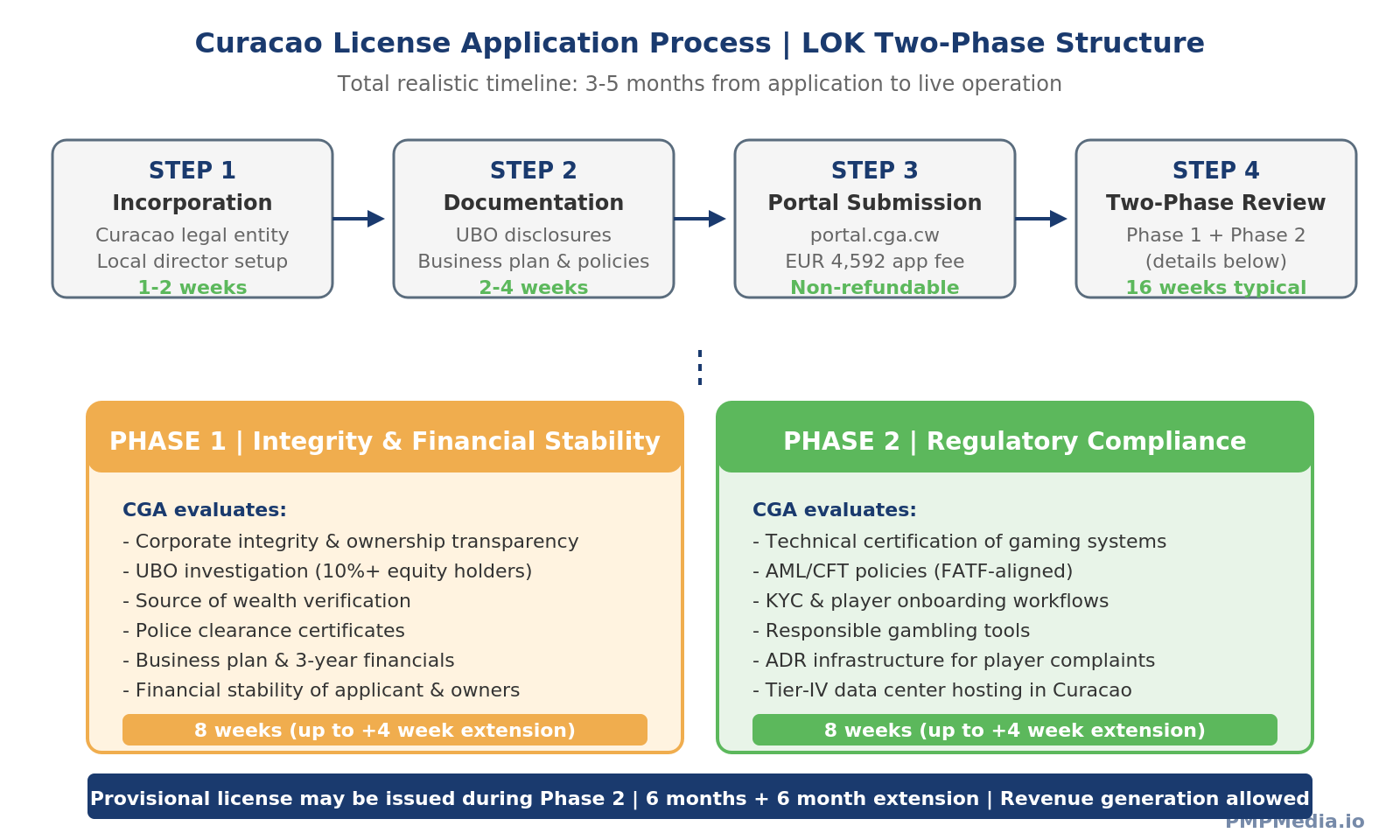
The LOK application process is structured in two formal phases. Understanding this structure is essential because each phase tests different aspects of the business.
Phase 1: Integrity and Financial Stability
Phase One focuses on who you are and whether you have the financial capacity to run a legitimate gambling operation. The CGA reviews:
- Corporate integrity and ownership transparency
- Financial stability of the applicant entity and beneficial owners
- Personal history disclosures for all UBOs and Key Persons
- Source of wealth verification with police clearance certificates
- Sanctions screening and FATF compliance
- Business plan with three-year financial forecast
The CGA aims to process Phase One within 8 weeks from complete submission, with a possible 4-week extension if additional information is required. Applicants who fail critical integrity or financial stability tests are rejected at this stage. Applicants who meet most requirements but have minor gaps may progress to Phase Two while working to close those gaps.
Phase 2: Technical and Regulatory Compliance
Phase Two tests whether you can operate compliantly under LOK. This phase covers:
- Technical certification of gaming software and random number generators
- Cybersecurity and data protection infrastructure
- AML/CFT policies aligned with FATF standards
- KYC procedures and player onboarding workflows
- Responsible gambling measures and player protection tools
- Alternative Dispute Resolution infrastructure for complaints
- Tier-IV data centre hosting arrangements in Curaçao
- Game rules, payout logic, and technical manuals
Phase Two also takes 8 weeks with a possible 4-week extension. Operators who successfully complete both phases receive a definitive license issued for an indefinite duration, subject to ongoing compliance and the CGA’s retained powers of revocation or suspension.
Provisional Licenses
If an applicant does not fully meet all requirements but is not rejected outright, the CGA may issue a provisional license valid for up to 6 months, extendable for another 6 months depending on progress. This is a genuinely useful feature because it allows operators to start generating revenue while finalising compliance obligations, which most tier-1 jurisdictions do not offer.
Realistic Total Timeline
Adding everything up, the full process typically runs:
- Company incorporation: 1-2 weeks
- Application preparation and documentation: 2-4 weeks
- Phase One review: 8 weeks (up to 12 with extension)
- Phase Two review: 8 weeks (up to 12 with extension)
- Technical setup and launch: 2-4 weeks
- Total realistic timeline: 3-5 months from application to live operation
Provisional licensing can compress this by allowing revenue generation during Phase Two. Operators planning a launch should budget 5-7 months end-to-end including corporate setup and banking, which typically takes longer than most people expect.
Curacao License Costs in 2026
Cost transparency is one of the better features of the new LOK framework. The official fees are published and predictable, though total costs including setup and ongoing compliance are higher than the headline numbers suggest.
Official CGA Fees
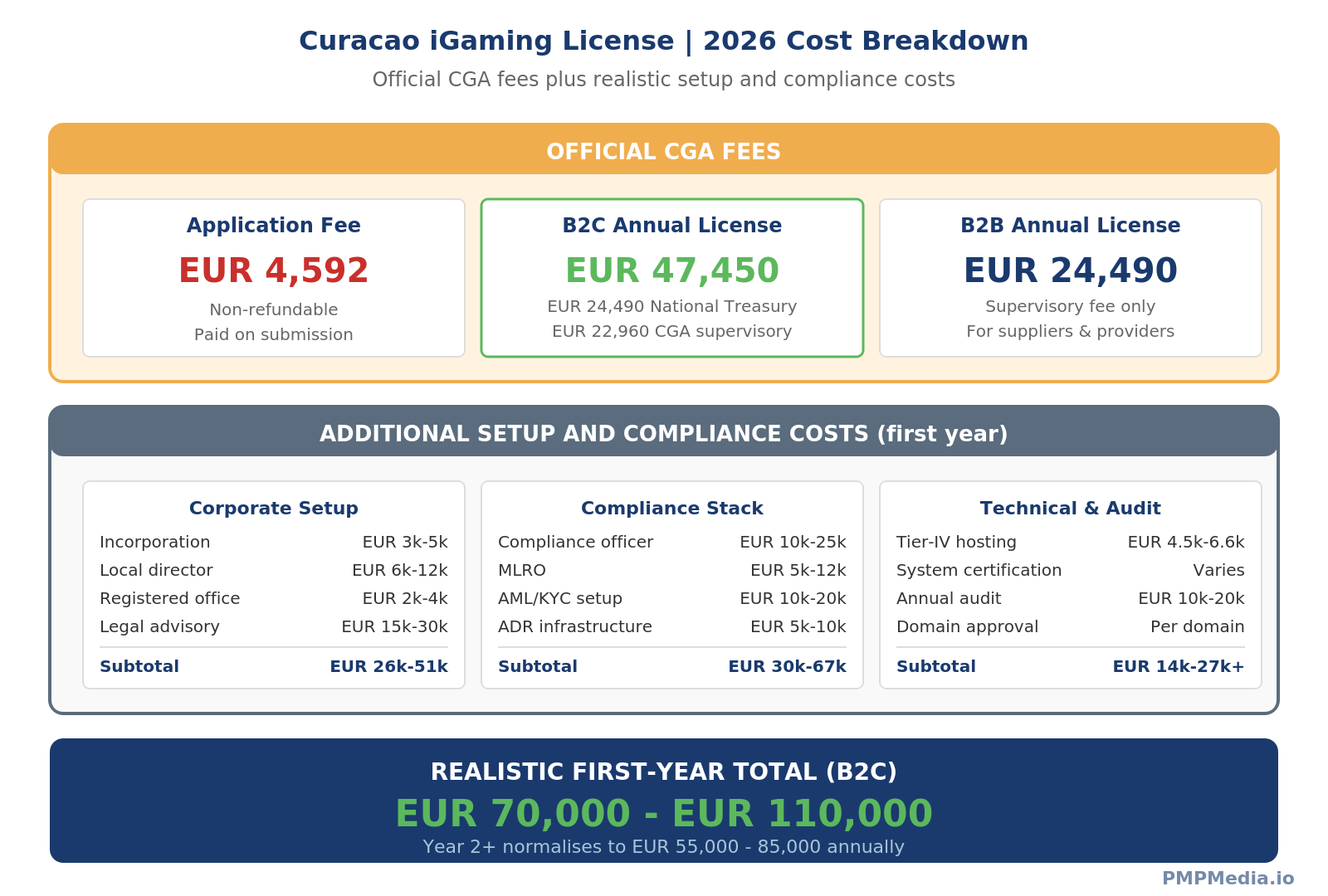
- Application fee: €4,592 non-refundable, paid on submission
- Annual B2C license fee: €47,450 total (split into €24,490 National Treasury fee and €22,960 CGA supervisory fee)
- Annual B2B license fee: €24,490 supervisory fee only
- Additional games or B2B services: €13 per item
- Domain approval: separate fee per approved domain
Annual fees must be paid within 14 days of CGA notice and annually thereafter by January 15. The 2026 fee schedule is Version 2.0, updated by the CGA in November 2025 to clarify supervisory fee procedures.
Corporate Setup Costs
- Curacao company incorporation: €3,000-€5,000
- Local managing director services (annual): €6,000-€12,000
- Registered office and local point of contact: €2,000-€4,000 annually
- Compliance officer appointment: €10,000-€25,000 annually depending on model
- MLRO appointment: €5,000-€12,000 annually
- Legal and application advisory support: €15,000-€30,000 (first year)
Technical and Operational Costs
- Tier-IV data centre hosting in Curacao: €1,140-€1,650 per quarter (€4,560-€6,600 annually)
- AML/KYC policy development: €10,000-€20,000 (first year)
- ADR infrastructure setup: €5,000-€10,000
- Technical certification of gaming systems: varies by scope
- Annual audit and compliance reviews: €10,000-€20,000
Realistic Total Cost Picture
For a B2C operator, the first-year all-in budget typically runs €70,000-€110,000, covering regulatory fees, corporate setup, compliance infrastructure, and advisory support. Year two onwards normalises to €55,000-€85,000 annually. These are serious numbers, though still materially below Malta (first-year €150,000-€250,000, ongoing €100,000-€180,000 before variable taxes).
WHAT THIS MEANS IN PRACTICE
Operators who budget only for the €47,450 annual CGA fee are setting themselves up for a compliance crisis. The regulatory fee is roughly half of the realistic total cost of running a Curacao-licensed operation properly. The other half is the compliance stack, substance costs, technical infrastructure, and advisory support that the CGA now actually expects. Budget accordingly, or the license becomes a liability rather than an asset.
Tax Structure
This is where Curacao retains its strongest commercial advantage over Malta, the UK, and most other licensing jurisdictions.
- Corporate income tax: 2% flat rate on net profits for E-Zone companies serving international clients
- Gaming tax on GGR: 0% (no separate gaming tax on gross gaming revenue)
- VAT on gaming services: 0%
- Withholding tax on dividends to non-residents: 0%
- Sales tax, import duties, bet turnover tax: 0%
The OECD Pillar Two 15% minimum corporate tax came into effect in Curacao on January 1, 2025. This applies only to multinational groups with consolidated annual revenue above €750 million, which is a threshold that no realistic iGaming operator considering Curacao will hit. For practical purposes, the 2% rate continues to apply.
The effective total tax burden for a properly structured Curacao operator lands around 2% of net profits, compared to roughly 5-7% blended in Malta. On pure tax rate, Curacao wins by a wide margin. The trade-off is the commercial access that comes with Malta’s premium positioning, which is the real reason operators serving regulated EU markets pay Malta’s premium despite the tax disadvantage.
Substance Requirements Timeline
Curacao’s substance requirements are phasing in through 2028-2029, and operators applying now need to build this into their operational planning rather than treating it as a problem for later.
Current Requirements (2026)
- Curaçao-incorporated legal entity
- At least one Curacao-based managing director
- Local point of contact for ongoing correspondence
- Designated compliance officer
- Designated Money Laundering Reporting Officer (MLRO)
- Tier-IV certified data centre in Curaçao for player data storage
- Independent accounting and audit arrangements
April 2028 Phase-In
- At least one full-time Key Person residing in Curaçao (additional to the managing director)
April 2029 Phase-In
- Three Curaçao-based full-time Key Persons
- Physical office established in Curaçao
Temporary exemptions of up to two years are available for smaller, newer operators who can demonstrate genuine operational constraints. Operators planning long-term presence should engage a Curaçao-based trust company or corporate service provider early to secure office space and qualified local hires before the deadlines arrive. The 2028 single-Key-Person requirement is closer than most people assume.
Color-Coded Seals and License Verification
The CGA introduced a color-coded digital seal system under LOK that serves both operators and players:
- Green seal: Active B2C license (operator serving players directly)
- Blue seal: Active B2B license (supplier or service provider)
- Orange seal: Provisional license during transition period (expired October 15, 2025)
The seals are dynamic and link to the CGA’s public verification database. Each seal corresponds to the operator’s Certificate of Operation and is tied to approved domains. The CGA actively flags fraudulent sites displaying fake seals — the February 2026 trumpbet.cc case is a recent example of public enforcement action.
Players checking whether a casino is genuinely licensed should always verify through the CGA’s public database rather than trusting the seal displayed on the website. Fake seals do exist and the verification step is trivial.
Prohibited Jurisdictions
Under LOK, CGA licensees cannot offer services to players in certain jurisdictions. Understanding these restrictions is critical because violations attract serious enforcement.
Core prohibited jurisdictions
- United States
- Netherlands
- France
- Australia
- Curaçao itself (Curaçao citizens are blocked regardless of location)
Additionally prohibited under LOK
- United Kingdom (explicit restriction on service and marketing)
- Germany (explicit restriction on service and marketing)
- All FATF High-Risk AML jurisdictions (list updates quarterly)
Operators must implement IP geo-blocking, KYC verification, and payment system controls to enforce these restrictions. VPN-based circumvention attempts attract fines or license suspension. The CGA conducts regular audits to verify compliance with geographic restrictions.
October 8, 2026 Transparency Deadline
The CGA introduced new player-facing transparency rules in April 2026 with a compliance deadline of October 8, 2026. By that date, all licensed operators must:
- Provide clearer terms around withdrawals, account closures, and crypto transactions
- Obtain explicit consent from players to the updated T&C at signup or at their next login for existing accounts
- Document the consent process in a way the CGA can audit
This deadline is closer than most operators with complex multi-market setups expect, and the T&C overhaul is typically a 6-8 week project done properly. Operators who have not started should treat this as a priority.
Pros and Cons
Pros
- Annual fees (€47,450 B2C) materially below Malta (first-year total typically €150,000+)
- 2% corporate tax on net profits, 0% on GGR, 0% VAT, 0% withholding on dividends
- 3-5 month realistic timeline to launch versus 6-12 months for Malta
- Single license covers casino, sportsbook, poker, lotteries, and esports betting
- Provisional license option allows revenue generation during Phase 2
- Indefinite license validity under ongoing compliance
- Improving international credibility under LOK reform
- Broad global market access outside prohibited jurisdictions
- CGA-Netherlands Gambling Authority cooperation raising standards
Cons
- 38% application rejection rate signals higher bar than pre-LOK
- Tier-1 payment processors still prefer MGA over CGA credentials
- Banking relationships more difficult than with Malta license
- Substance requirements phasing in from April 2028-2029
- No EU market access (Germany, UK, NL, FR all prohibited)
- USA, Australia, and Curacao itself fully prohibited
- Tier-IV data centre hosting adds €4,500-€6,500 annually
- Compliance stack (AML, KYC, ADR, responsible gambling) now genuinely required
- Perception lag in some markets despite LOK improvements
Common Mistakes New Applicants Make
I have watched enough operators navigate the LOK application process to see the patterns clearly. These are worth flagging because they cost people time and money.
Underestimating the Phase 1 scrutiny. The CGA investigates UBOs holding 10% or more of the equity, requests police clearance certificates, verifies source of wealth, and rejects applicants with unclear ownership structures. If you have complex corporate layering or beneficial owners in sensitive jurisdictions, address this before applying, not during the review.
Budgeting for fees only, not compliance. The €47,450 annual fee is half of the realistic ongoing cost. The compliance infrastructure, substance, technical audits, and advisory support bring first-year total to €70,000-€110,000. Operators who budget only for the regulatory fee run into cash flow problems in month 4-6.
Waiting on substance planning. The April 2028 single Key Person requirement and April 2029 three-Key-Person-plus-office requirement are closer than they look. Operators who start planning in 2027 often find themselves rushing to hire qualified local talent in a constrained market. Start early.
Ignoring prohibited jurisdictions. The UK, Germany, and FATF high-risk jurisdiction restrictions are not optional. Operators who try to serve these markets through VPN workarounds or partial geo-blocking face license suspension. Build proper geo-blocking from day one.
Treating provisional licenses as permanent. Provisional licenses are valid for 6 months with a possible 6-month extension. Operators who drift into provisional status without a clear path to definitive licensing end up in regulatory limbo. Use the provisional period to close the gaps identified in Phase 2, not to delay indefinitely.
Skipping the October 2026 T&C deadline. The new transparency rules require active work, not just policy updates. Operators running multiple brands across multiple markets need 6-8 weeks to do this properly. Start now rather than in September.
Who Curacao Works For
- Well-capitalised operators serving international markets outside EU and USA
- Crypto-native operations with FATF-aligned AML frameworks
- Operators targeting Latin America, Asia, Africa, and grey-market jurisdictions
- Sportsbooks and casinos focused on non-regulated markets
- Groups using Curacao as a first license before upgrading to Malta or UK
- Operators valuing the 2% corporate tax and zero GGR tax structure
- Businesses comfortable with 3-5 month timelines
Who Should Look Elsewhere
- Operators targeting regulated EU markets (need Malta or local licenses)
- Businesses requiring tier-1 payment processor relationships
- Underfunded startups unable to support €70,000+ first-year compliance stack
- Anonymous crypto operations without proper KYC infrastructure
- Operators targeting USA, UK, Germany, Netherlands, France, or Australia
- Businesses unable to establish genuine Curacao corporate substance
Is the Curacao License Still Legit?
Yes, and more so in 2026 than at any point in the jurisdiction’s history. The LOK reform has replaced a fragmented sub-license system with direct state licensing, mandatory compliance obligations, and active regulatory enforcement. The CGA publishes its license register, flags fraudulent operators, cooperates with the Netherlands Gambling Authority, and aligns its standards with FATF recommendations.
That said, “legit” comes with context. The CGA does not provide the same depth of consumer protection as the UK Gambling Commission or the Malta Gaming Authority. Player disputes still need to go through the operator’s ADR process rather than direct regulatory intervention. Banks and payment processors still treat Curacao with more caution than Malta. These are real limitations, not scaremongering.
For operators, the question is whether the commercial advantages (lower cost, broader scope, faster timeline, better tax) outweigh the reputational and operational limitations. For most international-facing operators outside regulated EU markets, the answer remains yes. For operators whose business model depends on EU access or tier-1 European payment processing, the answer is usually no.
Related Guides
- Curacao vs Malta Gaming License Comparison
- Malta Gaming License
- UK Gambling License
- Curacao License Cost Breakdown
- Curacao License Requirements
- Types of Gambling Licenses
- iGaming Licensing Guide
- Global iGaming Regulation Guide
- What Is a Gambling License
Final Verdict
The Curacao iGaming license in 2026 is a genuinely different product than it was three years ago. The LOK reform has raised the regulatory bar, tightened the application process, introduced real compliance obligations, and improved international credibility through the CGA’s cooperation with the Netherlands Gambling Authority and alignment with FATF standards. The 38% rejection rate is the clearest signal that the CGA is serious about the new regime.
What has not changed is the commercial value proposition. Curacao remains materially cheaper than Malta, genuinely faster to launch, and structurally more tax-efficient than any tier-1 European jurisdiction. The license covers a broad range of gaming activities under a single authorisation, allows crypto deposits and withdrawals without separate approvals, and opens access to most international markets outside regulated EU jurisdictions and the USA.
For the right operator — properly capitalised, with clean ownership, serious about compliance, targeting markets where MGA credentials are not required — Curacao in 2026 is a strong choice. For operators hoping to find the old light-touch framework, it is not the right jurisdiction anymore. The question is not whether Curacao is legitimate. It is whether your business model fits what the new Curacao actually is.
Curacao’s comprehensive B2C license under LOK covers casino games, sports betting, lottery, bingo, and peer-to-peer poker. Emerging product categories like prediction markets and event contracts operate under different regulatory frameworks — understanding the prediction markets vs betting distinction matters for operators considering these products within or alongside a Curacao license.
FAQ
Is the Curacao iGaming license still valid in 2026?
Yes. Under the LOK framework effective December 24, 2024, the Curaçao Gaming Authority (CGA) issues direct B2C and B2B licenses. As of early 2026, there are over 330 active licenses on the CGA’s public register. Old master licenses expired by January 2025, so any operator still claiming to run on a sub-license is operating illegally.
How much does a Curacao license cost in 2026?
Official CGA fees: €4,592 application fee and €47,450 annual B2C license fee (€24,490 Treasury + €22,960 supervisory). B2B licenses cost €24,490 annually. Realistic total first-year cost including corporate setup, compliance infrastructure, and advisory support typically runs €70,000-€110,000. Year two onwards normalises to €55,000-€85,000.
How long does the Curacao license application take?
The CGA aims to process each of the two phases within 8 weeks, with a possible 4-week extension per phase. Total realistic timeline including corporate setup and technical launch is 3-5 months. Provisional licenses can be issued during Phase 2 to allow earlier revenue generation. Operators should budget 5-7 months end-to-end including banking setup, which often takes longer than expected.
What tax does a Curacao-licensed operator pay?
Corporate income tax is 2% on net profits for E-Zone companies. There is no gaming tax on gross gaming revenue, no VAT on gaming services, no withholding tax on dividends to non-residents, and no turnover or bet taxes. The OECD Pillar Two 15% minimum tax applies only to multinational groups with €750M+ consolidated revenue, which excludes virtually all iGaming operators considering Curacao.
What is the difference between B2C and B2B licenses?
B2C licenses authorise operators to offer gaming services directly to players (casino, sportsbook, poker, esports, lotteries). B2B licenses authorise suppliers to provide gambling-related critical services and goods to licensed operators (game development, sportsbook software, live studio providers, payment processing). The two cannot be combined under a single license. Applicants must choose based on their business model.
What countries are prohibited for Curacao operators?
Core prohibited jurisdictions: USA, Netherlands, France, Australia, and Curaçao itself. Additionally prohibited under LOK: United Kingdom and Germany (explicit restriction on service and marketing). All FATF High-Risk AML jurisdictions are also prohibited, with the list updating quarterly. Operators must implement IP geo-blocking and KYC controls to enforce these restrictions.
Does a Curacao license give access to European markets?
No. A Curacao license does not provide legal access to regulated EU markets. UK, Germany, Netherlands, and France are explicitly prohibited under LOK. Spain, Italy, Sweden, Denmark, and other regulated EU jurisdictions require local licensing. Operators targeting these markets need Malta (MGA) or specific local licenses. See our Curacao vs Malta comparison for more detail.
What are the substance requirements for Curacao?
Current requirements (2026): Curaçao-incorporated entity, one Curaçao-resident managing director, local compliance officer, MLRO, Tier-IV data centre hosting. From April 2028: one additional full-time Key Person resident in Curaçao. From April 2029: three Curaçao-based full-time Key Persons plus physical office. Temporary exemptions of up to two years are available for smaller operators with genuine operational constraints.
Can crypto casinos get a Curacao license?
Yes, but they must comply with the same AML/CFT standards as fiat operators. The CGA requires transaction monitoring for all payment methods including blockchain-based ones, chain analysis tools for flagging suspicious wallet activity, and full KYC procedures. Anonymous crypto platforms without FATF-aligned AML frameworks are rejected at Phase 1. Licensees can hold crypto in entity-owned wallets and process crypto deposits and withdrawals under the standard B2C license without separate authorisation.
How does Curacao compare to Malta?
Curacao is significantly cheaper (€70k-110k first-year total vs Malta’s €150k-250k), faster (3-5 months vs 6-12 months), and more tax-efficient (2% vs ~5-7% blended). Malta offers EU market access, tier-1 payment processor relationships, and stronger commercial credibility. The right choice depends on target markets and business model. See our full Curacao vs Malta comparison.
What is the CGA seal and how do I verify it?
The CGA issues dynamic color-coded digital seals to licensed operators: green for B2C, blue for B2B. Orange seals were used for provisional licenses during transition and expired in October 2025. Each seal links to the CGA’s public verification database and is tied to approved domains. Players should verify licenses through the official database at the CGA portal rather than trusting the seal on the website itself, since fake seals do exist and the CGA actively flags fraudulent sites.
Can I operate under a Curacao sub-license in 2026?
No. The master-and-sub-license system was abolished under LOK. All master licenses expired by January 2025. Every operator offering gambling services under a Curacao authorisation must now hold a direct license from the CGA. Any operator still claiming to run on a sub-license is operating illegally, and the CGA has announced enforcement actions including domain-level blocks and referrals to international law enforcement.
 Share
Share


 0 views