






Prediction markets have stopped being a niche experiment. In March 2026 alone, Kalshi processed $12.35 billion in trading volume and Polymarket another $10.15 billion, making the combined monthly volume of the two leaders roughly $24 billion. A year ago those numbers would have sounded ridiculous. They are real, they are verifiable, and they change the conversation about what prediction markets actually are.
The short version of where things stand: Kalshi is the regulated US powerhouse that now dominates sports event contracts. Polymarket is the global crypto-native leader with unmatched breadth in politics and crypto markets. Traditional sportsbook brands like DraftKings and FanDuel have entered the space, Robinhood has plugged event contracts into its brokerage app, and a handful of smaller platforms occupy specific niches that the giants do not fully cover.
This guide walks through what each platform actually offers in 2026, where each one fits, and how to choose between them based on what you actually want to do. The honest answer is that most serious users end up on more than one platform, because each one has genuine strengths that the others do not match.
What Are Prediction Markets?
A prediction market is a platform where users trade contracts tied to the outcome of future events. Prices sit between $0 and $1, and they represent the market’s collective estimate of probability. A contract trading at $0.72 implies a 72% chance the event resolves yes. If the event happens, the contract pays $1. If it does not, the contract pays nothing.
The difference from traditional fixed-odds betting matters. In a sportsbook, the operator sets the odds and takes the other side of every bet. In a prediction market, you are trading against other users, and prices move with supply and demand. The platform takes a fee but does not hold the opposing position.
Typical markets include:
- Will the Federal Reserve cut rates at the next meeting?
- Will Bitcoin close above $100,000 by year end?
- Who will win a specific election?
- Will a sports team advance to the next playoff round?
- Will a particular movie gross over $500 million worldwide?
That breadth is part of why prediction markets have gone mainstream. The 2024 US election cycle was the catalyst, but sports have driven the growth curve since. In March 2026, 87% of Kalshi’s volume came from sports event contracts, led by NCAA March Madness basketball.
WHAT MAKES PREDICTION MARKETS DIFFERENT
Fixed-odds betting locks you into the house’s price. Prediction markets let you take either side of a contract, set your own limit order, and exit a position before the event resolves. The economics are closer to an options market than to a sportsbook, and the mental model that works best is the one a trader would use, not the one a bettor would use.
Top Prediction Market Platforms in 2026
The platform landscape has expanded meaningfully in the past 18 months. What used to be a Kalshi-vs-Polymarket conversation now includes half a dozen genuine contenders, each with a specific angle. The ranking below reflects current market position, not just historical relevance.
1. Kalshi
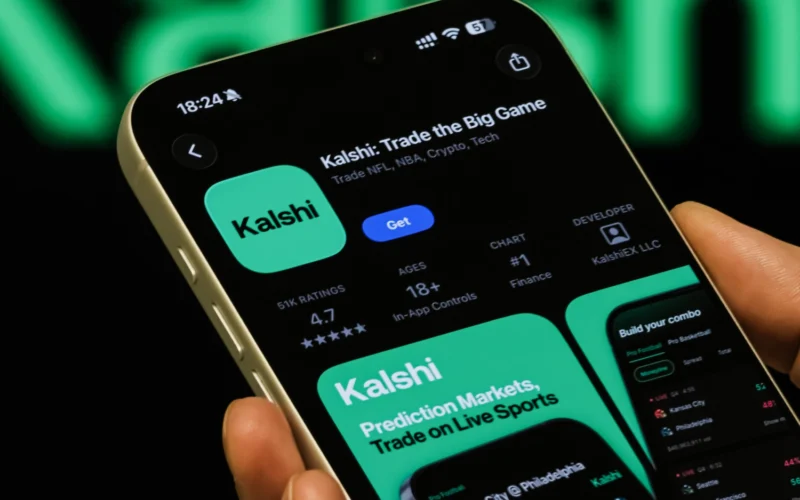
Kalshi is the dominant prediction market platform by volume in 2026. It operates as a CFTC-regulated Designated Contract Market in the US, which gives it a legal foundation that offshore competitors cannot match. It is also available in more than 140 countries internationally.
The company processed $12.35 billion in trading volume in March 2026, an 18% increase over its previous record. Sports event contracts drove 87% of that volume, with NCAA March Madness basketball as the single biggest category. For a platform that was primarily associated with political and economic markets two years ago, that shift is significant.
What works well
- Full CFTC regulation gives US users legal clarity
- FDIC insurance up to $250,000 on user balances
- Fiat deposits through bank transfer, wire, debit card, Apple Pay
- Deep liquidity across sports, economics, and politics
- Mobile app experience is polished and fast
- Sub-10ms execution for institutional VIP users
Where it falls short
- Full KYC required, which adds friction at signup
- Position limits on political contracts ($100K per CFTC rules)
- Sports contracts currently geofenced in Massachusetts pending litigation
- Fees are higher than Polymarket on most markets
- Less breadth outside sports and macro than Polymarket
Kalshi is the default answer for US users who want a legitimate, fully regulated experience with real dollar deposits. The sports volume has made it the destination for event-contract trading on American sports in particular.
2. Polymarket
Polymarket is the global leader outside the US regulatory framework and is now re-entering the US market after a multi-year absence. The company acquired QCX, a CFTC-registered exchange, and launched Polymarket US in February 2026. The US product is currently invite-only and limited to sports, while the international platform covers politics, crypto, sports, and cultural markets across 160+ countries.
Global Polymarket volume hit $10.15 billion in March 2026. The platform leads in political markets ($2.97 billion in March) and crypto-adjacent contracts ($2.72 billion), where its user base has structural advantages. Liquidity on major markets is genuinely deep, and the platform’s on-chain transparency lets anyone verify volumes and settlements.
What works well
- Deepest liquidity of any global prediction market
- No KYC on the international platform
- Low fees, with many markets charging zero trading fees
- On-chain transparency through Polygon blockchain
- Broadest market selection outside the US
- Strong political and crypto market coverage
Where it falls short
- International platform blocked for US residents
- US platform (Polymarket US) still invite-only as of April 2026
- Requires crypto wallet setup and USDC for international trading
- Settlement on Polygon adds complexity for first-time crypto users
- 1.5% fee for converting USDC to fiat on withdrawal
Polymarket is the strongest choice for non-US users who want maximum liquidity and market selection, and for anyone comfortable with crypto infrastructure. Once Polymarket US opens to the broader public, that calculation will change for American users as well.
3. DraftKings Predictions
DraftKings entered the prediction market space through its acquisition of Railbird Exchange in late 2025, and the product went live in 38 US states in early 2026. CEO Jason Robins has called prediction markets “the most exciting new growth opportunity we have seen since PASPA was struck down in 2018.”
The strategic angle here is geography. DraftKings Predictions operates in California, Texas, Florida, and other major non-sportsbook states, giving the company access to roughly 40% of the US population that cannot legally use traditional DraftKings sports betting. That market expansion matters more than the technology itself.
What works well
- Available in 38 US states including California, Texas, Florida
- Established brand recognition among US sports bettors
- Polished app and onboarding experience
- Proprietary market-making arm provides liquidity
- Integration with broader DraftKings ecosystem
Where it falls short
- Limited market breadth compared to Kalshi and Polymarket
- Still building liquidity in non-sports categories
- US-only availability
- Fee structure less competitive than crypto-native alternatives
DraftKings Predictions makes the most sense for existing DraftKings users who want prediction-market-style exposure to sports, and for residents of states where DraftKings sportsbook is unavailable. The product is improving fast but is not yet a Kalshi-level experience for serious traders.
4. Robinhood Event Contracts
Robinhood integrated event contracts directly into its brokerage app in 2025, and volume has grown quickly. In Q3 2025 alone, users traded over 2 billion event contracts on the platform. The product sits within the same interface used for stocks, options, and crypto, which removes one of the biggest friction points for traditional investors curious about prediction markets.
Event contracts on Robinhood are offered through Robinhood Derivatives, LLC and route through regulated exchanges. Markets cover sports, politics, economics, and some culture and technology categories, with pricing displayed in cents representing approximate probabilities.
What works well
- Zero additional app to install if you already use Robinhood
- Clean integration with regular brokerage workflows
- Standard Robinhood security and account protection
- Growing market selection across categories
- Supports fractional contracts and sub-penny pricing on some markets
Where it falls short
- Market selection narrower than dedicated prediction market platforms
- Less depth on political and crypto markets than Polymarket or Kalshi
- Interface optimised for stock traders, not prediction market specialists
- US-only availability
Robinhood is the natural choice for existing users who want to experiment with event contracts without leaving their main investing app. It will not replace Kalshi for serious traders, but for casual engagement it is genuinely convenient.
5. Manifold Markets
Manifold is a play-money prediction market platform that has become the go-to place for learning how event contracts work without real financial risk. Users trade with a virtual currency called mana, which cannot be cashed out but can be used across thousands of user-created markets covering everything from major news events to personal predictions.
The absence of real money makes Manifold less useful as a probability oracle, but more useful as a sandbox. The community is active and creative, and the platform has been embraced by researchers and forecasters who want to test ideas without capital at risk.
What works well
- No financial risk, so perfect for learning the mechanics
- Thousands of niche markets created by users
- Active community with strong discussion culture
- Free signup, no KYC, global availability
- Good environment for developing forecasting intuition
Where it falls short
- Prices less meaningful without real capital at stake
- Not a place to profit or hedge real-world exposure
- Liquidity is thin on many niche markets
- Incentives differ from real-money platforms in subtle ways
Manifold is the right starting point for someone who wants to understand how prediction markets work before committing real money elsewhere. Many serious traders used it as their on-ramp to the category.
6. OG (Overtime)
OG Predictions launched in early 2026 and has carved out a position as a sports-focused prediction market with tight integration into the Crypto.com ecosystem. Volume is smaller than Kalshi or Polymarket, but the platform offers competitive fees and attracts sports-first traders who want specialised liquidity.
What works well
- Sports-first interface optimised for game outcomes
- No winner bans or position limits common at sportsbooks
- Competitive fee structure
- Integration with Crypto.com user base
Where it falls short
- Newer platform still building liquidity
- Narrower market selection than major competitors
- Primarily US-focused
OG is the right choice for sports traders who want prediction-market-style execution with Crypto.com account integration. For anything other than sports, it is not the first platform to check.
7. Augur
Augur deserves mention for historical context and for what might happen next. It was the first decentralised prediction market built on Ethereum, launching in 2018 after years of development. User adoption never matched the ambition, and the platform went dormant by 2022.
In 2025, the Augur team announced a reboot with updated oracle technology and a renewed focus on decentralised prediction markets. Whether the revival produces a meaningful competitor to Polymarket or remains a niche project for decentralisation purists is still unclear. As of early 2026, activity is minimal but the project is genuinely active again.
Reality check
- Historically important, currently rebuilding
- Decentralised architecture that cannot be shut down by regulators
- Higher complexity than centralised or semi-centralised alternatives
- Not a practical choice for most users in 2026
Augur is worth watching for users who care about censorship-resistant prediction markets and are willing to accept the friction that comes with fully decentralised infrastructure. For anyone else, the major platforms above are the practical answer.
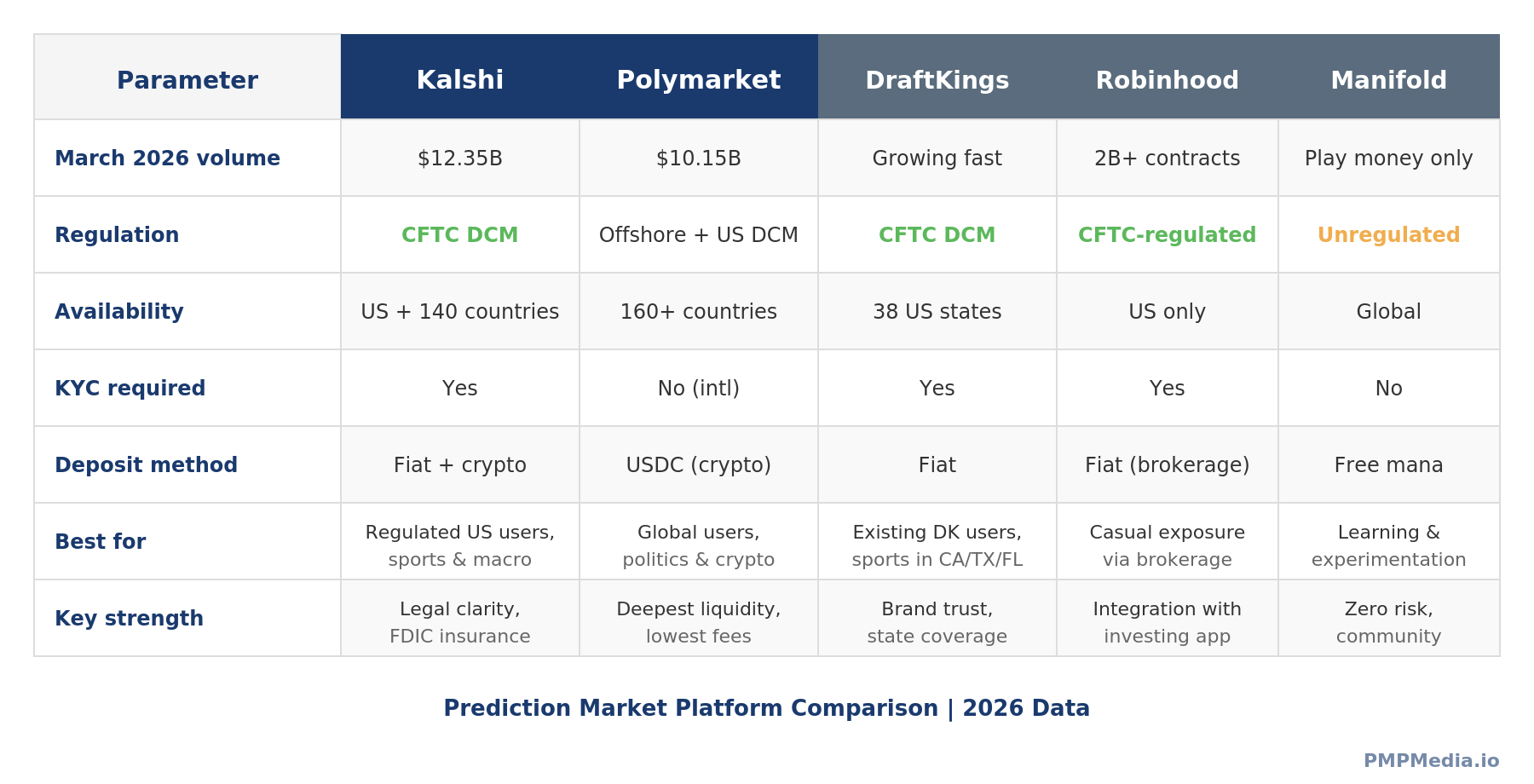
Comparison of the Main Prediction Market Platforms
The differences between platforms matter more than marketing pages suggest. Here is how the main options compare on the factors that actually affect user experience.
How to Choose the Right Platform
There is no universal answer, but the decision usually comes down to three questions.
Where are you located? US users start with Kalshi or DraftKings Predictions. Non-US users start with Polymarket. This is the single biggest filter.
Do you want real money exposure? If yes, Kalshi for US, Polymarket for international. If no, Manifold gives you the full mechanics without risk.
What do you want to trade? Sports are Kalshi’s specialty. Politics and crypto are Polymarket’s. Macroeconomic events are well covered on both. Sports with a familiar interface is where DraftKings and Robinhood compete.
WHAT SERIOUS USERS ACTUALLY DO
Most experienced prediction market users hold accounts on multiple platforms. The reason is simple: prices differ across platforms, and the gaps create arbitrage opportunities for anyone willing to manage the workflow. Kalshi and Polymarket frequently price the same event 2-5 cents apart, which is meaningful on large positions. You do not need to be a professional trader to benefit from comparing prices before placing a trade.
What Users Actually Care About
Beyond the headline comparisons, three factors matter more than anything else in practice.
Liquidity
A platform can look polished, but thin liquidity makes the experience frustrating. Bid-ask spreads widen, orders take longer to fill, and exiting a position becomes expensive. On major events, Kalshi and Polymarket both have liquidity deep enough to absorb $10,000+ positions without significant slippage. On smaller markets, even the leaders can feel thin. Checking the order book before committing to a position is a habit worth developing.
Regulatory Status
Regulation is not just a compliance issue, it is a practical one. Kalshi’s CFTC status means your account is protected, funds are FDIC-insured, and there is a clear legal framework if something goes wrong. Polymarket’s offshore structure means more freedom but less recourse. For small positions the difference may not matter, but for anyone trading serious size, it does.
Regulatory status varies dramatically by country. US CFTC regulation is the clearest framework for prediction markets, but UK classifies them as betting intermediaries, the EU takes a patchwork approach, and many jurisdictions have yet to formally classify the category. For the complete global iGaming regulation landscape covering all major markets, see our dedicated guide.
Curacao’s broad license scope covers casino, sportsbook, and poker, but not prediction markets — operators considering event contracts need different regulatory frameworks. For the current state of prediction market platforms and their licensing routes, see our comparison guide.
Fees
Fees compound. A 2% fee on a single trade is negligible, but the same 2% on 50 trades a month eats real returns. Polymarket’s fee advantage over Kalshi on most markets is one of the main reasons active international traders prefer it. Kalshi’s fees are defensible given the regulatory overhead, but they are still fees.
Are Prediction Markets Legal?
Legality depends on jurisdiction and platform. The regulatory map looks different now than it did even 18 months ago.
In the United States, CFTC-regulated platforms like Kalshi, DraftKings Predictions, Robinhood, and Polymarket US operate within a clear legal framework. Sports event contracts are subject to ongoing litigation in some states (Massachusetts has a preliminary injunction as of January 2026), and Senator-level proposals to give states authority over sports contracts have been introduced but not passed.
Internationally, Polymarket operates across 160+ countries without US-style regulation. Most users outside heavily regulated jurisdictions can access Polymarket freely, though some countries restrict crypto-based financial products in ways that affect access.
The practical answer: check local rules before depositing funds, but for most users in most countries the major platforms are accessible and legal.
Prediction Markets vs Traditional Betting
Prediction markets and sportsbooks look similar at first glance, but they work differently in ways that matter.
In a sportsbook, the operator sets the odds. If you bet $100 on a team at -110, the book takes the other side, adjusts its odds as money comes in, and profits on the spread between the two sides. Your counterparty is always the book.
In a prediction market, you trade contracts against other users. The platform charges a fee but does not take the opposing position. Prices move based on what users are willing to pay, not what the operator wants them to be. This creates different behaviour. Prices on prediction markets tend to move faster in response to news, and they often reflect information that has not yet been priced into sportsbook lines.
For traders who want to act on breaking information, prediction markets often offer better fills than sportsbooks. For casual bettors who just want to back a team they like, traditional sportsbooks are simpler. Many users do both, and the overlap is growing.
How Prediction Market Pricing Actually Works
Understanding the pricing mechanism is what separates serious users from casual ones.
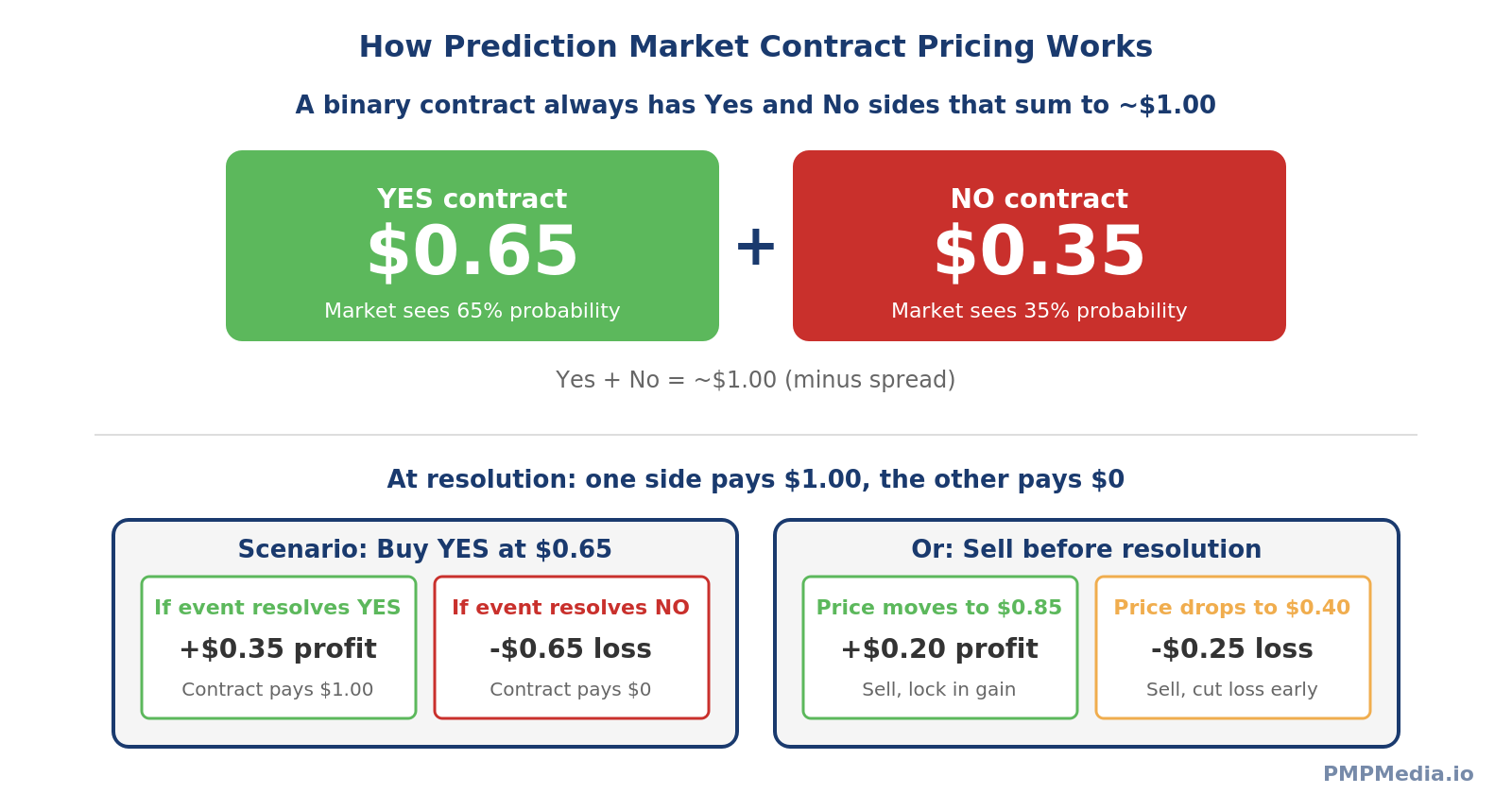
Every binary prediction market contract has two outcomes: Yes and No. Prices range from $0.01 to $0.99, and the prices of Yes and No together sum to roughly $1.00 (minus spread). If a Yes contract trades at $0.65, the No contract will trade at approximately $0.35.
When you buy a contract, you commit capital equal to the contract price. If your prediction resolves correctly, the contract pays $1.00. If it does not, it pays $0. Your profit on a winning Yes contract bought at $0.65 is $0.35, or about 54%. On a losing trade, you lose your $0.65.
Prices move continuously as users buy and sell, reflecting new information and shifting sentiment. You can sell your position at any time before the event resolves, capturing profit or cutting losses as prices change. This flexibility is the main reason prediction markets feel more like trading than betting.
Common Mistakes to Avoid
A few patterns come up repeatedly for new users, and they are worth flagging explicitly.
Trading thin markets without checking liquidity. A market with $500 of total volume is not a market, it is two people disagreeing. Prices on thin markets do not reflect genuine probability and can move sharply on tiny trades.
Ignoring resolution criteria. Before committing capital, read exactly how the market resolves. Ambiguous criteria lead to outcomes that feel wrong even when the prediction was directionally correct. This is the single most common source of complaint from new users.
Over-weighting recent news. Prediction markets often overreact to headlines in the first few minutes, then settle. Waiting for the initial move to stabilise usually produces better entry prices.
Treating prediction markets like sportsbooks. The mental model that works for parlays and point spreads does not work here. Think of each contract as an options position, not a bet.
Final Thoughts
Prediction markets have crossed the threshold from interesting experiment to legitimate financial product. The combined March 2026 volume of roughly $24 billion across just the two leaders is the kind of number that attracts serious institutional attention, and it will continue to grow as regulatory clarity improves and major brands like DraftKings, FanDuel, and Robinhood bring mainstream users into the category.
For most people, the right approach is to start with one platform that fits your location and risk tolerance. Non-US users should explore Polymarket. US users should start with Kalshi or DraftKings Predictions, or sample the mechanics on Robinhood if they already use it for investing. Manifold remains the best risk-free entry point for learning how event contracts actually behave.
The edge in prediction markets does not come from random guessing or from following the crowd. It comes from noticing when prices move too much or too little relative to the underlying probability, and from being willing to take positions when your view differs from the consensus. That is true whether you are trading $50 or $50,000. The mechanics scale, and the platforms above are the infrastructure that makes it possible.
FAQ
What is the best prediction market platform in 2026?
For US users, Kalshi is currently the largest and most regulated option, with DraftKings Predictions and Robinhood offering competitive alternatives. For non-US users, Polymarket is the clear global leader by volume and market selection. Both Kalshi and Polymarket processed over $10 billion in volume in March 2026.
Is Polymarket available in the US?
Polymarket launched Polymarket US in February 2026 after acquiring CFTC-registered exchange QCX. The US product is currently invite-only and limited to sports contracts, with a public rollout expected but no confirmed timeline. The international Polymarket platform remains blocked for US residents.
Is Kalshi legal in all 50 US states?
Kalshi operates as a CFTC-regulated Designated Contract Market and is available to users in most US states. Sports contracts are currently geofenced in Massachusetts following a January 2026 preliminary injunction, and ongoing litigation may affect availability in other states.
Can you make money trading prediction markets?
Yes, but success depends on analysis rather than guessing. Profitable users typically develop expertise in specific categories (politics, macro, specific sports), identify mispriced contracts, and manage position sizes carefully. Treating prediction markets like lottery tickets produces lottery-ticket results.
How do prediction market fees compare to sportsbook vig?
Prediction market fees are generally lower than sportsbook hold. Polymarket charges zero on many markets, while Kalshi’s fee formula produces costs typically below 1% of position size. Traditional sportsbooks bake a 4-5% vig into their lines on standard bets. The fee advantage is one of the main reasons prediction markets appeal to frequent traders.
Do I need cryptocurrency to use prediction markets?
Not necessarily. Kalshi, DraftKings Predictions, and Robinhood all accept standard dollar deposits through bank transfer, debit card, and similar methods. Polymarket’s international platform requires USDC and a crypto wallet. The regulated US platforms do not require crypto at all.
Are prediction markets the same as gambling?
Legally, it depends on the platform and jurisdiction. CFTC-regulated platforms like Kalshi are classified as derivatives exchanges, not gambling operators, which is why they can operate in states where sports betting is banned. From a user perspective, the mechanics sit somewhere between options trading and fixed-odds betting, with pricing behaviour closer to financial markets than to sportsbooks.
How do I know if a prediction market is liquid enough to trade?
Check total volume and the bid-ask spread before committing. Major markets on Kalshi and Polymarket routinely show millions in open interest and spreads of 1-2 cents. Thin markets show low volume and spreads of 10+ cents. A spread wider than 5 cents on a binary contract usually means the market is not ready for serious size.
What happens if a prediction market resolves ambiguously?
Each platform has a dispute resolution process. Kalshi uses CFTC oversight and formal dispute procedures. Polymarket uses a decentralised oracle (UMA) that can be challenged and escalated. Ambiguous resolutions do happen, which is why reading the exact resolution criteria before entering a market matters more than most users realise.
 Share
Share


 0 views