Prediction markets went from a niche corner of crypto and political forecasting to a $22.5 billion monthly volume industry in under three years. In March 2026 alone, Kalshi processed $12.35 billion and Polymarket processed $10.15 billion, with a combined 1,100% year-on-year growth. Sports contracts drive 85%+ of Kalshi’s volume, Trump Media is launching its own platform, and the Supreme Court may end up deciding whether prediction markets are financial instruments or gambling by 2027.
This guide covers everything someone approaching prediction markets in 2026 actually needs to understand: how they work, which platforms matter, what categories have the most liquidity, the legal status (it is complicated), the real risks, and how to start trading if you decide to. It is written for both new entrants and experienced traders looking for a grounded 2026 view without the hype.
For deeper reading on specific platforms, see our Polymarket review, Kalshi review, or our full comparison of the best prediction markets platforms.
Quick Verdict
Prediction markets in 2026 are a legitimate, fast-growing asset class that sits between traditional derivatives trading and sports betting. They offer genuine edge for traders who understand probability and market microstructure, produce forecast accuracy that beats most pollsters, and create clear entertainment value for casual users. They also carry real risks: legal uncertainty in multiple US states, opaque oracle resolution in crypto-based markets, and wash trading or information asymmetries that punish unprepared participants. Approach them as a new category of financial market, not as “better sports betting.”
What Are Prediction Markets
A prediction market is a marketplace where users trade contracts tied to the outcome of real-world events. Each contract pays $1 if the event resolves “yes” and $0 if it resolves “no.” The price between $0.01 and $0.99 represents the market’s implied probability of the event happening.
For example, a contract “Will the Fed cut rates in June 2026?” priced at $0.42 implies the market assigns a 42% probability to that outcome. If the Fed cuts rates, “Yes” holders receive $1 per contract. If not, the contract expires worthless.
This structure does three things simultaneously. It lets users speculate on outcomes they believe are mispriced. It aggregates information across thousands of participants into a single live probability. And it creates a settlement mechanism that pays winners and collects losses automatically.
For a formal definition, see our what are prediction markets page. This guide focuses on the practical landscape.
A Short History
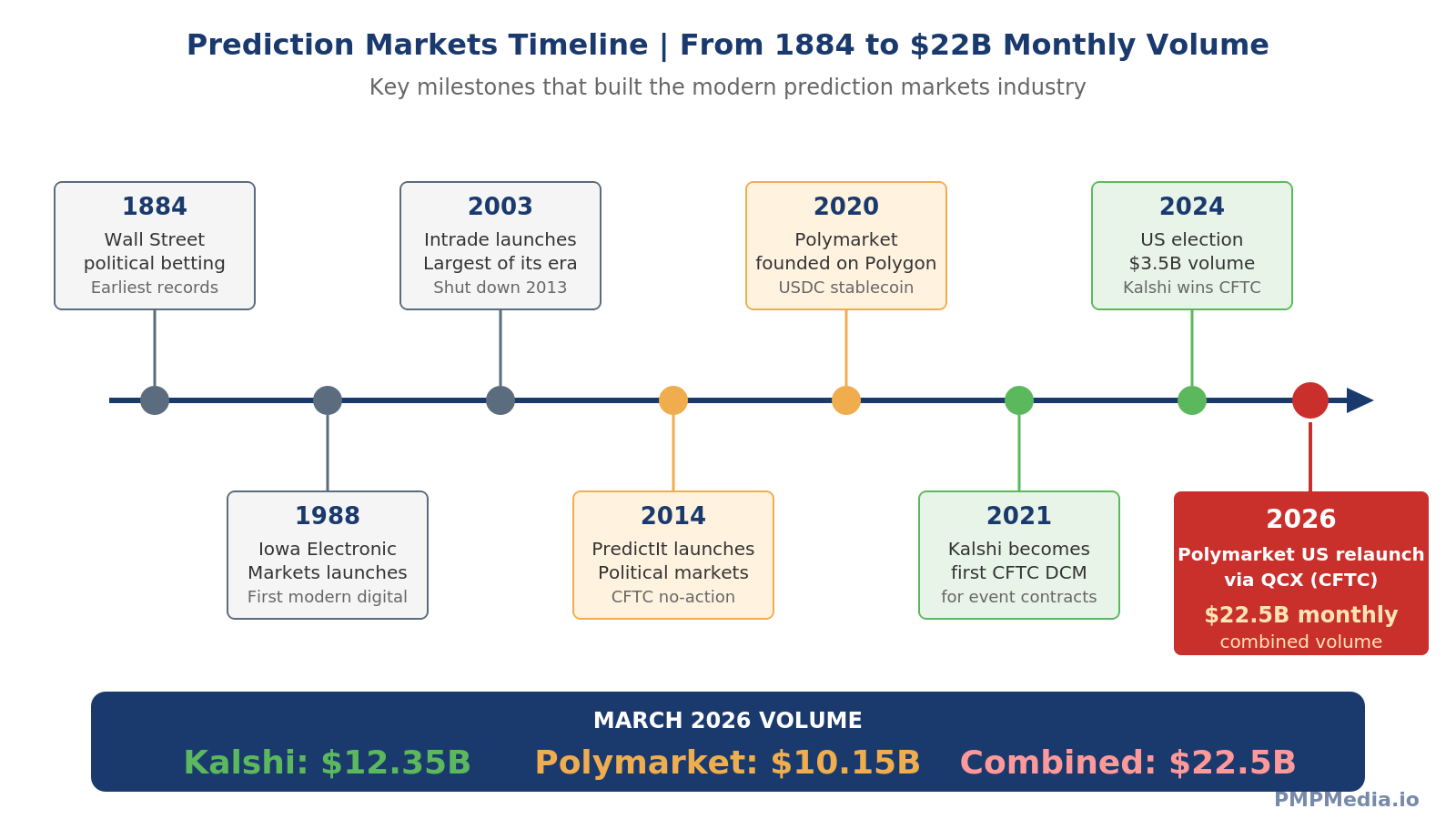
Prediction markets are not a 2024 invention. They trace back to informal political betting on Wall Street dating to 1884, with some forms of event betting going back to 1503. The modern digital version started with the Iowa Electronic Markets in 1988, a University of Iowa research project that still operates with small-stakes political and economic contracts.
The key milestones that brought prediction markets to where they are in 2026:
- 1988: Iowa Electronic Markets launches as the first modern electronic prediction market
- 2003: Intrade goes live and becomes the largest real-money prediction market globally before shutting down in 2013
- 2014: PredictIt launches with CFTC no-action relief for political event contracts
- 2020: Polymarket founded on Polygon blockchain, uses USDC stablecoin for trading
- 2021: Kalshi becomes the first CFTC-designated contract market for event contracts
- 2024: Polymarket processes over $3.5 billion during the US presidential election cycle. Federal court rules in Kalshi’s favor against the CFTC over political event contracts
- February 2026: Polymarket US relaunches via QCX acquisition, becoming a CFTC-regulated exchange for US users
- March 2026: Combined Kalshi + Polymarket monthly volume hits $22.5 billion
This is the fastest growth trajectory of any new financial market category since crypto derivatives. The combination of regulatory clarity in some areas, political interest driving awareness, and sports contracts creating volume has accelerated everything.
How Prediction Markets Work: Mechanics
Binary contracts and pricing
Almost every major prediction market contract is binary. Each contract has a “Yes” side and a “No” side. Prices range from $0.01 to $0.99 and sum to $1.00 between the two sides (minus small platform fees or spreads). If you buy 100 “Yes” shares at $0.65, you pay $65 for the position. If “Yes” resolves true, you receive $100 ($35 profit). If it resolves false, you lose your $65.
The price reflects the market’s aggregate probability estimate. Prices move as new information arrives, traders place new orders, and sentiment shifts. Active markets on Kalshi and Polymarket routinely see spreads of 1-2 cents, comparable to institutional-grade financial products.
Order books and liquidity
Prediction markets use open order books, like stock exchanges. You can place limit orders (buy or sell at a specific price) or market orders (execute immediately at the best available price). Maker orders that provide liquidity to the book typically pay no fees. Taker orders that remove liquidity pay variable fees (0.07-1.80% depending on platform and market conditions).
Liquidity is highly concentrated. The top 50 markets on Polymarket and Kalshi account for most of the daily volume, while long-tail markets can have spreads of 10+ cents and minimal depth. The practical implication is that trading strategy differs dramatically between high-volume markets and niche ones.
Resolution and settlement
Every contract has a resolution date and clearly defined settlement rules set at creation. When the event occurs, an oracle (a system that bridges real-world information with the platform) checks trusted data sources, verifies the outcome, and reports the result. This triggers automatic payout to winners.
Resolution mechanics differ by platform. Kalshi uses internal settlement tied to official data sources (government reports, sports league data, verified news). Polymarket uses UMA’s Optimistic Oracle, a decentralized protocol where any user can propose an outcome by posting a $750 USDC bond. If no one disputes within a 2-hour challenge period, the proposal becomes final. Disputed outcomes go to UMA token-holder voting.
The oracle mechanism matters because it determines trust. Kalshi’s settlement is operationally simpler and less contentious. Polymarket’s UMA system has resolved 99%+ of markets without controversy but has produced occasional high-profile disputes on ambiguous outcomes.
Making money
Users profit three main ways. First, by holding winning contracts to resolution and receiving $1 per share. Second, by trading in and out of positions as probabilities shift, locking in gains before resolution. Third, by market making (providing liquidity on both sides of a market to capture the spread).
Losses happen when you buy contracts at prices higher than the final outcome probability, when you panic sell at unfavorable prices, or when oracle disputes resolve against your position. Experienced traders treat prediction markets as a probability game where the edge comes from better information, better pricing discipline, and better risk management than the average participant.
The Major Prediction Market Platforms
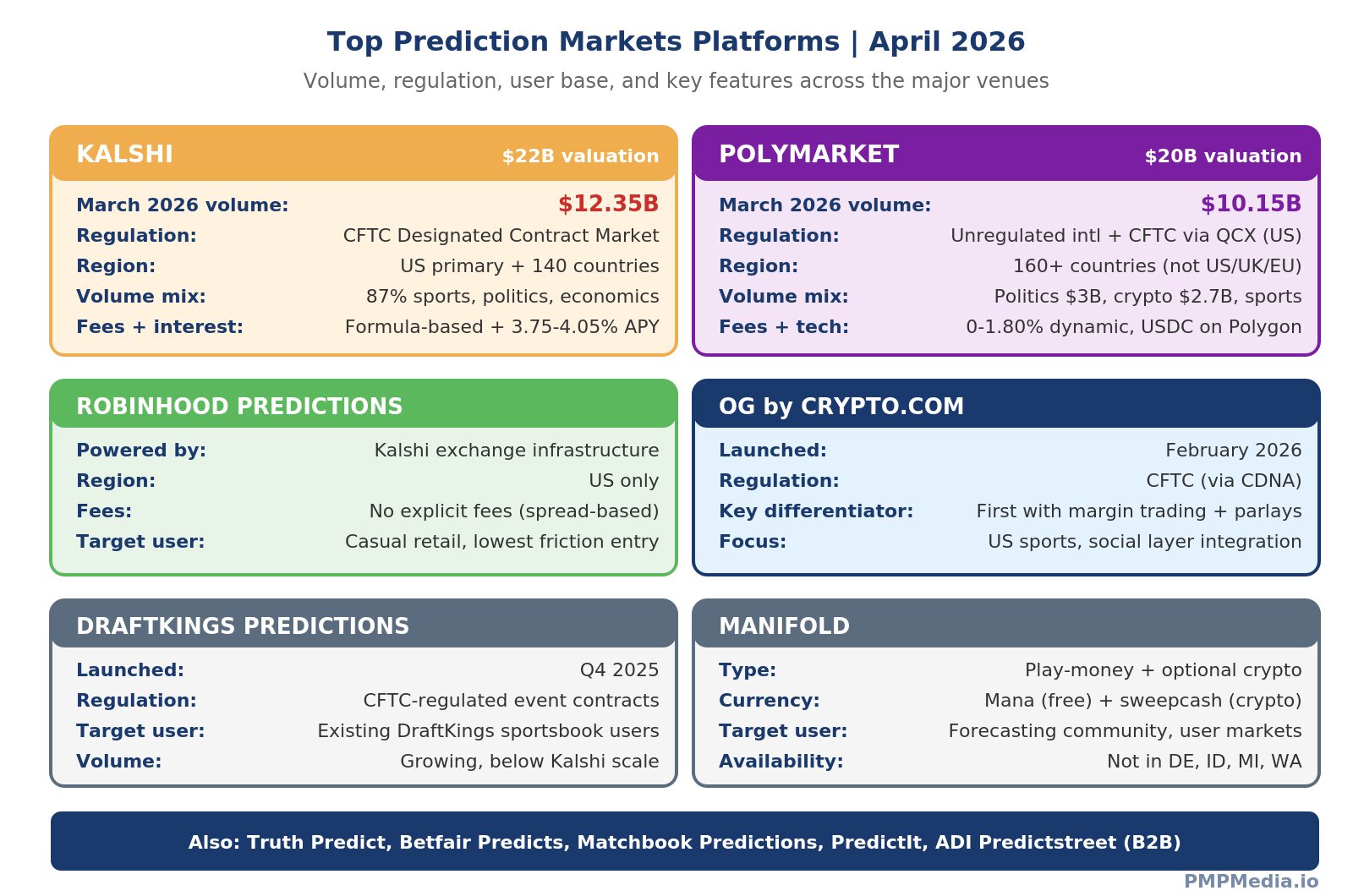
The prediction markets landscape in 2026 centers on two dominant platforms plus a growing set of secondary players.
Kalshi
Kalshi is the largest CFTC-regulated prediction market in the US. March 2026 volume was $12.35 billion, with 87% from sports contracts. The platform raised Series E at an $11 billion valuation in December 2025 and is now reported to be in discussions at $22 billion valuation. Fee structure uses a formula based on contract quantity and price, working out to roughly 1-7% per trade. Kalshi pays 3.75-4.05% APY on idle cash balances.
Kalshi’s strength is regulatory clarity in the US. Its weakness is geographic restriction (mainly US users) and the ongoing state-level legal battles over sports contracts. For a full breakdown, read our Kalshi review.
Polymarket
Polymarket is the largest prediction market globally by trading volume outside the US, with March 2026 volume of $10.15 billion. Politics accounted for $2.97 billion and crypto-adjacent markets for $2.72 billion. The platform operates as two products: Polymarket International (global, crypto-native, unregulated) and Polymarket US (CFTC-regulated via QCX, invite-only beta as of April 2026).
Polymarket’s fee structure was originally zero, now dynamic at 0%-1.80% depending on category. Settlement uses the UMA Optimistic Oracle. Funding is USDC on Polygon for international users, dollar deposits for US users. For the full review, see our Polymarket review.
DraftKings Predictions
Launched in Q4 2025, DraftKings Predictions brings a CFTC-regulated event contracts product to DraftKings’ existing sportsbook user base. The platform integrates naturally into the DraftKings app and targets users who already trade sports but want prediction-style contracts. Volume is growing but remains well below Kalshi’s level.
Robinhood Predictions
Robinhood Predictions launched in late 2024 powered by Kalshi’s regulated exchange infrastructure. It offers the full Kalshi catalog (political markets, economic data releases, sports outcomes) through Robinhood’s zero-friction mobile interface. No explicit trading fees for users, though Robinhood takes a spread. For Robinhood’s existing user base, this is the lowest-friction entry point to prediction markets in the US.
OG by Crypto.com
Crypto.com launched OG as an independent prediction markets platform in February 2026, with event contracts registered under the CFTC and a $500 rewards offer for the first million users. OG runs on infrastructure from Crypto.com and Derivatives North America (CDNA). The platform differentiates by offering margin trading (a first for regulated prediction markets), parlays, and a social layer. Focus is US sports.
Manifold
Manifold is a reputation-based prediction market using play-money “mana” and optional cryptocurrency “sweepcash” convertible to dollars. The platform focuses on long-tail markets, user-created questions, and community-driven forecasting. Not available in Delaware, Idaho, Michigan, or Washington State. Unlike Kalshi or Polymarket, Manifold targets forecasting culture rather than trading volume.
Secondary and emerging platforms
- Truth Predict: Trump Media’s crypto-based prediction market, launched via partnership with Crypto.com CDNA infrastructure
- Betfair Predicts: Flutter’s UK-focused prediction product, launched April 2026
- Matchbook Predictions: First UK-licensed prediction market, launched January 2026 under Gambling Commission framework
- ADI Predictstreet: B2B prediction platform that recently signed a deal with DAZN to embed prediction features in streaming
- PredictIt: Political markets under CFTC no-action relief, $850 per position cap
- Augur: Decentralized Ethereum-based platform, now effectively defunct
Prediction Markets vs Sports Betting vs Traditional Gambling
This distinction matters for regulation, user experience, and trading strategy. The boundaries are genuinely fuzzy, and the answer depends on who you ask.
Structural differences
Sports betting operates through bookmakers who set odds and take the opposite side of user bets. The house has a built-in margin (the vig or overround) that guarantees profit over volume. When you lose a bet, the bookmaker wins directly.
Prediction markets operate through peer-to-peer exchanges. The platform matches buyers and sellers and collects fees, but does not take positions. When you lose a contract, another user wins directly. Pricing is driven by supply and demand rather than set by an operator.
Traditional gambling (roulette, slots, most casino products) has a fixed house edge built into the mathematics of the game. The outcome depends on randomness, and the long-term expected return is negative.
Practical differences
- Pricing: Sportsbooks use odds (-110, +150). Prediction markets use dollar prices between $0.01 and $0.99.
- Liquidity management: Sportsbooks always accept your bet (up to limits). Prediction markets require matching counterparties.
- Exit before resolution: Prediction markets allow easy position exit at current market price. Sports bets typically require “cash out” features at disadvantageous prices.
- Fee structure: Sportsbooks bake margin into odds. Prediction markets charge transparent percentage fees.
Regulatory framing
The debate over whether prediction markets are gambling or financial instruments is not academic. It determines which regulator has jurisdiction, what licensing is required, and who can legally participate. In the US, federal courts are currently split on this question, which is why Kalshi’s sports contracts are legal in some states and not others.
The regulatory category question matters because different license frameworks apply depending on how a platform is classified. For the full picture of license categories operating globally, see our types of gambling licenses classification guide.
Market Categories
Understanding where liquidity concentrates tells you where the serious money is and where strategies work.
Sports
Sports dominate prediction markets volume in 2026. Kalshi reported $9.9 billion of its $11.39 billion March 2026 volume came from sports contracts. Polymarket hosts 4,000+ active sports markets. Categories include game winners, championship outcomes, player performance milestones, season records, and in-game events updated in real time.
European football, US major leagues (NFL, NBA, MLB, NHL), and international events (World Cup, Champions League, Olympics) drive the deepest liquidity. Sports markets are where prediction markets most directly compete with traditional sportsbooks.
Politics and elections
Politics is the category that built Polymarket’s reputation. As of April 2026, Polymarket has over 1,500 active political markets. Categories include US elections at federal and state level, UK political developments (Starmer leadership contracts are currently high-volume), European elections, cabinet appointments, legislative votes, approval ratings, and geopolitical outcomes.
Politics is where prediction markets most visibly compete with polling for forecast accuracy. During the 2024 US election, prediction markets called the outcome in real time while major pollsters were still showing it as a toss-up.
Crypto and finance
Crypto-adjacent contracts are Polymarket’s second-largest category, generating $2.72 billion in March 2026. Polymarket hosts 5,400+ active crypto markets covering Bitcoin price milestones, Ethereum targets, altcoin outcomes, and token launch predictions. Financial markets cover Fed rate decisions, inflation targets, equity milestones, commodities, and corporate earnings outcomes.
Geopolitics
Geopolitical contracts cover international conflicts, diplomatic events, sanctions outcomes, and treaty decisions. The Strait of Hormuz crisis starting February 2026 made oil and commodities one of Polymarket’s fastest-growing subcategories, with 153+ active oil-related markets.
Technology and science
Tech markets cover AI breakthroughs, IPO outcomes, product launches, corporate milestones, and scientific discoveries. SpaceX launch success, AI model releases, and IPO pricing are consistent volume drivers. Scientific markets (climate, medical, research) tend to have thinner liquidity but attract dedicated forecasting communities.
Culture and entertainment
Culture markets cover awards show winners, box office performance, music chart outcomes, celebrity events, and viral moments. Polymarket has 360+ active culture markets. These tend to see attention-driven volume spikes rather than sustained activity.
The unusual
Some markets get creative. Kalshi has hosted contracts on whether specific words appear in earnings calls, celebrity outfit choices, legal case outcomes, and weather milestones. The long tail of prediction markets is where forecasting communities experiment with the edge of what can be priced.
Legal Status by Jurisdiction
This is where things get genuinely complicated. Prediction markets occupy different regulatory categories in different places, and the situation is evolving fast.
United States
Federally, prediction markets are regulated by the CFTC as event contracts or swaps. Kalshi holds a Designated Contract Market license. Polymarket US operates as a CFTC-regulated exchange via the QCX acquisition. This gives both platforms federal legitimacy.
The state-level picture is messier. Multiple states argue that sports event contracts are gambling under state law, regardless of CFTC status. Massachusetts Judge Barry-Smith issued an injunction blocking Kalshi sports contracts in January 2026. Nevada, Arizona, Connecticut, Illinois, and others have taken enforcement actions. Arizona filed criminal charges against Kalshi in February 2026. The Trump administration sued Connecticut, Arizona, and Illinois in April 2026 to preempt state regulation in favor of federal CFTC authority. A Supreme Court case on the underlying federal-versus-state question is increasingly likely by 2027.
United Kingdom
The UK Gambling Commission issued guidance in February 2026 confirming that most prediction market contracts fall within the definition of a “Betting Intermediary” under UK gambling law. This means prediction market operators serving UK customers need a Gambling Commission license, not FCA authorization. Matchbook became the first UK-licensed prediction market in January 2026. Polymarket and Kalshi are explicitly prohibited from serving UK users.
European Union
The EU treats prediction markets inconsistently. Some member states (Germany, France, Netherlands, Belgium) prohibit or restrict access. Denmark allows platforms like Polymarket and Kalshi as long as they do not target Danish users with local payment methods or language. Other member states fall into various grey areas pending clearer regulation.
Geoblocked jurisdictions
MetaMask Prediction Markets (powered by Polymarket) is geoblocked from: Australia, Belgium, France, Germany, Netherlands, Switzerland, Ontario (Canada), Poland, Romania, Singapore, Taiwan, Thailand, Ukraine, UK, USA, and all US-sanctioned jurisdictions. This list is a reasonable proxy for where Polymarket International cannot legally operate.
Canada
Canada splits by province. Ontario has excluded international prediction markets. Other provinces have mixed enforcement positions. No Canadian-licensed prediction market operates at national scale as of April 2026.
Rest of world
In most of Latin America, Asia, and Africa, prediction markets operate in regulatory grey areas. Polymarket International is available in 160+ countries. The practical question in most of these jurisdictions is whether local banking or payment infrastructure supports crypto-based platforms rather than whether prediction markets are technically legal.
For a deeper dive on this topic, see our prediction markets regulation guide.
How to Start Trading
The practical path depends on where you are and what you want to trade.
US users
- For sports and politics with regulatory clarity: open a Kalshi account, verify identity, fund via bank transfer or debit card
- For the Robinhood interface: access Kalshi contracts through Robinhood Predictions if you already have a Robinhood account
- For crypto-native and lowest fees: apply for the Polymarket US invite waitlist (limited to sports contracts in early access)
- For sports-focused with margin: sign up to OG by Crypto.com
International users
- Outside the US, UK, EU restricted states, and geoblocked jurisdictions: Polymarket International is the primary option
- Setup requires a crypto wallet (MetaMask works well), USDC on Polygon for funding, and familiarity with crypto mechanics
- Alternatively, MetaMask Prediction Markets offers a wrapped version of Polymarket with simpler onboarding
UK users
- Matchbook Predictions is the only UK-licensed prediction market as of April 2026
- Betfair Predicts launched in April 2026 with Flutter’s licensing
- Polymarket and Kalshi cannot legally serve UK users
Starting strategy
For new users, the practical recommendation is to start small (under $100), focus on markets you genuinely understand, and track your decisions over at least 50-100 trades before concluding anything about your skill. Prediction markets reward discipline and pattern recognition over time. Most new users lose money in their first 3-6 months because they overweight narrative conviction and underweight liquidity dynamics.
Risks and Common Mistakes
Regulatory risk
Laws change and platforms can lose access to markets overnight. US state-by-state enforcement against sports contracts is an active risk. A Supreme Court ruling against federal CFTC authority would force major platform restructuring. Non-US users face similar risks as jurisdictions clarify their positions.
Platform risk
Centralized platforms (Kalshi, DraftKings, Robinhood, OG) face operational risk if the company fails. Decentralized platforms (Polymarket) face smart contract risk and oracle dispute risk. Both models have failure modes, and users should size positions accordingly.
Liquidity risk
Markets outside the top tier can have wide spreads and thin order books. Exiting a large position in an illiquid market can be expensive or impossible. New users consistently underestimate this and end up trapped in positions they cannot easily exit.
Information asymmetry
Prediction markets attract sophisticated traders with better information than casual users. Pricing often reflects this information advantage. Users who trade based on gut feel or mainstream media narratives typically lose to traders with deeper research or real-time data access.
Wash trading and manipulation
Polymarket’s anonymous structure allows wash trading (traders buying and selling with themselves to create apparent volume). UPI reported this is “quite prevalent on Polymarket” per market research interviews. Kalshi’s KYC requirements make wash trading harder but not impossible.
Oracle disputes
Polymarket’s UMA oracle has resolved 99%+ of markets without controversy but has produced high-profile disputes on ambiguous outcomes. A dispute can delay payout or flip the resolution in ways that are not always intuitive. Understand the resolution mechanism before trading significant positions.
Common mistakes
Overtrading illiquid markets. New users often trade niche markets where their information edge does not compensate for the wide spreads and execution risk. Stick to top-volume markets until you understand the liquidity dynamics.
Confusing conviction with edge. Being confident about an outcome does not mean the market is mispriced. Your job is to find gaps between market probability and true probability, not to prove you are right.
Ignoring fees on short-duration trades. Dynamic fee structures mean frequent trading on low-margin markets can eliminate your edge entirely. Model the break-even before high-frequency strategies.
Not understanding resolution criteria. Read the full resolution rules before trading. Edge cases (Was the outcome announced by the deadline? Does the data source count?) decide close markets.
Using prediction markets as sports betting without adjusting mental model. Prediction markets reward probability-first thinking. Users who approach them like sportsbooks miss the different liquidity dynamics and fee structures.
Why Prediction Markets Are Growing
The 1,100% year-on-year growth on Kalshi is not an accident. Several structural factors are driving adoption simultaneously.
Forecast accuracy. Prediction markets consistently outperform expert predictions and polling averages on verifiable outcomes. The 2024 election was the most public demonstration of this, but the pattern holds across politics, economics, and sports. For institutions and serious analysts, this creates real value beyond speculation.
Regulatory clarity in the US. The CFTC designation of Kalshi as a DCM and Polymarket’s QCX acquisition gave both platforms federal legitimacy that earlier prediction markets lacked. This opened the door to institutional participation, mainstream media coverage, and partnership deals (Kalshi-Fox Corporation, ADI Predictstreet-DAZN).
Sports contracts unlock volume. The legal permissibility of sports event contracts under federal CFTC authority (contested by states but currently operating) turned prediction markets into a competitor for the $100B+ US sports betting market. This is what drove 87% of Kalshi’s March 2026 volume.
Political engagement. Polymarket became a cultural phenomenon during the 2024 election and the Trump administration’s second term. Political markets create passionate user communities that drive engagement beyond pure financial speculation.
Crypto infrastructure. Polymarket’s Polygon-based architecture allowed it to scale globally in a way that traditional financial infrastructure could not match. USDC settlement, smart contract enforcement, and permissionless participation created a product that works in 160+ countries simultaneously.
The 2026-2027 Outlook
Three trends will shape prediction markets over the next 18 months.
The Supreme Court question. Ninth Circuit reports suggest the judges were skeptical of Kalshi’s arguments against Nevada’s state gambling laws. If the Ninth Circuit rules against Kalshi, a circuit split with earlier rulings in Kalshi’s favor makes a Supreme Court case very likely by 2027. This could redefine whether sports event contracts are federal-only or subject to state law.
Consolidation and institutional entry. Kalshi and Polymarket are both raising at $20B+ valuations. Bernstein projects $1 trillion prediction market volume by 2030. Institutional capital is entering through Fox Corporation partnerships, DAZN integrations, and traditional sportsbook entries (Matchbook, Betfair, DraftKings).
Regulatory response internationally. The UK Gambling Commission has set a model (treat prediction markets as betting exchanges). The EU is likely to follow with a coordinated approach. Australia, Canada, and parts of Asia are expected to make final decisions on their regulatory treatment during 2026-2027.
Who Should Trade Prediction Markets
Prediction markets work for:
- Traders with probabilistic thinking who understand market microstructure
- Users with genuine information advantages in specific categories
- Speculators looking for a more transparent alternative to traditional sports betting
- Researchers and analysts using market prices as forecast signals
- Crypto-native users comfortable with wallet mechanics (for Polymarket International)
Prediction markets do not work well for:
- Users seeking guaranteed returns or low-volatility investment
- Participants who cannot distinguish between conviction and edge
- Users in jurisdictions with unclear or hostile regulatory treatment
- Casual bettors who prefer fixed-odds simplicity over exchange mechanics
- Anyone who cannot afford to lose the capital they deploy
Related Guides
- What Are Prediction Markets (Definition)
- Best Prediction Markets Platforms
- Polymarket Review
- Kalshi Review
- Prediction Markets Regulation
- Are Prediction Markets Legal
- Prediction Markets vs Betting
Final Verdict
Prediction markets in 2026 are a legitimate asset class with $22+ billion in monthly volume, $40+ billion in combined platform valuations, and clear regulatory legitimacy in the US under the CFTC framework. They offer real advantages over traditional betting (transparent pricing, exchange-based mechanics, genuine information aggregation) and create forecast accuracy that outperforms most experts on verifiable outcomes.
They also carry real risks. The legal picture is unsettled in the US, restrictive in most of the EU, and evolving in the UK. Liquidity is highly concentrated in top markets, punishing users who spread thin across niche contracts. Information asymmetries favor sophisticated traders. Oracle disputes can flip positions unexpectedly.
Approach prediction markets as a new type of financial market rather than a better sportsbook, size positions conservatively until you understand the mechanics, and focus on categories where you have genuine edge. The category will be materially bigger and more regulated in 18 months than it is today. The question is whether you will have learned enough about how it works to participate effectively when it matures.
FAQ
Are prediction markets gambling?
It depends on the jurisdiction. In the US, the CFTC treats them as event contracts (derivatives), while multiple states argue they constitute gambling. In the UK, the Gambling Commission classifies them as betting intermediaries (gambling). In the EU, treatment varies by member state. The legal classification determines which regulator has authority and what licensing applies.
How do prediction markets make money?
Platforms earn revenue through trading fees (0.07-1.80% per trade on Polymarket, formula-based on Kalshi), bid-ask spreads on certain market structures, and interest earned on user deposits (Kalshi pays 3.75-4.05% APY to users but earns more on Treasury holdings). Some platforms also monetize data and API access for institutional users.
How accurate are prediction markets?
Research consistently shows prediction markets outperform expert forecasts and polling averages on verifiable outcomes. The 2024 US election is the most prominent recent example. Accuracy is strongest in high-volume markets with diverse participants and weakest in thin markets dominated by small groups. Markets with clear resolution criteria and deep liquidity typically produce probability estimates within 2-3% of the ultimate frequency of the events.
Can you make money on prediction markets?
Yes, but consistent profits require real skill. The average casual user loses money due to fees, spreads, and information disadvantages. Profitable traders typically have domain expertise (sports analytics, political data, economic modeling), disciplined risk management, and patience. Market making can generate consistent returns for users with capital and infrastructure but requires managing inventory risk.
What is the biggest prediction market?
By monthly trading volume, Kalshi is the largest at $12.35 billion in March 2026. Polymarket is second at $10.15 billion. Both are valued at approximately $20-22 billion each. Together they account for 95%+ of global prediction market volume.
Are prediction markets legal in the US?
Kalshi and Polymarket US are CFTC-regulated and operate legally at the federal level. State-level challenges to sports event contracts are ongoing in Massachusetts, Nevada, Arizona, Connecticut, and Illinois. The federal government is suing those states to preempt state gambling enforcement. A Supreme Court decision on federal-versus-state authority is increasingly likely by 2027. See our are prediction markets legal guide for detail.
Are prediction markets legal in the UK?
Only UK Gambling Commission licensed operators can serve UK users. Matchbook Predictions (January 2026) and Betfair Predicts (April 2026) are the main UK-licensed platforms. Polymarket and Kalshi are prohibited from serving UK customers. The UKGC treats prediction markets as betting intermediaries, equivalent to betting exchanges.
What is the difference between Kalshi and Polymarket?
Kalshi is CFTC-regulated, US-based, primarily fiat-funded, and has ~85% sports volume. Polymarket International is crypto-native (USDC on Polygon), available in 160+ countries, and skews toward politics and crypto markets. Polymarket US launched in February 2026 as a separate CFTC-regulated product for US users. For a detailed comparison, see our Polymarket review and Kalshi review.
How do prediction markets resolve outcomes?
Each platform uses an oracle mechanism. Kalshi uses internal settlement tied to official data sources and verified news. Polymarket uses UMA’s Optimistic Oracle, where any user can propose an outcome by posting a $750 USDC bond. If undisputed within 2 hours, the proposal becomes final. Disputed outcomes go to UMA token-holder voting. Over 99% of markets resolve without dispute.
Can I short a prediction market?
Yes. Buying “No” shares is functionally equivalent to shorting “Yes.” You can also sell “Yes” positions you previously bought to exit before resolution. OG by Crypto.com additionally offers margin trading, allowing leveraged short positions on prediction markets, which is a first for CFTC-regulated platforms.
What fees do prediction markets charge?
Fees vary by platform. Polymarket uses a dynamic structure of 0%-1.80% depending on category, with Polymarket US at flat 0.30%. Kalshi uses a formula (0.07 × contracts × price × (1-price)) that works out to roughly 1-7% per trade depending on market conditions. Robinhood Predictions charges no explicit fees but earns through spreads. OG and DraftKings Predictions use competitive percentage-based structures.
Can prediction markets predict the future?
Prediction markets aggregate information from participants into probability estimates, which on average are more accurate than individual expert forecasts or polls on verifiable outcomes. They do not predict the future with certainty. They produce a probability distribution reflecting collective knowledge. Users who treat prediction market prices as probabilities (not certainties) extract the most value from the information.
 Share
Share


 0 views