






A prediction market is a marketplace where people trade contracts tied to the outcome of specific future events. The contract price represents the market’s estimate of the probability the event will happen. If the event occurs, the contract pays $1. If not, it pays $0. Somewhere between those two extremes, thousands of traders negotiate what they think the probability actually is, and the price moves in real time as new information arrives.
That definition is simple, but what makes prediction markets interesting is not the mechanics. It is what happens when you use money to aggregate opinions. Prediction markets consistently produce probability estimates that beat expert forecasts, beat polling averages, and beat most individual analysts on verifiable outcomes. The 2024 US election was the most recent proof point: markets called the outcome while major pollsters were still showing a toss-up. That is not an accident.
This guide explains what prediction markets actually are, how they work mechanically, why they tend to be accurate, what the common examples look like, and how they differ from traditional betting. For the broader industry overview including platforms, regulation, and how to start trading, read our prediction markets guide.
The Core Definition
A prediction market is a type of exchange where the traded asset is not a stock, bond, or commodity. It is a contract tied to whether a specific event will happen by a specific date.
Every contract has three components:
- The question: a clear, verifiable event with an unambiguous yes or no outcome
- The deadline: a specific resolution date by which the outcome must be determined
- The resolution source: a trusted authority or data source that will confirm the final outcome
Examples of prediction market questions that have actually traded in 2026:
- “Will the Federal Reserve cut interest rates in June 2026?”
- “Will Bitcoin close above $100,000 on December 31, 2026?”
- “Will the Kansas City Chiefs win Super Bowl LX?”
- “Will Keir Starmer remain UK Prime Minister through December 2026?”
- “Will SpaceX successfully land Starship on the moon by the end of 2027?”
Each question has a Yes contract and a No contract. Their prices must sum to $1.00 (ignoring tiny platform spreads). If the Yes is trading at $0.62, the No is trading at $0.38. The market is saying there is a 62% implied probability the event resolves Yes.
How Prediction Markets Work Mechanically
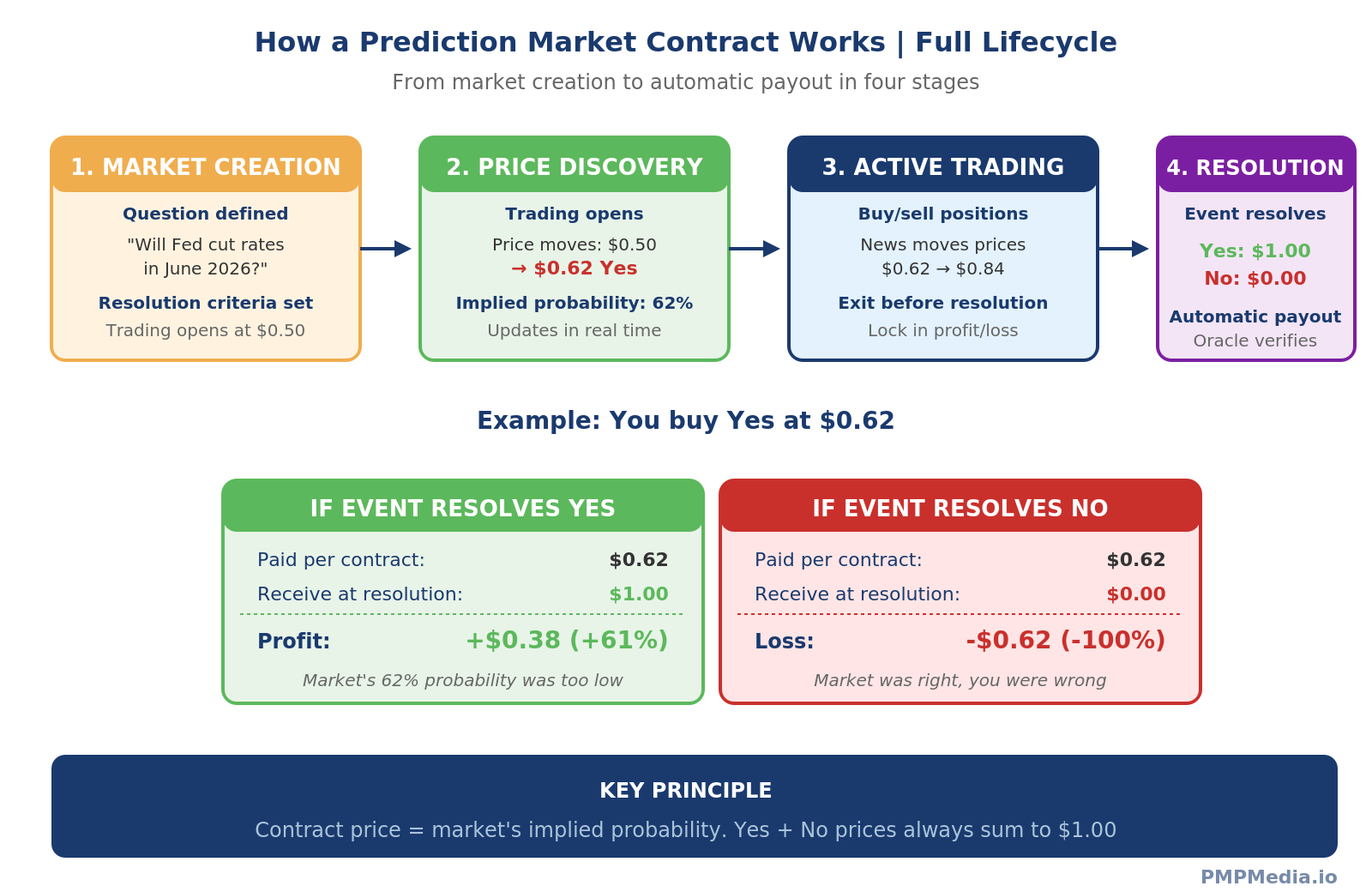
Understanding the mechanics matters because they are different from anything most people have traded before. Here is the full cycle of a prediction market contract.
Step 1: Market creation
A platform or user creates a market by defining the question, the deadline, and the resolution rules. For example: “Will the US Consumer Price Index come in above 3.0% year-over-year for April 2026?” The resolution source would be the Bureau of Labor Statistics announcement, scheduled for release on a specific date.
The platform then opens trading. Both Yes and No shares start at $0.50 (implying 50% probability) until trading begins. As soon as orders arrive, prices move.
Step 2: Trading and price discovery
Traders buy and sell Yes and No contracts through an order book, similar to a stock exchange. If more traders think Yes is undervalued at $0.50, buy orders push the price up. If more traders expect No to happen, sell pressure on Yes pushes it down.
Prices on active markets update constantly. A typical Kalshi or Polymarket contract on a high-volume question will see spreads of 1-2 cents and thousands of trades per day. When breaking news arrives, prices can move 10+ cents in minutes.
The important mechanical detail: when you buy a Yes contract at $0.62, you pay $0.62 now. If the event resolves Yes, you receive $1.00 (profit of $0.38, or 61% return). If the event resolves No, you receive $0 (loss of $0.62).
Step 3: Resolution and payout
On the resolution date, the platform’s oracle checks the outcome against the resolution source. If CPI came in at 3.2%, the “above 3.0%” market resolves Yes. Yes contracts pay $1.00 each, No contracts pay $0. Payout happens automatically.
Different platforms handle resolution differently. Kalshi uses internal resolution tied to official data sources and trusted news. Polymarket uses UMA’s Optimistic Oracle, a decentralized system where any user can propose an outcome by posting a bond, and disputes get resolved by UMA token holders. Over 99% of markets resolve without controversy, but the edge cases can be interesting.
Step 4: Exit before resolution
This is a feature that most people miss. You do not have to hold contracts to resolution. If you bought Yes at $0.62 and the price rises to $0.84 because news supports your position, you can sell the contract immediately and lock in the $0.22 profit without waiting for the event to actually happen.
This is why prediction markets behave more like stock exchanges than like sportsbooks. You are not trapped in your position. You can exit at any time the market will let you, at whatever price the order book is offering.
Why Prices Equal Implied Probability
This is the concept that makes prediction markets interesting beyond speculation. It is worth understanding properly.
Imagine a contract “Will Event X happen?” trading at $0.70. A rational trader thinks through the math:
- If I buy Yes at $0.70 and the event happens, I win $0.30
- If I buy Yes at $0.70 and the event does not happen, I lose $0.70
- My expected profit equals (probability of Yes × $0.30) − (probability of No × $0.70)
- This equals zero only when probability of Yes = 70%
If traders genuinely believed the probability was higher than 70%, they would buy more Yes contracts, pushing the price above $0.70. If they thought it was lower, they would sell, pushing the price down. The equilibrium price reveals what the collective market actually believes the probability to be.
This is why prediction markets are often called “probability engines.” The price is not an arbitrary guess. It is the aggregated belief of every trader who has put money on the line, weighted by how much capital they were willing to commit.
Why Prediction Markets Are Often Accurate
The academic literature on this is surprisingly consistent. Prediction markets tend to outperform individual experts, polling averages, and most forecasting methods on verifiable outcomes. The phenomenon is called the wisdom of crowds, and prediction markets are probably the clearest practical demonstration of it.
Three mechanisms drive the accuracy:
Financial incentives for honesty
In a poll, respondents can say anything without consequence. In a prediction market, you have to back your belief with money. If your belief is wrong, you lose. This selects for traders who genuinely think they have an edge and filters out people who are just noise. Over time, the traders with consistently better information have more capital to deploy, which amplifies their influence on prices.
Information aggregation
Every trader brings their own information to the market. A political consultant in Washington has different information than a local journalist in Ohio, who has different information than a data scientist building a statistical model. When all of them trade on the same contract, the price reflects a weighted blend of their private information. No individual forecaster can match that breadth.
Real-time updates
Unlike polls, which are snapshots taken at a specific moment, prediction markets update continuously. When news breaks, prices move within seconds. This makes them particularly useful for fast-moving events where the probability genuinely changes hour by hour.
The 2024 US election is the canonical example. By election night, prediction markets had shifted decisively before most TV networks called states, and major polling averages were still showing a statistical tie when markets were pricing near-certainty.
This accuracy is not perfect. Markets can be wrong, especially when participation is thin or when traders have systematic biases. But on average, across thousands of verifiable questions, they produce probability estimates within 2-3% of the ultimate frequency of the events.
Real-World Examples of Prediction Markets in Action
Prediction markets have been used for far more than just speculation. Understanding the range of applications helps show why the category matters.
Elections and politics
Polymarket processed over $3.5 billion in election-related volume during the 2024 US cycle. In April 2026, the platform has 1,500+ active political markets covering elections, leadership contests, cabinet appointments, and legislative outcomes. Prediction market prices are now routinely cited by financial news and political analysts as probability estimates.
Economic forecasting
Markets on Fed rate decisions, inflation outcomes, and GDP numbers are used by traders, economists, and policy analysts. They provide a real-time implied probability of specific macro outcomes that financial markets can reference. Kalshi hosts markets on virtually every major Bureau of Labor Statistics release.
Sports
Sports event contracts are the volume leader in 2026. Kalshi reported 87% of its March 2026 volume, or $9.9 billion, came from sports contracts. This includes game outcomes, championship winners, player performance milestones, and in-game events. Sports prediction markets compete directly with traditional sportsbooks but with different mechanics.
Corporate decision-making
Some companies use internal prediction markets for forecasting and decision-making. Best Buy experimented with internal markets to predict whether a Shanghai store would open on schedule — the employees correctly predicted the delay, saving money. Google, Ford, and other large companies have run internal markets to forecast product launch dates, sales figures, and project outcomes.
Public health and research
Prediction markets have been used in pilot studies to forecast disease spread. A statewide influenza outbreak in Iowa was predicted 2-4 weeks in advance by a prediction market of healthcare workers. Pharmaceutical companies including Eli Lilly have used prediction markets internally to forecast drug development outcomes.
Science and technology
Markets on SpaceX launch success, AI model release dates, cryptocurrency milestones, and IPO outcomes attract forecasting communities interested in specific domains. While volume is lower than sports or politics, these markets often produce surprisingly accurate forecasts on narrow technical questions.
Prediction Markets vs Traditional Betting
This is the question most new users ask first, and the answer matters for both regulatory treatment and practical experience.
Structural difference
In traditional sports betting, a bookmaker sets the odds and takes the opposite side of every bet. The house has a built-in margin called the vig or overround that guarantees profit over volume. When you bet $100 at -110 odds (implied probability around 52.4%), you are paying the bookmaker roughly a 4.5% fee baked into the odds themselves. When you win, the bookmaker pays you. When you lose, the bookmaker keeps your money directly.
In a prediction market, you are trading against other users through an exchange. The platform matches buyers and sellers and takes a transparent fee, but does not take positions. When you win, another user loses directly. The platform does not have skin in your specific trade.
Pricing transparency
Prediction market prices are literally the implied probability. A contract at $0.70 means 70% probability. There is no hidden margin in the number itself. The platform adds fees separately (typically 0-2%), and those fees are disclosed.
Sportsbook odds have the margin built in. The posted odds on both sides of a coin flip are typically -110 and -110, implying 52.4% on each side, even though the true probabilities sum to 100%. That 4.8% “extra probability” is the bookmaker’s edge.
Exit and liquidity
Prediction markets let you sell positions at any time the order book will accept the trade. If you buy Yes at $0.40 and the price rises to $0.70 before the event resolves, you can sell to lock in the $0.30 profit. You are never locked into your original bet.
Traditional sportsbooks offer “cash out” features, but these are priced at substantial discounts to true probability and are not always available. The exit is a nice-to-have on sportsbooks; it is a core feature on prediction markets.
Market variety
Sportsbooks focus on sports. Some also offer politics and entertainment, but with limited depth. Prediction markets span everything that can be verifiably resolved: sports, politics, economics, science, technology, weather, culture. Kalshi hosts more than 600 distinct markets on any given week. This breadth is part of what makes prediction markets a different product category, not just a sportsbook with a different interface.
Regulatory classification
In the US, prediction markets are regulated by the CFTC as event contracts or swaps. Sports betting is regulated by state gaming commissions. The distinction is not universally accepted (several states currently argue Kalshi’s sports contracts violate state gambling laws), but at the federal level, prediction markets are treated as financial instruments. For more on this, see our prediction markets vs betting guide.
Risks to Understand
Prediction markets are a legitimate category, but they are not risk-free. Anyone considering participation should understand the realistic ways to lose money or get stuck in positions.
You can lose your entire contract cost. If you buy Yes at $0.62 and the event resolves No, you lose all $0.62 per contract. Unlike traditional investments where you can hold indefinitely and hope, binary contracts have hard resolution dates.
Liquidity dries up in long-tail markets. The top 50 markets on Kalshi and Polymarket have deep order books and tight spreads. Everything below that can have spreads of 10+ cents and minimal depth. Exiting a position in an illiquid market can be expensive or impossible.
Information asymmetries favor sophisticated traders. Large prediction markets attract professional traders with research budgets, real-time data access, and modeling infrastructure. Casual users trading on vibes and mainstream media narratives typically lose over time. The market is not a charity.
Platform risk exists. Centralized platforms can face operational issues. Decentralized platforms face smart contract risk and oracle dispute risk. Size positions accordingly, and do not keep more capital on any single platform than you can afford to lose.
Regulation can change. Laws evolve, platforms can lose access to markets or jurisdictions, and a Supreme Court ruling on the federal-versus-state authority question could fundamentally reshape the US landscape by 2027.
Where Prediction Markets Are Legal
The legal situation is genuinely complicated and varies widely by jurisdiction. Here is the short version:
- United States: Legal federally under CFTC authority. State-level challenges to sports contracts are ongoing in Massachusetts, Nevada, Arizona, Connecticut, Illinois, and others. Main platforms: Kalshi, Polymarket US, DraftKings Predictions, Robinhood Predictions, OG by Crypto.com.
- United Kingdom: Regulated by the Gambling Commission as betting intermediaries. Only UK-licensed platforms (Matchbook Predictions, Betfair Predicts) can serve UK users. Polymarket and Kalshi are prohibited.
- European Union: Varies by member state. Germany, France, Netherlands, Belgium, and others restrict or prohibit. Some states operate in grey areas.
- Rest of world: Polymarket International is available in 160+ countries but geoblocked from Australia, Canada (Ontario), Singapore, Thailand, and others.
For full coverage of the legal picture, see our prediction markets regulation guide and are prediction markets legal page.
A Short History of Prediction Markets
Prediction markets are not a 2024 invention. Informal political betting on Wall Street dates back to 1884. The modern electronic version started with the Iowa Electronic Markets in 1988, a University of Iowa research project that still operates today.
Key milestones:
- 1988: Iowa Electronic Markets launches as the first modern prediction market
- 2003: Intrade goes live as the largest real-money prediction market of its era
- 2014: PredictIt launches with CFTC no-action relief for political event contracts
- 2020: Polymarket founded on the Polygon blockchain using USDC stablecoin
- 2021: Kalshi becomes the first CFTC-designated contract market for event contracts
- February 2026: Polymarket US relaunches as a CFTC-regulated exchange after acquiring QCX
- March 2026: Kalshi and Polymarket combined monthly volume hits $22.5 billion
The industry is growing at over 1,000% year-on-year. What started as a niche research category is now a $40 billion valuation market category with institutional partnerships (Fox Corporation, DAZN, Trump Media) and serious regulatory attention.
Who Uses Prediction Markets
Users fall into a few broad categories:
Speculative traders. The largest group. People who think they have an edge on a specific outcome (a sports team, an election, a crypto price) and want to trade on that view. For this group, prediction markets are an alternative to traditional betting or financial speculation.
Information aggregators. People who use prediction market prices as forecast signals without necessarily trading. Journalists, policy analysts, and institutional investors cite prediction market probabilities the way they used to cite poll averages.
Market makers. Sophisticated traders who provide liquidity on both sides of a market to capture the spread. This is a professional activity requiring capital, infrastructure, and risk management, and market makers are a meaningful portion of volume on top markets.
Researchers and academics. Data scientists studying collective intelligence, forecasting accuracy, and market microstructure use prediction market data for academic research.
Institutions and organizations. Companies, non-profits, and government agencies use internal or public prediction markets for decision-making, resource allocation, and risk analysis.
Related Guides
- Prediction Markets Guide (Industry Overview)
- Best Prediction Markets Platforms
- Polymarket Review
- Kalshi Review
- Prediction Markets vs Betting
- Prediction Markets Regulation
- Are Prediction Markets Legal
The Short Answer
Prediction markets are marketplaces where people trade contracts tied to future events. The contract price represents the market’s implied probability of the event happening. When the event resolves, winners receive $1 per contract and losers receive nothing. What makes the structure interesting is that the resulting prices tend to be surprisingly accurate probability estimates, because money filters out noise and rewards traders with genuine information.
In 2026, the category has crossed from niche to mainstream. Combined monthly volume on the two leading platforms exceeds $22 billion. Forecast accuracy on verifiable events beats most expert analysis. Regulation is still evolving, but the US has federal clarity under the CFTC framework and international platforms serve 160+ countries.
If you want to trade them, the best prediction markets page compares the main platforms. If you want to understand the broader industry including categories, regulation, and strategy, read our prediction markets guide.
FAQ
Are prediction markets gambling?
It depends on jurisdiction. In the US, the CFTC regulates them as event contracts (derivatives), not gambling. In the UK, the Gambling Commission classifies them as betting intermediaries. Some US states argue sports contracts are gambling regardless of CFTC status. The classification debate is ongoing and may reach the Supreme Court by 2027.
Prediction markets sit at the intersection of financial markets and gambling regulation. Platforms need regulatory authorization to operate legally, similar to how sportsbooks and casinos need gambling licenses — though the specific category of authorization varies by jurisdiction.
How do prediction markets make money?
Platforms earn revenue primarily through trading fees (typically 0-2% per trade) and bid-ask spreads on some market structures. Some platforms also earn interest on user deposits (Kalshi pays users 3.75-4.05% APY but earns more on the underlying Treasury holdings). A few platforms monetize institutional data and API access.
Are prediction markets accurate?
On average, yes. Academic research and industry studies consistently show prediction markets outperform expert forecasts and polling averages on verifiable outcomes. Accuracy is strongest in high-volume markets with diverse participants. Thin markets with limited participation can be significantly less accurate.
Can anyone trade prediction markets?
It depends on jurisdiction and the platform. In the US, Kalshi, Polymarket US, DraftKings Predictions, Robinhood Predictions, and OG are available with standard identity verification. Outside the US, Polymarket International is available in 160+ countries for users with crypto wallets. The UK is limited to UKGC-licensed platforms like Matchbook. Several countries restrict or prohibit access entirely.
How much money do you need to start?
Most platforms have no minimum deposit. You can start with as little as $10-$50. Experienced traders typically recommend starting small (under $100) until you understand how pricing, liquidity, and resolution work. The learning curve is real, and most new users lose money in their first months.
What is the difference between Kalshi and Polymarket?
Kalshi is US-based, CFTC-regulated, and fiat-funded. Polymarket International is crypto-native (USDC on Polygon), available globally, and unregulated in most jurisdictions. Polymarket US launched in 2026 as a separate CFTC-regulated product. For detailed comparisons see our Polymarket review and Kalshi review.
Can you make money on prediction markets?
Yes, but consistent profits require skill. Users with domain expertise, disciplined risk management, and patience can generate returns. Casual users trading on narrative or gut feel typically lose over time due to fees, spreads, and information disadvantages versus professional traders.
What happens if the market resolution is disputed?
Different platforms handle disputes differently. Kalshi has internal resolution tied to official sources, with an appeals process. Polymarket uses UMA’s Optimistic Oracle, where disputes go to token-holder voting. Over 99% of markets resolve without dispute. The edge cases that do get disputed can take days or weeks to finalize.
How are prediction markets different from polls?
Polls ask respondents what they think without any financial consequence. Prediction markets require participants to back their beliefs with money. This selects for people who genuinely think they have information and filters out noise. Markets also update continuously as news arrives, while polls are snapshots taken at specific moments.
Can prediction markets predict anything?
They work best for events with clear, verifiable outcomes and deadlines. Questions like “Will X happen by Y date according to source Z” work well. Vague questions (“Will the economy be good in 2026?”) do not work because there is no objective way to resolve them. The need for clear resolution criteria is a fundamental constraint on what prediction markets can and cannot forecast.
 Share
Share


 0 views