Key Points
- CFTC suspended the TRUMPSAY series and the nickname contract from Kalshi, without placing a complete prohibition.
- According to the current record, the CFTC presumptively considers the company’s certification false. Kalshi has until 11 December to respond.
- Former White House Teleprompter Operator to Pay $172,539.02 for Insider Trading in Presidential Speeches.
Kalshi allowed people to bet on which nicknames Donald Trump will use before 2027. Such wagers will have to be suspended following the CFTC’s order.
The CFTC order came into force on 13 November, although the decision was announced publicly on 17 November. Kalshi said: “We are complying with the order.” It should be noted that the CFTC has not declared these contracts illegal; however, questions concerning Kalshi’s certification may become difficult for the company.
CFTC Questions the Validity of the Company’s Certification
The initial CFTC order clearly indicates that “there is no final determination that a presidential mention contract can or cannot comply.” However, CFTC presumptively believes the certification is false. The company has to file a written defence before 11 December. This presumption is not the final judgment, and the exchange now gets a chance to refute it.
Kalshi certified its TRUMPSAY series on 20 February 2025 and amended the rules for multi-word phrases on 29 July 2026. Staff at the CFTC issued the advisory on 22 September. Almost one week later, the exchange listed the nickname contract without submitting a new certification. The company may argue that its original certification predates the advisory. With regard to self-certification policy, exchanges have the right to list contracts without prior CFTC approval, although the agency may suspend such listings pending the review of the certification.
How Wagers on Presidential Utterances Annoy the Regulators
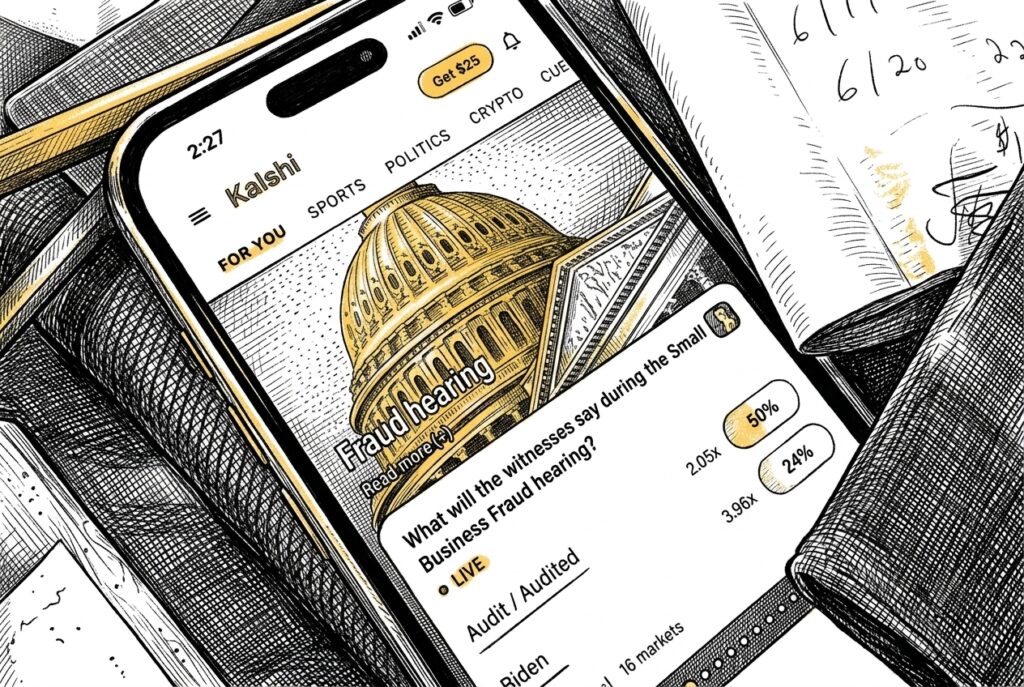
Under TRUMPSAY contracts, investors have an opportunity to bet whether Donald Trump is going to utter a certain word prior to a definite date. There was one expired contract that asked whether he would use the word “Sleepy Joe” before April 2026, says Ars Technica. CBS News claims that people typically spend hours analysing a speaker’s vocabulary. However, the person who knows about the upcoming speech in advance has a huge advantage.
There are two possible types of manipulations in this regard. Someone could persuade the speaker to use a specific phrase, or a trader could know about it before the public. As the example provided in the advisory shows, it is easier to do when persuading the host to use a catchphrase or when dealing with prepared scripts and remarks. Staff also believed that more substantial proof should be provided about fair conditions of operation.
Sanctions for the Former White House Teleprompter Operator Who Took Advantage of His Position
Gabriel Perez worked at the White House as a teleprompter operator, and therefore had access to prepared presidential speeches before their public delivery. Perez opened an account on Kalshi on 8 December 2025 and used this advance knowledge for trades on presidential mention contracts. Perez managed to make money on 39 out of 43 contracts and even changed his bets after leaving part of the prepared speech unused by Trump.
On 28 August, the CFTC decided to impose on Perez the obligation to return $107,539.02 in trading profits and pay an additional fine of $65,000. He also agreed to the ban on trading via any CFTC-registered entity for three years. Perez reached a settlement but did not admit to the allegations. In the official statement, the regulator stated that he “acted in breach of his duty of trust and confidence.” The fine was termed a “substantial discount” due to his cooperation during the investigation.
Kalshi helped to detect the abnormal trading activity, and the regulator appreciated its help. The head of the Enforcement Division of CFTC also noted on X that the surveillance system revealed this activity. In July, the White House suspended Perez, and the press secretary Karoline Leavitt claimed that Trump regarded this behaviour as a “disgrace.”
Other Mentioned Markets Are Still Open
There has been some uncertainty as to how extensive the CFTC’s order was, according to reports. Bloomberg has reported that all markets related to the president were ordered closed down, whereas CNBC reported that there were only a few such markets still trading. The order specifically mentions TRUMPSAY and the nickname contract. On 17 November, Kalshi was still operating contracts about what JD Vance and Zohran Mamdani would say during the DealBook Summit. The market predicting remarks from Nvidia, Target, Microsoft, and SpaceX executives was still open.
As reported by Bloomberg, Polymarket’s international platform, which is outside of CFTC jurisdiction, was still offering the markets predicting mentions from the president. Just one day before the order was issued, Donald Trump Jr. stopped working with Kalshi as a paid adviser on 12 November. The company described the parting as mutual and said that it resulted from the investments his firm had made in the rival Polymarket platform. It has been reported that he was being compensated with Kalshi stock. The CEO of Kalshi described this situation as an “optics problem.”
Kalshi Explains the Usefulness of Predicting the President’s Words
According to Tarek Mansour, the CEO of Kalshi, “What the president does say moves markets.” Kalshi’s chief regulatory officer Sudhir Jain has stated that investors could hedge their portfolios against risks using the information about the president’s remarks predicted by such contracts in October.
It is worth noting that the financial stake involved is quite high. After a request from the regulator, Kalshi has already withdrawn all sports-related markets in August. According to Reuters’ source, the removed markets were earning Kalshi $90 million monthly. Kalshi is also said to be negotiating a new funding round at the value of $65 billion for its compute futures platform. Although Kalshi says that it amended its rules back in March, the CFTC says that it did not make the necessary heightened showing.
Kalshi Has Until 11 December to Respond
The 11 December date is the deadline for Kalshi to submit its reply regarding the falsification of certification, not a deadline for a final regulatory decision based on that reply. After reviewing this document, the commission will determine whether there was a falsification and take action accordingly. There is no time frame in the decision, so the stay remains in effect until the next step by the CFTC.
In any case, the advisory leaves an opportunity for re-listing these contracts in “limited circumstances,” where exchanges can prove high quality of their regulation and surveillance. Ars Technica noted that the CFTC examines each mentioned market separately and does not ban the entire category. As we mentioned above, Senator Elizabeth Warren asked the White House counsel to explain how they will prevent another similar situation in the future.
Expert Analysis: Does the Value of Hedging Overcome the Threat of Insider Trading?
Kalshi’s defence of presidential mention markets highlights the main vulnerability of such markets as well. According to Mansour, the words of the president can move financial markets. In that case, anyone who learns about these words in advance gets valuable information. The case of Perez proves how this information can be used in trading. In general, Kalshi claims the financial purpose of these contracts, while the advisory of the CFTC focuses on possible manipulation or insider trading.
In our opinion, a contract that is based on one person saying one word gives the most straightforward example of regulators’ concern. Surveillance systems can detect manipulations after they occur, but they cannot stop a person from getting some confidential information. However, the defence of Kalshi makes sense: their surveillance detected Perez, and the CFTC has sanctioned him. But in this case, the reliance on surveillance systems to detect abuse of confidential information means recognition of the possibility of obtaining this information in advance.
We also note that the restriction of these contracts in the US market can drive such risks to offshore platforms, especially since the international website of Polymarket continues listing Trump mentions.
 Share


 9 views