Key Points
- Kalshi says that five people watched its midterm markets for every trader, but the company has not specified how and when it was measuring the ratio.
- Favourites have won 95 per cent of races for CBS, compared to 98 per cent for Kalshi with a different set of results.
- Voters who were surveyed favoured market leaders 10 to 20 percentage points more than others, while big legal cases revolve around sports contracts.
Kalshi Says That It Has Five Viewers Per Trader, but Who Verified the Numbers?
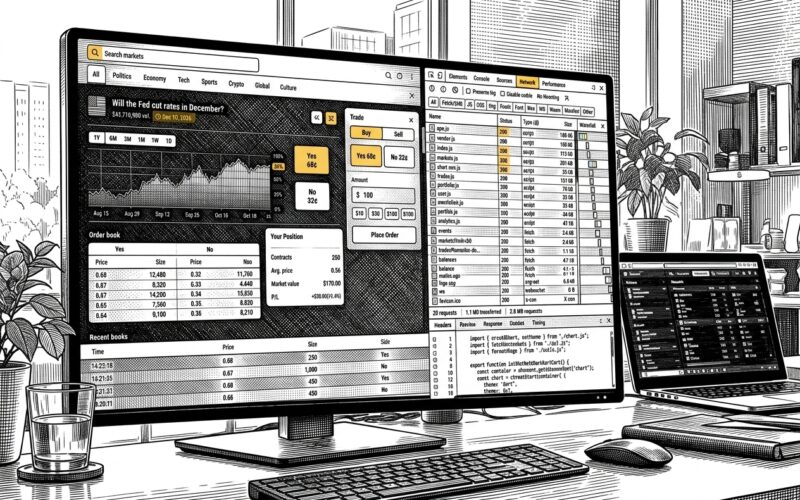
Kalshi says that its House market gave the Democrats a 99 per cent chance of winning at 8:10 pm Eastern on 3 November. Its Senate market follows at 9 pm, ahead of TV networks, according to the company. Kalshi also claims that five people watched its election markets for every trader. But this number does not reflect whether watching the odds had any effect on people’s votes.
Five Viewers per Trader, but No Exact Measurement Method
On 6 October, Kalshi stated that the people watching its midterm markets outnumbered traders five to one. The company also says that visits are 50 times greater than the number of traders, while three out of four users did not trade. According to CryptoSlate, Kalshi did not specify the time period and the method of measuring the audience ratio. Without these specifications, the number remains a company claim without any independent verification.
Kalshi admits an issue in its October post. Some visitors treat its market odds as polling data or think that Kalshi sets the odds itself. As a result, Kalshi states: “Kalshi is not a poll, nor is it an oddsmaker.” It adds Brier scores, low-volume marks and live trading feeds to every midterm market to help users understand the numbers. But it still agrees to show those market percentages with polling data on its partnerships with CNN, CNBC, and Fox, according to CBC News.
$2.5 Billion Trading Volume of Kalshi During Midterm Requires Clarification
According to Kalshi, there has been over $2.5 billion of trading in their 2026 midterm markets, compared to $1.3 billion trading during the 2024 election cycle. It should be noted that elections in both periods are different. CryptoSlate further notes that Kalshi did not ensure that market coverage or dates are comparable between the figures. Reuters has also reported $1.33 billion on Monday, however, it was earlier information and it may have referred to another period. FinanceMagnates says that notional volume is the total volume, when each contract is considered with the value of $1 (the amount of payout), rather than the actual price.
FinanceMagnates reported $5.33 billion in notional trading on Saturday, 7 November based on the company’s daily trading files. Some 75% were made by combo contracts, which work similarly to parlays. Notional trading of only one day surpassed the total of the midterm election trading period. Also, Pew found that politics accounted for 4 per cent of Kalshi’s trading volume from July 2024 to April 2026, and sports accounted for 80 per cent.
Kalshi’s Favourites Won 95 Per Cent of Races, but Tight Races Paint a Different Picture
An analysis by CBS News indicated that Kalshi’s favourite won 95 per cent of congressional and gubernatorial races. CBS used market odds one week before election day. Dartmouth economist Eric Zitzewitz described the races as “the biggest, most liquid prediction election markets we’ve ever had.”
Kalshi claimed an even more impressive 98 per cent accuracy rate with their favourite candidates winning 479 out of 487 races for various offices. Their research indicated that directional accuracy rose from 93.8 per cent three months before the election to 98.2 per cent on election day. However, CBS and Kalshi’s figures cannot be compared since they include different sets of races and measure different times. Indeed, Kalshi’s own summary of results features a contradiction – the House race table shows 95 per cent accuracy and 356 wins out of 360 races, which is 99 per cent accuracy.
Directional accuracy refers to the ability of a prediction market to predict the victory of a particular candidate. Calibration checks how well the probabilities in the market match reality – in the case of 70 per cent probability, one would expect seven out of ten wins. Kalshi claimed that its Brier score, with a lower number indicating better accuracy, dropped from 0.040 to 0.016 in the days before the election. The calculation included races called by 6:26 am on 4 November and was based on Kalshi’s research.
According to CBS, 388 out of 481 races saw favourites being offered a price of between 90 and 100 per cent and all such candidates won the elections. On the other hand, predictions were not very accurate in the races featuring candidates with low prices. Among 38 races where the favourite’s probability was lower than 75 per cent, the favourite won 52.6 per cent with an average probability of 64.6 per cent in the market. The sample size of 38 races is too small to make a judgement on the performance of prediction markets in general. Also, CBS reported that Republicans were favourites in all 23 races where the predicted winners did not win, while Democrats always won.
Voters Took Market Odds Seriously But Were Sceptical of Their Precision
In a Brennan Centre-sponsored survey of 1,994 registered voters, taken on 21 September, market odds’ impact on expectations regarding election outcomes was analysed. Participants became 10 to 20 per cent more likely to expect victory for the market favourite regardless of polls. However, only 1 per cent believed in the accuracy of the predictions of markets while 37 per cent trusted polls. Moreover,the lack of a warning message to voters diminished the effect of the market odds. The experiment was focused on voters’ expectations about the winners rather than changes in their behaviour.
Also, research from the Anti-Corruption Data Collective, presented to CNBC, demonstrates how easy price movements can occur in the markets with low trade activity. For 18,000 active congressional markets at Kalshi and Polymarket, 88 per cent can change their price by ten cents after a trade below $1,000. That reflects sensitivity to individual trades rather than any market manipulation. As reported by AP, Kalshi general counsel Rick Heaslip said that in liquid markets “distorted prices will snap back.”
June elections in Los Angeles were a case where markets made incorrect predictions. One market indicated that Spencer Pratt had 78 per cent chances to advance to the runoff, while he ended up with third place in the mayoral race “traded the most heavily” in 2026, CNBC reported. Later, the supporters of the candidate raised doubts regarding the counting of votes, according to CNBC. The Los Angeles County Registrar of Voters urged not to confuse markets’ predictions with actual votes.
Market Integrity Worries About Elections and Sport Bets Litigation Are Separate Matters
Worries over election market integrity were raised even prior to the midterms. According to AP, in April, three candidates got suspended from betting on their elections by Kalshi. Besides, another candidate in North Carolina received a three-year suspension and a fine on 31 August.
It was reported by Politico that the Democrats are going to make regulations stricter after having taken control of Congress in January. Senator Jeff Merkley said that it is time to “rein in this gambling.” Prior to the election, Senator Elizabeth Warren also wrote to Kalshi and Polymarket, as she was “troubled by election-related event contracts.” It was reported that Kalshi answered on 2 November, citing more than a dozen investigations of election trades.
However, Kalshi’s main litigation concerns another matter — it deals with sports contracts. The company and its founders were charged on 28 October in Utah with making sports bets via an undercover agent. The state of New Jersey filed a case with the Supreme Court on 4 November requesting the right to regulate sports event contracts, yet the Court did not accept the case. On 3 November, the Second Circuit denied Kalshi’s request for a stay of the New York gambling laws while the company was appealing the decision. Thus, all lawsuits from Utah, New Jersey, and New York regard sports bets and not elections.
Kalshi Still Judges Its Own Effectiveness
With regard to the above issues, Kalshi’s good results on election day bring into question the credibility of the statistics announced by the company. It provides information about its own audience ratio, prediction precision and trading volume, which is not confirmed by any outside auditor. Our main interest is the audience statistics since, according to Kalshi, three-quarters of viewers do not trade. They have nothing to lose, but they see price influence by traders nevertheless. Audience ratio, changes in voter expectations and voting outcomes are different things. Kalshi gives the first figure, the Brennan study covers the second one, and neither of them measures changes in voting.
Kalshi claims that its market prices either match or beat polling averages wherever they exist. However, Columbia University economist Rajiv Sethi stated to CBC News that prediction traders continue relying on polling results. Our hypothetical assumption is that markets may beat polls thanks to the fact that traders use polling information in order to take a position.
The performance of the market has changed throughout the election process. According to Mark Hulbert writing for MarketWatch, in January Kalshi thought that Democrats had only a 28 per cent chance to win both chambers of Congress. However, Kalshi stated to CBS that it had underestimated the chances of Democrats less than any other professional forecasters. At the same time, according to CBS citing a New York Times study, Kalshi lagged behind Nate Silver’s model all through the election cycle.
We consider midterms to be a perfect opportunity for Kalshi to prove its forecasting capacity in the election process, even taking into account that a significant portion of Kalshi’s trading operations goes to sports and parlay-style contracts. It announced overseas elections and a market page for the 2028 presidential election to be coming next. Until its audience statistics are verified by an independent auditor, the five-to-one ratio remains a promotional statement. Who will check the ratio in case Kalshi announces an even bigger audience next time?
 Share


 6 views