Key Points
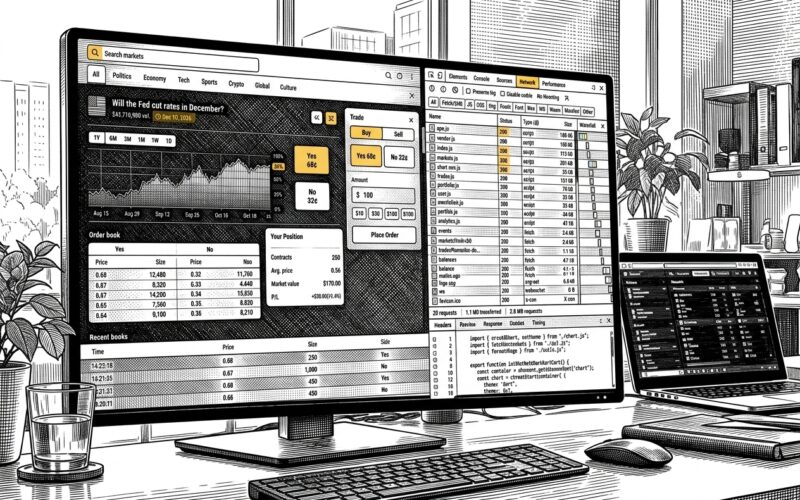
- Meta’s employees are trying out Takes, a prediction app that operates with points (cred), not money bets, and won’t be available to the public.
- There are already lawsuits filed against Kalshi and Polymarket concerning real-money betting, which means that Takes may have another legal status in the case of money or prize betting.
- Survey data reveals that the main participants in prediction markets are mostly young people who also constitute the target audience for Takes, a prediction app developed by Meta.
Meta’s employees are making predictions about Tim Cook’s next career move by placing a bet on whether or not he’ll take the CEO position at Nvidia using the reputation-based prediction app called Takes, created by Meta but not yet publicly available. In the meantime, there are lawsuits filed against similar platforms which allow real-money betting. There’s uncertainty as to whether cred will continue to operate on points or whether the app will require licences one day.
Meta Staff Are Testing a Prediction App Based on Points Called Takes
As the Wall Street Journal reported on 13 November, Meta employees are using the prediction app called Takes. Users are betting cred points, a short name for credibility points. They grow if the prediction is correct and drop if it fails. Also, they predicted who would win that Friday’s episode of Jeopardy!. As expected, most of them believed that Cook would not become Nvidia’s CEO.
Meta constantly conducts tests of its products using its own employees in a practice known as dogfooding. However, some such projects never come into public use, and product names often change throughout development. Meta did not comment on any possible launch date for Takes, and no clear schedule has been established. Since employees already know each other, their use of the app during testing does not necessarily represent what will happen with public users.
From Arena to Takes: What June’s Reports Said About It
The New York Times reported on 23 June that Takes was previously called Arena. Mark Zuckerberg had ordered the team of developers to create an application like Polymarket and Kalshi. The employees estimated the age group of 18 to 34 years to be the target audience and set a target of acquiring 100 million monthly users. All the information is based on the June reports, and there is no confirmation from Meta about it.
The Journal also reviewed recordings of the meeting in spring when Zuckerberg claimed that he and product chief Chris Cox had been discussing how to develop 50 applications. According to internal documents reviewed by NPR in June, Meta had planned to apply its Llama AI model to create prediction questions and to decide on the outcome of the predictions. There is no confirmation of Takes using Llama in tests among employees. This is important because the system will have to use AI to decide on the right result when the prediction is unclear.
Also, according to the June reports, Meta had not excluded real-money betting after the introduction of Takes. The November coverage has not established whether this option is still being considered.
Data of the Survey Show That Prediction Market Traders Are Mainly Young
Prediction markets receive much attention on the internet, but the survey data prove that the number of traders is rather low. According to the survey by Kagan, a unit of S&P Global, in August, 10% of 2,500 US internet adults (the margin of error is 1.9 percentage points) claimed to have traded on prediction markets in the last year. Among them, 61% are under the age of 35, while 13% are 55 years old or older. Sports events are the basis of trading for 70% of these users.
The survey covered real-money platforms and adult internet users, so it provides little evidence of the demand for free prediction games. Younger users are already active in cash markets, but their interest in points-only games has not been tested yet. Even without real money, users should understand the rules of winning predictions.
Louisiana and Utah Launch Lawsuits Against Real-Money Prediction Market Platforms
Real-money prediction platforms have come under new legal scrutiny in the same week. On 12 November, Louisiana filed lawsuits against over 30 parties, including Kalshi, Polymarket, Robinhood and Coinbase. The state judge granted an ex parte restraining order later that day. The temporary order will expire in 10 days unless extended, and a hearing is set for 30 November. On 13 November, the US government and the CFTC brought a lawsuit in federal court. The complaint states that, where markets are regulated by the CFTC, federal law overrides state laws about gambling.
Addressing the Cantor Convergence conference, CFTC Chairman Michael Selig described the controversy as follows: “Somebody says it’s gambling, somebody says it’s a derivative.” He stated that legal controversies regarding definitions should not subject executives of a company to the risk of imprisonment. The response of Louisiana Attorney General Liz Murrill on X was that Selig’s comments were “flatly false”. Utah had already made additional moves on 28 October and charged Kalshi, its CEO Tarek Mansour, and COO Luana Lopes Lara. According to the Associated Press, Kalshi claims that the prediction market is within federal jurisdiction. These are just allegations, and there has not yet been a conviction in court.
Takes Fits Another Legal Category Until Further Notice
Takes is not concerned with those lawsuits since it does not work with real money. A free platform that uses points that can neither be converted into money nor exchanged for anything else of value may be considered a prediction market that is not regulated by financial event contracts legislation. This legal status can change if the application uses real money, purchases or redeemable prizes. Requirements concerning consumer protection can also be applied. In case Meta launches the Takes product in the future, Facebook and Instagram may become promotion channels for the service, reaching a broad audience. There are no details about the possible release geography of the application.
Expert Analysis: Free Predictions Can Keep Users Engaged
The key difference between Takes and other Meta applications is that it doesn’t require users to spend any money. However, Meta has not disclosed the ways of making money from this product. It may come from ads, users’ data or the real-money version of the application. In our opinion, using points as currency in Takes protects Meta from additional regulatory responsibilities as long as they are not converted into cash. The inclusion of cash prizes, purchases or withdrawals of money changes the status of the service in the eyes of the regulator.
The idea of entering the gaming industry and earning some money from it was suggested by many experts. However, the information about the project shows another approach. Instead of being a game based on winning or losing some money, it can become a game where users compete to make accurate predictions. While such entertainment is absolutely safe, it can also lead to additional engagement since it is not connected with losing money. Users may read the warnings about the risks of this product stated by Blumenthal and concerns shared by some Meta employees on internal discussion boards. On the other hand, the lack of money-related issues makes the service harmless enough, and the company can use its social network and recommendation algorithms to draw users’ attention. Using AI to resolve disagreements can become the most advanced feature of Takes. Both arguments seem to be reasonable, and there is no way to decide who is right without more information. What matters is whether it will be possible for users to get something valuable for their cred in the future. In case the points cannot be exchanged for anything, the service is nothing more than a quiz game. But in case of any conversion, the rules will be examined carefully. So far, Meta hasn’t provided the answer, making Cook’s prospects of becoming Nvidia CEO look much easier to guess.
 Share


 8 views