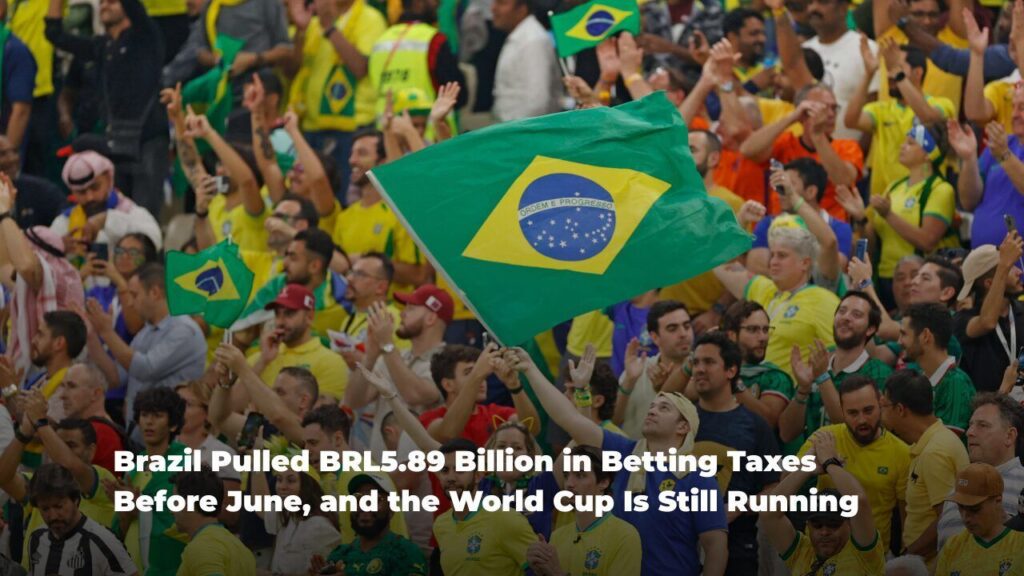
- Between January and May 2026, Brazil collected BRL5.89 billion in betting taxes, up 85.88% on the same period last year, with World Cup activity pushing monthly volumes past any pre-tournament benchmark.
- Klavi, a data intelligence firm, recorded BRL510 million in transfers to licensed platforms from the tournament’s opening to 25 June; one Brazil vs Scotland fixture alone moved more than BRL25 million in a single day.
- Unlicensed platforms are estimated to hold between 41% and 51% of total market activity, and regulated tax receipts could roughly double if those operators were brought in or shut out.
Five Months In, Brazil’s Betting Tax Already Cleared 60% of Last Year’s Total
The Brazilian legal betting industry had already accumulated sufficient taxes to account for 60% of the total amount collected in 2025 before summer came around. According to information provided by the Federal Revenue Service, the tax collection from sports betting and online gambling was at BRL5.89 billion ($1.18 billion) during the period January-May 2026, which was BRL3.169 billion ($634 million) in the same period in 2025.
Tax auditors Claudemir Malaquias and Marcelo Gomide presented the numbers at a briefing, with Revenue Secretary Robinson Barreirinhas in attendance. For a market that only formalised its regulatory structure in 2025, the pace is hard to ignore. Brazil’s full-year betting tax collection in 2025 reached BRL9.95 billion ($1.99 billion); at the rate 2026 is moving, the year could close at BRL14 billion ($2.8 billion), and that estimate was put together before the World Cup added its weight to monthly volumes.
Betting Now Rivals Tobacco and Agriculture as a Federal Tax Source
The gambling industry had paid BRL4.5 billion ($869 million) in taxes alone in the first four months of 2026, which was equal to what the tobacco industry and the agricultural industry together were contributing every month, at around BRL1 billion per month. The industry revenues were BRL12.2 billion ($2.3 billion). For context, the whole of 2025 produced BRL36.9 billion; the market is compressing that timeline with each passing quarter.
Estimates for the year before launch had set GGR between BRL3 billion and BRL5 billion. Instead, it turned out to be somewhere between BRL22 billion and BRL31 billion, putting Brazil in the top three online gambling jurisdictions in the world, right after the US and the UK. Going from a grey market to one of the top three within a year is not growth, it is a paradigm shift that most regulators did not foresee.
World Cup Money Is Flooding Licensed Platforms Faster Than Anyone Projected
Klavi tracked fund transfers from 1.2 million users across 187 licensed platforms in Brazil, covering the stretch from the tournament’s first whistle through 25 June. The cumulative total came to BRL510 million ($102 million). The Brazil versus Scotland match on 24 June pulled in more than BRL25 million ($5 million) in a single day, running 35% above the daily average Klavi had recorded in the weeks before the tournament opened.
Individual transaction values moved alongside volume. The average betting-related transfer rose from around BRL185 to BRL235 ($37 to $47), a 24% climb, which says something different from raw transaction counts; bettors are not just showing up in greater numbers, they are committing more each time they do. H2 Gambling Capital projects the tournament could generate between BRL20 billion and BRL25 billion ($3.8 billion to $4.8 billion) in additional deposits before the final whistle, a figure that would drag 2026’s annual total past every forecast currently on the table.
The Numbers Look Strong, But Half the Market Is Still Invisible to the Government
Every figure cited above reflects the licensed market only. A study commissioned by the Brazilian Institute for Responsible Gambling (IBJR) estimated that between 41% and 51% of Brazil’s total betting activity flows through platforms operating outside the legal framework, with unlicensed operators processing up to BRL39 billion in gross activity and contributing nothing to federal tax receipts.
The Federal Revenue Service has been direct about the gap: collections would be far greater if unlicensed sites were pushed into the regulated system or cut off from Brazilian players. Redirecting that demand toward licensed operators does not require growing the market; the bettors are already there, just sitting in channels the government cannot see or tax. Domain blocking and coordination with the Federal Police are already written into the regulatory structure, yet the channelisation shortfall keeps surfacing as the one problem the sector cannot quietly absorb.
187 Licensed Operators, but Ten Brands Hold Most of the Market
The Finance Ministry’s data shows that 25 million CPF holders placed bets in 2025, with 187 authorised websites currently active. The number of operators indicates competitiveness; however, the revenue share paints a different picture. There are ten operators who account for 68.8% of the total market share. Betano is the top brand, a Greek operator, that had a net gaming income of roughly BRL3.5 billion for the first half of 2025. International brands with infrastructure already in place have absorbed the bulk of demand, while the lowest tier of licensed operators averages roughly 0.1% each.
Licensed providers grew from 49 at the start of 2025 to 87 by April 2026, yet more licenses have not meant more competition. Up to half of current licensees are expected to consolidate or leave as the economics of holding a fraction of a per cent become impossible to justify. The monthly income from tax payments during the first quarter of 2026 exhibited high volatility, with its highest point being recorded at BRL1.49 billion in January falling to BRL859 million in March, which was characteristic of the instability of the players with small shares whose volumes depend on the events rather than their stable clientele. 2025 was about grabbing the territory; Year Two will be all about the reckoning where only the big and deep-pocketed will survive.
The Deposit Tax Is Dead, but the Regulatory Pressure Is Not
Not every regulatory move has landed against the licensed sector. The CIDE-Bets bill, a proposed 15% tax on player deposits that cleared Brazil’s Senate in December 2025 and was projected to raise BRL30 billion annually for public security funds, was removed by the Chamber of Deputies in February 2026. Industry lawyers and trade bodies had warned that channelisation to licensed platforms could drop below 20% if the levy passed; its removal was treated as a significant relief across the sector.
The GGR tax, however, is already on a legislated upward path under Complementary Law No. 224, signed by President Lula; the rate moves from 12% to 13% in 2026, 14% in 2027, and 15% by 2028. Supporters of the deposit tax have indicated it may return in a dedicated bill rather than as an attachment to criminal justice legislation. Brazilian authorities have maintained a sceptical public posture toward betting companies while quietly banking the revenue they generate. That contradiction holds together when the numbers are manageable; it becomes harder to sustain as the sums involved grow large enough to anchor federal budget targets.
Expert Analysis
Brazil’s five-month tax figure only confirms what last year’s full results already pointed toward; the market scaled faster than any official projection accounted for. The World Cup sits on top of a baseline that was already running ahead of forecast, adding a concentrated burst of volume to a trajectory that needed no help. The structural risk is not coming from the licensed side of the ledger. With 41% to 51% of activity still running through unlicensed operators, the government is pulling in roughly half of what the market could theoretically deliver under full enforcement. The defeat of CIDE-Bets removes the most immediate threat to channelisation, but its supporters have signalled intent to reintroduce it through separate legislation; the risk has shifted form, not disappeared. The revenue picture looks solid from a distance. How long it stays that way depends on decisions being made in rooms that have very little to do with betting.
Explore more:
 Share
Share


 236 views