Key Points
- Bally’s proposed installing slot lounges at O’Hare and Midway airports to replace the $6.8 million in VGT licensing revenue at risk in Chicago.
- The Las Vegas Convention and Visitors Authority has asked Bally’s to present a financing plan by August, with the operator acknowledging the casino will likely not be ready by 2028.
- Bally’s carries over $4.3 billion in long-term net debt as it simultaneously builds or plans projects worth a combined $7 billion across Chicago, Las Vegas, and New York.
Chicago’s VGT Problem Is Getting Ugly
Bally’s walked into that Chicago city council committee room expecting allies and walked out with neither a vote nor a verdict. The session had been convened to settle the city’s push to legalise video gaming terminals, but it collapsed under the weight of tension between council members before anyone could reach a decision.
What the meeting did produce was a counteroffer from Bally’s that nobody had publicly floated before. Instead of simply pushing back against VGT legalisation, the company proposed installing slot lounges at both O’Hare and Midway airports. Christopher Jewett, Bally’s senior vice president of corporate development, put the revenue case directly to the Chicago Sun-Times: “We believe one lounge can generate approximately $5 million in actual gaming and admission taxes, which go directly to the city.”
The airport figure is not coincidental. Chicago’s approved budget had set aside $6.8 million in VGT licensing revenue, built on the assumption that roughly 80% of 3,300 eligible liquor licensees would apply. Nearly 300 venues have already moved to do exactly that. Mayor Brandon Johnson had fought the VGT legalisation from the start, but the city council’s alternative budget stripped his position out and lifted the ban. His office and the council remain at odds, with no resolution in sight.
$75 Million on the Line
Bally’s has not left its objections vague. The company’s own estimates put the potential damage at nearly $75 million in lost annual revenue and roughly 1,000 jobs cut from its combined casino workforce. For a project that has already absorbed two construction stoppages, forced design revisions, and required a $940 million financing arrangement with Gaming and Leisure Properties just to stay on track, those are figures that carry real consequences.
The Illinois Gaming Board’s monthly reports show Illinois casinos have pulled in $889.5 million in total adjusted gross receipts so far in 2026, sending $53.6 million to local tax coffers. VGTs across the same state have generated $1.4 billion in net terminal income and $68.5 million in local taxes during that same stretch, spread across more than 1,100 municipalities. Chicago had been the largest holdout against that model. Losing that status is not, for Bally’s, a minor policy adjustment.
Jewett laid it out plainly before the council: “Had we known that, within just a few years, this body would reverse course and allow an alternative form of gambling that breaches the agreement, we would never agree to the numerous commitments, all of which we’ve held up.”
The Licence Extension That Quietly Got Done
Away from the VGT fight, Bally’s has quietly secured one win it badly needed. Chicago’s temporary license, which was heading towards its expiry date of 9th September 2026, has been granted more time as the wording has been incorporated into the state’s omnibus tax package, SB3019. Both chambers have approved the bill on 1st June, and it is now waiting for Governor JB Pritzker’s approval. The license has now been extended until 9th September 2027, after which the Illinois Gaming Board can issue two additional extensions of three months each. Chairman Soo Kim had already told reporters at the permanent casino’s topping-off ceremony in late April that a Q1 2027 opening was the target.
At the construction site located at 560 West Grand Avenue, the steel frame of the building has been erected entirely for the podium and the hotel tower, an important step in construction on the way to completing the construction worth $1.7 billion and that will generate approximately 3,000 jobs. Over 1,000 tradesmen have rotated on the site by now. Some weather-related delays pushed some of the early 2026 schedule back, but Bally’s says it is chasing a year-end completion.
Las Vegas: The Financing Question Nobody Has Answered
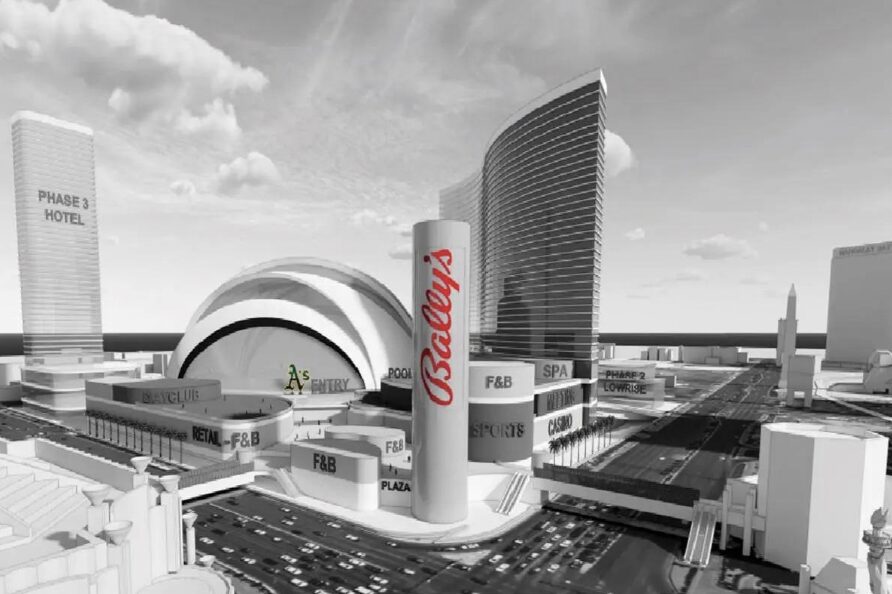
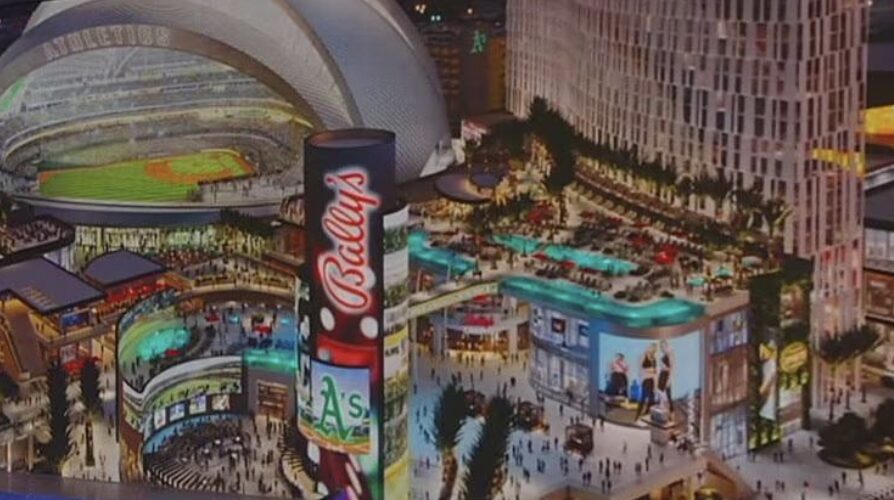
Chicago’s pressures are tangled up in politics and community agreements. Las Vegas is a different problem entirely, and arguably a sharper one. Bally’s $1.2 billion Strip development shares a site with the new Athletics baseball stadium, which is pacing well toward its spring 2028 opening. The casino project beside it is not generating the same confidence. Steve Hill, president and CEO of the Las Vegas Convention and Visitors Authority, told The Athletic that Bally’s does not currently have the financing to build the project out. The LVCVA has pushed the operator to produce a credible plan by August. If Bally’s timeline slips far enough, the Athletics may move to develop some of their own shared infrastructure rather than wait, a pivot that could add $100 million to the team’s costs.
Before the Nevada Gaming Commission this week, Bally’s CFO Mira Mircheva and attorney Dan Reaser offered a careful separation of timelines. The 2028 date, they explained, belongs to the stadium, not the casino. Reaser told commissioners directly: “The April deadline of 2028 is for the stadium to open and for the baseball season to proceed. The April 2028 timeline is for the retail district, parking garage, utilities and plaza, but not the towers that come at a later date.” Bally’s had already told iGB a casino opening by 2028 is “unlikely.” FAA approval on hotel tower height restrictions remains outstanding, with Clark County awaiting that clearance before it can move the project to the County Commission.
New York has the Biggest Number of All
While Chicago holds its breath and Las Vegas demands answers, Bally’s is simultaneously moving toward the most expensive item on its list. In December of last year, the firm received one of the three downstate New York casinos licences, setting the ball rolling for a $4 billion integrated resort to be developed on an existing golf course in the Bronx. The proposed integrated resort will entail construction of a 500,000 square foot casino, a 500 room hotel and an entertainment venue which will be located above the East River. This year, Bally’s bought 20 acres of waterfront property at the price of $156.6 million. The property was earlier used by the golf course as its clubhouse and parking facility.
Much of the application documentation is redacted, but one publicly available timeline passage states construction begins approximately eight to nine months after licensure. Licences were awarded in December, which puts that window at August or September of this year. Bally’s told iGB in February: “We have every motivation to get started as quickly as this fall on our NYC project.”
The Debt Picture Behind the Ambition
Bally’s entered Q2 carrying $559 million in cash, a number that reads differently when stacked against long-term net debt exceeding $4.3 billion and $2.2 billion in lease liabilities. The acquisition pace has not slowed: since the start of 2025, the company has taken majority interests in Star Entertainment and Intralot, and agreed to acquire Evoke in an all-share deal valued at $325.2 million. Shares climbed roughly 50% over the past year as that asset accumulation gathered momentum, then pulled back 15% across the last six months.
Mircheva told the Nevada Gaming Commission that the merger of Bally’s International Interactive and Intralot, a refinancing round, and a real estate sale have together reduced the company’s outstanding debt load and created room to fund ongoing builds. Her assessment of what comes next was direct: “We’re making good progress, while continuing to invest in very exciting projects, including Nevada, Chicago, and New York, that once online will transform the revenue and EBITDA profile of the restricted group.”
Expert Analysis
Bally’s is not a company in distress. It has built a wider asset base in two years than most operators manage in a decade, and the underlying logic of each individual project holds up. What is harder to square is the distance between those ambitions and the current reality: a flagship Chicago casino fighting a VGT threat that could cost it $75 million a year before it has even fully opened, a Las Vegas project with unresolved financing and an August deadline from the city’s own tourism authority, and a $4 billion New York resort that begins construction just as debt exceeds $4.3 billion. The airport slot lounge idea is a genuinely creative play. Whether the Chicago council treats it as a serious offer or a negotiating move will say a great deal about how the summer ends for Bally’s.
 Share
Share


 211 views