Key Points
- Blackstone and Kings Park Capital’s managed funds have reached an agreement on selling their casino portfolio of 33 venues to Banijay Gaming, and this deal is estimated to be closed in the second half of 2026.
- The company JOA reported €430m of gross earnings in 2025 and received over 4.6 million visitors per year, making it the second biggest casino company in France in terms of casino outlets.
- French legislation bans real-money gambling online, so Banijay can expand its offline business only at this time.
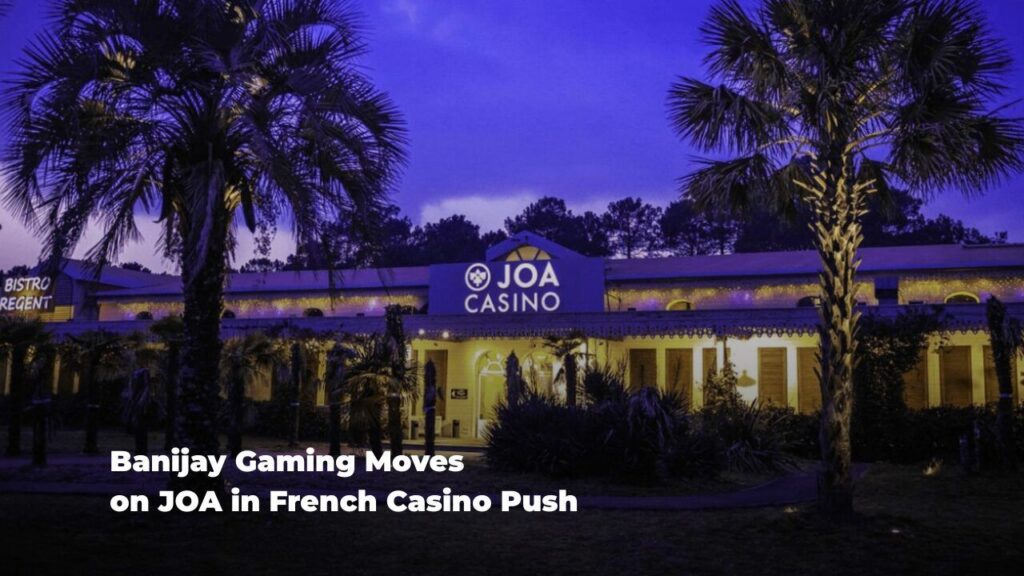
Banijay Gaming has reached a deal to buy JOA, France’s second-largest casino operator by venue count, from funds managed by Blackstone and Kings Park Capital. No financial terms have been disclosed. The completion is scheduled for later this year 2026, provided consultations with employees are carried out and approval from competition authorities and gaming bodies is obtained.
Total ownership of JOA implies Banijay Gaming owns 33 casinos distributed all over France, which last year had a visitor base of over 4.6 million and earned gross sales of around €430m in 2025. The amount includes gaming, hospitality and leisure income, and in addition to the casinos, the JOA estate owns 37 restaurants, 44 bars, and five hotels.
The Business Behind the Casino Count
JOA is not simply a portfolio of gaming floors. Across France it operates as a leisure institution with roots that run deep into local communities. Laurent Lassiaz, who stays on as JOA chairman alongside the existing management team, told iGB in a June interview: “For the French population, the casino is a local leisure destination; it’s part of the local list of leisure activities that you can do. And that’s the reason why it resists a poor economic environment so well.”
Local resilience, not marquee real estate or destination tourism, seems to be the thing Banijay is actually acquiring. It is believed that the team wants to leverage the technology, the artificial intelligence, and the data skills that it has at JOA sites without compromising its entrepreneurial spirit and reputation.
Nicolas Béraud, chairman of Banijay Gaming, confirmed what the group is after: “Customers increasingly expect seamless experiences across digital and physical environments, and this transaction positions us perfectly to respond to that evolution. We look forward to supporting JOA’s next phase of development by bringing our expertise in technology, artificial intelligence and data, while preserving the entrepreneurial culture and operational excellence that have made the company successful.”
Tipico Was the Groundwork – JOA Follows the Same Logic
This deal has a clear line running back through Banijay’s recent history. During October 2025, the company announced a majority stake acquisition in Tipico Group which was valued at about €4.6bn inclusive of debt; the deal was completed in April 2026, with Betclic, Tipico and Admiral operating as Banijay Gaming along with 1,250+ betting outlets in Germany and Austria.
Today, Banijay Gaming is the fourth largest operator of European sports betting and gaming firms, earning in excess of €7.5bn in annual revenues, producing €1.6bn in adjusted EBITDA and generating more than €1bn in cash flow each year. Before this deal, France was only reachable through Betclic’s digital platform; JOA hands the division its first physical presence in the country.
Banijay Group CEO François Riahi left little room for interpretation: “The acquisition of Tipico has transformed us into a diversified omnichannel European leader in gaming, and the acquisition of JOA is fully relevant with this evolution. As in Germany and Austria, we will become a leader in land-based gaming in another of our core countries: France.”
France’s Market Is Growing – The Online Door Remains Shut
The French gambling industry posted healthy figures for 2025. Gross gaming revenue stood at €14.1bn, marking a 3% increase from the previous year, according to Autorité Nationale des Jeux. Land-based casinos contributed €2.81bn to that figure, posting a 3.4% increase, with attendance growing by 2% to 31.6 million. Online gambling revenues were €2.61bn, registering an 8.5% rise, accounting for 18.5% of regulated revenues.
That figure comes with a structural limitation which lies in Banijay’s direct line of sight. Real-money online casinos are outlawed in France, and gambling online is legal only when limited to sports betting, horse racing, and poker through ANJ-licensed operators, with lottery products controlled exclusively through FDJ. A government proposal to legalise online casinos appeared in late 2024 but soon fell apart in light of opposition from the land-based industry. Casinos de France argued that such a move would cost 15,000 jobs and cause catastrophic harm to the incumbent companies.
Lassiaz himself has a clear position on where online regulation could eventually take the sector. In that same June interview he said: “My view is that it would be a huge new vertical for us, and I’m the defender of the evolution from brick-and-mortar to click-and-mortar. I think it would be a natural extension of what we already do on a regular basis.”
Whether France’s regulator moves that way under new ANJ President Pascal Chèvremont is still unknown. As matters stand, the JOA acquisition brings Banijay retail casino capacity, nothing more.
The Tax Environment Banijay Is Stepping Into
Banijay is buying JOA in a French market that is considerably harder on operators than it was before 2025. On 1 July 2025, France passed a notable gambling tax reform through the Social Security Financing Act, pushing duties higher across both online and land-based sectors to fund the country’s social security system. Online sports betting operators saw their effective fiscal burden rise from 54.9% to 59.3%; for physical casinos, state duties and municipal levies combined now land somewhere between 57% and 60% of gross gaming revenue.
Pressing ahead in that fiscal climate points to confidence in the French market’s long-term position rather than any near-term earnings play. Banijay has not said publicly whether JOA’s cost structure has been adjusted to absorb the higher charges.
Same Leaders, Clearer Direction
Banijay has confirmed that JOA’s governance will remain unchanged once the deal completes. Laurent Lassiaz stays on as chairman, with the existing management team kept in full. The company says this preserves continuity for employees, customers and local communities.
Lassiaz described the change of ownership without ambiguity: “Joining Banijay Gaming marks an exciting new chapter for JOA. After a successful period with Blackstone and Kings Park Capital, which laid the foundations for our growth, we have found another long-term partner with whom we share a common vision for the future.”
On the Tipico side, Banijay has made clear that integration will hold until after the 2026 FIFA World Cup. At the group’s capital markets day in March, CEO Riahi said the immediate priority was getting Tipico’s product ready for the tournament, not pushing through internal restructuring. Given the JOA deal still needs regulatory clearance, any meaningful integration there is unlikely to arrive before the Tipico work is even finished.
Expert Analysis
Banijay’s acquisition path is becoming readable. Buy regulated, established operators in key European markets, then pull them together under a single omnichannel structure. Germany and Austria received Tipico’s retail betting network. France now gets JOA’s casino estate. Betclic’s digital platform runs across the whole thing.
What Banijay cannot yet do is complete the loop in France the way it has done elsewhere. The online casino ban keeps digital and physical apart in a market where, under different regulations, they would reinforce each other directly. Whether that changes under the new ANJ leadership, or whether the land-based lobby shuts it down again as it did in 2024, determines exactly how far the French omnichannel strategy can stretch. Banijay has bought JOA anyway. It is backing the French casino market’s local durability, the same point Lassiaz made himself, as worth holding even without the online component that would make the model whole.
Explore more:
 Share
Share


 72 views