Key Points
- Mark Zuckerberg met Kalshi CEO Tarek Mansour in 2025 to explore an acquisition, but talks broke down with competing accounts over why the deal fell apart.
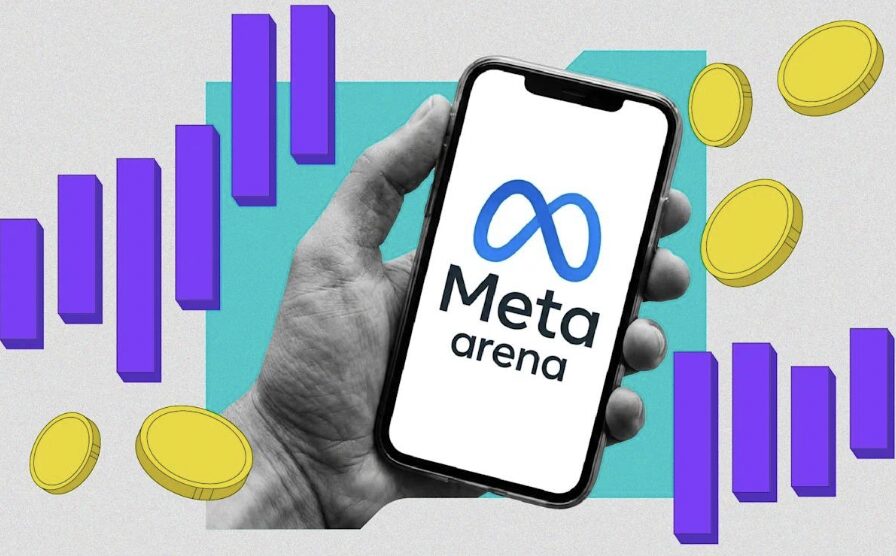
- Meta is developing Arena, a standalone prediction market app powered by AI and operating on virtual points rather than real money.
- Kalshi’s valuation jumped from $2 billion to $22 billion in a single year as combined monthly trading volume on Kalshi and Polymarket climbed from $28 billion to nearly $220 billion.

Mark Zuckerberg did not set out to build a prediction market platform from scratch. Before any development team was briefed, he reportedly tried to acquire the company already at the forefront of the sector. NPR, citing three people with direct knowledge of the discussions, reported that Zuckerberg sat down with Kalshi founder and chief executive Tarek Mansour in 2025 to explore a possible takeover.
Those conversations never advanced beyond an early stage, and accounts of why they ended differ significantly. Some sources indicated that Mansour was not interested in handing over a company he had built as its value climbed sharply, while others pointed to Meta’s wariness over the legal and ethical complications attached to Kalshi’s business, which faces active legal challenges in more than a dozen US states. When NPR approached both companies for comment, neither responded.
Meta Builds the Platform It Failed to Acquire
Once the Kalshi deal collapsed, Meta put together an internal team to create its own product. The application, named Arena, is being developed as a standalone platform where users forecast outcomes across news events, cultural developments, and topics gaining traction online. Internal documents reviewed by NPR show Arena will run on virtual points rather than cash, which puts it in a fundamentally different category from Kalshi and its chief rival, Polymarket.
Meta’s artificial intelligence systems will handle the questions, oversee the markets, and settle outcomes when events conclude. Running on points rather than money gives Arena a practical buffer, allowing it to avoid the state-level regulatory pressure that has kept Kalshi’s legal teams occupied for months. Whether Meta intends to introduce real-money functionality at a later stage has not been confirmed.
The acquisition discussions may have come to nothing, but a commercial arrangement did follow. In March, Meta and Kalshi agreed to integrate Kalshi’s prediction markets into Threads, a deal that hands Kalshi significant distribution reach inside Meta’s social platform without requiring a sale.
Kalshi’s Valuation Rose from $2 Billion to $22 Billion in a Year
Meta’s move into prediction markets did not happen in isolation. The sector has expanded at a pace that most industries do not see across an entire business cycle. According to The Block’s prediction market data tracking, combined monthly trading volume across Kalshi and Polymarket stood at roughly $28 billion in June 2025, and twelve months later that number had climbed to nearly $220 billion, with sports contracts accounting for the largest share of the surge.
Investor confidence tracked that growth closely. Kalshi had raised $1 billion through its Series F financing round, which was closed in May 2026, at a valuation of $22 billion compared to $2 billion for the same period a year ago. Polymarket, running its exchange outside the regulatory purview of the US authorities, was valued at roughly $10.7 billion. Analysts have put a figure of $1 trillion on potential annual trading volume across the sector by 2030.
Meta reported 3.566 billion daily active users across its family of apps for the January to March 2026 quarter. Any meaningful uptake of Arena within that audience would pull the prediction market sector well beyond its current base of financially minded and politically engaged traders, and into a consumer mainstream that neither Kalshi nor Polymarket has come close to reaching.
State Regulators and Federal Oversight Pull in Opposite Directions
Growth at this scale draws attention from regulators, and prediction markets have not been spared. State gaming authorities across the United States maintain that event contracts offered by platforms such as Kalshi are gambling products dressed up under a different name. Kalshi’s sports event contracts, which went live in January 2025, attracted particular scrutiny, and multiple states have pursued legal action. The CFTC has moved to define which event contracts fall within permissible limits under federal rules, while the sector has held the position that CFTC oversight shields it from state gambling laws. State regulators have refused to accept that argument.
Polymarket has faced pressure of its own. A Wall Street Journal investigation alleged that influencers received payment to produce misleading promotional content involving fabricated trades and invented winnings, prompting the platform to launch an internal audit of its active promotional materials. The controversy arrived at an awkward moment, falling just weeks after Polymarket opened its regulated US exchange to the public. The platform nonetheless reported annualised revenue crossing $1 billion within six weeks of that launch.
Federal criminal investigators have opened two cases tied to trading activity on Polymarket. The first centres on allegations that a special forces soldier used classified information relating to US military operations involving Venezuelan leader Nicolás Maduro to place winning bets. The second involves a Google employee accused of drawing on confidential search trend data to predict the most-Googled individuals of 2025 accurately and pocketing more than $1 million from the outcome. Both cases were reported by NPR.
Meta’s Acquisition Instinct and What Happens When It Hits a Wall
The failed Kalshi bid sits within a pattern that has defined Meta’s expansion for more than a decade. Rather than building from scratch, the company grew its reach by acquiring platforms that had already captured users. Instagram in 2012 and WhatsApp in 2014 pulled Meta far beyond its roots as a single social network, turning it into an advertising machine with a global audience. More recently, Meta added AI wearable company Limitless and Moltbook, a social network built for AI bots, to its portfolio.
That acquisition record has kept regulators focused on Meta. According to the Federal Trade Commission, the company tends to follow a model of buying its competitors outright or introducing products that could make its competitors irrelevant, which is referred to as the “buy or bury” model by the FTC. However, a federal judge dismissed these arguments and did not rule in favour of the FTC, which means that the FTC appealed the decision.
Tim Wu, a law professor at Columbia University, who also advised the Biden administration on technology policy, was candid in his interpretation of the situation. “Meta seems to clutch at every shiny object,” Wu told NPR. Pointing to the company’s withdrawal from the metaverse and the collapse of its cryptocurrency project Libra, he added: “With the help of their advertising cash cow, they’ve been able to fail again and again without consequence.” On Arena itself, Wu was equally blunt: “I can’t imagine a casino app with fake money is going to be much of a thrill.”
Expert Analysis
What Meta failed to acquire may matter less than what the attempt itself reveals. Zuckerberg did not approach a play-money platform or a niche operator; he pursued the sector’s leading regulated exchange. That is a deliberate target, not a casual one, and it tells you what Meta actually wanted. Arena in its current form, built on virtual points and social engagement, looks less like a destination and more like a holding position while the regulatory picture around real-money prediction markets takes shape. The sector moved from $28 billion to $220 billion in monthly volume in the space of twelve months. Whether Arena is ever the full answer to that opportunity, or simply the version Meta is allowed to ship right now, is the question worth watching.
Explore more:
 Share
Share


 249 views