

Key Points
- Bally’s offered to open slot lounges in all five terminals across O’Hare and Midway, projecting $5 million per lounge in gaming and admission taxes.
- The company has threatened to sue Chicago and halt its $4 million annual licensing payments if the VGT legalisation ordinance is not repealed.
- A City Council committee hearing ended without formal action after Alderman Anthony Beale moved to adjourn amid a bitter confrontation over sweepstakes machines.
Bally’s Pushes Airport Slots and Demands Chicago Walk Back Its Video Gambling Decision
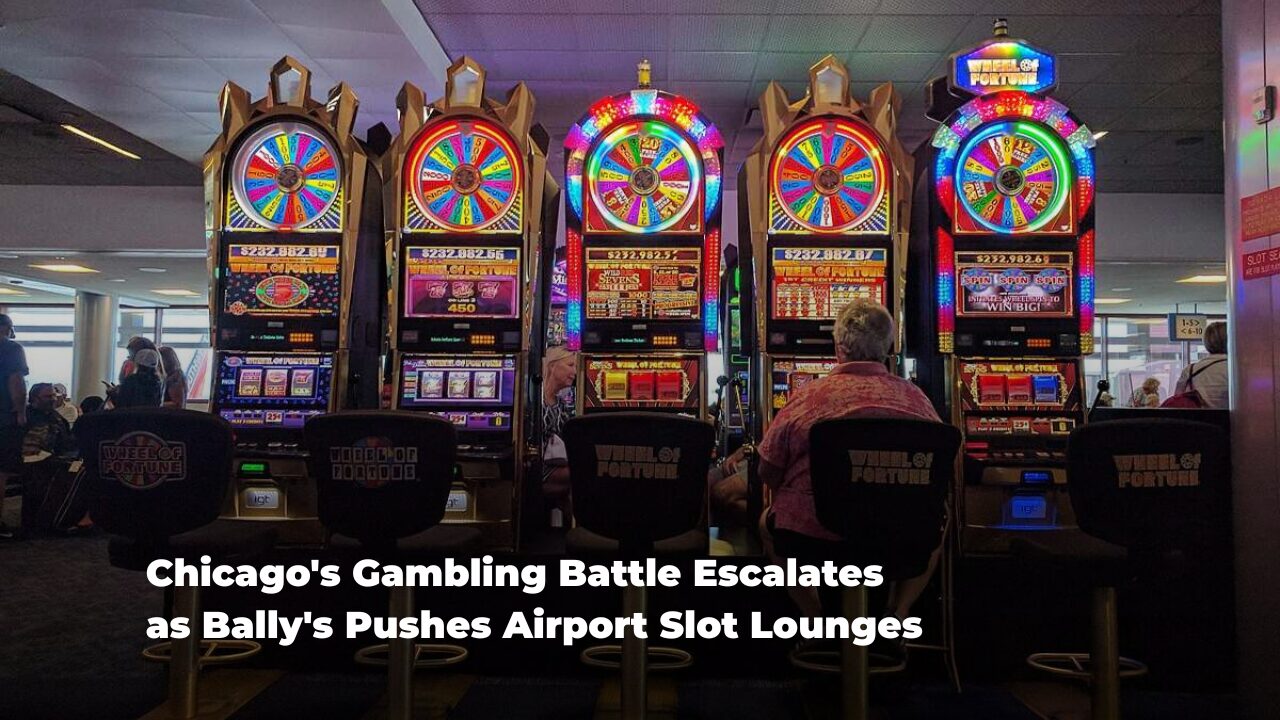
Chicago’s gambling row took a sharper edge this week when Bally’s put forward an offer that carried the unmistakable weight of a warning. The casino company, currently running a temporary floor at Medinah Temple while its River West permanent site takes shape, went before the City Council’s Committee on Workforce Development and proposed dedicated slot machine lounges at both O’Hare International Airport and Midway International Airport, pitching the move as the more sensible path forward compared to the VGT expansion that has fractured City Hall for the better part of this year.
According to the Chicago Sun-Times, Christopher Jewett, Bally’s Senior Vice President for Corporate Development, told the committee that every one of O’Hare’s four passenger terminals, along with Midway’s single terminal, could carry a standalone slot lounge. “We believe one lounge can generate approximately $5 million in actual gaming and admission taxes, which go directly to the city,” Jewett said. “This alone can replace the revenue in question.”
A $6.8M Promise the City Is Already Banking On
The $6.8 million figure is not theoretical; it has already been baked into Chicago’s approved $16.6 billion budget for 2026, passed by a City Council majority that simultaneously lifted the city’s longstanding VGT ban. That projection rested on an assumption that 80% of the approximately 3,300 establishments holding off-premise liquor licences would apply to operate terminals, with the Illinois Gaming Board requiring six to eight months to clear those applications.
Bally’s positioned the airport lounges as a clean one-for-one swap for that figure, though several aldermen were less certain the comparison held up. Alderman Gilbert Villegas had already put forward a narrower ordinance that would restrict VGT legalisation to the airports alone, calling it the “low-hanging fruit” amid a messier citywide argument, and pointed to projections placing airport slot revenue at up to $40 million annually, with most of that money coming from passengers passing through rather than Chicago residents. A Christiansen Capitol Advisors study commissioned to examine the wider VGT picture found that citywide legalisation would leave Chicago only marginally better off once lost casino income was factored in, with the city taking just 5.15% from VGT terminal revenue compared to around 20% from casino slot machines.
Bally’s Has a Different Word for What Happened: Breach
Jewett was careful to make one thing clear: the airport offer was not a business pivot. The company sees the VGT ordinance as a direct violation of the 2022 deal it reached with the Lightfoot administration. CBS News Chicago reports that the agreement gave Bally’s a monopoly on virtual slot machines within Chicago city limits, and that legalising VGTs outside Bally’s property would render that contract null and void. “Had we known that, within just a few years, this body would reverse course and allow an alternative form of gambling that breaches the agreement, we would never agree to the numerous commitments, all of which we’ve held up,” Jewett told the committee.
The consequences on the table are specific: a lawsuit, an end to the $4 million in annual licensing fees Bally’s pays the city, and withdrawal from its diversity and union hiring obligations. Beyond those immediate threats, Bally’s has warned that full VGT expansion across Chicago stands to strip the city of $74 million in annual revenue and could wipe out up to 1,050 jobs between its temporary and permanent operations, as VGT revenue directly competes with the slot income the host agreement was designed to protect. Mayor Brandon Johnson has publicly backed Bally’s reading of the situation, maintaining that the VGT ordinance runs against the city’s contractual commitments. His administration had steered Wednesday’s hearing into existence specifically to build the case for a repeal, routing the matter through the Workforce Development Committee rather than the Licences Committee, which had originally cleared the VGT ordinance and whose chair has been vocal in her objections.
The Hearing Ended Before It Could Reach a Conclusion
No vote came out of Wednesday’s session. Alderman Anthony Beale, among the council’s loudest voices for keeping VGTs legal, turned the spotlight on Bally’s own record, asking why the company had done nothing with its airport gaming authorisation despite the Illinois General Assembly granting it years earlier. He also picked apart the financial logic underpinning the airport substitute, pointing out that revenue generated at O’Hare and Midway is ring-fenced within the enterprise fund for airport operations, which means it cannot be redirected to plug a gap in the city’s general budget regardless of how large the gross number looks.
The confrontation escalated further when Beale turned to Business Affairs and Consumer Protection Commissioner Ivan Capifali and demanded answers about an estimated 7,000 sweepstakes machines spread across Chicago’s bars, restaurants, and petrol stations, devices that mimic slot machines while using non-cash payouts to operate in a legal grey area. Capifali refused to engage with gambling policy questions at the hearing. Beale accused him of having no integrity, called for his resignation, and then moved to adjourn. The committee cleared out without casting a single vote, on the VGT repeal or the airport lounges. Licences Committee Chair Alderman Debra Silverstein maintained that Johnson had deliberately gone around her committee, the same body where the VGT ordinance was first approved, and the place where she argued any repeal should properly be heard.
What Needs to Happen Before a Single Machine Goes Live?
If Chicago does move forward, it will join an extremely small group. Slot machines in commercial airports exist in only one state across the entire country, Nevada, where they operate at Harry Reid International Airport in Las Vegas and Reno-Tahoe International Airport. Illinois law already laid the groundwork in 2019, carving out a route for airport slots in Chicago provided they sit beyond TSA security checkpoints and carry city approval, but that legislation has gone untouched since it passed. O’Hare and Midway together process more than 105 million passengers each year, placing Chicago among the busiest air travel markets in the United States. Federal aviation and security compliance requirements mean analysts are working with a timeline of at least a year before any machine could actually be switched on.
Expert Analysis
The airport lounge offer reads cleanly on paper, but it sidesteps the core problem rather than resolving it. Bally’s is using the contractual architecture of the 2022 host agreement as leverage, and the slot lounge pitch serves as both a revenue alternative and a political argument for keeping VGTs out of Chicago’s neighbourhoods. What has not changed is the underlying standoff: the council approved VGT legalisation, Bally’s says that the act voids the host agreement, and neither side has moved. Beale’s enterprise fund objection is not a minor procedural point; it cuts directly at whether airport slot income can actually substitute for general budget revenue the way Bally’s has presented it. A formal council vote on the VGT ordinance looks unavoidable now, and whoever loses that vote is almost certain to pursue it through the courts. With the permanent casino still on track to open this year, the weeks spent without a resolution carry a cost Bally’s is making harder to ignore.
Explore more:
 Share
Share 


 10 views








 Analysis
  Business
  Companies
  Crime
Crime  Finance
  M&A
M&A  Prediction Markets
  Regulation
  Reports