
Key Points
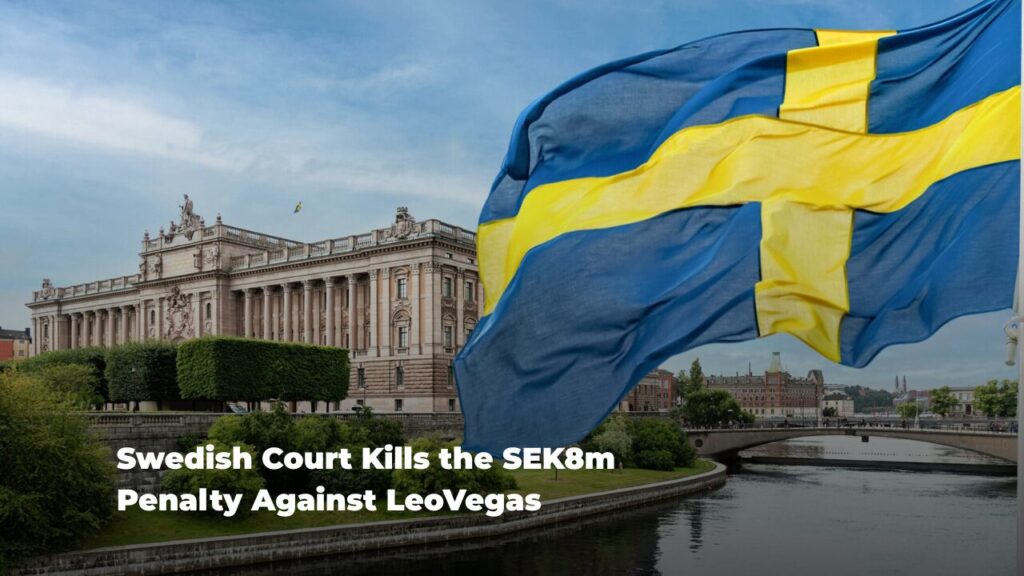
- On 12 June 2026, the Administrative Court in Linköping wiped out an SEK8m (€735,336) fine against Roar Vegas, the entity that operates LeoVegas in Sweden.
- Sweden’s gambling regulator identified three customers showing signs of excessive gambling during Q1 2024; the court found Roar Vegas had handled each case within a fair window of time.
- The Swedish Gambling Authority has three weeks from 12 June to appeal; as of publication, neither side has spoken publicly.
LeoVegas walked out of a Swedish courtroom with something worth far more than the money itself. On 12 June 2026, the ruling made by the Administrative Court of Linköping revealed that there was no proof that Spelinspektionen, the Swedish gambling authority, had been able to demonstrate that there was any neglect of the duty-of-care obligation on which it had based the SEK8m (£735,336) fine that it had imposed on Roar Vegas, which operates LeoVegas in Sweden.
For an operator now operating under MGM Resorts International’s umbrella, the ruling lands with consequences that stretch far past the figure on the penalty notice.
Three Accounts. One Long Fight With the Regulator
It started with a routine supervisory sweep. Spelinspektionen pulled 12 customer accounts from the first quarter of 2024, focusing on the heaviest losers split across two age bands: 18 to 24, and 25 and above. Three of those accounts caught the regulator’s eye.
Each of the three carried monthly deposit limits ranging from SEK100,000 to SEK300,000, ran through money fast after depositing it, and spent long stretches logged in and active.
Spelinspektionen’s view was blunt: Roar Vegas had seen the warning signs but sat on them too long. The regulator said the operator leaned too much on automated alerts instead of pushing for a harder, more direct response. That reasoning carried Spelinspektionen all the way to a formal reprimand and an SEK8m fine in March 2025, a figure pegged against Roar Vegas’s estimated annual turnover of SEK1.65bn.
Roar Vegas rejected the whole conclusion and went to court.
The Case That Held Up in Court
Roar Vegas built its defence on two foundations. On the facts, it pointed to a trail of action: automated notifications sent, deposit limits enforced, accounts suspended where the situation called for it, and direct contact made with the players themselves. It argued that those steps arrived within a fair window and that its monitoring setup, a blend of automated tools and human review, met what Swedish law actually asked for.
The legal pillar proved sharper. Roar Vegas argued that Sweden’s duty-of-care rules identify which behavioural signals operators should watch but stay silent on how to weigh one signal against another. No thresholds are set. No clock starts ticking with a defined deadline. The company’s case was pointed: it was being fined for falling short of a standard nobody had ever put in writing, and that was not fair.
Roar Vegas also challenged the indicators Spelinspektionen had chosen to rely on. Long sessions and fast losses after a deposit, the operator argued, are patterns you see constantly among sports bettors; they cannot simply be read as proof that someone has a gambling problem.
On top of that, the company pointed to a real legal grey zone: the uncertainty around processing personal health and financial data for responsible gambling purposes, uncertainty that existed before legislative changes arrived on 1 June 2024.
The regulator rejected all of it. The court saw things differently.
The Reasoning Behind the Ruling
The Administrative Court examined the same evidence and reached a different conclusion at every turn. It was agreed that all three customers had been gambling in a high-risk way. It was agreed that responsible gambling steps were needed. What it could not agree with was that Roar Vegas had failed: the operator had moved with reasonable speed, used the tools at hand, and made direct contact with the players involved. Delays in pushing harder did not cross into punishable territory.
The court’s logic was clear. Sweden’s duty-of-care provision can back enforcement, but the bar sits at what the judges described as a “clear and obvious” violation. Roar Vegas had not come close to crossing it.
“Measures could in some cases have been taken or escalated earlier,” the ruling stated. “The duty-of-care provision is sufficiently clear to serve as a basis for intervention, at least in cases involving a clear and obvious violation. The appeal shall therefore be granted, and the Swedish Gambling Authority’s decision shall be overturned.”
The court also confirmed that the duty-of-care obligation carries no fixed countdown. Online gambling runs at all hours; what matters is whether the operator responded within a reasonable period. In this case, it had.
A Pattern, Not an Anomaly
This was not a one-off. Back in 2021, Spelinspektionen handed LeoVegas a SEK2m warning over due diligence practices from 2019, the first year Sweden’s re-regulated market was operating. LeoVegas appealed that decision too, making the same kind of argument: the industry needed clearer guidance on what the rules actually required.
Before that, in October 2019, the same Linköping court had already overturned Spelinspektionen’s attempt to cut LeoVegas down to a two-year licence, a consequence of a UK Gambling Commission penalty. The court handed the operator a full five-year term instead.
Gustaf Hagman, who was LeoVegas Group CEO at the time, treated that 2019 ruling as validation. “After our investments in regulatory compliance and our experiences from regulated markets, this decision is a receipt that we are conducting a professional business,” he said.
Three disputes. Three challenges. The 2026 ruling is the newest entry in what is clearly a deliberate posture: when LeoVegas believes a regulatory decision does not have solid legal ground under it, the company goes to court.
The Dutch Outcome Tells a Different Story
Sweden is not the whole picture. In December 2025, the Dutch gambling authority fined LeoVegas €500,000 for responsible gambling failures, and the company did not appeal. That penalty stands.
The gap between the two outcomes matters more than it might look. The compliance category is almost identical in both countries: failing to protect players from excessive gambling. What separates the results is the legal framework each regulator operates within, and specifically how precisely that framework spells out what operators must do and when they must do it.
Sweden’s court found the rules too loose to uphold the fine. In the Netherlands, LeoVegas accepted what came.
What Comes Next, and Why Does It Matters?
Spelinspektionen has until early July 2026 to decide whether to appeal. At the time of publication, neither the regulator nor LeoVegas had said anything publicly.
For operators working in the Swedish market, this ruling lands with real, practical weight. If automated alerts, deposit restrictions, account suspensions, and direct contact with players, all applied within a fair window, are enough to satisfy the duty-of-care standard, then the harder question still has no answer: at exactly what point does a case demand a faster or more forceful response?
That grey area now has a court ruling parked inside it, and any operator facing similar scrutiny will reach for it.
For compliance teams and anyone who writes the policies behind responsible gambling programmes, the ruling is a hard reminder: these obligations are not just ethical pledges. They are legal standards. They get tested in court. And the precision of the language in those standards is often what decides the outcome.
Vague rules give operators room to fight back. If Spelinspektionen wants future enforcement to survive an appeal, it may need Swedish legislators to write something sharper into the Gambling Act before the next case reaches a courtroom.
What the Ruling Actually Settles?
The Linköping court confirmed one thing with no ambiguity: Sweden’s duty-of-care framework can drive enforcement, but only when the breach is beyond dispute. What the ruling does not settle is where exactly that threshold sits.
Roar Vegas did not time every intervention perfectly, and the court acknowledged that openly. But imperfect timing, in the absence of any legal benchmark for what perfect timing actually looks like, was not enough to make the fine stick.
Spelinspektionen now sits with a choice it cannot avoid. It can take the case to a higher court and push for a sharper legal standard to be set from above. Or it can accept the ruling and go to the legislature, working to embed more specific obligations into the Gambling Act itself.
Either way, the current position, operators and regulators pulling in different directions over what the rules mean, helps nobody. Not the players the rules were written to protect, and not the credibility of the regulatory system trying to enforce them.
Explore more:
 Share
Share


 286 views