






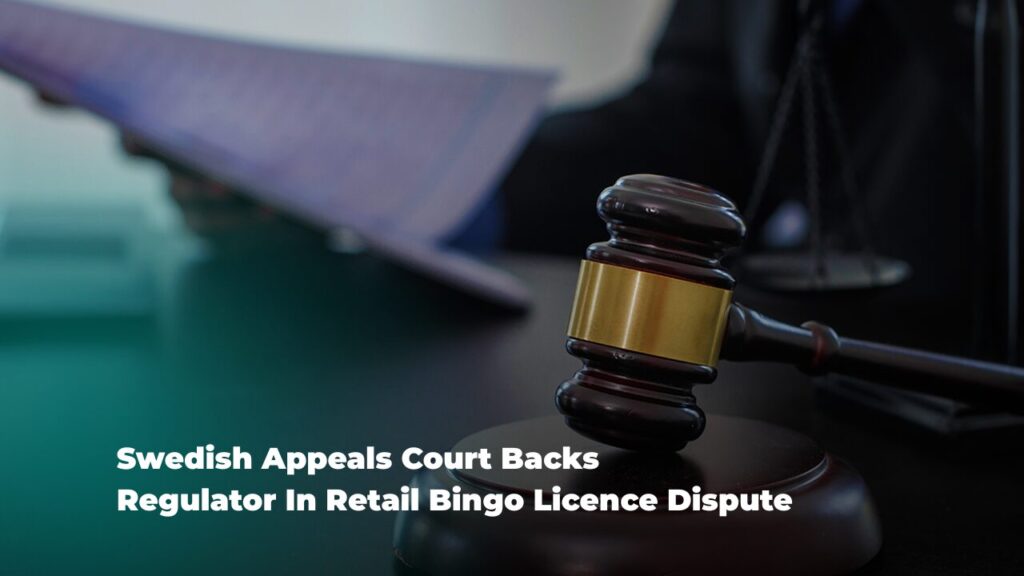
Sweden’s Administrative Court of Appeal in Jönköping has upheld the decision of the country’s gambling regulator, Spelinspektionen, to reject an application for electronic bingo operations outside traditional bingo venues.
The ruling, published this week, confirms that the regulator has the authority to limit where non-temporary bingo activities may be conducted under Sweden’s Gaming Act.
The judgment reverses an earlier decision by the Administrative Court in Linköping, which would have opened the door for the retail electronic bingo terminals.
Licence Application Sought To Expand Bingo Into Nearly 300 Retail Locations
The dispute dates back to June 2023 when operator Föreningen Idrottens Spel i Sverige applied for a licence to offer charitable bingo through electronic terminals located in approximately 297 retail outlets across Sweden.
Most of the proposed locations were small shops and kiosks. Spelinspektionen rejected the application in March 2024, arguing that the proposal failed to meet the suitability requirements outlined in Chapter 3, Section 1 of the Gaming Act.
According to the regulator, gambling activities must maintain high levels of safety and consumer protection, minimise gambling-related harm and prevent criminal misuse.
Spelinspektionen also raised concerns that locating bingo terminals in retail environments would increase exposure among children and young people because such venues provide lower levels of social supervision than dedicated bingo premises.
In November 2024, however, the Administrative Court in Linköping disagreed with the regulator. The court concluded that Swedish legislation did not explicitly limit non-temporary bingo to traditional bingo halls and argued that regulation should adapt to recent market developments.
Court Finds Retail Model Conflicted With Legislative Intent
Spelinspektionen appealed the ruling afterwards and the Administrative Court of Appeal has sided with them, reinstating the original licence refusal.
According to the court, Sweden’s gambling legislation has historically adopted a restrictive position towards self-service gambling terminals. This contains clear limitations regarding where gambling machines may operate.
While exemptions exist for bingo, the court noted that these traditionally applied to environments with stronger social control, including bingo halls and licensed restaurants.
The judges agreed that placing electronic bingo terminals in retail kiosks would weaken the protective framework envisaged by lawmakers. The court also highlighted the scale of the proposed expansion.
Under the association’s model, the number of bingo locations in Sweden would have increased from around 50 traditional venues to nearly 300 dispersed retail sites.
Ruling Raises Questions About Sustainability Of Swedish Bingo
In its final assessment, the appeals court concluded that there were sufficient grounds under the statutory suitability requirements to deny the licence. However, the operator warned that restricting bingo expansion could have wider consequences for the sector.
According to the association, this ruling risks undermining the sustainability of bingo operations in Sweden long-term. It could reduce important funding streams generated through charitable gaming activities.
Expert Opinion
A Swedish court has backed the Spelinspektionen’s refusal of a license to expand bingo terminals across 297 retail locations. Though this application was rejected in March 2024, the Administrative Court in Linköping repealed the regulator’s decision by November. After filing an appeal, Spelinspektionen’s legislation has been upheld.
 Share
Share


 238 views