





Key Points
- The Gambling Act draft from Austria was sent to the European Commission via the TRIS procedure on 4 August 2026 and the standstill period would continue until 5 November 2026.
- According to a study commissioned by Tipico, 71% of the online GGR of Austria, which is about €500m per year, goes to unlicensed operators under the monopoly system.
- Operators continuing to operate in Austria despite not having a license on 1 January 2027 will have 18 months of exclusion in the licensing procedure, increasing to 24 months from 2030.
A Standstill That Could Shape the Entire Market
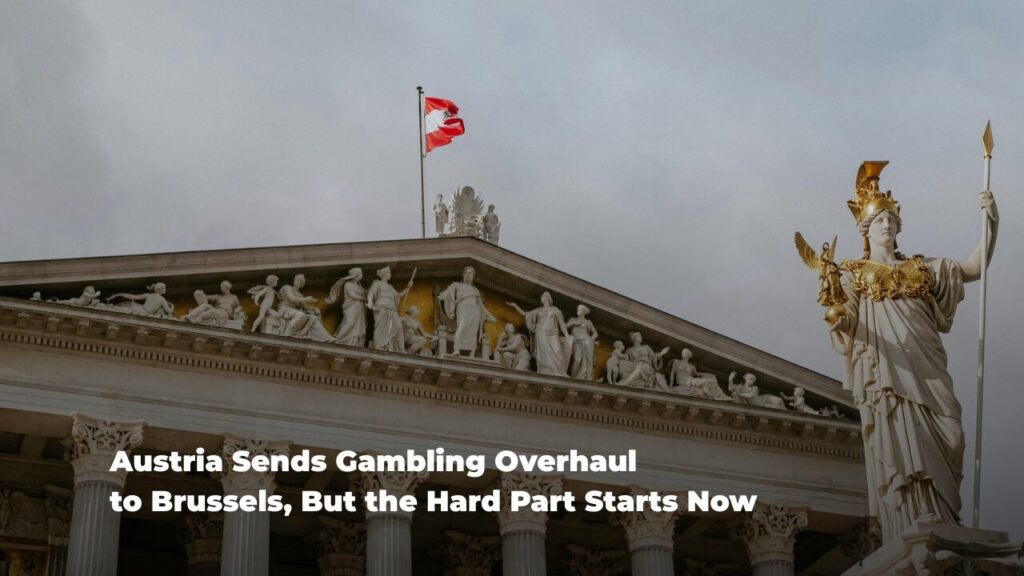
The draft amendments of Austria’s Gambling Act were handed over to the European Commission on 4 August 2026 by the country’s Finance Ministry, thus making the bill part of the Technical Regulation Information System (TRIS) in Europe. This results in a mandatory three-month standstill period, set to expire on 5 November 2026, after which the European Commission and other countries can review the bill and express any objections before it is adopted.
This particular point of information is crucial since there are possible objections based on issues such as state aid or single market regulations, and should the European Commission issue its opinion, the time left will be even shorter. However, the parliamentary process can move on alongside the three-month standstill period. It is important to note that the entire process of adopting this particular law relies heavily on time since the reform itself is based on one hard date – opening up the competitive market by October 2027, when the monopoly license of Win2Day expires.

Thirty-Five Years of Monopoly, and Why It Stopped Working
Austria’s gambling framework has its roots in the Glücksspielgesetz of 1989, which established a monopoly granting Österreichische Lotterien exclusive rights to lotteries and online gambling, while Casinos Austria holds the casino licences. For years, enforcement held the structure together. Then offshore operators began filling the market, and the monopoly became increasingly difficult to defend in practice.
A study commissioned by Tipico found that 71% of Austria’s online GGR, roughly €500m annually, was flowing to unlicensed operators. A separate Regulus Partners analysis put the unlicensed share at the same level, with revenues reaching up to $719m. Monika Racek, CEO of Austrian operator Admiral, put it directly: “The current monopoly is leading to an ever-growing black market where players enjoy no protection whatsoever. There are no player bans, no limits and no control.”
Austria is not the first European market to draw this conclusion. Germany liberalised its online regime in 2021, yet a 2026 study by Germany’s GGL regulator calculated a channelisation rate of only 77%, meaning licensed operators still account for just over three-quarters of the online market five years after liberalisation. That figure is not lost on Austria’s industry. The OVWG has pointed to Germany as a cautionary example of what happens when responsible gambling conditions are set so strictly that the licensed product cannot compete with unlicensed alternatives.
The Deadline Operators Cannot Afford to Ignore
The most economically relevant clause within the reform is directed at operators who currently provide gaming services to Austrian gamers without having a licence. Such operators need to stop all operations no later than 1 January 2027 in order to immediately qualify for a licence. In case the operators fail to comply, they will be excluded for 18 months. After 2030, the period will increase to 24 months.
Exiting the market on time is not sufficient on its own. The Ministry of Finance estimates the reform could provide restitution for approximately 20,000 Austrian consumers with outstanding claims against unlicensed operators, and those claims must be settled before a licence is granted. All outstanding Austrian tax liabilities must also be cleared. For large European operators, including evoke, Lottoland and Betway, which have thousands of player claims working through Austrian courts, the path to a licence involves years of legal resolution before an application can even begin.
There are early movers too. Tipico and Merkur removed their online operations even before there was a law. But under the draft regulation, they will have no major advantage over those who continue to operate right up till the deadline of January 2027, since both can become qualified after having to undergo the waiting period. This has been viewed negatively by some, saying it is sending the wrong message to the operators.
What the New Licensing Framework Proposes?
The draft replaces Austria’s single-operator online model with a competitive concession structure. Online concessions would run for five years initially, with 10-year renewals available, and a 45% tax applied to gross gaming revenue. Casino licences would be capped at 13, allocated in packages to prevent excessive concentration and ensure geographic distribution across the country.
Player protection forms a substantial part of the framework. Austria would establish a national self-exclusion register covering casino gambling, slot machines and online platforms, combining self-exclusions with operator-imposed bans. Deposit limits of €250 per week apply for players aged under 26 and €1,680 per month for those aged 26 and over, with any player-requested increases taking effect only after 72 hours. Slot machine stakes would be reduced, game speeds slowed, and a mandatory cool-down period introduced after 90 consecutive minutes of play. Operators would also be legally required to submit gambling harm analyses to support research and policy on gambling-related harm.
Enforcement powers would be significantly expanded. Payment blocking, blacklisting and network blocking would be available to restrict unlicensed operators, backed by a digital supervisory platform overseeing a cross-operator deposit limit independent of any individual gambling company.
The Tax Rate and the Channelisation Problem
A 45% GGR tax is high for a newly liberalised market. The OVWG has argued that opening the market could generate an additional $234m per year for the government, but only if the licensed product is commercially attractive enough to pull players away from unlicensed sites. If tax rates and stake limits make the licensed offering less competitive, players have little reason to switch, and the black market problem persists regardless of what the legislation says.
The OVWG has already signalled it will push for adjustments, including higher deposit limits for players who can demonstrate affordability and a rethink of the €2 per spin stake cap. The association’s position is that conditions modelled too closely on Germany’s framework risk producing the same outcome, a regulated market that cannot compete on its own terms.
Political analyst Felix Geyer was frank about the timeline: “Given how slow political processes in Austria can be, I’m sceptical about whether they will be able to hand out licences within 12 months. Especially since I don’t expect them to begin before the law actually comes into force.”
Expert Analysis
The TRIS submission is a necessary procedural step, not the deciding one. The coalition parties, ÖVP, SPÖ and NEOS, described this as the biggest reform of the Gambling Act in 26 years, and the cross-party consensus has been stable. Getting Brussels to clear the draft without a detailed opinion by November is achievable. What is harder is ensuring the final conditions, tax rate, deposit limits, and licensing timelines, produce a market that actually channels Austrian players into the regulated system rather than deeper into unlicensed alternatives.
Christian Rapani, attorney with Austrian law firm Rapani Rechtsanwälte, told NEXT.io: “We would therefore expect the final framework to reflect input from regulators, industry participants, and legal practitioners, with a view to finding conditions that are genuinely effective rather than merely stringent on paper.”
Thomas Forstner, OVWG secretary general, was direct about the industry’s position: “After 10 years of working on this, we are of course happy to see the idea of an organised system come to fruition. Our next step is to get the right conditions in place for the providers. Austria is a big market, and I think it is a very good market.”
Whether those conditions are adjusted before the law returns to parliament after November will determine whether this reform closes Austria’s black market gap or simply rearranges it.
Explore more:
 Share
Share


 296 views