Key Points
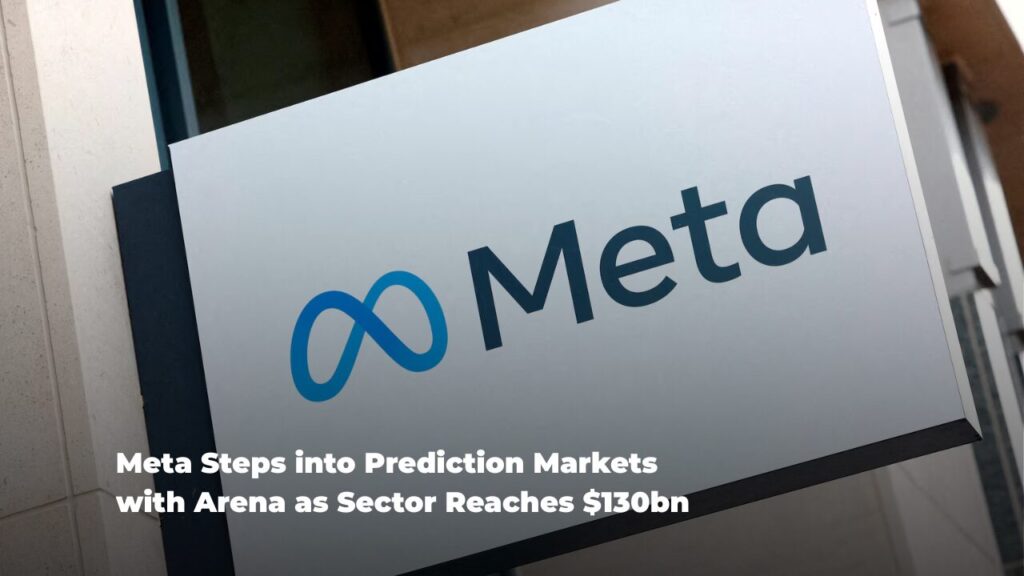
- A separate team of Meta employees led by Mark Zuckerberg has been tasked with creating Arena – a completely separate app with prediction markets that will be isolated from other platforms like Facebook, Instagram, WhatsApp, and Messenger.
- The platform is set to launch using a points system, but the company is still considering adding cash betting options in the future.
- DraftKings dropped as much as 2% following the reports, with Flutter Entertainment’s FanDuel and Robinhood also moving lower.
The CEO of Meta is developing a prediction market application with a select few employees at the company. The application, codenamed Arena, was recently revealed by The New York Times quoting anonymous sources from within Meta. The application will enable people to predict results for events in areas such as politics, sports, entertainment, and world events. The application will operate independently of the other applications like Facebook and Instagram.
At launch, the platform is expected to run on a points-based model rather than cash wagers, closer in design to a video game than a betting exchange. Real-money wagering has not been ruled out for future versions. Meta declined to comment.
Zuckerberg Targets a Sector Already Pulling in Billions
The timing is not accidental. Prediction markets have gone from a fringe hobby to a serious financial category in just two years. Kalshi and Polymarket processed roughly $50 billion in combined trades across 2025. By mid-2026, the two platforms were collectively pulling in around $24 billion per month, according to a Pew Research Center analysis of data from The Block. Operators earn fees on every transaction, and at those volumes, even a modest fee structure produces serious revenue.
Zuckerberg has run this play before. Snapchat Stories gained traction, and Meta copied the format onto Instagram. TikTok pulled users away from Facebook, and Reels appeared within months. Arena follows the same instinct: find where attention is moving, then chase it. With 3.56 billion daily active users spread across its existing apps, Meta has a distribution engine that no prediction market startup can compete with.
Meta has tried this once before. In 2020, the company launched Forecast, a crowdsourced platform designed to aggregate public predictions during the early spread of COVID-19. It ran on a points system, avoided real-money wagering, and never found a large audience. Meta shut it down in 2022. Arena returns to that same basic model, but the market it is entering now looks nothing like it did then.
Stocks Fall as Incumbents Absorb the News
Markets reacted fast. DraftKings slipped by up to 2%, reversing part of its fall, while Flutter Entertainment, which owns FanDuel, also experienced losses. Robinhood was down as well, as CNBC reported, coming just a few hours after The New York Times’ article was published.
The reaction was not purely about Arena. DraftKings and Flutter have been dealing with prediction market pressure for the better part of a year, as investors try to calculate how much sports wagering volume could drain toward event contracts. Meta’s arrival sharpens that question considerably. A company that can push a new app to over three billion users through existing platforms, without spending a pound on acquisition, represents a different category of threat.
Trump Media and Technology Group has its own prediction market plans in motion. Robinhood and Interactive Brokers have both introduced event contracts. The field is filling up fast, with finance platforms, media companies and tech giants all moving at the same time.
Regulatory Heat Is Building Across the Sector
Meta is entering a sector under active regulatory pressure. In April, federal prosecutors in New York charged US Army Master Sergeant Gannon Ken Van Dyke with using classified knowledge of Operation Absolute Resolve, the US military operation that captured Venezuelan President Nicolas Maduro, to place bets on Polymarket. Van Dyke reportedly invested $33,034 and walked away with $409,881, according to the Department of Justice. The CFTC joined prosecutors in filing civil charges; it was the first time the agency had pursued insider trading involving event contracts.
Polymarket is separately dealing with a damaging marketing scandal. A Wall Street Journal investigation published on 21 June found that around $1.9 million in bets shown across 1,105 creator videos were staged on near-identical copies of the Polymarket website. Creators were paid and told not to disclose the arrangement. The company responded by committing to a “comprehensive audit of active promotional content” to ensure compliance with its internal standards and applicable disclosure laws.
Senator Richard Blumenthal of Connecticut did not hold back. “Meta copied slot machines to add kids to Instagram. Now Zuckerberg is turning his company into a prediction market,” he wrote, framing the company’s model as one built on monetising addictive behaviour. Blumenthal directed his followers toward two bills he is co-sponsoring: the Kids Online Safety Act and the Prediction Markets Security and Integrity Act.
A Points-Based Launch Keeps Regulators at Arm’s Length, for Now
Meta’s choice to avoid cash wagering at launch is calculated. A points-based product sits outside the CFTC’s immediate classification of gambling, which keeps Arena clear of the regulatory frameworks that have tied up competitors. That protection is conditional. If Arena grows and Meta moves toward monetisation, the scrutiny that has followed Polymarket and Kalshi will almost certainly follow it too, especially given where the sector stands right now.
Bernstein forecast in April that the sector could reach $1 trillion in annual trading volume by 2030, a number that has pulled in operators from every corner of finance and media. Whether this volume remains in the hands of retailers or gets taken up by institutions and algorithms will determine whether an app like Arena, which is targeting consumers, has room to operate.
The people who know about the project say that this product still may end up on the shelf. Alongside Meta Photos, which is another experimental app based on AI-created media, Arena is part of an effort to experiment with new categories of products apart from social platforms. Most of Meta’s standalone experiments have quietly disappeared. Arena is different in one important respect: the market it wants to enter already exists, already has billions in monthly volume, and is drawing competitors from every direction.
Expert Analysis
Most companies entering prediction markets face an immediate distribution problem. Meta does not. Pushing Arena to an audience of 3.5 billion daily users through Facebook and Instagram costs nothing extra, and it removes the obstacle that has slowed every other new entrant. Kalshi and Polymarket earned their users through crypto networks, major political events and press coverage built over the years. Meta can skip all of that. The points-based model at launch buys time; it lets Meta study behaviour, test formats and build an audience before any monetisation decision forces a confrontation with regulators. The real pressure point is what comes next. Zuckerberg has been public about reducing Meta’s dependence on advertising revenue. A prediction market with real-money wagering would generate fees on every trade. At the volumes this sector is already producing, which is not a small number, the commercial case for moving in that direction will not wait long.
 Share
Share


 261 views