







Key Points
- The total project budget has risen from approximately $5.1 billion to $5.7 billion, with roughly $300 million of the $600 million increase traced directly to the Iran conflict.
- Construction was suspended in February 2026 after US and Israeli forces attacked Iran, resuming in March once site safety was confirmed.
- Wynn holds a 40% stake in the joint venture and has now contributed $1.06 billion in cash to the project, including $48.1 million in Q2 2026 alone.
Wynn’s UAE Casino Costs Just Jumped $600M, and a War Is Half the Reason
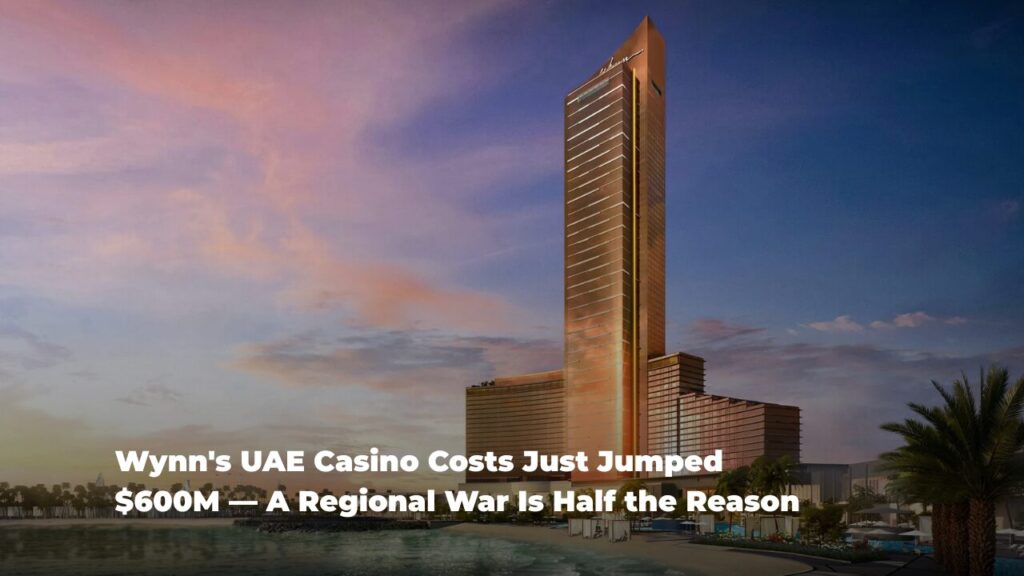
Six months ago, Wynn was informing investors that their UAE resort would open in March 2027. In Tuesday’s announcement, it opened in September 2027 and increased the project budget by $600 million. The amounts are important, but what lies behind them is even more telling.
Half of this overrun stems directly from the Iran conflict: the high premium rates for marine war risks insurance in the Persian Gulf, alternative supply chains due to the blockage of the Strait of Hormuz, and capitalised interest costs which accumulated due to a longer construction period. The rest of this increase comes from trade coordination, remeasurement, and costs which can be associated with a project of this magnitude without being linked to regional conflicts. This ratio was stated accurately by CEO Craig Billings during the Wynn Q2 earnings call: “Of that, approximately half is directly attributable to disruption from the regional conflict, material cost increases, shipping cost increases and the pre-opening and capitalised interest costs associated with the extended construction timeline it created. The remaining portion reflects remeasurement, trade coordination, and other costs you’d expect on a project of this scale and duration, independent of anything happening in the region.”
That distinction is deliberate. Wynn is not attributing the full overrun to geopolitics; it is splitting the bill clearly, and in doing so, it has put a corporate price tag on Gulf conflict exposure that most companies in the region have avoided quantifying.
Construction Halted in February, Restarted in March
The order of the events is important. Following the US and Israeli attacks against Iran, the construction work on the Al Marjan Island site was put on hold in February 2026. It only resumed in March, after ensuring the safety of all the employees involved. On the Q1 earnings call held in May, Billings had already mentioned “a modest delay,” but without providing a new date for completion. The Tuesday announcement of September 2027 was the first concrete promise made by the company following the delay.
The effect of the war on the project was not a single disruption; rather, it was compounded. There was a shift in the shipping insurance market, material suppliers were changed, shipping was re-routed to avoid the Strait of Hormuz, and the staff was affected as well. Each of these issues separately could be handled; combined, they moved the deadline as well as the costs.
Despite that, Billings described construction as currently moving “at a rapid pace.” On the earnings call, he told analysts: “We are now actively progressing through the interior fit-out of the hotel rooms with mechanical, electrical and finishing work all moving along in sequence. In addition to construction, pre-opening hiring and operations planning are advancing very well.” He added that a personal site visit in June gave him confidence: “I travelled to the UAE in June and saw the progress first hand. My flights were full and day-to-day activity in Dubai was healthy.”
$1.06 Billion Deployed, With More to Come
The financial commitment behind the project is substantial. According to Wynn’s Q2 2026 results, the company contributed $48.1 million to the joint venture during the quarter alone, bringing its total cash injection to approximately $1.06 billion. Wynn holds a 40% stake in the development, with partners Marjan and RAK Hospitality Holding holding the remainder.
With the total project budget now at around $5.7 billion and Wynn’s stake at 40%, its ultimate financial exposure is well beyond what has already been deployed. Billings acknowledged on the call that stopping construction would have been far more costly than absorbing the budget increase. That calculation explains why the company kept building through the disruption rather than pausing further.
Sole Land-Based Licence Holder in a Market Without Competitors
Wynn received the UAE’s first commercial gaming facility licence on 4 October 2024, granted by the General Commercial Gaming Regulatory Authority. No competitor has been awarded a land-based equivalent since. Billings has previously said he expects two competitors to enter the UAE market in the years ahead, projecting a market worth $3 billion to $5 billion in gross gaming revenue. He has also noted that with no announced competition yet, those estimates may be conservative.
Following the earnings call, Deutsche Bank analyst Steven Pizzella framed the September date as a positive development: “We believe the market will react well to having an official opening date for the UAE and will start to anticipate the opening at some point.” The analyst team described themselves as remaining bullish on the project over the long term.
That view reflects a straightforward investor logic. A delayed monopoly is still a monopoly. The September date also aligns, as Billings noted, with the start of the UAE’s peak tourism season, when international travel to the Gulf increases as temperatures moderate.
The Regulatory Framework Around the Resort Keeps Moving
While the land-based resort is still 13 months from opening, the UAE’s gaming market is not standing still. Play971, the country’s first licensed online gaming and sports wagering platform, launched ahead of the 2026 FIFA World Cup, offering betting markets across major international sports and leagues, alongside casino-style games streamed from a GCGRA-licensed studio in Abu Dhabi. The platform is operated by Abu Dhabi-based Coin Technology Projects LLC and represents the 19th licence issued by the GCGRA since the regulator was established in September 2023.
The regulator is clearly building a multi-channel market before Wynn opens its doors, not waiting for the flagship resort to activate the broader framework. When September 2027 arrives, Wynn Al Marjan Island will not be the only regulated gaming experience in the country; it will, however, remain the only licensed land-based integrated casino resort.
Expert Analysis
The $600 million overrun is significant, but it is not necessarily alarming when considered against the project’s projected revenue ceiling. With analysts placing the UAE gaming market’s potential at up to $8 billion in annual gross gaming revenue, the additional spend shifts the payback timeline rather than the fundamental investment case. What the conflict has demonstrated practically is that the Strait of Hormuz remains a genuine logistical chokepoint for large-scale construction in the Gulf region. For developers and operators planning future assets in the UAE, the Wynn experience now represents a documented, quantified case study in regional conflict exposure. The September 2027 date, delayed but firm, is being treated by the company and its analysts not as a setback, but as the starting point for what Billings called “the most exciting integrated resort opening globally in over a decade.”
Explore more:
 Share
Share


 231 views