







Key Points
- Robinhood filed its petition to SCOTUS on September 10, 2026; Crypto.com did it on September 11 – both contesting the Ninth Circuit decision which determined that sports events contracts are not federal swaps.
- Nine prediction market websites received a cease-and-desist warning from Connecticut on September 10 – while the federal battle has been heating up.
- Proposed changes to Rule 40.11 have been published by the CFTC on June 10, 2026 in order to clarify definitions of the terms which are being disputed in courts right now.
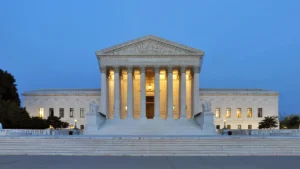
Sports prediction markets have been fighting a two-front war for months, against states in courtrooms and against federal uncertainty in regulatory filings. That war just escalated sharply. Robinhood filed a petition with the US Supreme Court on September 10, 2026, followed one day later by Crypto.com’s North American Derivatives Exchange, both challenging a Ninth Circuit ruling that affirmed the dissolution of preliminary injunctions protecting their sports event contracts in Nevada. The central question both petitions put before the Court is direct: does the Commodity Exchange Act pre-empt state gambling laws when sports event contracts are traded on a CFTC-registered exchange?
What the Petitions Actually Argue?
The legal battle turns on one word: swap. Under the Commodity Exchange Act, swaps are derivatives sitting exclusively under Commodity Futures Trading Commission jurisdiction, placing them beyond state gambling regulators. Crypto.com’s filing argues that sports event contracts qualify because their payout depends on a sporting outcome “associated with potential economic consequences,” pointing to the billions of dollars in commercial activity surrounding major US sports. The petition extends that logic further, suggesting municipalities face measurable financial exposure from fan unrest and safety costs linked to sports outcomes, and that vendors managing supply chains around game-day decisions carry hedgeable risk.
That framing is not legally untested territory. Both the Third and Ninth Circuits addressed the economic-consequence argument directly and reached opposite conclusions. The Third Circuit ruled 2-1 on April 6, 2026 that sports event contracts are swaps under the CEA, finding that payouts dependent on sporting outcomes can be associated with potential financial, economic, or commercial consequences. The Ninth Circuit rejected that reasoning entirely, concluding that “sports event contracts were not swaps because they were sports bets.” Two circuits, one statute, two incompatible readings.
Robinhood’s filing tracks the same federal preemption argument. “The Supreme Court now has the opportunity to provide clarity on the regulation of prediction markets, which we believe rightly sits with the CFTC,” a Robinhood spokesperson confirmed to Bloomberg Law. Crypto.com echoed that position, with a spokesperson stating the company is “proud that our regulator, the CFTC, supports the industry’s effort to obtain clarity through the judicial process.”
The Circuit Split That Forced This Moment
The petitions did not arrive in isolation. When the Ninth Circuit ruled on August 28, affirming that Nevada could enforce its gambling laws against the platforms and dissolving the preliminary injunctions the companies had relied on, it put itself directly at odds with the Third Circuit’s April ruling. Columbia Law Professor Joshua Mitts described the situation plainly at the time: “This is a classic circuit split.” DraftKings jumped 7% and Flutter Entertainment rose more than 6% on the day of the Ninth Circuit ruling, the market reading both moves as a reprieve for established sportsbooks that had spent months watching prediction markets chip at their audience.
New Jersey had already petitioned the Supreme Court separately, asking the justices to review the Third Circuit’s Kalshi ruling. With Robinhood, Crypto.com, and New Jersey all pressing for Supreme Court review, the possibility of consolidated hearings is real, a scenario Crypto.com’s filing explicitly anticipates given how closely its question tracks the one New Jersey posed.
Enforcement Closing In From Multiple Directions
Courts are not the only pressure point. On September 10, 2026, Connecticut’s Department of Consumer Protection issued cease-and-desist orders to nine platforms, including Crypto.com, Robinhood, Kalshi, Coinbase, Polymarket, Gemini, Novig, ProphetX, and Webull. The department warned that non-compliance could trigger civil penalties and criminal sanctions under state gaming laws. DCP Commissioner Bryan T. Cafferelli was direct: “None of these entities possesses a license to offer wagering in our state, and even if they did, their contracts violate numerous other state laws and policies, including offering wagers to individuals under the age of 21.”
According to Robinhood’s own Supreme Court petition, more than 20 states have commenced or threatened enforcement actions against prediction market platforms, with at least 12 states having proceedings pending. Underdog has countersued Connecticut, arguing federal CFTC jurisdiction is exclusive. The patchwork is becoming operationally difficult for platforms serving users across multiple states simultaneously.
Kalshi’s Separate Move at the Ninth Circuit
While Crypto.com and Robinhood went directly to the Supreme Court, Kalshi chose a different first step. The company filed for an en banc rehearing at the Ninth Circuit, asking the full court to reconsider what a three-judge panel decided unanimously. Federal courts of appeals grant such requests rarely, and the rehearing request remains pending. Kalshi argues the panel misread both the Commodity Exchange Act and the CFTC’s regulatory framework governing gaming-related contracts. The outcome of that request could influence the broader litigation timeline, even as the Supreme Court petitions move forward separately.
The Regulator Sitting Between Two Timelines
What makes this moment genuinely complicated is that the CFTC is running a parallel track of its own. The agency filed an amicus brief siding with Crypto.com’s exchange at the Ninth Circuit, clearly signalling how seriously it views its jurisdictional stake. The court rejected both the CFTC’s and the platforms’ interpretation regardless. Then, separately, the CFTC published its proposed amendments to Rule 40.11 on June 10, 2026, before the Ninth Circuit even ruled. Those amendments are designed, in CFTC Chair Michael Selig’s own words, to “deliver regulatory clarity by setting out clear criteria for determining when an event contract involves an enumerated activity,” covering gaming, war, terrorism, and assassination.
The proposed amendments add a formal definition of “gaming” to Rule 40.11, the very term courts have been splitting over for months. By June, prediction market trading volume had already exceeded $25 billion in a single month, and the number of event contract types traded on CFTC-registered exchanges had grown from 220 in 2021 to over 8,000 by May 2026. Rulemaking is not a theoretical exercise here; it covers a market moving real commercial volume.
Expert Analysis
In our opinion, the most insightful aspect of the whole controversy is neither the petitions nor the petitions’ content. The reason we say this is because, prior to the court decision that declared the CFTC’s position unlawful, the agency itself made an attempt to amend its Rule 40.11 back in June. This shows that the CFTC was well aware of the vulnerabilities of its own legal terms, but instead of making amendments, the courts took it upon themselves to declare the regulation unconstitutional. What happened now is that the proposed changes stand there waiting for the Supreme Court to rule either way regarding the necessity of their implementation.
What we find editorially difficult to ignore is the structural contradiction at the heart of the CFTC’s position. The agency wrote Rule 40.11 to govern gaming-related contracts. The Ninth Circuit used Rule 40.11 against the CFTC, concluding that the rule itself prohibits designated contract markets from listing gaming-related products, which the court found sports contracts to be. The CFTC created the ambiguity it is now trying to litigate out of existence. Whether the Supreme Court will view that history as the CFTC fixing a drafting problem or as evidence the agency overstepped its original mandate is, arguably, the most consequential unresolved question in US financial regulation right now.
 Share
Share


 5 views