Key Points
- 33,252 bank accounts are frozen under stronger anti-gambling enforcement.
- Six rural banks lose licences under wider financial oversight.
- Gambling transactions increase near Eid and show risk in the system.
For a long time, the approach remained unchanged. Authorities located illegal gambling websites, shut them down, and believed they reduced the problem. Yet platforms returned, and money continued to flow. Then regulators began to question whether websites were never the main focus.
The focus moved to money.
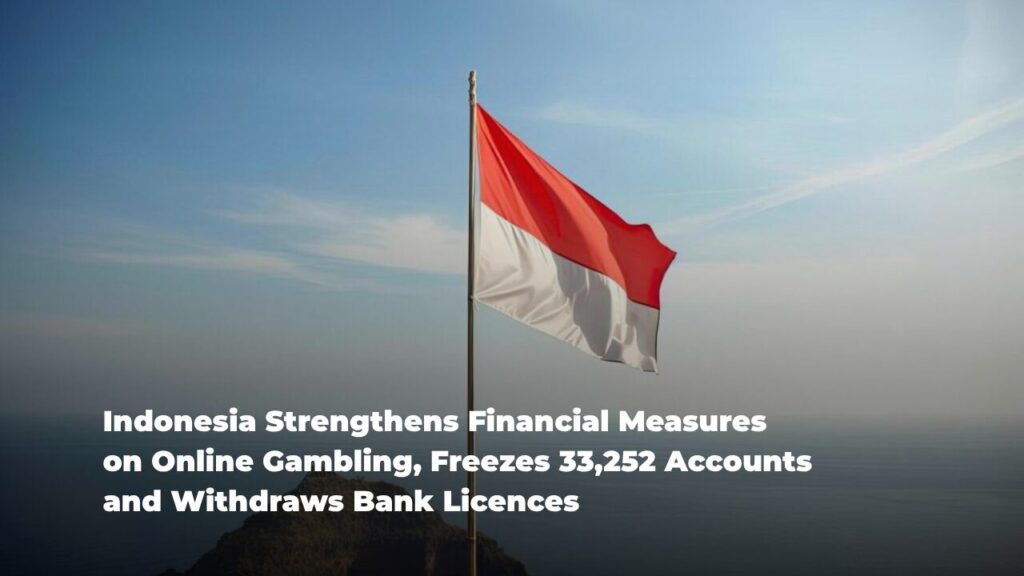
When financial pipelines stop, the system weakens at its base. This idea now drives enforcement strategies in Indonesia. Acting on this, OJK froze 33,252 accounts linked with online gambling. This figure increased from 32,556 due to stricter EDD checks across banks.
Dian Ediana Rae, head of Banking Supervision, spoke during the March 2026 press event in Jakarta. He said “Related to the eradication of online gambling, which has wide-ranging effects on the economy and financial sector, OJK has requested banks to carry out enhanced due diligence or blocking of 33,252 accounts indicated to be linked to online gambling”.
The implication stands direct.
Authorities now treat online gambling as a financial system risk. This classification changes how action takes place.
Banking System Faces Enforcement Pressure
Freezing accounts is one layer only.
The deeper change appears as enforcement enters the banking system and reaches institutions once seen outside the issue. Between January and March 2026, OJK cancelled the licences of six rural banks known as Bank Perekonomian Rakyat. These included PT BPR Koperindo Jaya in Central Jakarta and PT BPR Pembangunan Nagari in Agam Regency West Sumatra. Action came under financial oversight and consumer protection, showing that all institutions carry responsibility.
Banks shift their role now.
They act as checkpoints with accountability, and this move from response to enforcement marks a change in system behaviour. Coordination increases across bodies. OJK works with LPS under Law Number 4 of 2023 on Financial Sector Development and Strengthening. At a broader level, financial stability depends on cooperation with the Financial System Stability Committee, government, parliament, and law agencies, creating a connected structure where monitoring and enforcement act together.
Seasonal Patterns Show Shifts in Gambling Activity
The timing of this crackdown does not happen by chance. When data is examined, a pattern appears that regulators have now observed twice in sequence. Figures from the Financial Transaction Reports and Analysis Centre PPATK present a clear direction. Deposits linked to illegal gambling platforms increased after Eid al-Fitr for the second year in a row. In 2025, values moved from IDR 2.96 trillion in January to IDR 3.05 trillion in February, then rose to IDR 5.08 trillion in April.
This rise did not appear small.
It showed a spike that matched a major festive period in Indonesia.
This year, early signs show the same direction forming again. By late March, near Eid between 19 and 20 March, transaction levels had already passed January and February. The same cycle continues. PPATK chief Ivan Yustiavandana explained the process behind this movement. He said more money moves during festive periods, creating liquidity, and illegal platforms use this moment. The activity does not act without a pattern. It follows economic cycles, which gives regulators an advantage when timing is correct and not delayed.
Law Action Moves from Finance to Digital Systems
Financial disruption alone cannot break gambling networks, and authorities understand this clearly. These systems operate across digital and financial paths, so enforcement now targets both at once. In a recent operation led by the Cybercrime Directorate of the Indonesian National Police, 132 illegal gambling websites were taken down. At the same time, IDR 255.75 billion linked to suspected gambling activity was frozen. Investigators used financial monitoring tools to follow transaction paths, map payment flows, and work with banks to identify thousands of accounts tied to these networks.
This approach shows a shift in enforcement methods.
Illegal gambling systems function as connected networks, not separate units, and acting on one part leaves other parts active. Officials continue to state that blocking payment channels works best, since these systems depend on access to funds. When that access stops, the structure begins to weaken.
From Single Actions to System-Level Response
What appears from these steps is more than a crackdown. It shows a change in how Indonesia responds to online gambling at the system level. Online gambling no longer stands as an activity at the edge of the formal economy. Account freezes, licence removal, transaction tracking, and joint enforcement reveal a plan to block illegal activity from the financial system. At the same time, the scale shows depth, with thousands of accounts and trillions of rupiah already moving through these networks.
The issue now shifts.
It is not about whether enforcement exists. It is about whether the system can stay ahead of behaviour that changes each time new barriers appear.
Expert View: Impact on Financial System and Industry
Indonesia’s approach shows a shift toward financial-based enforcement, and this move creates a direct impact on all institutions inside the system. For banks, compliance costs will increase. Enhanced due diligence is not a simple change, it needs investment in transaction monitoring systems, data analysis, and risk models. Smaller banks, especially rural ones, face stronger pressure, which explains licence removals already happening. Regulators send a clear message that weak compliance systems will not continue.
From a strategy side, banks must treat gambling-linked transactions as high-risk exposure, similar to money laundering. This may lead to tighter onboarding, stricter transaction limits, and deeper account checks, which may slow customer growth and affect user experience in retail banking.
Across the industry, effects go beyond Indonesia.
Regulators in other regions may follow similar financial control methods, especially where online gambling exists in unclear legal areas. Cross-border cooperation may increase, and shared financial monitoring frameworks may appear as governments exchange data and methods. Opportunities open for fintech and regtech providers. Demand will rise for fraud detection systems, behaviour analysis tools, and AI-based compliance solutions as institutions look for scalable systems. Legal gambling operators may also gain, as illegal competitors face disruption in payment access.
Risks remain present.
Strong enforcement may push illegal networks toward hidden channels like cryptocurrency or informal systems, which reduce tracking ability. There is also a risk of blocking valid users, which may reduce trust in banking systems among people without a connection to gambling. Winners include compliant banks, regtech firms, and governments seeking control over financial flow. On the other side, illegal operators, non-compliant banks, and parts of the informal digital economy face loss.
Looking forward, the next phase may focus on predictive enforcement using data to act before activity rises. Stakeholders should watch the closer links between financial intelligence units and banks, and possible rules on alternative payment systems.
A deeper change is already moving forward.
Financial systems no longer act as passive channels. They now act as enforcement tools, and each connected institution must respond in that way.
 Share
Share


 428 views