





Key Points
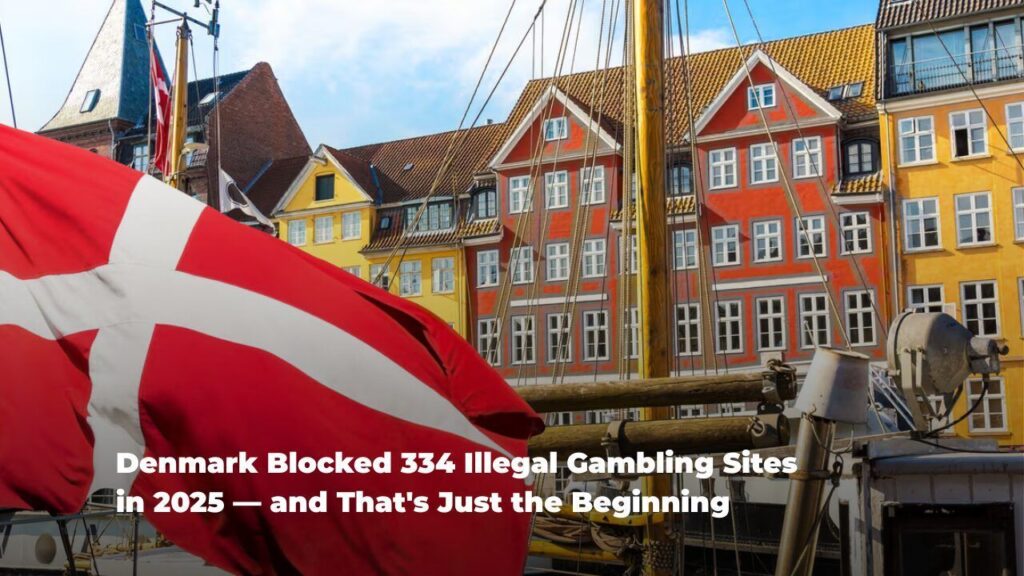
- Denmark’s regulator blocked 334 unlicensed gambling sites in 2025, a 70% rise on the 197 blocked in 2024, driven by stepped-up surveillance rather than black market growth.
- The Spilpakke 1 legislative package, passed in October 2025, handed Spillemyndigheden authority to target affiliate and referral sites for the first time, alongside a whistle-to-whistle sports advertising ban.
- Online casinos overtook lotteries as Denmark’s largest gambling segment in 2025, generating DKK4.31 billion in GGR, while Denmark’s channelisation rate has quietly slipped to 72% from around 90% in 2022.
334 Sites Down, 695 Under the Microscope
Denmark’s gambling regulator spent 2025 hunting down illegal operators with a precision that produced results. Spillemyndigheden secured court orders blocking 334 unlicensed websites, all targeting Danish players, and published the details this week in its annual report. The initiative utilised proactive web searches, information analysis, and tips from the public in order to uncover those individuals operating without a Danish license.
A cooperative effort with the anti-fraud division of the Danish Tax Authority greatly expanded this reach. From there, 695 platforms were flagged for deeper investigation. Courts confirmed 334 of those as running gambling operations without valid Danish licences, and blocks were imposed. Beyond the legal proceedings, 36 further sites quietly pulled or adjusted their gambling content after the regulator made contact.
One thing that Spillemyndigheden was certain about was that the increase in the number of blocks didn’t translate to growth in the black market. The number 334 is a 70% increase from the 197 websites that were blocked back in 2024, but Spillemyndigheden says that the increase is a result of better surveillance, not growth in the market.
DNS Blocking Works — With Caveats
The report put DNS blocking under scrutiny rather than simply defending it. After 178 sites were blocked in June 2025, third-party traffic data showed visits falling by roughly 34% over the following six months compared with the period before. Not every domain told the same story, though; some blocked sites registered no measurable drop in traffic at all.
Chasing mirror sites through the courts each time had been a drain on enforcement capacity. An updated agreement with Teleindustrien, the Danish ISP trade body, changed that; clone or mirror domains can now be blocked dynamically, without a fresh court order for every instance. Operators who redirect users from casino123.com to casino124.com in case of being blocked will be found out sooner.
In addition, one more developing threat mentioned in the report is website hijacking, which occurs when illegal operators exploit legal websites by making gambling-themed subdomains redirect users to offshore casinos. Currently, under Danish law, it is possible to block whole websites but not individual subdomains.
App Stores and Social Platforms Enter the Frame
Illegal gambling is no longer just a web problem. The regulator’s report flagged a clear drift toward mobile apps on iOS and Android, alongside social and streaming platforms as vectors for unlicensed marketing. Formal complaint routes with Apple and Google were put in place to speed up app removals from Danish stores.
On the social side, licensed operators gained direct reporting access on Meta’s platforms, cutting the time it takes to pull infringing content. The regulator described this as enabling “faster, and therefore more efficient, handling of these matters.” Encrypted platforms such as Telegram and Discord were also identified as growing promotional channels for illegal gambling — areas where educational campaigns are running, but where enforcement remains technically challenging.
Spilpakke 1 Gave Spillemyndigheden Real Teeth
The campaign for enforcement was not carried out in a legislative vacuum either. “Spilpakke 1” legislation was passed in October 2025 by a large parliamentary majority and conferred on Spillemyndigheden the power to prevent not only unlicensed providers but also the affiliates and referrals which provide paths for Danes to access them. Child protection and prohibition measures were further enhanced. Funding was also allocated to build an automated digital advertising monitoring system.
Most visibly, the package introduced a whistle-to-whistle ban on gambling advertising during live sport, beginning ten minutes before kick-off and running until ten minutes after the final whistle. Gambling ads on public transport and within 200 metres of schools were also prohibited, as were “free money” welcome bonuses. Denmark’s Tax Minister Ane Halsboe-Jørgensen called it “the beginning of a showdown with a gaming industry that has been allowed to take up too much space for far too long.”
Online Casinos Cross a Milestone
The market numbers behind all this enforcement tell their own story. For the first time, casinos became the largest segment among Denmark’s gambling industry in 2025 as indicated by the annual report of the Danish Gambling Authority. Casino GGR amounted to DKK4.31 billion accounting for 38% of total market GGR, growing by 12.1% year-over-year. The casino sector has grown more than two-fold since 2012 with an overall 139% growth in that period.
Online gambling accounted for 73% of total GGR in 2025 compared to 70% in 2024 and increased sharply from 33% only in 2012. The Danes gamble on their phones because mobiles accounted for 73% of all the online gambling revenues in 2025 whereas casino and betting revenue from mobile was at only 27% in 2012.
The growth did not go in all segments’ favour. GGR from land-based casinos fell by 5.6% to reach DKK378 million or 3% of the total market GGR. For the first time ever, liberalised land-based bingo entered the figures, generating only DKK30 million which is below 1% of total GGR. Spillemyndigheden also participated in 25 investigations into unlawful installation or operation of gambling machines and betting terminals during the year.
Denmark and Ireland Sign Cross-Border Cooperation Deal
Denmark’s enforcement posture is also extending outward. A Memorandum of Understanding was signed on 7 July 2026 between the Gambling Regulatory Authority of Ireland and the Danish Gambling Authority to enhance cooperation in compliance, supervision, and the exchange of information. Speaking about the agreement, Anne Marie Caulfield, Chief Executive Officer of the GRAI said that it was “another very important milestone for building cooperation between regulators who regulate adjacent markets.” Cooperation and dialogue between Ireland and Denmark will help in achieving better regulation.
This trend is not only specific to Ireland and Denmark; the same can be observed in many other countries in Europe. Anders Dorph, Director General of the Danish Gambling Authority, is also the Chair of the Gaming Regulators European Forum (GREF).
Expert Analysis
Not everyone views the tightening picture with confidence. Gustaf Hoffstedt, secretary general of Sweden’s gambling trade body BOS, pointed to H2 Gambling Capital data showing Denmark’s channelisation rate has slipped to 72%, down from roughly 90% in 2022. “Denmark, together with the United Kingdom, has been the two beacons of light in Europe when it comes to safeguarding the licensing market,” Hoffstedt said, adding that 72% is “totally dissatisfactory.”
His concern is direct: more restrictions risk pushing consumers toward the unlicensed market rather than away from it. Spillemyndigheden’s own report acknowledges that some blocked domains show no traffic decline at all, which means determined players are finding workarounds. The regulator blocked more sites than ever in 2025, partnered with global tech platforms, and secured new legislative authority — yet the channelisation data suggests the regulated market’s grip on Danish players has loosened, not tightened. How Denmark manages that tension, between enforcement ambition and market attractiveness, will define whether Spilpakke 1 strengthens the licensed market or quietly fragments it.
 Share
Share


 142 views