





Key Points
- Betr purchased NFA-registered introducing broker Ascent Capital Management, allowing the company to operate as a CFTC-registered introducing broker while speeding up the launch of prediction markets powered by Polymarket technology inside its gaming super app.
- Through the acquisition, Betr avoids waiting through the extended NFA approval process and moves beyond sportsbook and casino products into federally regulated event contracts linked to sports, politics, culture, and other real-world events.
- The transaction also mirrors a larger industry movement as operators including Fanatics, PrizePicks, Underdog, DraftKings, and FanDuel continue shifting toward regulated event-contract trading while regulators across global markets increase scrutiny.
Prediction markets still sit in the background for many betting platforms, yet Betr has chosen a very different direction. The company acted with speed and little noise, though the move quickly drew attention from gaming executives, regulators, and fintech investors alike. What first appeared to be a routine acquisition soon exposed a larger shift developing across the industry. Sports betting and financial-style trading no longer stand as separate worlds because the line between them keeps fading. Operators now scramble to secure positions before regulators settle the framework. Users could soon see betting apps evolve into something much broader, while sportsbooks face questions that continue growing harder to dismiss.
Betr Takes an Aggressive Route into Prediction Markets
Many betting operators continue moving carefully around prediction markets, rolling out limited products while regulators debate the rules surrounding them. Betr chose another path entirely. The real-money gaming super app, launched by Jake Paul and Joey Levy, acquired Ascent Capital Management Inc. to accelerate its prediction-market expansion. At first glance, the transaction looks tied mainly to licensing and regulatory approvals. Underneath that layer, though, the acquisition delivers something carrying major value in the current environment, speed.
At the core of the deal sits Ascent’s position as an introducing broker registered with both the US Commodity Futures Trading Commission and the National Futures Association. That registration changes Betr’s position immediately because the company no longer depends fully on the approval timeline it had already been working through.
Betr filed its NFA membership application in October 2025. Months passed by while the process stayed unresolved. Then another option surfaced, and the acquisition created a quicker route into federally regulated prediction markets. Reports indicate that Ascent Capital Management has held an introducing broker registration since 2011. That regulatory structure now becomes part of Betr’s own framework as the company pushes further into event contracts linked to real-world outcomes.
Betr called the acquisition a way to “fast-track” its prediction-market ambitions. Behind those words sits a larger industry truth because timing now shapes competition in this market more than ever before.
Why Prediction Markets Have Turned into a Fight for Market Control?
Traditional sportsbooks and prediction markets can look similar at first because both focus on future results. Once users step inside the system itself, the differences become clear. Rather than placing fixed bets against bookmaker odds, users trade contracts tied to whether an event takes place. Those contracts can revolve around sports outcomes, elections, economic data, entertainment events, and weather developments.
That shift changes the way users engage with the product. Many participants no longer treat the activity purely as gambling. More users now see the experience as trading information or predicting probability outcomes. The distinction carries weight because prediction markets now operate between two major regulatory systems. Sportsbooks generally fall under state gaming regulators, while federally regulated event contracts may come under oversight from the Commodity Futures Trading Commission.
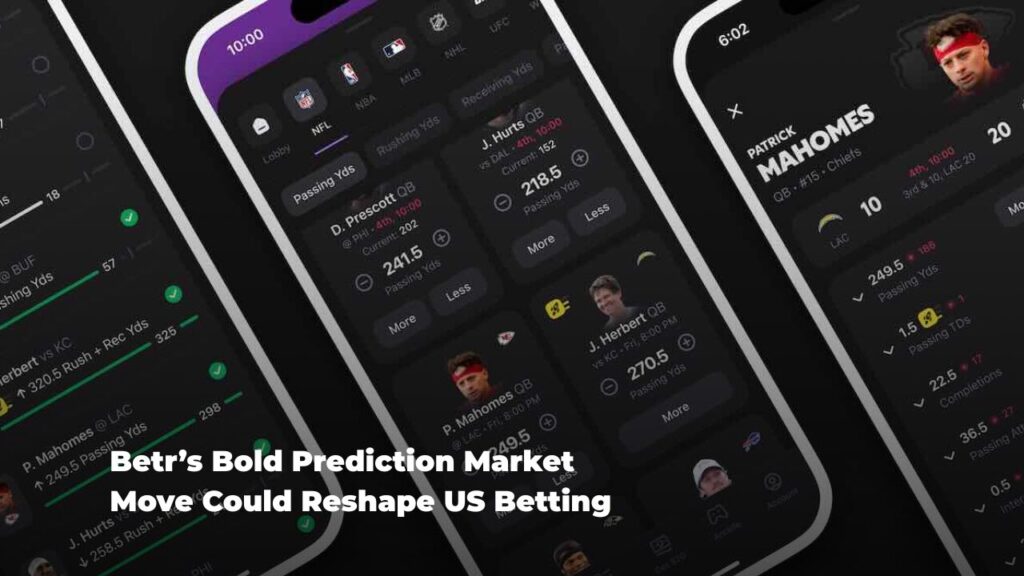
Betr plans to place those contracts inside the same wallet users already use for Picks, Sportsbook, Casino, and Arcade products. The company stated that contracts linked to sports, politics, culture, and other event categories should launch later this year, while wider expansion is expected during 2026.
Growth could arrive quickly because Betr says it already has more than one million paying users. Unlike newer operators attempting to build audiences from the ground up, the company already controls a sizable distribution network.
Polymarket’s Technology Becomes Central to Betr’s Strategy
Earlier in March, Betr formed a partnership with Polymarket, one of the most recognised names operating in the global prediction-market sector. The Ascent acquisition now provides the regulatory structure Betr needs to deploy that technology within a compliant framework across the United States. Joey Levy described the move as part of a wider transformation taking shape across finance and entertainment.
“Prediction markets represent one of the most exciting evolutions in interactive entertainment and financial technology. By securing IB registration through the acquisition of an established broker, we can now focus entirely on launching a seamless, compliant prediction market experience powered by Polymarket.”
Those remarks reveal how quickly the industry’s position has shifted. Operators no longer frame prediction markets as experimental additions sitting beside core products. More companies now treat them as a major long-term category.
At the same time, Polymarket continues dealing with regulatory pressure across international markets. Authorities in Argentina recently ordered the platform blocked and removed from Google and Apple stores after claiming it operated as a “covert online betting system” without proper authorisation. Brazil also declared prediction markets illegal. Finance Minister Dario Durigan argued that wagering on random events, including weather outcomes, sits outside the country’s approved sports-betting structure.
Other markets have responded in a very different way.
Gibraltar licensed its first prediction-market operator last month. Later, Predict Street announced that it had become the official prediction-market partner of the 2026 FIFA World Cup. Those sharply divided regulatory reactions explain why companies such as Betr continue prioritising compliance structures before expanding at full speed.
The US Betting Sector Starts Shifting Direction
Betr is not making this move alone. Across both sports betting and fantasy sports, companies have already begun reorganising themselves around event contracts. Fanatics followed a similar path after purchasing Paragon Global Markets last year. That acquisition allowed Fanatics to become the first sportsbook operator to launch prediction markets ahead of rivals such as DraftKings Predictions and FanDuel Predicts.
Daily fantasy sports operators also pushed harder into the sector. PrizePicks secured futures commission merchant approval and partnered with Kalshi in November 2025 before expanding its prediction-market products into 48 states. The company now provides sports event contracts across 35 states along with Washington, D.C. Underdog partnered with Crypto.com in September 2025. Later, the company received FCM approval in January. It currently offers event contracts across 36 states.
The transition became important enough that Underdog cut its workforce by 20% in March while shifting resources away from traditional DFS operations.
Partnership structures have also changed at pace. Introducing brokers now work more closely with federally regulated exchanges such as Kalshi and Crypto.com’s derivatives platform to distribute event contracts. Introducing brokers cannot directly hold customer funds in the same way as futures commission merchants can, though the structure still creates a hybrid model where gaming companies gain access to regulated financial infrastructure without fully operating as financial institutions.
Pressure from Congress Begins to Grow
The timing of Betr’s acquisition matched a closely watched Congressional hearing centred on sports integrity. What started as a discussion around integrity concerns soon widened into a broader debate surrounding prediction markets themselves. Bill Miller of the American Gaming Association and Patrick McHenry presented sharply different views regarding the regulation of event contracts. The American Gaming Association repeated its long-standing position that sports-event contracts should remain under state and tribal gaming regulators rather than move toward federal commodities oversight.
The disagreement stretches well beyond technical regulation because it touches the future shape of the betting industry itself. If prediction markets continue expanding under federal oversight, traditional sportsbooks could end up competing against operators working within very different regulatory systems. For sportsbooks, the concern no longer centres only on complexity. A larger fear now revolves around structural imbalance.
Why Betr’s Acquisition Holds Greater Importance Than Expected?
At first glance, purchasing an introducing broker may appear to be a routine corporate transaction. The reality carries more significance because Betr secured something increasingly difficult to obtain quickly, regulated market access. The acquisition gives the company infrastructure, speed, and regulatory positioning while the long-term rules surrounding prediction markets still remain unsettled.
Consumer behaviour is already changing alongside that uncertainty. Younger users continue moving toward products that feel interactive, tradeable, and tied to real-world information instead of static sportsbook wagers. Prediction contracts fit directly into that behaviour pattern. Operators now face a difficult balancing act. Ignoring prediction markets could leave companies behind competitors, while aggressive expansion may trigger regulatory conflict as oversight frameworks remain fragmented across global markets.
The companies holding the strongest position may not necessarily be the biggest sportsbooks. The advantage could instead belong to firms capable of combining compliance infrastructure, trading technology, and large-scale user distribution before regulators finally settle the debate.
Expert View, Prediction Markets Move Closer to Gaming’s Core
Betr’s acquisition signals that prediction markets no longer operate at the outer edge of the gaming industry. Step by step, they are moving toward the centre. For operators, the immediate impact centres on compliance investment and infrastructure alignment. Sportsbook companies with scale but without federal regulatory pathways may now face pressure to acquire brokers, exchanges, or derivatives partnerships simply to remain competitive.
That pressure keeps rising because regulatory positioning has evolved into a strategic asset instead of remaining only a legal requirement. The wider market could slowly move toward a hybrid structure combining betting with financial-style trading. Companies already operating large gaming apps with active wallets and strong retention systems gain a measurable advantage because they can distribute prediction products directly to existing users.
Several groups could benefit immediately from that transition. Federally aligned exchanges, infrastructure providers, and compliance-focused operators currently hold strong positions. Consumers may also gain access to a broader product variety along with more liquid event-based markets. Traditional sportsbooks face the heaviest pressure over the long term.
If prediction markets continue expanding under separate regulatory standards, sportsbook operators may face uneven compliance burdens and competitive disadvantages. State regulators could also lose influence as more event contracts shift toward federal oversight structures.
The next phase will likely focus less on product innovation and more on regulatory definition. Attention now turns toward how Congress, the CFTC, state gaming regulators, and tribal authorities respond to the rapid expansion of sports-related event contracts.
The companies that ultimately survive this transition may be the ones viewing prediction markets not as a temporary trend, but as a lasting structural change across digital gaming and financial entertainment.
 Share
Share


 276 views