






Key Points
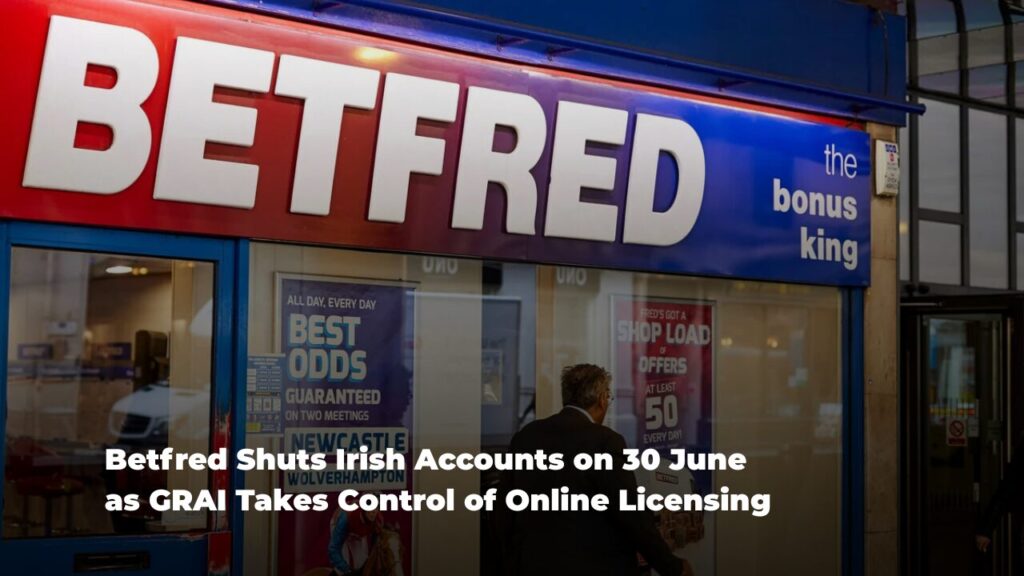
- Betfred will shut down Irish customer accounts from 30 June, one day before the GRAI formally takes charge of online gambling licensing under the Gambling Regulation Act 2024.
- Customers have been told to withdraw their money before the deadline and not place bets settling after 29 June, with Betfred confirming it will pay out ante-post World Cup wagers.
- The pause sits inside a much wider pullback from Ireland, with Flutter, Entain, and BoyleSports all having cut back or reconsidered their positions ahead of the new rules.
Betfred’s Irish customers got a short, direct message this week. Their accounts will stop working on 30 June. The Warrington bookmaker told users it is “taking a temporary pause in the Irish market, while we align with the new GRAI gambling regulations,” and added: “We hope to be back soon.” Customers must withdraw whatever money is left in their accounts before the month ends, and should not place any bet that will not settle before 29 June.
The date is not a coincidence. On 1 July, the Gambling Regulatory Authority of Ireland (GRAI) formally took over online gambling licensing under the Gambling Regulation Act 2024. Every operator running a digital gambling service must hold a GRAI-issued licence from that point. Betfred looked at the mid-transition window, weighed the risk, and stepped out.
A Two-Year Run That Has Already Stopped
Betfred arrived in Ireland in autumn 2024 and never planted a single shop on Irish soil. The whole operation was online. Measured against a UK business built on more than 1,300 betting shops, a busy sportsbook, and a casino, Ireland was always a small piece of a much bigger picture. So walking away temporarily is not a crisis for a company this size. Ireland simply was not big enough to carry the enforcement risk once the GRAI’s powers switched on. Betfred was asked for more details. The answer was brief: the pause is temporary, no return date, nothing further to add.
Open Bets, World Cup Wagers, and What Comes Next
For Irish customers sitting on open bets, the first question is obvious: what happens to money already staked? The 2026 FIFA World Cup runs until 19 July, nearly three weeks after accounts go dark. Racing Post reported that Betfred intends to settle those ante-post bets as normal, pause or no pause. For anything else sitting open in customer accounts, the company said it will be “in touch shortly.” The instruction for anyone still holding an active account is simple enough: take your money out before 30 June, and do not place a single new bet that will not settle before that date.
Ireland’s New Rules and What They Cut Out
The 1 July date did not appear overnight. The GRAI began operations back in March 2025. By February 2026, Justice Minister Jim O’Callaghan had pushed through an extension of its powers, covering licence applications and formal enforcement authority. O’Callaghan described that moment as “an important step towards replacing Ireland’s outdated gambling laws,” saying the new framework “reflects the nature of modern gambling and takes into account the harms associated with problem gambling, by providing safeguards to protect people from those harms, especially children.”
The Gambling Regulation Act 2024 gives the GRAI authority to fine operators up to €20 million or ten per cent of turnover for any breach, whichever is larger. Credit card gambling is gone. Free bets and VIP hospitality packages are out as marketing tools. Gambling ads cannot run on television or radio before 9 pm. Customers must choose to receive marketing rather than being signed up automatically. No ATM machines inside betting shops.
Read that list again and the real story becomes clear. Each restriction lands directly on a tool that most gambling operators have used as standard practice for years. Bonus-led sign-up campaigns, gone. VIP retention, out. Broad broadcast advertising before 9 pm is blocked. Google has quietly moved in step with all of this, requiring a valid GRAI licence before any operator can run gambling ads targeting Irish users. For anyone running customer acquisition in Irish gambling, none of this is a small compliance tweak. The whole model needs rebuilding, from how new customers are brought in to how existing ones are kept.
Flutter, Entain, and BoyleSports Had Already Started Moving
Betfred is not the first. A sequence of major operators had already started pulling back from Ireland, and it began well before July became a deadline. In October 2025, Flutter Entertainment closed 28 Paddy Power shops across the Republic, citing cost pressures, with 119 jobs put at risk. Entain tried to sell its Irish Ladbrokes business to independent bookmaker Bar One Racing. Those talks came to nothing. Entain has since confirmed it will close 39 of its roughly 100 Irish Ladbrokes shops, putting 226 jobs at risk. BoyleSports, the largest privately owned bookmaker in Ireland, has been sending its business details to potential buyers since at least February 2026, according to industry sources. No deal has come through yet.
Four of the most familiar names in Irish betting, all moving in the same direction, in the same window. Each has its own stated reasons. Strip those away and the same calculation sits underneath all of them: what it now costs to operate in Ireland versus what Ireland actually pays back.
Not everyone reads the same picture the same way. Welsh bookmaker DragonBet is entering Ireland right now, for the first time, which means some operators see the new framework as a cleaner place to compete rather than a reason to pack up. A regulated market, properly run, does remove a certain amount of noise. Whether that belief holds up commercially is another question. The answer will come once the GRAI moves through its first round of licence applications and operators find out what enforcement actually looks and feels like on the ground.
Expert Analysis
Betfred’s call is not hard to follow. The company came to Ireland late, built nothing physical there, and now faces fines of up to €20 million for operating without a GRAI licence after 1 July. Stepping back temporarily costs very little for a business that lives and breathes in the UK. The harder question is what “temporary” actually means once the process starts. Ireland’s new rules carry real operational weight. Fit-and-proper checks on senior staff, physical inspections, mandatory spending controls for customers, marketing restrictions that cut off most standard acquisition routes: each one adds to a compliance load that operators running on thin Irish margins will have to measure very carefully before deciding a return is worth it.
For marketers, the point is specific. Any operator that returns to Ireland after 1 July is not picking up an old programme. Paid search needs a GRAI licence first. Bonus acquisition is off the table. Affiliate activity has to be checked line by line against the new advertising rules. Opt-in requirements change how CRM databases and email campaigns can legally be built and run. Whoever gets back into Ireland first will be the operators who started rebuilding their acquisition frameworks before the licence arrived, not after. Betfred says it hopes to return soon. How soon that actually happens depends as much on how ready the marketing operation is as on how fast the GRAI processes the paperwork.
 Share
Share


 270 views