Key Points
- Sweden’s overall channelisation rate fell to 84% in 2025, the third year in a row it has missed the SGA’s own 90% target.
- Online casinos sit at just 81% while sports betting holds at 96%, pointing to a sharp divide within the licensed market.
- ATG’s own estimate puts the Q4 2025 figure as low as 73%, casting doubt on how well Sweden can actually measure its black market problem.
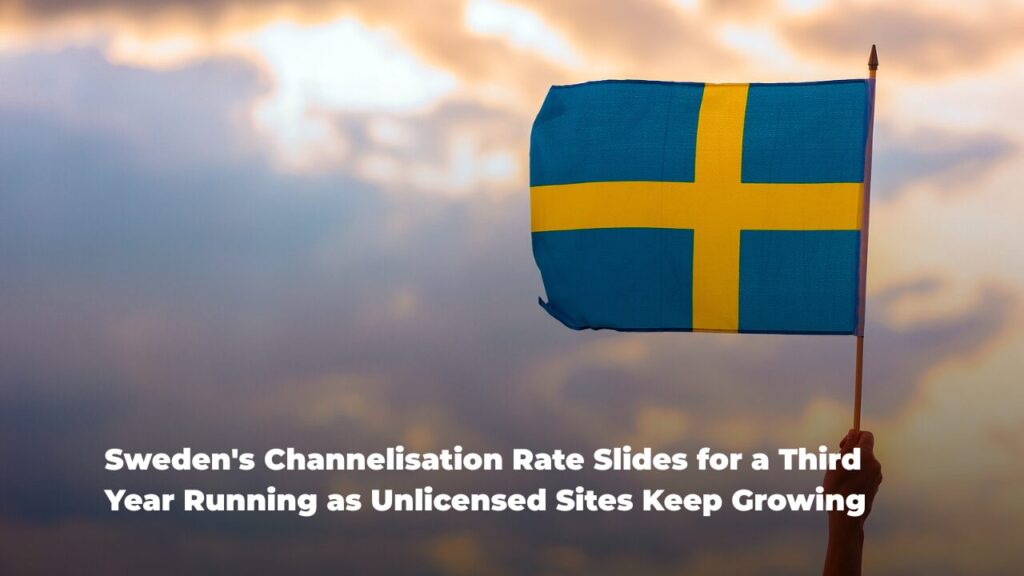
Sweden’s regulated gambling market is bleeding players to unlicensed sites for the third consecutive year. The channelisation ratio, which is a gauge of how many gamblers use licensed entities for their gambling activities, declined to 84% in 2025, after declining from 85% in 2024 and 86% in 2023, per the latest report by the Swedish Gambling Authority (SGA).
However, the 90% threshold that had been set by the Swedish Gaming Authority after the launch of the industry in 2019 by the regulator has not yet been achieved.
It is clear to any operator or marketer operating in Sweden that this is not just a regulatory figure, but an indicator of where the action lies, and why. The reasons are more obvious than most market reports will admit openly.
Online Casino and Sports Betting Are Operating in Completely Different Worlds
The headline figure of 84% hides more than it reveals. Underneath it sits a divide between product verticals that Sweden has failed to close. Sports betting held a channelisation rate of 96% in 2025, which means nearly every sports bettor in the country was placing money with a licensed operator. Online casinos came in at just 81%, which means roughly one in every five online casino players sent at least some of their money outside the licensed system.
The 84% overall score achieved by the SGA was determined using two different techniques: one involved a player questionnaire scoring 89%, while another utilized internet traffic analysis for a score of 78%. The 11-point gap between these two techniques is not the result of rounding error nor some small detail hidden in the methods employed section. This difference represents uncertainty in the actual level of market visibility by the SGA.
The Spelpaus Problem No One Saw Coming
The SGA counted 2,186 unlicensed gambling websites operating in Sweden. Illegal skin betting sites pulled the largest share of unlicensed traffic, accounting for 42% of it. Sites mixing online casinos with betting products took 35%, while casino-only unlicensed sites drew 21%.
Asking the question to players regarding what attracts them to unlicensed gambling sites, the regulator found that most of them mentioned Spelpaus. The idea of Spelpaus came into existence when Swedish authorities decided to develop a self-exclusion register to make sure that all problem gamblers would be banned simultaneously from every licensed operator. However, things did not go according to plan, as those who joined Spelpaus wanted to go to unlicensed operators. Others pointed to better odds, or games that the licensed market simply does not stock.
That is where the story turns uncomfortable for anyone selling gambling products in Sweden. The licensed market’s own responsible gambling infrastructure is, for a portion of players, working as a pathway toward the least protected part of the market. No acquisition strategy sits in isolation from that.
What the Regulator Says, and What the Industry Says Back?
Johan Röhr, who has been serving as acting director general of the SGA since Camilla Rosenberg stepped down in November 2025, acknowledged the figures without treating them as a crisis. “The channelisation rate in 2025 is estimated at 84%, which shows that a majority of Swedish gambling continues to take place at operators with a Swedish licence,” he said. “The measurements in recent years indicate a relatively stable market.”
His broader point is not without basis. Before Sweden reregulated in 2019, fewer than half of all gambling transactions touched a licensed operator. Going from below 50% to 84% in six years is a real shift, not a cosmetic one. Holding at 84% is not the same thing as moving toward 90%, though, and the rate has gone in one direction only, downward, for three years straight.
Swedish operator ATG has been running its own channelisation tracking, and its figures keep landing below the SGA’s. In its Q4 2025 report, published in March 2026, ATG put the channelisation rate for that quarter at somewhere between 73% and 84%.
The bottom of that range sits 11 points below the SGA’s full-year number. ATG estimated unlicensed gambling revenue at between SEK 3.6bn (€330m) and SEK 7.3bn (€660m) per year, with gross turnover running from SEK 60bn (€5.5bn) to SEK 120bn (€11bn). Swedish traffic to unlicensed operators, the company also found, has grown tenfold since 2019.
ATG’s chief analytics officer, Tobias Melin, did not dress it up. “Channelisation is moving in the right direction, but there is still a long way to go to reach the state’s target. At the same time, we see how unlicensed sites use the same platforms, payment solutions and in some cases even remain available despite decisions by authorities. That shows the regulatory framework needs to be tightened in order to truly shut out the unlicensed operators.”
The detail sitting behind that statement is striking. ATG found that 14 of the 20 unlicensed sites drawing the most Swedish traffic were built on the same platform suppliers used by licensed operators. Eight of them accepted deposits and withdrawals through Swedish bank accounts via BankID. Five were already on the SGA’s own prohibition list, formally banned, and Swedish players were still using them.
A Policy Fight That Has No Resolution Yet
The channelisation rate has become the number at the centre of a bigger argument about how Sweden should be running its gambling regulation. Online operators, speaking through BOS, the Swedish Trade Association for Online Gambling, argue that high taxes, tight advertising rules and a less competitive licensed product are pushing players toward offshore sites. ATG has taken the opposite position, arguing that online casino and horse betting are different products that should not be taxed the same way.
BOS secretary general Gustaf Hoffstedt was not softening anything. “Channelisation is the mother of all other challenges. Without doubt, that is the most important challenge in Sweden and elsewhere,” he told SiGMA News. Hoffstedt has also argued that Sweden’s original legal framework let certain offshore operators serve Swedish customers without formally targeting the market, which makes enforcement structurally harder than the surface picture suggests.
That argument matters to marketers because it shapes what the licensed market can actually offer, how it is allowed to promote itself, and what it costs to run an operation inside it. A market where licensed operators are squeezed on product range, advertising access and margin is a market where unlicensed competition holds a built-in edge, and the channelisation data suggests that edge is being pressed.
Where Does This Go From Here?
Röhr will hand over to Peter Knutsson as permanent SGA director general in August. Whether that change in leadership produces a different approach to measuring or confronting unlicensed gambling remains to be seen. As iNTERGAME reported, the industry responded positively in September last year to proposals from a government-appointed investigator focused on curbing the black market, but those proposals have not yet become law.
For now, Sweden’s licensed gambling market is competing against 2,186 unlicensed sites, some built on the same infrastructure, some taking BankID payments, and some sitting on a prohibition list that Swedish players are still ignoring. The 90% target is officially still in place. The distance between that target and where the market actually sits has grown every year since 2022. That is the condition every operator and marketer in Sweden is working within, whether their strategy has been built around it or not.
Expert Analysis
Sweden’s channelisation data points to a market where structural conditions favour unlicensed operators in the segment that matters most, online casinos.
The Spelpaus finding is the starkest example: responsible gambling policy is producing an unintended redirection effect for a portion of the highest-risk players in the market. ATG’s data on shared platform infrastructure and BankID access makes clear that the unlicensed market is not operating from a distance; it is embedded inside the same payment and technology ecosystem as the licensed one.
For marketers, the practical consequence is that acquisition and retention strategies in Sweden are being shaped not only by competition between licensed operators, but by a parallel market that faces fewer restrictions, lower costs, and in some cases, the same product catalogue.
 Share
Share


 274 views