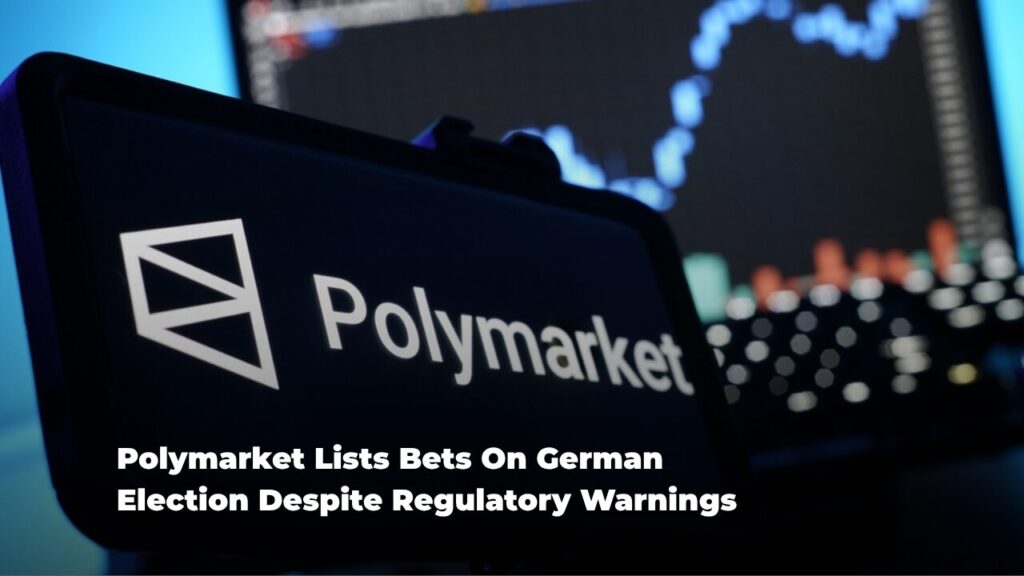
Polymarket is offering markets on German political events, despite repeated warnings from Berlin authorities that such activity breaches national gambling laws. The platform allows users to trade on real-world outcomes, listing contracts across regional elections and political developments involving senior figures.
Active markets include bets on upcoming state elections in Saxony-Anhalt, Berlin, and Mecklenburg-Western Pomerania, all scheduled for September. The platform has also listed a contract on whether Friedrich Merz will step down as chancellor before 2027.
Participation from within Germany is restricted at the payment level. However, the platform remains accessible online due to a regulatory gap.
German law excludes political betting under current framework
Germany’s regulatory framework is defined by the Interstate Treaty on Gambling introduced in 2021, which limits legal wagering to sports betting under licensed operators. It also prohibits betting on elections or public policy outcomes.
Oversight falls under the Joint Gambling Authority of the Länder, which has stated that prediction markets on political events may constitute illegal gambling. Authorities have advised citizens to avoid such platforms, citing concerns around transparency and manipulation.
Despite this position, activity linked to German political markets is on the rise. Contracts related to Berlin elections have attracted notable interest, with some markets extending beyond simple election outcomes.
Supporters argue that financial incentives can produce more accurate signals than traditional polling. This argument gained attention during the 2024 election cycle, when some analysts viewed these markets as reflecting real-time sentiment. Media organisations in the United States have since experimented with incorporating such data into coverage.
Regulatory concerns focus on anonymity and market influence
European regulators have taken a cautious approach to prediction markets, particularly in jurisdictions where legal classification remains unclear. In Germany, these platforms exist in a “grey zone” between financial instruments and gambling products.
Authorities have raised concerns about anonymity on crypto-based platforms. Transactions often lack clear identity verification, making it difficult to determine who is placing trades or whether coordinated activity is taking place.
This creates the risk of insider-style behaviour, where individuals with access to privileged information could trade ahead of public developments undetected. Regulators have pointed to instances where trading volumes increased sharply before geopolitical events involving countries such as Iran and Venezuela. While no direct violations were established, these patterns have raised questions about how information flows through these markets.
There is also concern about the influence of probability pricing on public perception. When markets assign odds to political outcomes, those figures can shape expectations once they circulate online. Large trades can shift prices quickly, creating a sense that certain outcomes are likely even when public opinion remains uncertain.
Critics argue that this dynamic may affect how individuals interpret political developments. Attention can shift from policy discussions to financial positioning, altering how events are consumed.
Enforcement challenges leave access largely intact
German regulators have maintained their position that platforms like Polymarket operate outside the law under current rules. The challenge lies in enforcing restrictions within a digital environment that allows continued access.
Payment controls can limit direct participation, but they do not prevent users from accessing the platform itself. Workarounds such as alternative payment methods and VPN usage reduce the effectiveness of enforcement.
This creates a situation where regulatory limits exist in principle but are difficult to apply in practice. Authorities keep monitoring activity and issuing warnings, but the persistence of these markets highlights the limitations of current measures.
Expert Opinion
Polymarket is pushing regulatory limits in Germany by listing bets on its elections. Though they have been issued warnings, the company is leveraging loopholes in the current legal framework. I am confident the authorities will implement stricter enforcement in the near future.
Explore more:
 Share
Share


 358 views