

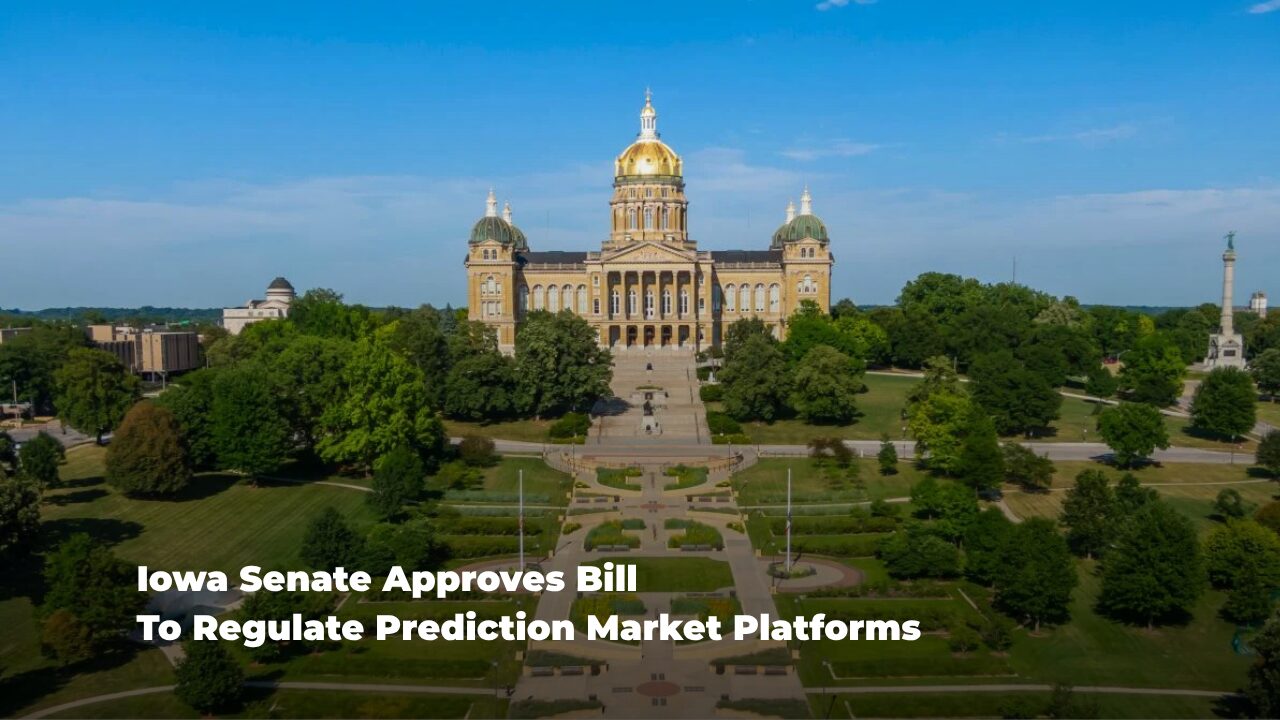
The Iowa Senate has passed Senate Bill 2470, marking the first time a US legislative chamber has approved a measure to regulate prediction markets. The bill cleared the Senate with a 45-1 vote, with Doug Campbell casting the only vote in opposition.
The legislation targets platforms where users trade contracts tied to real-world outcomes such as elections, sports and economic events. Lawmakers are focusing on how these platforms operate and whether their structure resembles traditional betting systems.
Bill introduces tax structure and licensing requirements
Senate Bill 2470 sets out a financial model for operators offering event contracts in Iowa. The measure imposes a 20% excise tax, 20% tax on adjusted revenues, and a $20 million licensing fee.
Lawmakers are attempting to bring these platforms within a controlled framework while capturing revenue from their activity.
The bill places financial pressure on operators, which could limit market entry or force existing platforms to reassess their presence in the state.
Federal and state authority remain in conflict
Prediction markets operate within a contested legal space. Platforms argue that they fall under the authority of the CFTC, which oversees derivatives markets under federal law.
Many regulators consider these platforms comparable to gambling and argue they should comply with state gaming laws. This creates unresolved jurisdictional conflict.
The CFTC has previously asserted exclusive oversight of certain prediction market activities. If courts uphold that position, state-level measures such as Iowa’s bill could face limits in enforcement. If states retain authority, Iowa’s model could influence how other jurisdictions approach regulation.
Legal challenges and national implications
Kalshi has already filed a lawsuit against Iowa seeking to block the enforcement of state gaming laws. The case raises a central question about whether event contracts should be treated as financial instruments or gambling products.
Courts are examining both issues. Some cases focus on whether federal law overrides state regulation, while others assess the nature of the contracts themselves. The issue could eventually reach higher courts, including the Supreme Court, depending on how conflicting rulings develop.
Across the US, lawmakers are increasing scrutiny of prediction markets. Concerns include insider trading risks, market manipulation and the use of contracts tied to sensitive topics such as elections or geopolitical events.
Iowa’s move represents the first direct attempt by a state to regulate the sector through taxation and licensing. Other states are monitoring the approach and may adopt similar frameworks if it proves workable.
The bill will now move to the Iowa House of Representatives for further consideration. If SF 2470 advances and is signed into law, it is likely to face immediate legal challenges. The outcome will influence the future of prediction markets across state and federal systems.
Further updates on regulatory developments will be available in the Regulation Section.
Explore more:
 Share
Share


 8 views







 Analysis
  Business
  Companies
  Crime
Crime  Finance
  M&A
M&A  Prediction Markets
  Regulation
  Reports