






Key Points
- Group revenue for the Q2 period has amounted to $195.5m, hitting the $185m guidance mark, with adjusted EBITDA amounting to $52.6m above the $45m mark.
- The $1.2bn Legend acquisition is delivering ahead of schedule, with cross-selling already live and direct prediction market deals signed with Polymarket and Kalshi post-quarter.
- Full-year 2026 revenue guidance has been raised for the second consecutive quarter to $1.005bn–$1.025bn, and NFL prediction market revenue remains entirely outside the forecast.
One thing is missing your own guidance twice consecutively. The other is doing that even as you are taking in a $1.2bn acquisition.
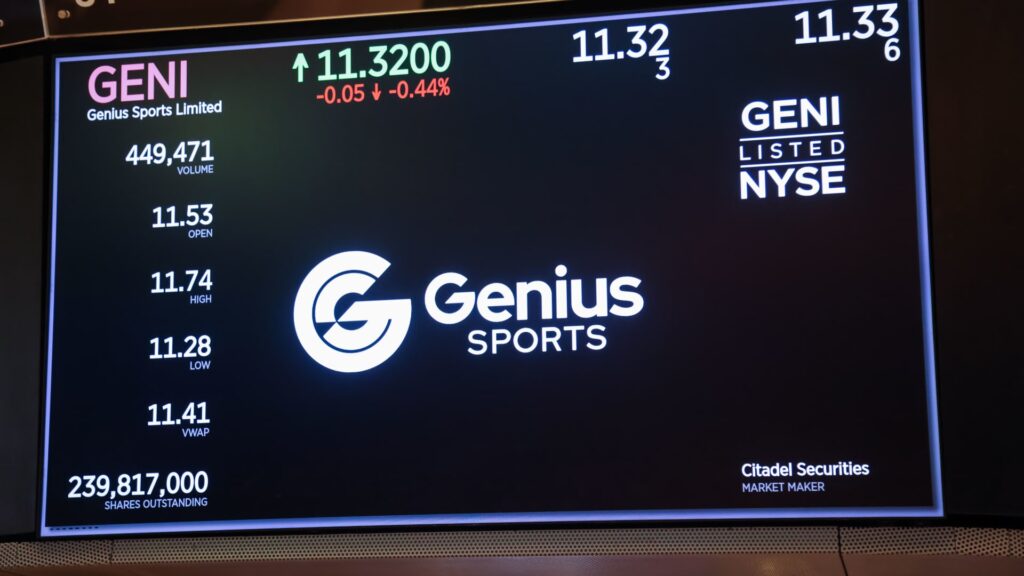
Genius Sports (NYSE: GENI) announced the company’s financial performance for the quarter ending on August 6, 2026, with the total group revenue standing at $195.5m for the quarter ended June 30, 2026. The amount is 65% higher than the $118.7m revenue that the company generated in Q2 2025, and exceeds the $185m guidance it had provided post-Q1. The adjusted EBITDA stood at $52.6m, an increase of 54% over the last year and more than the $45m guidance.

What Actually Drove the Beat?
The headline number gets the attention, but the detail underneath is more revealing. Genius grew revenue by $76.8m year-on-year in Q2, yet sales and marketing expenditure increased by only $3.2m over the same period. That gap between revenue growth and marketing spend is the clearest signal that the Legend media platform is doing exactly what Genius promised at acquisition: lowering the cost of reaching and converting new clients at scale.
Revenues for Media Technology, Content and Services surged 193% annually to $78.2 million. The main source was Legend, which Genius completed buying out on 1 May 2026 through a deal worth up to $1.2 billion. This involved $800 million in cash and $100 million in stocks upon closure, alongside an earnout amounting to $300 million in two years’ time. Apart from Legend, there was also growth in the segment because of rising demand for Genius Sports Moment Engine where 174 new advertisers signed up in Q2 2026, enticed by its World Cup offerings. Some of these advertisers included McDonald’s, YouTube TV, and DoorDash.
The betting segment held its position as the group’s primary revenue engine. Betting Technology, Content and Services generated $117.4m in Q2, up 28% year-on-year, supported by price increases on contract renewals, expansion of value-add services and growth in existing markets.
The Net Loss Explanation Nobody Is Giving
The net loss widened to $76.7m in Q2, against $53.9m in the same quarter last year. Taken alone, that looks like deterioration. Read alongside the cost breakdown, it tells a different story.
The company absorbed $28.9m in non-recurring transaction expenses directly related to the Legend deal, $13.8m in net interest expense from the term loan taken on to finance the acquisition, and an $8m loss on fair value remeasurement of contingent consideration. Those three items account for the bulk of the year-on-year movement in net loss. Loss from operations, which strips out non-operating items, actually improved by $25.1m year-on-year, falling from $80.7m to $55.6m. The wider net loss is a transaction artefact, not a sign that the underlying business is under pressure.
Q2 last year also included a $27m positive foreign exchange gain, which flatters the comparison further. Without that one-time tailwind in the prior period, the year-on-year net loss gap narrows considerably.
CEO Mark Locke addressed the trajectory directly: “We continue to realise the benefits of the infrastructure we’ve spent years building. Advertisers are placing greater value on our combination of official data and audience, prediction markets are opening an entirely new avenue for growth, and our core betting business continues to outperform.”
Two Guidance Raises in Two Quarters
Genius has revised its annual revenue guidance to $990m-$1.01 billion, which is clearly an aggressive increase over the previous guidance of $810m-$820 million prior to the acquisition. The second quarter results have led to another upward revision of the guidance. The new guidance for 2026 annual revenue is $1.005 billion to $1.025 billion, while adjusted EBITDA is expected to be in the range of $285m-$295m, compared to $270m-$280m in the previous guidance range.
For Q3 specifically, management is guiding for approximately $260m in revenue and $85m in adjusted EBITDA. That sequential step-up reflects a full quarter of Legend contribution plus NFL season volume, which historically drives a meaningful share of Genius’s betting segment activity.
Locke also noted the integration is tracking ahead of internal expectations: “In our first quarter as a combined business, we exceeded guidance on revenue, adjusted EBITDA and cash, raised our full-year outlook, and are already seeing the benefits of the Legend integration.”

The Deals That Are Not Yet in the Numbers
Post-quarter, Genius signed direct commercial agreements with both Polymarket and Kalshi, the two leading CFTC-regulated prediction market platforms in the United States. The Polymarket agreement covers exclusive live streaming rights across selected competitions, official data for contract settlement and integrity services, alongside digital marketing distributed through Legend-owned media properties.
During the Q2 earnings call, Locke confirmed that Genius treats prediction market operators as large-tier operators, structuring deals with fixed minimums and upside, mirroring its traditional sportsbook contract model. He also confirmed that no NFL prediction market revenue is included anywhere in the raised guidance. Asked what an NFL clearance would mean for the business, he called it “very significant,” citing both direct financial value and the reputational weight of the affiliation, while advising investors not to anticipate it during the current season.
In other words, the guidance Genius has already raised twice does not yet account for what would likely be its largest single prediction market revenue source.
First-Half Summary
In the first half of the year ended 30 June 2026, Genius generated $383.5m of total revenues, which increased by 46% compared to the previous year. The company’s adjusted EBITDA came in at $76.6m, showing a growth of 42% year on year. The net loss was recorded at $132.2m, which is much higher than last year’s $62.1m loss.
Management expects approximately $145m in unlevered free cash flow in H2, with year-end cash guided at approximately $260m. Net leverage is expected to sit at around 2x by year-end.
Expert Analysis
The back-to-back guidance raises carry weight, but the more durable signal is what is happening to the cost structure. Genius added $77m in revenue in Q2 on $3m of incremental marketing spend. That ratio is not an accident; it reflects a business where Legend’s owned media audience, around 180 million users, is now being monetised across both the media and betting segments without requiring proportional additional spend to reach them. The net loss will remain elevated through 2026 as Legend-related debt and amortisation work through the income statement, but those are known, finite costs. What remains open-ended, and absent from guidance, is the prediction market revenue line, particularly once the NFL season enters the picture.
Explore more:
 Share
Share


 214 views