







Key Points
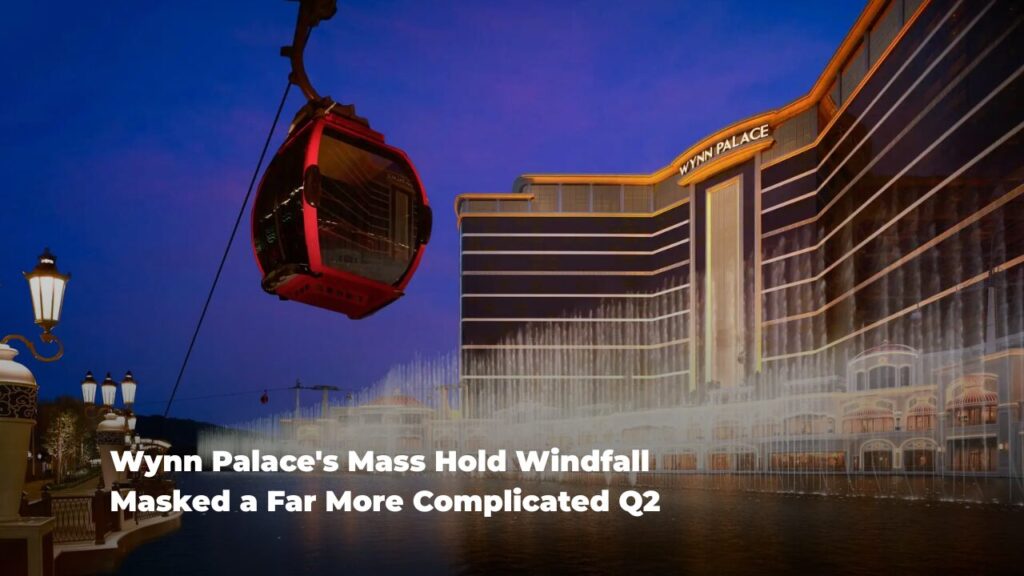
- The mass win rate at Wynn Palace amounted to 29.7%, which is a significant improvement compared to 22.3% last year, thus making about $140m extra wins on the same volume.
- VIP turnover at both Wynn resorts in Macau declined by 36.8%, which is the figure missed by most publications.
- The opening of the UAE resort was rescheduled for September 2027 with an increased budget of $600m, which is the third postponement of the opening date since the beginning of the project in January 2022.
Wynn Palace’s Hold-Rate Windfall Masked a Far More Complicated Q2
The figures for revenues at Wynn Resorts, amounting to $1.86 billion and profit totalling $140.1 million, were released on 4th August 2026 and were above the projections of analysts. The stock price increased by about 6% during the after-market trading period. The numbers themselves appeared to be impressive. The mechanics behind the numbers
One Property Carried the Quarter
Adjusted property EBITDAR was up only 2.9% to $568.3 million, with the margin falling from 31.8% to 30.6%, while revenues were up 6.9%. Operating cost increases eat away at any earnings increases when the latter are lower than revenues in this manner, and this is exactly what is taking place in three of the four properties of Wynn.
The exception was Wynn Palace, where the revenues came in at $653.4 million and grew 21.1% compared to the previous year, while the adjusted property EBITDAR increased 28.2% to $201.5 million. EBITDAR of the company grew by $15.9 million. Wynn Palace added a net of $44.3 million to the EBITDAR. Las Vegas lost $19.6 million, Encore Boston Harbour lost $7.8 million, and Wynn Macau lost $1.0 million. Excluding Wynn Palace, the company’s EBITDAR declined.
The Question Analysts Refused to Drop
The figure that dominated the earnings call was Wynn Palace’s mass-market win percentage. Mass table drop rose 3.0% to $1.90bn, yet the win rate jumped from 22.3% in Q2 2025 to 29.7%, producing a 36.9% surge in mass table win to $563.4m. Had the rate held at last year’s level on identical volume, mass table win would have been roughly $140m lower — a gap that dwarfs the group’s entire EBITDAR increase for the quarter.
Bank of America’s Shaun Kelley pressed CEO Craig Billings on whether a 29.7% hold rate was repeatable. Billings was direct: “We tried to normalise for mass hold. We did that for a few quarters, and nobody liked it. We reverted back to normalising for VIP, particularly as the market became more mass-oriented. You’re right, mass hold was at the higher end of the range. If you’re asking if that’s some type of broad trend based on side betting activity and other things like that, we certainly are seeing more of that activity on the floor.”
He linked part of the elevated hold to the recently expanded Chairman’s Club at Wynn Palace, saying the facility “is also designed to increase dwell time, which obviously has a positive impact on hold.” Citigroup analysts had flagged this connection back in April, noting that nine high-value players, including the three largest observed in the survey, were all playing with Wynn on the same visit, writing: “It looks like ‘Build it and they will come’ still holds in Macau.” Deutsche Bank, in a note following the results, said the Chairman’s Club remains in its ramp-up phase and that the expanded area could attract new customers while extending playing time among existing ones.
Whether 29.7% becomes a recurring feature or reverts toward the 22% to 24% range seen historically is the central question heading into Q3 reporting.
VIP Went in the Opposite Direction
While most attention was on the mass hold figures, the VIP market dropped sharply at both the Macau operations. The group’s total VIP billings dropped by 36.8% to $3.20bn, while the VIP hold did not hit the estimated 3.1% to 3.4% figure for both properties, settling at 2.97% for Wynn Palace and 2.58% for Wynn Macau. CFO Craig Fullalove pegged the total loss from the VIPs at just above $8.6m.
The weakness was partially blamed by Billings on the FIFA World Cup eating into the time of the high-rollers during the latter part of Q2 through early Q3. He added that gambling activities picked up in the latter part of July through early August when the World Cup distraction was over and summer holiday travels started picking pace. Jefferies observed in its post-results note that management had pointed out the improving trends in late July as an encouraging sign for the current quarter.
Las Vegas: A Cost Problem, Not a Demand Problem
The revenues of the city remained constant at $643.2 million, whereas the hotel achieved its best-ever monthly EBITDAR in May. The EBITDAR of the hotel fell to $215.2 million from $234.8 million. The difference stemmed from cost rather than volume issues. Operating costs, net of gaming taxes, were at $4.5 million per day, up 6.2% from a year ago, mainly due to wage escalations and costs related to new facilities open for a full quarter.
According to Billings, operating costs in Las Vegas were expected to be within a range of $4.4 million-$4.7 million per day for the rest of 2026. Until the company generates higher revenues than the costs are growing, Las Vegas’ margins will stay thin even in light of casino volume or room occupancy. However, he noted that Q3 started with bad luck on the tables in Las Vegas.
Forward indicators are more constructive. Wynn is tracking ahead of last year for the Formula One weekend in November, and Billings said group and convention booking pace had accelerated through July, with demand looking firm heading into Q4 and 2027.
UAE: Third Delay, $600m More, September 2027 Confirmed
The Wynn Al Marjan Island project update carried the same market significance as the earnings performance. At the announcement of the project in January 2022, the projected completion year was set at 2026, then adjusted to Q1 2027. Later in May 2026, Billings reported an additional “modest” delay. This was the third revision, but now with a specific completion date set for September 2027.
The budget of the project is expected to increase to about $5.7bn compared to $5.1bn. Wynn owns a 40% stake in the joint venture with local developer Marjan and RAK Hospitality Holding, so it will contribute an additional equity worth $240m to the $600m budget overage. Billings attributed the increase in two categories: around half of the budget increase relates to the war situation in the region, including higher material costs, transportation costs, and interest expense due to the delay; the rest of the increase is related to re-measurement and logistical coordination and scale-related costs.
He pushed back against any suggestion the opening would be phased, stating that all on-site amenities would be accessible from day one, and noted that September aligns with the start of the UAE’s peak tourism season. “What I can tell you is that we would open the doors and open all the amenities exactly as we would any other particular opening,” he said. “We don’t do hoarding.”
Macau Expansion Enters Construction Phase
Wynn confirmed that both major Macau expansion projects are now moving forward. The event centre and theatre at Wynn Palace will begin construction within weeks, following receipt of the revised land contract from the Macau government in July, with completion targeted for 2028. The Enclave, a 432-suite hotel tower that will increase Wynn Palace’s room inventory by approximately 25%, is set to begin construction before year-end and open in 2029. Expansionary capital expenditure in Macau is guided at $350m to $400m for 2026, with early spending focused on piling and ground works.
Expert Analysis
Wynn’s Q2 result is credible on the revenue line but structurally thin at the margin level. The mass hold at Wynn Palace generated roughly $140m in incremental win above what last year’s rate would have produced, yet group EBITDAR grew by only $15.9m. The variance was offset by the increase in costs in Las Vegas, the decrease in volume of VIPs in Macau, and capital spending in the UAE. The adjusted EBITDAR of properties has been ranging between $562m and $570m for the last four quarters, despite the increase in revenues. The underlying business is running flat. Until Wynn Al Marjan Island opens and the Macau expansion projects begin contributing revenue, probably from 2029 onwards, growth will depend heavily on whether Wynn Palace’s elevated mass hold is a product of the Chairman’s Club investment or a statistical spike that will not repeat.
Explore more:
 Share
Share


 244 views