Key Points
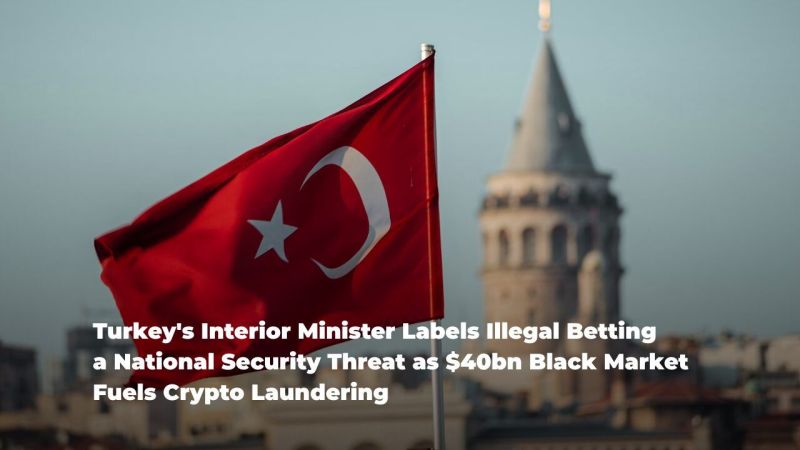
- Turkish Interior Minister Mustafa Çiftçi claims that illegal gambling drains the country of $40 billion per year and has transitioned from being a public order issue to a national security matter.
- Turkey shut down 47,493 illegal betting websites in 2026 alone through 680 raids in which 5,629 individuals were arrested, while 6,314 bank accounts were frozen during the FIFA World Cup final.
- The coordinated action by the Turkish government is aimed at crypto wallets, shell commerce sites, and influencers under the 11th Judicial Package, which imposes harsher penalties and asset seizures.

Interior Minister Raises the Stakes, Calling Illegal Betting a Security Threat
Language coming out of Ankara has hardened significantly. Speaking recently in an interview on Habertürk, Interior Minister Mustafa Çiftçi, who was appointed to the post in February 2026, has said that “illegal gambling is now not just a law-and-order issue, but it is a direct national security issue.” This statement is indicative of a stance which has long been espoused by high-ranking Turkish authorities, but has been expressed by Çiftçi in unequivocal terms.
“Turkey loses about $40 billion a year through illegal gambling,” he noted. “Gambling has moral and social implications. Behind every amount gambled there is a destroyed life of a young person. Gambling is haram according to our belief.”
The above number, which is quoted at $40 billion by the Ministry of Interior, exists in a wider range of figures, which Turkish vice president, Cevdet Yılmaz, put at $20 billion to $60 billion in May 2026. This is because the measurement of the underground economy is very difficult as it tries to elude any kind of detection. Nonetheless, the size cannot be debated.
This perspective goes beyond the numbers because once a minister makes the connection between illegal betting, organised crime, and national security, the institutional approach changes from that of being a reactive response to one of proactive threat management. This change is now reflected in the way Turkey is using its law enforcement assets.
Cryptocurrency Identified as the Engine Behind Money Laundering
The minister was specific about what has changed structurally in recent years. Cryptocurrency and digital payments have given illegal betting syndicates tools that are far harder to trace than cash-based operations.
“Casinos, junkets, cryptocurrencies and underground banking are the most critical parts of the money laundering infrastructure that fuels international organised crime,” Çiftçi stated. “The global gambling market will reach $205 billion in 2030.”
This is not an isolated concern. As of early 2026, Turkey’s Financial Crimes Investigation Board (MASAK) has been granted gate-keeping powers over gambling-related financial flows, with authority to instruct banks to freeze accounts and suspend payment institutions that are found to be systematically facilitating illegal betting revenues. In coordination with the Central Bank, six financial organisations have already had their operations suspended and assets seized by judicial order.
The minister also described how criminal networks have adapted beyond obvious channels. Syndicates are using shell e-commerce sites, intermediary payment providers, and seemingly legitimate financial tools to move betting proceeds. “Criminal organisations are no longer robbing with knives or guns, but with algorithms and digital wallets, and we are responding in the same arena,” he warned.
2026 Enforcement Numbers Tell a More Urgent Story
The statistics of this year alone illustrate the magnitude of the issue and the extent of the measures being taken to tackle it. As many as 47,493 illegal betting websites have been shut down, with 5,629 people arrested during 680 operations that were conducted by the authorities since January 2026. This information was gathered by the Interior Ministry of the country, and it was shared by the Anadolu Agency.
Blocking action was one of the measures in a longer trend. Between 2006 and 2025, Turkey blocked 548,420 websites that dealt with illegal gambling or betting sites with 84,000 blocked in 2025 alone, as well as blocking 12,548 server addresses. The figures picked up
The most accurate move ever made was in the final game of the FIFA World Cup 2026. Minister of Justice Akın Gürlek stated that 6,314 bank accounts were identified ahead of the game and frozen at the same time across 32 banks just when the final kicked off, trying to make sure that the largest window for illegal betting would be blocked. Illegal bets on the FIFA World Cup 2022 amounted to about $35 billion, with potential figures in 2026 amounting to $50 billion.
Measures have been taken to dismantle the entire structure: legal cases have been brought against individuals who promote online gambling sites on social media, and 19 places known as external financing centres have been searched for dealing with bets.
The Legal Framework Tightens Further
Turkey’s existing law, Law No. 7258, already criminalises the operation or facilitation of unlicensed gambling, frequently bundling such cases with money laundering and fraud charges. The country operates legal betting exclusively through its National Lottery Administration and the sports betting entity İddaa under the Spor Toto Organisation.
What has changed in 2026 is the prosecutorial architecture sitting behind that law. Justice Minister Akın Gürlek sent official letters to 171 chief public prosecutor offices across Turkey’s 81 provinces, requiring coordination meetings at least every six months between law enforcement, prosecutors, and MASAK agents. The directive mandates that prosecutors develop stronger investigative capacity around how illegal operators breach digital environments and move money across borders.
This is part of President Erdoğan’s 11th Judicial Package, enacted in late 2025, that enacts stronger penalties such as prison sentences, fines, and confiscation of the money in bank accounts involved in gambling. The package focuses on foreign players as well; previously, Erdoğan had singled out Georgia, Armenia, Cyprus, and North Macedonia as countries housing the illegal platforms for Turkish customers.
In a different case code-named “Paymix-3”, conducted by the Izmir Chief Public Prosecutor’s Office in May 2026, 38 people were arrested and about 1.6 billion Turkish lira ($35.4 million) in criminal assets was detected, and legal action was taken against 15 suspects thought to be living abroad.
The Context Competitors Have Missed
What makes Çiftçi’s latest statements significant is not the crackdown itself; Turkey has been conducting enforcement operations against illegal betting for years. The shift is in how the government is framing the threat and building institutional infrastructure around that framing.
The creation of the Illegal Betting and Sports Crimes Investigation Bureau within the Istanbul Chief Public Prosecutor’s Office in June 2026 marks a structural change, not just an intensification of existing efforts. The use of AI-powered monitoring systems to identify suspicious account patterns represents a technical evolution in enforcement capacity that previous administrations lacked.
There is also a religious dimension that reinforces political will. The Presidency of Religious Affairs of Turkey, known as Diyanet, has considered gambling as an issue of Islamic social values where it has been indicated that 80% of youth are involved in the gambling-related content available on the internet and has collaborated with Yeşilay (Green Crescent).
Expert Analysis
Turkey’s crackdown is increasingly operating on two tracks simultaneously: domestic enforcement through coordinated law enforcement, financial monitoring, and prosecutorial reform; and international pressure on the jurisdictions and payment systems that enable offshore operators to reach Turkish users.
The World Cup freeze operation demonstrated a new capability, real-time financial interdiction at scale, which goes well beyond routine website blocking. If MASAK and the prosecutor’s network continue to develop cross-border enforcement under the 11th Judicial Package, the compliance risk for payment processors and banks facilitating these flows will rise sharply.
For international gambling operators licensed in Curaçao, Malta, or the Isle of Man and serving Turkish users, the direction of travel is now unambiguous. Çiftçi’s declaration that Turkey has “reached a capacity to see, analyse and respond to this threat” is not abstract; the 2026 enforcement figures suggest that capacity is being deployed with growing precision.
 Share
Share


 169 views