Key Points
- The Turkish National Lottery Administration blocked a total of 84,585 illegal gambling and betting sites in 2025. They also expanded their efforts in cracking down on streams, social media accounts, mobile applications and online foreign content providers associated with illegal gambling.
- The financial analysts along with law enforcement agencies also ramped up their efforts against the money transfer companies, money laundering activities, offshore betting organisations, and even advertising platforms. They even froze TRY 5 billion which is around $108.9 million in funds suspected to be involved in illegal betting activities.
- However, despite such efforts from the authorities, the intelligence numbers showed that the betting trend in Turkey was rising even further.
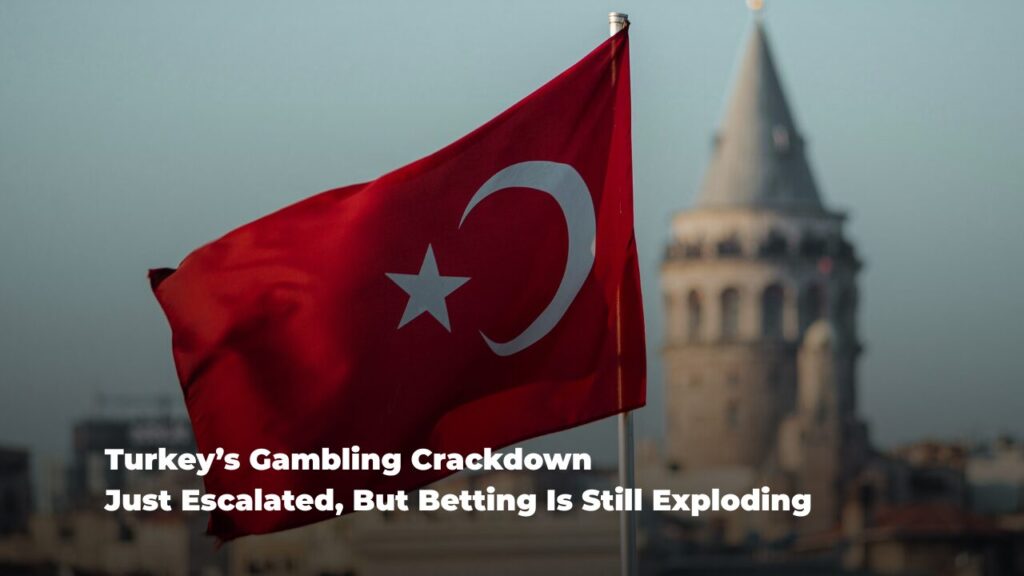
Turkey’s fight against illegal gambling has moved far beyond simple website bans. Regulators now pursue streaming services, payment firms, mobile applications, social media pages and the wider digital systems supporting offshore betting networks. Still, another reality keeps surfacing beneath the enforcement drive. Betting demand inside Turkey continues rising, even during one of the country’s toughest crackdowns in recent years. That gap carries weight because the issue no longer centres only on access. Authorities now face a gambling economy that rebuilds itself at a pace regulators struggle to match.
Turkey Expanded Its Gambling Crackdown Beyond Website Restrictions
The Turkish National Lottery Administration blacklisted a total of 84,585 websites engaging in unauthorised gambling and betting activities throughout the year 2025, however, the operation was far from just blacklisting websites. The authorities expanded their operations into the realm of streaming services, social media sites, mobile applications, and offshore content providers involved in unregulated betting.
Furthermore, there was an upsurge in criminal and financial investigations. The enforcement agencies turned their attention towards payment processors, illicit transactions, offshore bookmakers, and marketing channels. An amount of TRY 5 billion or nearly $108.9 million was frozen.
Even after those actions, market intelligence data showed betting interest across Turkey continued climbing. The numbers exposed growing demand throughout the market and revived concerns over whether enforcement efforts alone can slow the country’s expanding underground gambling economy.
Turkey Shifted Away From a Website-Only Enforcement Strategy
For years, Turkey concentrated its illegal gambling enforcement efforts on closing betting websites. That structure still operates today, although the latest campaign revealed a far wider strategy. Regulators now appear to treat illegal betting as a connected digital ecosystem instead of isolated websites functioning on their own. Turkey’s National Lottery Administration, Milli Piyango İdaresi, MPI, reported 84,585 websites for closure during 2025 as part of continuing anti-gambling operations. Current laws allow authorities to impose access bans on platforms offering unauthorised online betting services or guiding users toward those operators.
Government figures also revealed how quickly the market expanded before enforcement pressure increased. Officials identified 24,815 websites in 2022. The number then surged to 168,030 in 2023 before climbing again to 232,899 in 2024. Between 2006 and 2025, authorities identified 556,818 websites linked to illegal gambling activity and successfully blocked 533,261 of them. At first glance, those figures suggest strong containment efforts. Yet the data also exposed how rapidly illegal operators rebuild infrastructure, switch domains and return through offshore hosting systems after restrictions take effect.
Investigators discovered that many gambling operators depended on overseas domain registrations and server providers, especially in the United States, Armenia and several island jurisdictions. Authorities stated that 51% of blocked websites originated from the United States, while Armenia and the Isle of Man each represented 7%. Colombia accounted for another 5%.
That global reach helps explain why Turkish regulators widened their strategy beyond direct website bans. Blocking local access alone no longer seems enough to disrupt the broader infrastructure supporting illegal betting networks.
Streaming Services, Mobile Apps and Social Media Moved Into Focus
A major change in Turkey’s enforcement strategy emerged in May 2025 after authorities widened operations toward global gaming and content providers supporting illegal betting websites. During the year, the number of blocked gaming and content providers reached 14,263. Officials also reported 517 overseas illegal gambling and betting websites, together with 109 gaming platforms supplying services to those operators, to Turkey’s Foreign Ministry and the Financial Crimes Investigation Board, MASAK. Authorities said the goal was to improve cross-border enforcement coordination through international channels.
That escalation reflected a wider regulatory shift. Illegal gambling operations no longer rely only on standalone betting portals. Authorities identified 26 mobile applications carrying illegal gambling and betting content across app stores and reported them to the Information and Communication Technologies Authority, BTK. Streaming platforms also came under pressure. Regulators blocked access to 1,902 film and television streaming websites accused of advertising illegal gambling services or redirecting users toward betting operators.
The reasoning behind those measures became clearer as investigators examined how operators attract users. Many illegal betting networks no longer depend only on direct gambling advertisements. Instead, referral links now appear inside streaming portals, pop-up systems, messaging groups and influencer-style promotions where gambling exposure feels less visible to users.
That method lowers psychological resistance while reducing customer acquisition costs for operators at the same time. Social media soon became another major enforcement battleground. Authorities requested access restrictions against 3,021 social media accounts promoting illegal gambling and betting services. Courts later blocked 2,105 of those accounts. Another 261 social media profiles were reported to the Trade Ministry’s Advertising Board before restrictions followed.
Turkey also requested sanctions and additional measures against internet browsers, search engines and social media platforms carrying advertisements connected to illegal betting services. The scale of those operations showed regulators were no longer targeting gambling operators alone. The wider battle had shifted toward discoverability itself.
Payment Systems Became the New Battleground
Blocking websites rarely shuts illegal betting networks down because the flow of money keeps those operations alive. As that reality became harder to ignore, Turkish authorities pushed their attention deeper into the financial system. MPI said criminal complaints continue targeting illegal gambling websites, mobile apps, social media accounts and people or businesses linked to unlawful money transfers connected to online betting operations.
Criminal complaints against illegal gambling websites formally began in 2024. During that year, complaints involved 375,367 websites, including 168,030 operating between 2016 and 2023 and another 207,337 that began operating during 2024. The number of websites subject to criminal complaints reached 67,354 in 2025. Combined, authorities filed criminal complaints against 442,721 websites over the past two years while investigations and prosecution processes remain ongoing.
Financial intermediaries also found themselves pulled into the centre of the crackdown. Audit reports prepared by the Central Bank of the Republic of Türkiye led to criminal complaints against 11 payment and electronic money institutions. Shareholders, executives, employees and other individuals allegedly tied to illegal betting transfers also became part of those cases. At the same time, authorities identified premium-rate “850” phone lines that spread mass promotional messages directing users toward illegal betting platforms.
Officials reported those phone numbers to BTK, while criminal complaints focused on the people and organisations connected to the activity. Soon after, the financial side of the campaign became impossible to miss when Turkish authorities froze TRY 5 billion, close to $108.9 million, in suspected illegal betting funds last year. Officials described the seizure as one of the country’s largest operations against gambling proceeds so far.
The impact stretched beyond frozen money because payment disruption can hit withdrawals, liquidity control, affiliate payments and customer retention all at once.
Betting Demand Kept Growing Under Pressure
The scale of Turkey’s enforcement campaign drew attention, yet another development started raising bigger questions. Even while authorities intensified pressure, betting interest inside the country continued climbing.
Data from the iGaming intelligence platform Blask showed that gambling interest in Turkey kept rising despite the crackdown. The Blask Index measures user interest across betting brands through search activity and engagement signals.
The pattern exposed a growing gap between enforcement efforts and the level of demand still driving the market. Persistent interest often points toward deeper forces inside the system. Economic strain, mobile-focused digital habits, cryptocurrency use, entertainment behaviour and easy access to offshore platforms continue supporting gambling activity even during aggressive crackdowns.
Turkish authorities appear fully aware of that challenge.
In March 2025, Minister of Justice Akin Gurlek rolled out a nationwide strategy for enforcement, aimed at encouraging cooperation between the prosecution, police forces, and investigative units in order to increase efficiency. Twenty people, among whom were the Super Lig players, were convicted by Turkish courts in this case while under threat that the scandal would escalate. The scandal changed public attention because illegal betting concerns no longer centred only on anonymous online operators. Questions surrounding the integrity of professional sport suddenly moved into public view.
Cases involving referees, players and match outcomes often trigger stronger enforcement pressure because political and institutional consequences quickly begin spreading beyond the gambling sector itself.
Turkey’s Strategy Reflects a Wider Regulatory Shift
Turkey’s latest campaign mirrors a broader change in how governments now approach illegal digital gambling. Earlier enforcement models mainly targeted visible elements such as websites, advertisements and operators. Modern strategies now move underneath the surface and focus on infrastructure, including payment systems, hosting services, app ecosystems, search visibility, affiliate networks and content distribution channels.
That transition matters because illegal betting operations now behave less like traditional gambling businesses and more like decentralised digital ecosystems. Blocking one website changes little when operators can rebuild domains within hours, relocate servers across borders and restart customer pipelines through encrypted messaging apps or social platforms.
Turkey’s latest strategy suggests regulators increasingly recognise how that system operates. Whether those measures eventually reduce gambling participation remains unclear. Even so, the strategy raises operating costs, increases legal exposure and pushes illegal operators into weaker and more fragmented structures. Users may also face growing risks because fragmented networks can increase fraud concerns, unpaid winnings and unregulated financial activity.
Expert View: Turkey Shifts Toward Infrastructure-Level Enforcement
Turkey’s latest crackdown signals a major strategic change for the wider gambling industry. Regulators no longer view illegal betting only as a consumer-access problem. Their attention has increasingly shifted toward technology infrastructure and financial systems.
That distinction changes the way gambling networks operate.
Offshore betting operators now face pressure across several layers at the same time, including hosting services, payments, discoverability, content distribution and customer acquisition. Each new enforcement layer raises compliance costs, slows expansion efforts and weakens operational efficiency. Payment providers could face some of the strongest pressure next. Once regulators target financial intermediaries instead of focusing only on gambling brands, the level of risk extends far beyond betting operators themselves.
Banks, e-wallets, fintech companies and payment processors operating in high-risk regions may soon require tighter transaction monitoring and stronger compliance systems. Another detail also stands out, Turkey’s growing focus on discoverability. By targeting search engines, browsers, streaming platforms and social media advertising, regulators showed a deeper understanding of how modern gambling acquisition systems function.
That model could eventually spread into other regulated markets dealing with similar offshore betting growth.
At the same time, regulators continue facing clear risks. Persistent betting demand suggests enforcement alone may not fully remove consumer participation. Gambling activity could instead shift into harder-to-monitor spaces, including encrypted communities, crypto-based payment systems and decentralised affiliate networks.
Legal operators will also profit if enhanced enforcement results in weaker illegal competition and more users moving towards legal channels. Technology compliance service firms, fraud surveillance firms, and payment intelligence services may see increased demand as enforcement activity becomes more sophisticated. Illegal operators, affiliate marketers, and lightly regulated payment processors continue to face the greatest risks going forward.
Explore more:
 Share
Share


 243 views