





Key Points
- Slips launched Create Bet and Challenge on 9 September 2026, letting users wager on any topic straight from group chat, with peer-to-peer settlement and no platform fees between friends, currently offered as a limited-time promotion.
- The Los Angeles company closed a $3.5 million seed round in January 2026, backed by sports team co-owners and venture capital, with the company reporting 500% year-over-year growth.
- Slips operates in most US states but excludes eight, including Nevada and Maryland, without publicly detailing its licensing structure in those jurisdictions.
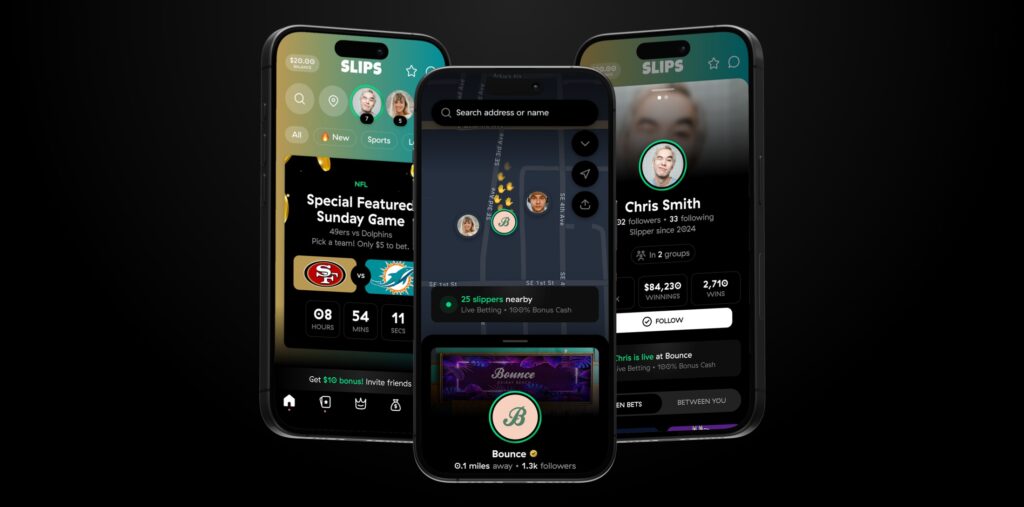
Bets can now be settled on any topic, from last night’s game to whether people will really show up, via a group chat message. This is the gist of Slips, the peer-to-peer betting company out of Los Angeles, which introduced its Create Bet and Challenge service on 9 September 2026. Now users can make their own bets, forward them to friends, and settle them peer-to-peer without platform costs. This new offering is unique compared to what is offered by the conventional sportsbook.
What Slips Actually Built?
This is not a minor update for the application. As per the announcement made by Slips, users will be able to make their own wagers on any topic and send them directly to the chat rooms where they will be settled within the application. The chat rooms got an upgrade to support pictures, reactions, and one-tap betting. ACH transactions are now free of charge.
The phrase Slips wants to own is “slip me,” positioned as a verb for friend-to-friend wagering the way “Venmo me” became shorthand for splitting a bill. Jess Richman, Founder and CEO, put it directly: “Every other operator in this space is doing the same thing with different logos, you against the house, on the same handful of markets. We built Slips around how people actually bet each other in real life.”
On the mechanics, that framing holds up. Traditional sportsbooks set the odds, take the vig, and profit whether or not the user wins. Slips matches users against each other, processes settlement, and never takes a position against either side. One party always wins. Zero fees between friends is part of the model, though the company’s own terms describe this as a limited-time promotion, with standard fees applicable to public discovery bets and membership tiers affecting the number of free transactions.
The Numbers Behind the Pitch
Slips does not have a clean slate to begin with. As early as September 2025, reports from casino.org indicated that there were already over 150,000 users who had made a total of over $6 million in wins since the platform’s launch. At the same time, Slips introduced prediction markets for the entertainment, financial, sports, and political arenas based on artificial intelligence.
The Create Bet launch in September 2026 extends that foundation into something more social. Rather than selecting from pre-built AI markets, users write the bets themselves. The group chat becomes the product. That shift matters because it changes the acquisition funnel: Slips no longer needs to convince someone to open a betting app. It needs them to send a single message.
A Funding Trail That Shows the Conviction
Investors have been building behind this thesis for some time. In January 2026, Slips closed a $3.5 million series seed led by Las Olas Capital and Sunset Bay Capital, with Andrew Schwartzberg, co-owner of the Charlotte Hornets and Leeds United, among the strategic participants. The round followed what Pulse2 reported as 500% year-over-year growth, attributed to the company’s own reporting.
This press release from January also revealed a revealing business indicator: in just one month since Slips introduced ACH payments, the number of premium memberships increased by more than 300%. It’s not clear what made users subscribe, but judging by the timeline, it seems that fast and free access to funds plays an important role. Gurminder Singh, Chief Technology Officer and Co-Founder, defined the main priorities clearly: “The funds we raise allow us to go faster on infrastructure, finance, and integration.”
Crypto payment support and exploration of stablecoin-based withdrawals are also on the roadmap, alongside planned international expansion. Six-time World Series of Poker champion Jason Mercier is among the company’s financial backers, per casino.org’s reporting.
The Regulatory Picture Nobody Is Explaining
Here is what most coverage of this launch will skip: Slips operates in most US states but currently excludes eight, among them Nevada and Maryland. The company has not publicly detailed its licensing structure or the legal basis for its exclusions in each jurisdiction. That gap is not unusual for an early-stage platform, but it becomes more significant in the current US wagering environment.
Under the Unlawful Internet Gambling Enforcement Act, the key question for any platform processing online wagers is whether the underlying bet is lawful under applicable federal or state law in the state where it is initiated or received. The statute contains an express intrastate exception, meaning bets placed and received entirely within a single state, under that state’s authorising law, are carved out. For Slips, which matches users across state lines, the picture depends heavily on which states have explicitly authorised peer-to-peer wagering of this kind, and that authorisation landscape is not clearly mapped.
Slips itself has stated it is not a CFTC-regulated prediction market and does not offer event contracts, binary options, or other derivative instruments. That distinction is genuine and important. The prediction-market litigation currently moving through four federal circuit courts, as documented by DLA Piper in September 2026, centres on Kalshi and Polymarket, which are CFTC-registered designated contract markets. Those cases involve a jurisdictional dispute between federal commodity regulation and state gaming laws that does not apply directly to Slips’ model.
What does apply to Slips is a simpler but equally unsettled question: do user-generated wagers settled on a private social platform constitute a “business of betting or wagering” requiring state gaming licences? Several states that have legalised sports betting built their frameworks around licensed sportsbooks, not user-matched social wagers. Where Slips fits within those frameworks varies by state and, in several cases, remains unresolved.
Expert Analysis
We think Slips has spotted something real. The product dynamic it is chasing, betting inside a group chat on anything from a golf round to someone’s punctuality, is genuinely distinct from what the established operators offer, and it speaks to a user behaviour that predates every sports betting app: friends have always bet each other, and nobody built a clean, low-friction rail for it until now.
Where we think the company is being less than precise is in how it presents the zero-fee structure. Describing peer-to-peer settlement with no platform fees as a core product characteristic, when the company’s own terms describe it as a limited-time promotion, is the kind of framing that tends to create consumer expectations that are difficult to walk back. If and when standard fees apply more broadly, that will be the moment users question whether the product they signed up for still exists.
The regulatory gap is more serious. Slips operates without explaining why it is available in 42 states but not in the other eight. Nevada, notably, has one of the strictest and most developed gaming regulatory frameworks in the country. Maryland has been among the more active states in pursuing unlicensed operators. The absence from those markets may reflect careful legal positioning; the silence around it does not. A company that wants to become the Venmo of wagering needs to be as transparent about its legal architecture as Venmo is about its banking partners. Right now, that transparency is missing.
Explore more:
 Share
Share


 3 views