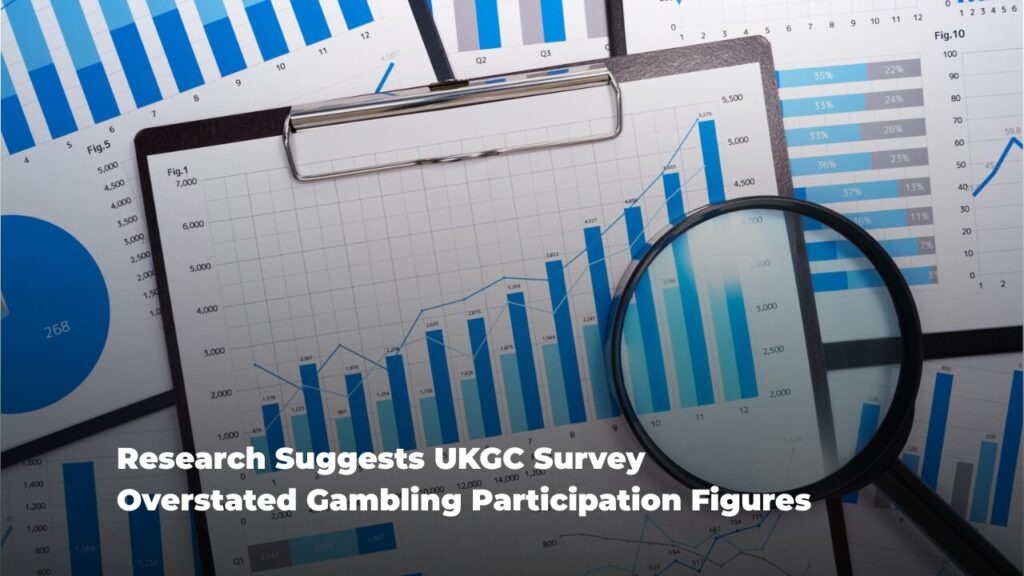
New research has raised fresh concerns about the Gambling Survey for Great Britain (GSGB), suggesting it overstated gambling participation across several activities. The analysis was conducted by Dan Waugh of Regulus Partners.
Presented at the UNLV Eadington Conference 2026, it compares GSGB estimates with actual operator data and concludes that participation figures are way higher than the reality within the legal market.
Introduced in 2023, the GSGB was designed as the Gambling Commission’s flagship survey, collecting responses from around 20,000 people annually. The regulator has described it as one version of the truth regarding participation and gambling harm in Great Britain.
However, Waugh’s analysis found significant discrepancies when comparing survey results against administrative data from licensed operators. “The data reveals substantial over-reporting of gambling participation in the GSGB compared to what is actually happening in the regulated market,” Waugh told NEXT.io.
“There are only two possible explanations for this. Either the survey sample is skewed or there are massive – and hitherto undetected – black markets for land-based casinos, betting exchanges and the football pools.
“Whichever explanation one applies, it is clear that the GSGB cannot be considered a reliable source of data for measuring gambling behaviours in the regulated market.”
Casino, Football Pools And Exchange Data Show Large Gaps
Using data supplied by the Betting and Gaming Council, which covers the entire licensed casino sector, Waugh compared actual casino visits with GSGB estimates. The survey suggested between 1.75 million and 2.25 million visits took place between July 2023 and February 2024 for casino table games alone.
Actual recorded visits to licensed casinos for all purposes during the same period exceeded one million. According to Waugh, the survey estimates were between 69% and 176% higher than recorded activity. The gap becomes considerably larger when accounting for the fact that 40% to 80% of casino visitors do not participate in table games, according to estimates from BGC casino operators. In comparison, the GSGB’s figures for casino participation were between 408% and 628% above the administrative data across 2023 and 2024.
The football pools market showed an even wider difference. Because The Football Pools Limited operates as the sole provider of the product, its customer data offers a direct measure of participation.
For one period in 2023, the GSGB estimated approximately 863,000 unique football pools players over four weeks. Actual operator records showed around 109,000 customers, implying an overstatement of 694%.
Research Highlights Potential Sample Bias Concerns
Waugh also examined participation in betting exchanges using customer data from Betfair, which is estimated to account for around 85% of the exchange betting market.
After adjusting the figures to represent the full market, the number of betting exchange users between January 2024 and January 2025 stood at approximately 172,000. The GSGB, however, estimated around 612,000 users during the same period, representing a gap of roughly 225%.
According to Waugh, the findings align with well-established challenges in survey research. He pointed to topic salience bias, where individuals with a stronger interest in gambling may be more likely to participate in surveys than the general population. He also referenced concerns around low response rates and selection bias.
Survey Methodology Faces Renewed Scrutiny
The latest findings add to an ongoing debate around the reliability of the GSGB. Before launching the survey, the Gambling Commission acknowledged potential risks associated with sample bias and committed to ensuring those risks could be properly managed.
The regulator has maintained that respondents interpret survey questions as intended and has defended the methodology behind the project.
Waugh’s paper also explored whether some survey responses could reflect gambling activity occurring outside the regulated British market. However, additional analysis raised further concerns.
When GSGB participation estimates were compared against official industry gross gambling yield figures, the implied spending levels for certain activities appeared unusually low. For non-remote casino games, implied spend per visit ranged from just £13.69 to £20.80.
Debate Continues Over Policy And Regulatory Use
Waugh concluded that the evidence points towards a pattern of “systemic bias” affecting both participation and gambling frequency estimates within the GSGB.
He argued that policymakers should avoid relying exclusively on any single survey when assessing gambling behaviour and instead draw on multiple sources of evidence, including operator data.
The debate surrounding the GSGB is unlikely to disappear soon. Last year, the Office for Statistics Regulation recommended that the Gambling Commission explicitly acknowledge the risk that the survey could overestimate gambling participation.
The Commission chose not to adopt that recommendation, stating that an LSE review suggested the scale of potential overestimation may be lower than feared. Those conclusions were later challenged by Waugh, who argued that the available evidence should have reduced confidence in the survey.
Due to the discrepancy between the survey estimates and operator data, the research by Dan Waugh raises questions about the accuracy of the GSGB’s results. Overstated participation figures could influence policy decisions and public discussions around legal gambling activity.
Explore more:
 Share
Share


 241 views