




Key Points
- PlayCity now reports illegal gambling channels directly to Kick’s headquarters, with the first two violating channels removed within the past week.
- Thirty-seven accounts across TikTok, Instagram, Twitch and Kick were blocked this month, reaching a combined audience of more than 895,000 followers.
- Violations carry a financial penalty of nearly UAH5.2 million (approximately $155,678), with law enforcement brought in when operators cannot be identified through public registries.
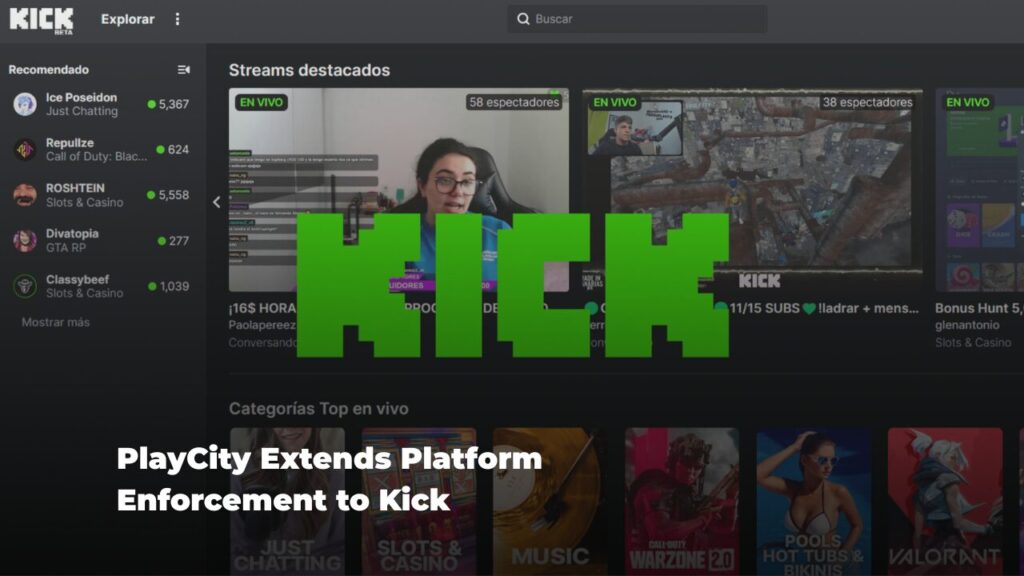
PlayCity, Ukraine’s gambling regulator, has added another player to the list of platforms falling under its regulatory scope as it now requires Kick, a streaming service, to provide access to its headquarters for identification of the channels with illegal gambling content in Ukraine.
As reported by PlayCity on Monday via its Telegram channel, Kick is the latest addition to the already existing list that includes TikTok, YouTube, Meta (Facebook and Instagram), Twitch, Viber, and Google.
“We are directly providing Kick’s headquarters with a list of channels that violate legislation and illegally advertise gambling,” PlayCity said.
First Removals Already Completed
The agency did not have to wait long. Two Kick channels went down within the same week the partnership was announced, pulled after PlayCity filed its first batch of complaints. Standard platform reporting rarely moves that fast; the contrast with direct regulatory contact is hard to ignore.
Those two removals sit inside a larger June sweep. Across TikTok, Instagram, Twitch and Kick, 37 accounts were blocked this month. The numbers break down as 20 TikTok accounts carrying 473,000 followers, 11 Instagram accounts with 314,000, four Twitch channels reaching 107,000, and the two Kick channels with a modest combined following of 1,200. Together, the blocked accounts had been reaching more than 895,000 users.
Across the full span of its enforcement campaign, PlayCity has now restricted access to 785 profiles found promoting unlicensed gambling on social networks and streaming platforms.
A Two-Stage Process Behind Each Takedown
Each removal follows the same sequence. Once content is flagged as a likely violation, PlayCity submits it to the platform for takedown or restriction. The priority at that stage is straightforward: stop the ad from running.
While that plays out, the second stage runs alongside it. PlayCity works to trace who placed the content. A confirmed identity from public registries means a fine of nearly UAH5.2 million, around $155,678. When open data hits a wall, the agency says it hands the case to law enforcement.
Not every complaint ends in a sanction. Material that falls short of the legal threshold for illegal gambling advertising is dismissed, and whoever filed the report receives a written explanation of why.
Public Complaints Are Driving Volume
PlayCity launched a public-facing online complaint form where anyone can report suspected illegal gambling promotions across social media, streaming services, television, radio, outdoor advertising and beyond. The form has pulled in 425 complaints since it went live, 19 of them in June. Twelve of those June submissions arrived directly through the PlayCity website.
Every submission goes through PlayCity’s internal team before anything happens. Content showing signs of a breach gets passed to the relevant platform. Submissions that lack sufficient evidence, or that simply do not qualify as illegal advertising, are closed with a written decision sent back to whoever filed them.
Expert Analysis
Measured in audience numbers, the Kick expansion is a minor step. Two channels with 1,200 followers combined is a thin cover compared with the TikTok and Instagram accounts taken down this month. The significance, though, runs deeper than the follower count.
Kick has scaled fast since launching in 2022, drawing in streamers and viewer communities that have long operated with minimal oversight. Locking in a direct reporting line now, while the platform is still finding its regulatory footing, puts PlayCity in front of the problem rather than chasing it.
PlayCity’s first annual report recorded fines exceeding UAH988 million levied on gambling organisers for legal violations, with a further UAH80 million specifically for advertising breaches. More than 4,100 illegal gambling websites were blocked across the year. Those are the numbers the regulator is now building on as it adds direct platform channels into the mix.
Ukraine’s unlicensed gambling market is not shrinking. Kantar research commissioned by the Association of Ukrainian Gambling Business Operators and conducted between March and May 2026 put the illegal segment at more than $1.39 billion annually, with the unlicensed share rising from 52.1% to 56.7% during 2026. More than 80% of those surveyed admitted to using illegal operators in the three months prior.
Platform partnerships are one response to that scale, but they do not close the gap entirely. Mirror sites and replacement channels can be live within a day or two of a takedown. That pace gap is the enforcement problem PlayCity has not yet solved.
What Does This Mean for Operators and Marketers?
Anyone operating in Ukraine’s gambling space should take note. The days of waiting out a slow platform moderation queue are gone. PlayCity now has direct lines into seven major platforms, and accounts are going down within days of a complaint landing. Competitors, users and the regulator itself can all trigger that process with equal ease through the public form.
With fines sitting at nearly UAH5.2 million per breach and law enforcement on standby when public registries run dry, the cost of getting caught is not theoretical. For anyone still running unlicensed promotions in Ukraine, the margin for error is closing.
Explore more:
 Share
Share


 263 views