





Key Points
- The chief executive officer of Lottoland, Nigel Birrell, announced that there was only a redundancy consultation in the Gibraltar office without revealing how many out of 270+ staff members were threatened.
- United Kingdom remote gaming tax hiked twice from 21% to 40% starting from 1 April 2026, which adversely affected the business of Lottoland online casino.
- An order of the Court of Justice of the European Union in April 2026 stated that the people of Germany could file a lawsuit against Lottoland regarding the money lost by them between 2019 and 2021.

Redundancy Consultation Begins at Gibraltar HQ
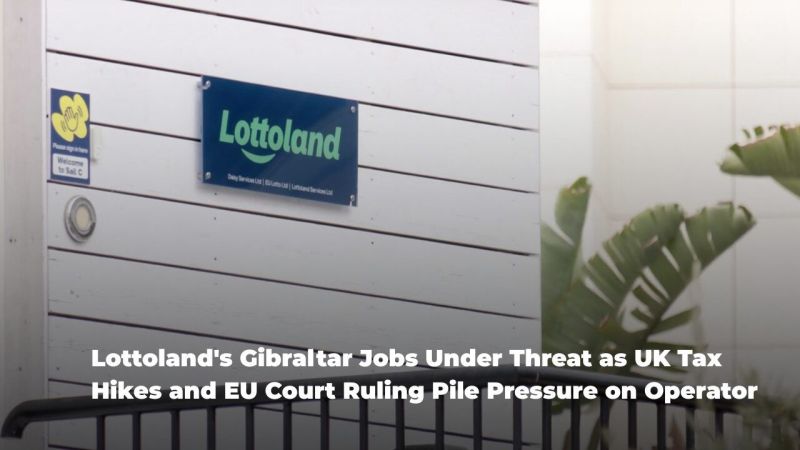
Staff at Lottoland’s Gibraltar headquarters have been placed under formal redundancy consultation, with the company citing “significant regulatory and commercial developments” as the driver. Nigel Birrell, group CEO, confirmed the process is under way, telling NEXT.io that the restructure aims to “better align the business with the changing environment.” No figure for the number of roles at risk has been released, and no deadline for the consultation has been set.
The scope is confined to Gibraltar. Lottoland holds licences in Gibraltar, the UK, Malta, Ireland, and Germany, but Birrell was explicit: “the proposals will only affect our Gibraltar office.” According to the company’s own website, more than 270 people work at that site, making it the company’s largest single location and the operational spine of its European business. Which departments face the deepest exposure remains undisclosed; Birrell said only that “a number of roles across the business may be affected.”
The company has given assurances, for what they are worth at this stage, that customers and products will not be affected by the restructure.
The Two UK Tax Hikes Squeezing the Business
Lottoland has not named specific regulatory triggers, but the arithmetic is not hard to follow. The UK autumn budget of November 2025 delivered the most substantial overhaul of gambling taxation in recent years, and Lottoland sits squarely in the firing line on two fronts.
From 1 April 2026, remote gaming duty rose from 21% to 40%, nearly doubling the levy on online casino products such as slots and live dealer games. Lottoland operates an online casino alongside its lottery products, making this increase immediately consequential for the company’s UK margin. A second wave follows: a new remote betting duty at 25%, up from 15%, takes effect in April 2027, targeting online sportsbooks, of which Lottoland operates one. That second hike is still twelve months away, but businesses plan ahead, and a company in consultation now is clearly factoring in costs that have not yet arrived.
The reforms are projected to raise £1.1 billion in additional gambling tax by 2029-30. For context, the government expected operators to pass on up to 90% of the duty increases to consumers, either through higher prices or reduced payouts, with the Treasury itself acknowledging this would reduce consumer demand and cost the measure around £500 million in yield by the same date. That projection alone signals that some operators will not survive the transition intact. During the industry campaign against the autumn budget measures, potential job losses were a central argument from the sector, and Lottoland’s consultation is the kind of outcome the industry warned would follow.
An EU Court Ruling with Consequences That Go Well Beyond Germany
Layered on top of the tax pressure sits a legal problem of a different order. In April 2026, in Case C-440/23, the Court of Justice of the European Union ruled that EU law does not prohibit member states from prohibiting some online gambling activities, even when the company providing those gambling activities has obtained a license from another member state. This decision followed a case brought against Lottoland, or rather its affiliate company European Lotto and Betting Ltd.
A German player had lost money through Lottoland between June 2019 and July 2021, a period when online games of chance were banned under German law. He filed a civil restitution claim through a Maltese court, which referred the question of EU law to the CJEU. There was no doubt about the ruling of the court. Namely, the principle of free movement of services is not an absolute principle, and consumers can try to recover their losses from operators in cases where such services have been banned.
Importantly, the CJEU also stated that German legalization of online gambling in 2021 does not absolve from responsibility any operations that have occurred before that year. Contracts made during the prohibition period can be treated as void, and players retain the right to pursue recovery. The court declined to assign responsibility to the player for using a foreign-licensed operator, placing any question of bad faith squarely with the operator, to be assessed by national courts.
The implications reach well beyond a single player’s claim. The ruling serves as a binding reference point for all EU courts, and it validates the legal framework that plaintiff lawyers across Europe have been working within. Thousands of similar claims, many sitting in legal limbo, gained considerably firmer ground after April 16. For Lottoland, the exposure is a direct financial risk to the business, not merely a reputational concern.
Why Gibraltar, and Why Now?
The concentration of cuts in Gibraltar, rather than across Lottoland’s wider European network, reflects where the operator’s core operations are housed. The territory is the company’s registered home and regulatory base, and the site where strategic and commercial decisions are coordinated. When a business needs to reduce costs in response to margin pressure, the head office absorbs the initial impact. That is what is happening here.
There is also a broader signal worth reading. Gibraltar’s position as a licensing and operational hub for online gambling companies is not under regulatory threat, but the companies domiciled there are increasingly exposed to the rules and enforcement actions of the markets they serve from that base. A CJEU ruling confirming that a Maltese or Gibraltarian licence does not override German prohibitions effectively narrows the commercial argument for operating under offshore licensing while targeting regulated markets. The value proposition of jurisdictions like Malta and Gibraltar, as the court made clear, does not guarantee access to the broader European market.
For Lottoland’s employees in Gibraltar, the redundancy process means waiting for a consultation that has no stated end date. Birrell said the company is “committed to consulting with employees openly, fairly and in line with all relevant legal requirements.” Statements like that are standard in formal consultation processes, but they offer little comfort to staff trying to read how much of a workforce reduction is being considered.
What Comes Next for the Industry?
Lottoland is not an outlier. The same UK tax changes that are compressing its margins are pressing on every operator with significant British casino revenue. The same CJEU ruling that raised Lottoland’s German liability profile has, in principle, raised the same question for any operator that served German customers during the pre-2021 prohibition period.
The Betting and Gaming Council has been lobbying for transitional relief on the tax changes, arguing that the abrupt move to 40% remote gaming duty, rather than a phased introduction, conflicts with the Treasury’s own stated principles of tax predictability. Whether that effort produces anything before the 2026 autumn statement remains unclear.
What is clear is that the combination of a near-doubled casino tax, an incoming sportsbook duty hike, and a court ruling that opens the door to retroactive player claims constitutes a genuinely difficult commercial environment. Lottoland’s consultation is the public face of a calculation that many operators are running privately.

Expert Analysis
Lottoland’s redundancy consultation is not a company-specific crisis; it is the first clearly visible consequence of a regulatory and legal convergence that has been building for months. The UK’s decision to nearly double remote gaming duty landed on operators that were already planning for the 2027 betting duty hike, and the CJEU ruling arrived before most had finished stress-testing their German liability exposure. A business managing three separate pressure fronts, a tax increase already in effect, a second one twelve months out, and an open-ended restitution risk from a decade-old regulatory gap, is going to make structural decisions. Cutting headcount at the operational centre is the most immediate lever available. The harder question, which neither Lottoland nor its Gibraltar-based peers have answered publicly, is whether these conditions represent a temporary squeeze or a sustained repricing of what it costs to run a cross-border European gambling operation.
Explore more:
 Share
Share


 187 views