Key Points
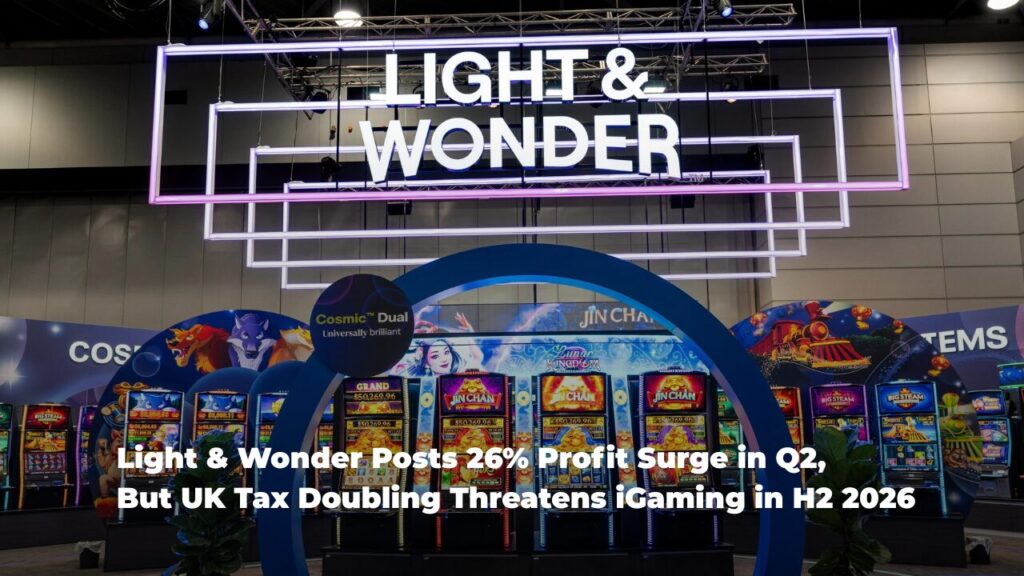
- The company recorded net profits of $120 million, which represents a 26% rise in Q2 2026, with iGaming revenues rising by 14% to $92m amid the increase in the UK Remote Gaming Duty from 18% to 40%.
- A 25% remote betting duty will be introduced in April 2027, indicating that the firm faces two successive years of being hit by taxes in the UK on its fastest-growing division.
- Light & Wonder CFO Oliver Chow made it very clear that the company will cut back sharply on share repurchases and will have net debt leverage of less than 3.0x by mid-2027.
Light & Wonder has shown its second quarter performance to be one that seemed impressive at first glance. Net income increased by 26% to $120 million. Revenues from iGaming increased by 14%. The consolidated adjusted EBITDA increased by 9% to $383 million, even though the increase in revenues was only 2%, meaning that Light & Wonder earns more profit on each dollar.
But the story of the remainder of 2026 lies beyond these numbers.
UK Remote Gaming Duty Doubled — and It Is Already Biting
Remote Gaming Duty in the United Kingdom rose from 21% to 40% in April 2026, and a second wave is already legislated. A 25% remote betting duty takes effect next April. For a supplier whose iGaming growth has been powered by North America but whose European portfolio carries meaningful UK exposure, these are material numbers.
President and CEO Matt Wilson did not minimise it. The company expects iGaming growth to moderate in H2 due to higher UK duty and tougher year-on-year comparisons. The detail most coverage overlooked: the tax rise was already active during Q2, which means the 14% iGaming revenue growth and 18% iGaming AEBITDA increase were achieved with the higher rate already in effect. That is either a sign of strong underlying demand absorbing the cost, or evidence that the full impact has not yet worked through the revenue line.
The first-half iGaming picture, $183m in revenue, up 16% year-on-year, and $66m in AEBITDA, up 20%, will be a difficult benchmark to match in H2 under higher tax and harder comparatives.

Gaming Operations and Grover Carry the Core Business
Gaming, the largest segment, posted 5% revenue growth to $554m, but the real movement was within it. Gaming operations revenue surged 18% to $247m, driven by expansion of the North American premium installed base and the contribution from Grover Gaming, acquired in May 2025. The North American premium installed base grew for the 24th consecutive quarter, adding 652 units sequentially and more than 2,550 units year-on-year.
Grover, the charitable gaming business Light & Wonder acquired for $1.05bn, added 277 units during Q2 and now covers more than 12,550 installed units across the United States. The acquisition is performing. Grover’s Tank Blast game recorded the highest revenue in its first 14 days of any comparable game in Indiana’s history, according to commentary on the earnings call.
Machine sales slipped 4% to $184m, with 8,796 units shipped globally. Management was direct on the cause: deferred casino openings and expansion transactions shifted into H2. CEO Wilson confirmed the contracts are in place. The pipeline is contracted, not cancelled.
iGaming processed $31.3bn in wagers through the Open Gaming System during Q2, a quarterly record, up from $26.6bn a year earlier. First-party titles occupied eight of the ten top-performing positions across the content network. The Huff N’ Puff and Pirates franchises were named as the strongest performers on the earnings call.
SciPlay Keeps Sliding — With One Genuine Bright Spot
SciPlay revenue fell 9% to $182m. Monthly active users dropped 12% to 4.6 million. Monthly paying users declined 13%. Wilson said on the earnings call: “We’re not happy with the result of SciPlay and where we’re at, and we take accountability for that.”
Two forces are compressing the segment. Sweepstakes casino operators have driven up paid customer acquisition costs significantly over the past year, making it structurally harder to grow the user base. Management believes regulatory action against those operators is beginning to shift conditions, but it is not yet visible in the revenue line.
But there is one exception that moves in the other direction. Direct-to-Consumer sales jumped by 51%, reaching an all-time high of $53 million or 29% of SciPlay’s total revenues. The average revenue per paying customer increased by 4%, to $133.80. As Oliver Chow, CFO of SciPlay, stated during the call: “We’re not going to declare victory, but we are seeing some green shoots.”
A 26% Profit Jump Built on Margin Discipline
The profitability story of Q2 is more instructive than the revenue growth. Group services revenue rose 8% to $601m; product revenue fell 7% to $227m. Recurring revenue, which includes gaming operations, Grover, iGaming, SciPlay and ongoing systems maintenance, reached approximately 70% of total quarterly revenue. Consolidated AEBITDA margin expanded to 46%, up from 44% a year earlier.
Net cash from operating activities reached $241m in Q2, a 127% increase year-on-year. Adjusted free cash flow hit $156m, up 50%. These are not accounting gains; actual cash generation accelerated sharply.
For the first half as a whole, net profit was $172m, 3% below last year. Q1 had been hit by roughly $50m in legal reserve contingencies tied to legacy matters, which suppressed the H1 total. Strip those out and the underlying trajectory is positive. Consolidated adjusted EBITDA for H1 was $710m, up 7% year-on-year.
The Strategic Pivot: Debt Reduction Takes Priority Over Buybacks
The most significant signal from the earnings call was not about revenue at all. Chow presented a debt reduction trajectory showing net leverage falling from 10.5x in 2020 to 3.4x at present. The target is below 3.0x by mid-2027, progressing towards an investment-grade credit profile. Total debt stands at $5.13bn against $148m in cash.
Share buybacks will slow from the pace set in Q2, when $134m was repurchased. The company has bought back approximately $2.1bn of stock since 2022, or around 27% of total shares outstanding. That programme has consistently lifted per-share earnings above net income growth, and pulling back on it removes one of the most reliable levers in the capital allocation toolkit.
“We reaffirm that the guidance for the full year consolidated AEBITDA will be in the mid to high single-digit growth,” Wilson said. “As we look ahead to the second half of this year, we continue to remain laser-focused on disciplined execution, investment in product innovation, and talent, and achieving our financial goals for 2026 and 2028,” he added. For 2028, the goal is an AEBITDA of $2 billion per year. The trailing twelve months’ AEBITDA is $1.49 billion.
Expert Analysis
The Q2 results show a business genuinely improving earnings quality. Recurring revenue at 70% of the total, margin expansion across all three segments, and a 127% jump in operating cash flow are not numbers a company manufactures with accounting manoeuvres. The Grover integration is tracking ahead of early expectations, and the 24-quarter premium installed base streak tells its own story about content execution.
The real test arrives in H2 2026. North American iGaming momentum needs to absorb both the UK duty impact and harder prior-year comparisons simultaneously. If iGaming AEBITDA growth moderates sharply from its current 18% pace, the full-year AEBITDA guidance narrows to a tight finish. The buyback slowdown removes a further cushion. For the broader iGaming supply chain, the UK Remote Gaming Duty doubling from 21% to 40% in a single step is a stress test of how much regulatory cost a supplier’s content premium can absorb before operators push back up the value chain. Light & Wonder’s Q2 performance suggests that premium is real. Whether it is durable enough to withstand a second tax wave in April 2027 is the question that follows this company into its next reporting period.
Explore more:
 Share
Share


 247 views