

Key Points
- Kenneth Dart’s Cayman Islands vehicle Candle Lake Limited crossed 30.02% ownership in Evolution AB on 24 July 2026, triggering a mandatory takeover bid under Swedish law with a deadline of 21 August 2026.
- Dart must either launch a formal bid at roughly SEK 700 per share or sell back below the 30% threshold; his total economic exposure including equity swaps exceeds 32%.
- Evolution’s share price jumped over 4% on the news, but analysts warn any bid may not attract enough sellers to force a full privatisation.
Dart Pulls the Trigger on Evolution, and Nobody Knows Why
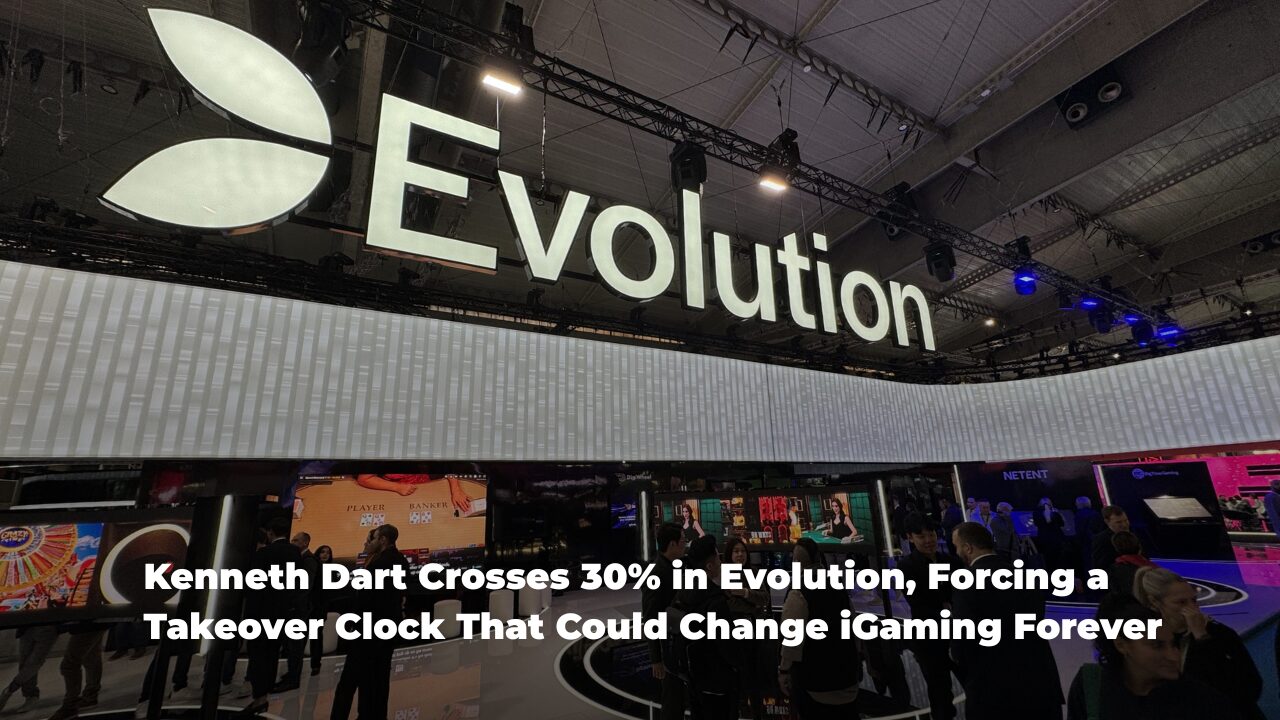
One of the world’s most secretive billionaires just handed iGaming’s most controversial supplier a decision it cannot ignore. On 24 July 2026, Kenneth Dart’s Cayman Islands investment vehicle Candle Lake Limited purchased 2.05 million additional shares in Evolution AB, pushing its combined holding to 59,798,619 shares. Such an amount corresponds to 30.02% of Evolution’s share capital and voting rights, which is just enough to trigger the mandatory tender offer in Sweden.
According to Chapter 3, Section 1 of the Act on Public Takeover of Shares on the Stock Exchange (2006:451), Candle Lake has four weeks after acquiring the shares to either make a full-scale public offer for the remaining shares or to divest to below 30%. This means that the deadline expires on 21 August 2026.
Dart is no ordinary investor. Born in Michigan in 1955, he renounced his US citizenship in 1994, relocating to the Cayman Islands, a jurisdiction with no personal income, capital gains, or property taxes. His family’s Dart Container Corporation manufactures the world’s largest volume of foam cups and acquired the Solo Cup brand. His investment portfolio runs heavily towards what the market calls “sin” stocks: he holds significant stakes in tobacco companies British American Tobacco and Imperial Brands, and now sits as Evolution’s largest single shareholder. Flutter Entertainment, one of the globe’s biggest betting operators, is also in his portfolio, where his interest recently approached the mandatory bid threshold under Irish rules.
What the Law Actually Requires?
The mechanics here matter more than the headlines suggest. Swedish law does not require Dart to make a generous offer. The minimum price for the mandatory bid is set at the highest price Candle Lake paid for Evolution shares in the six months prior to crossing the threshold, which the main article puts in the range of approximately SEK 700 (around €63.75). Evolution shares were trading near SEK 711 on Monday following the disclosure, meaning a floor-priced offer would attract minimal appetite from existing shareholders.
Dart also holds a cash-settled equity swap covering just over 4 million additional Evolution shares through affiliate LBS Limited. That structure carries no voting rights but pushes his total economic exposure above 32%, a detail that investors tracking this situation should note carefully.
Candle Lake’s own disclosure was clear on one point: the filing is “not an offer to acquire shares.” Law firm Roschier Advokatbyrå AB is advising the vehicle. That legal framing signals Dart is keeping his options open, not announcing a done deal.
There is a third route that most coverage has not mentioned. Sweden’s Securities Council can grant exceptions from the mandatory offer obligation, though recognised grounds typically relate to rights issues and share-based acquisitions rather than open-market purchases. For Dart, who bought these shares on the open market, that exception route is narrow.
Evolution’s Turbulent Few Years Set the Stage
The timing of Dart’s move cannot be separated from the storm Evolution has weathered since 2021. That year, private intelligence firm Black Cube produced a report alleging Evolution facilitated play in prohibited jurisdictions. The report reached US regulators, was leaked to the media, and triggered a licensing review in Britain that stretched nearly 19 months. Evolution has pursued the authors through US courts ever since.
In October 2025, NEXT.io revealed Playtech as the company that commissioned Black Cube, paying the Israeli intelligence firm £1.8 million to produce the report. Evolution CEO Martin Carlesund described the revelation as removing “a large piece from my belief in fair play, humanity in general and good ethics and morals.” Playtech CEO Mor Weizer, asked directly during Q2 earnings whether the business procured the report, replied: “Obviously, we can’t, it’s nothing, not a question for us.” Evolution intends to add Playtech as a named defendant in its defamation suit, with litigation expected to extend through 2026.
The UK regulatory thread reached a resolution of sorts in July 2026. The UK Gambling Commission settled its 19-month investigation with a £4.75 million payment from Evolution, related to findings that its games were accessible on black market casinos serving British consumers. The Commission confirmed it would publish full details of the regulatory failures. Rothschild Redburn analysts separately confirmed they had verified Evolution games on unlicensed sites, though Evolution told Bloomberg it could not replicate those findings.
Galaxy Gaming Deal Collapses, Clearing One Complication
One week before Dart crossed the threshold, Evolution terminated its planned $85 million acquisition of US table game supplier Galaxy Gaming. The deal, announced in July 2024, had been extended in November 2025 to give regulators more time, with Nevada and at least one other state yet to grant approval when the closing deadline passed on 17 July 2026. Evolution paid Galaxy a $5.2 million termination fee under the agreement.
CEO Martin Carlesund played down the impact, saying the merger would have “no material impact” given Galaxy’s size and adding that the two companies would continue their commercial relationship. Nevada had been a sticking point partly because, as Rothschild Redburn analysts noted in January 2026, the state regulator appeared unwilling to rule on the acquisition before the UKGC concluded its own review. With that UK settlement now resolved and the Galaxy deal terminated, the regulatory picture for a potential acquirer is less cluttered than it was six months ago.
What Going Private Would Actually Mean?
The question most coverage has treated as speculative deserves more direct examination. If Dart launched a successful full takeover, Evolution would most likely delist from Nasdaq Stockholm. For the live casino industry, that carries real consequences. Evolution supplies live dealer games to hundreds of licensed and offshore casinos worldwide; delisting would remove the quarterly financial disclosure that regulators, operators, and analysts use to track the company’s exposure to grey markets.
Many observers have argued that Evolution’s public status has amplified its regulatory difficulties. The Playtech-commissioned report gained traction partly because listed companies face continuous scrutiny that private suppliers do not. A private Evolution would face fewer mandatory disclosure requirements, though it would not be exempt from licensing obligations in the jurisdictions where it operates.
Historically, Dart has not sought to take over companies in which he holds large positions. His tobacco stakes are passive; his Flutter position, while approaching thresholds, is structured partly through instruments that do not carry voting rights. Evolution would be a significant departure from that pattern. Whether the crossing was deliberate or a byproduct of Evolution’s own share buybacks shrinking the total count has not been confirmed publicly.
What Are Analysts Warning About?
The market response was swift: the shares of Evolution rallied by over 4%, with the stock rising by 11.3% year to date until 24th July. The analysts at Rothschild Redburn have advised investors not to expect a hefty premium from the buyout. With the floor price around SEK 700, there is no motivation for institutions that bought above the floor price to tender. Dart could technically fulfil the legal obligation by making a minimum-priced offer that attracts virtually no acceptances, leaving Evolution public and his stake unchanged.
Social media commentary has speculated Dart may simply trim back below 30% and walk away, though that raises an obvious question: why cross the threshold at all, particularly when Evolution’s own buyback programme has been steadily reducing the share count, making the 30% line easier to cross passively over time.
Evolution itself has not commented publicly on the development.
The August 21 Deadline
Four weeks is not long. By 21 August 2026, Candle Lake must either file a formal bid with the Swedish Financial Supervisory Authority or execute share sales that bring its combined holding below three-tenths of Evolution’s voting rights. Under Swedish rules, the mandatory bid obligation is unconditional once triggered; there is no provision for simply waiting it out.
Evolution carries a market capitalisation of roughly $15 billion. A full privatisation at any meaningful premium would rank among the largest transactions in iGaming history. For now, the industry is watching a man who built his fortune on disposable foam cups and sovereign debt hold the future of one of online gaming’s most powerful infrastructure suppliers in his hands.
Expert Analysis
The Dart situation exposes a structural tension that public gaming suppliers have long faced: regulatory transparency and capital market access come bundled with accountability that private companies largely avoid. Evolution’s years of scrutiny, from the Black Cube report to UKGC enforcement, were intensified by its listed status and mandatory disclosure obligations. Going private would not remove Evolution from regulatory frameworks in Sweden, the UK, or the US, but it would remove the constant investor-relations pressure that amplifies every adverse finding. Whether Dart sees that as the point of the exercise or simply sees a company whose share price has been suppressed by controversy he believes is overblown, the August 21 deadline will force an answer. A floor-priced bid that goes nowhere legally satisfies Swedish law but resolves nothing strategically; a genuine premium offer would require institutional shareholders to decide whether Evolution’s long-term value justifies selling at Dart’s price. Neither outcome is obvious today.
Explore more:
 Share
Share 


 6 views





 Analysis
  Business
  Companies
  Crime
Crime  Finance
  M&A
M&A  Prediction Markets
  Regulation
  Reports