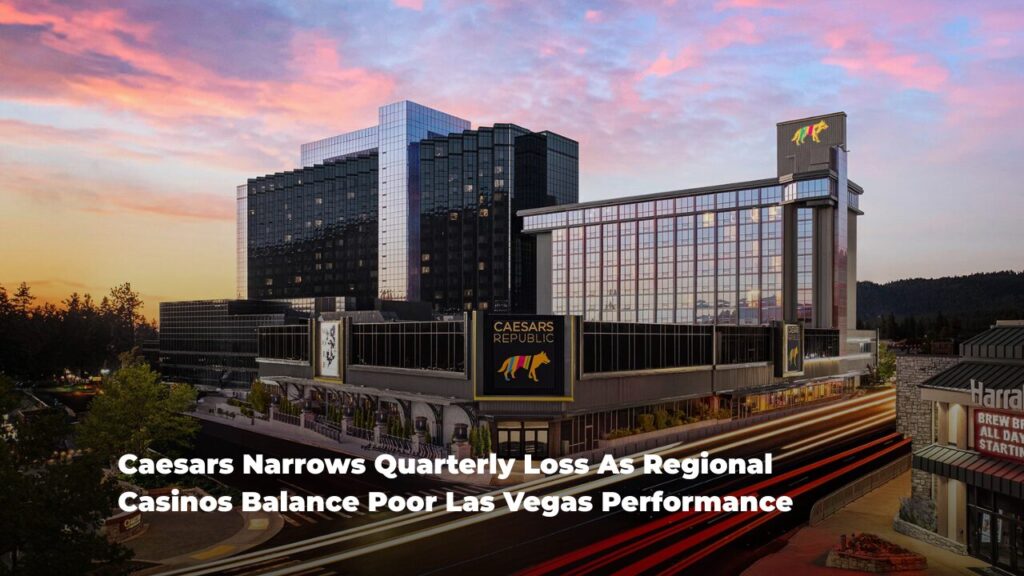
Caesars Entertainment reduced its second-quarter loss as stronger regional casino performance offset a weak period in Las Vegas.
Net revenue increased 3% to $2.99bn from $2.91bn a year earlier. Its net loss narrowed to $62m, or $0.30 per share, compared with $82m and $0.39 per share last year. However, consolidated adjusted EBITDA declined 3.7% to $920m from $955m.
Las Vegas remained the source of pressure. Revenue fell 3.5% to $1.02bn, while adjusted EBITDA dropped 12.6% to $410m. Attributable profit declined to $156m from $212m. Regional properties also rose 9.4% to $1.57bn and adjusted EBITDA increased 11.2% to $488m. The segment generated $23m in attributable profit after an $11m loss a year earlier.
Caesars Windsor changes comparisons as digital earnings decline
Regional figures now include Caesars Windsor after the company assumed operating responsibility for the Ontario property on 3 March.
Caesars acquired the operating assets for $54m and signed a 20-year agreement with Ontario Lottery and Gaming Corporation. Windsor then moved from the managed division into the regional segment, limiting comparison with last year.
Caesars Digital generated $351m in revenue, up 2.3%, although adjusted EBITDA fell 15% to $68m from $80m. Revenue also declined from the record $374m reported in the first quarter, while adjusted EBITDA is close to the previous quarter’s $69m.
Debt reduction continues ahead of proposed Fertitta acquisition
Total debt decreased to $11.81bn from $11.91bn at the end of 2025. Cash increased from $887m to $965m, reducing net debt to $10.84bn. Cash and available borrowing capacity totalled $2.93bn.
Caesars sold the World Series of Poker brand for $500m in October 2024 and the LINQ Promenade for $275m that December, using $500m of the proceeds to reduce debt.
The results arrived during Caesars’ proposed $17.6bn sale to Fertitta Entertainment. The transaction values its equity at $5.7bn, includes assumed debt and would provide shareholders with $31 in cash per share.
Caesars cancelled its usual earnings call due to the pending transaction. Shareholder approval, gaming clearances and other regulatory consents are required. Completion would remove Caesars from Nasdaq and return the group to private ownership.
A buyer would inherit regional growth, profitable digital operations, weaker Las Vegas earnings and substantial leverage.
Expert Opinion
While Las Vegas experienced another dip in both revenue and EBITDA, Caesars was able to balance its books and reduce the quarterly loss with regional properties. The company has pivoted effectively by integrating assets like Caesars Windsor to boost its revenue.
Explore more:
 Share
Share


 216 views