Key Points
- Operation Conto da Sorte uncovered a 37-company illegal betting network with an estimated BRL50 billion ($9.7 billion) in financial movement across Pernambuco, Ceará and São Paulo.
- Decree No. 13,033, signed by President Lula da Silva on 19 June, gives the Secretariat of Prizes and Betting formal powers to trigger bank account freezes against unlicensed operators within 24 hours.
- The government estimates that between 41% and 51% of all betting activity in Brazil currently takes place outside licensed channels, with the 2026 FIFA World Cup now serving as the biggest test of the regulated market’s ability to absorb demand.
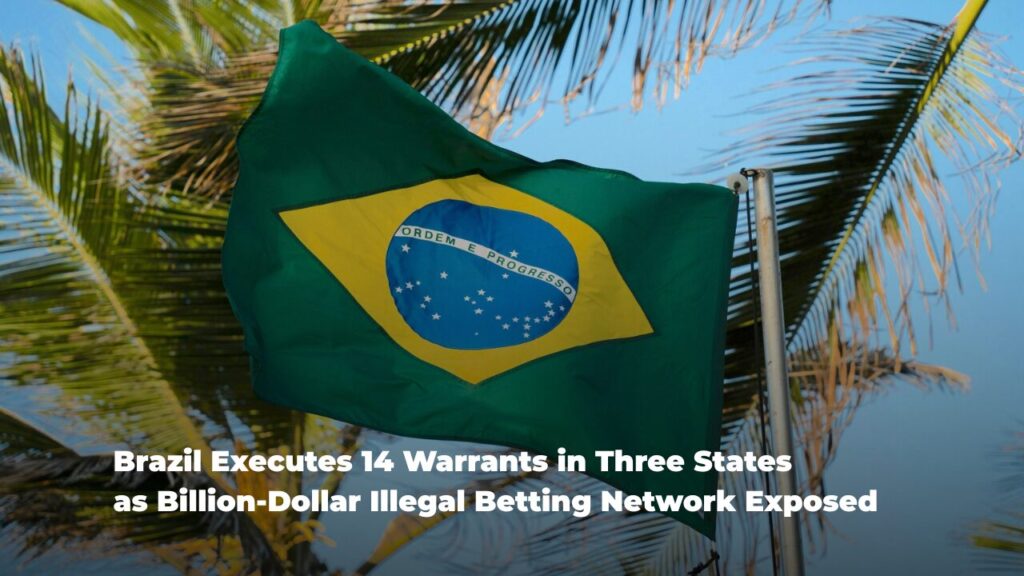
On 23 June, Brazilian federal authorities launched one of the most significant strikes against illegal betting the country has ever seen. Operation Conto da Sorte, executed across Pernambuco, Ceará and São Paulo, saw the Federal Revenue Service act alongside state Public Prosecutors’ offices to dismantle a network of 37 companies. The estimated financial movement tied to this network: BRL50 billion, or $9.7 billion.
Courts ordered the freezing of up to BRL145 million in assets, funds that may eventually compensate for damages caused by the scheme. Finance Minister Dario Durigan put it directly at a public announcement: “There was a movement, at first, of R$50bn, due to these 37 companies that operated illegally in the country, and these 14 search and seizure warrants will allow us to determine the exact amounts that will be announced very soon.”
No arrests have been made. Six individuals and seven properties are in scope, with investigators focused on pulling together documents, electronic devices, passports and financial records.
Shell Companies, Straw Owners and a Municipal Agency That Should Not Have Existed
Peel back the network and what you find is deliberate misdirection at every layer. Most of the 37 companies were registered under straw owners, people with no realistic means of running a business, some of them active recipients of emergency social assistance.
They were the visible faces. Control sat elsewhere. Several companies within the network had no physical presence whatsoever, existing solely to channel money through the banking system.
Investigators identified money laundering, tax evasion and the purchase of real estate with illicit funds. Operators had also failed to transfer net betting revenue to the state, a specific obligation embedded in Brazil’s betting law.
The trail leads back to 2025 and a regulatory breach the Secretariat of Prizes and Betting (SPA) flagged early. A municipal agency named LOTSERIDÓ, established in July 2024 by the small municipality of Bodó in Rio Grande do Norte, had started issuing betting licences. That authority belongs exclusively to the SPA at the federal level. No municipality can grant it.
The Supreme Federal Court confirmed as much, revoked LOTSERIDÓ’s authorisations and the agency was shut in October 2025. That should have been the end of it. The companies it had licensed kept operating anyway, without a word of approval from the SPA.
Official economic activity records from Bodó show BRL4.6 billion flowing through the accounts of at least a single company. The total across all 37 is still being determined.
New Decree Moves Enforcement from Websites to Bank Accounts
The raids did not arrive in isolation. Days earlier, on 19 June, President Luiz Inácio Lula da Silva signed Decree No. 13,033, a measure that pulls enforcement away from website takedowns and plants it squarely inside the financial system. The decree implements Article 21-A of Brazil’s fixed-odds betting legislation, a provision inserted this year under the Anti-Faction Law, and hands the SPA a formal mandate to identify illegal operators and trigger account restrictions.
Once the SPA flags an unlicensed operator, whether through its own market surveillance, a substantiated complaint or evidence of electronic fraud, banks and payment institutions have 24 hours to freeze the relevant accounts and stop any further transactions feeding that operation. They then have 48 hours to confirm they have done so.
The Central Bank sits above the process, receiving notice of each order and watching for compliance. Worth noting: the freeze is precautionary, not conclusive. The National Public Security Secretariat must open a forfeiture proceeding and allow operators 15 days to respond. Seizing the assets permanently still requires the Attorney General’s Office to bring a court action and win it.
The decree also protects bettors: forfeiture cannot touch money legitimately owed to them. Running alongside it, Ordinance No. 1,766/2026 introduces joint liability for banks and payment service providers that keep processing transactions for unlicensed operators after receiving formal notice.
The Central Bank and the Finance Ministry are required to set up a safe system of e-notification within 90 days for such actions; until then, all notifications will be sent using existing federal e-channels. In another move, the Federal Revenue Service stated that digital marketers who advertise unregistered online gambling sites would be liable for Income Tax, PIS, and Cofins.
41% to 51% of Betting Activity Remains Outside Licensed Channels
The timing of both the raid and the decree was not coincidental. At the 19 June announcement, the government disclosed that between 41% and 51% of all betting activity in Brazil still runs through unlicensed channels. Brazil has roughly 25.2 million active bettors. One in four places bet every day; more than half engage at least once a week.
The Federal Revenue Service collected BRL4.586 billion in taxes from 87 licensed operators between January and April 2026, nearly double what the same period in 2025 produced. The trend is real. So is the instability beneath it: BRL1.49 billion in January, BRL859 million by March, then a partial recovery to BRL1.189 billion in April.
SPA has been forthcoming about their limitations. From 2025 onwards, SPA has advocated that the National Telecommunications Agency, known as Anatel, block almost 50,000 illegal betting websites and 350 operators linked to them. The sheer magnitude of the problem by itself illustrates how website blocking has become unattractive as the main weapon; operators pop up on different web addresses. Starving them of money is a tougher challenge.
The 2026 FIFA World Cup, co-hosted by the United States, Canada and Mexico, sharpens the urgency considerably. Brazil’s share of global tournament betting is estimated at around BRL19 billion. That volume is coming regardless of whether the regulated market is in shape to capture it.
Offshore platforms answerable to no Brazilian regulator carry none of the compliance costs, responsible gaming requirements or advertising restrictions that licensed operators absorb. They will chase the same bettors, on the same phones, at the same time.
Expert Analysis
Alex Pariente, founder of Pariente Advisory and a veteran of nearly three decades in regulated gaming and resort development, has argued that Brazil’s tax figures confirm the early strength of its regulated model, but stop well short of confirming consolidation. The illegal market’s persistence is a channelisation problem, he says, one that enforcement alone cannot close. The markets that have actually moved the needle on unlicensed activity, he pointed to the UK, Sweden and Denmark, got there by combining competitive product regulation, systematic disruption of payment flows, consumer education and enforcement capacity proportional to the illegal market’s actual size.
“None of these levers, applied in isolation, produced results,” he wrote. “All of them, applied sequentially and with institutional coordination, did.”
Together, Operation Conto da Sorte and Decree No. 13,033 represent the most direct attack Brazil has mounted on the financial foundations of illegal betting. The 41-51% estimate is the number that matters. The next six months, and the World Cup bearing down on them, will show whether any of this actually moves it.
Explore more:
 Share
Share


 252 views