Key Points
- Bally’s disclosed substantial doubt about its ability to continue as a going concern in its Q2 2026 SEC filing, while projecting it would not satisfy its revolving credit facility’s liquidity maintenance requirement.
- The site workforce dropped from roughly 1,500 workers before August to around 1,000 by the date of the September 15 investor call, according to figures cited by company executives at separate briefings.
- Bally’s plans to open the Chicago casino in early 2027 with just 100 of 500 planned hotel rooms, alongside separately secured $560m in Bronx financing.
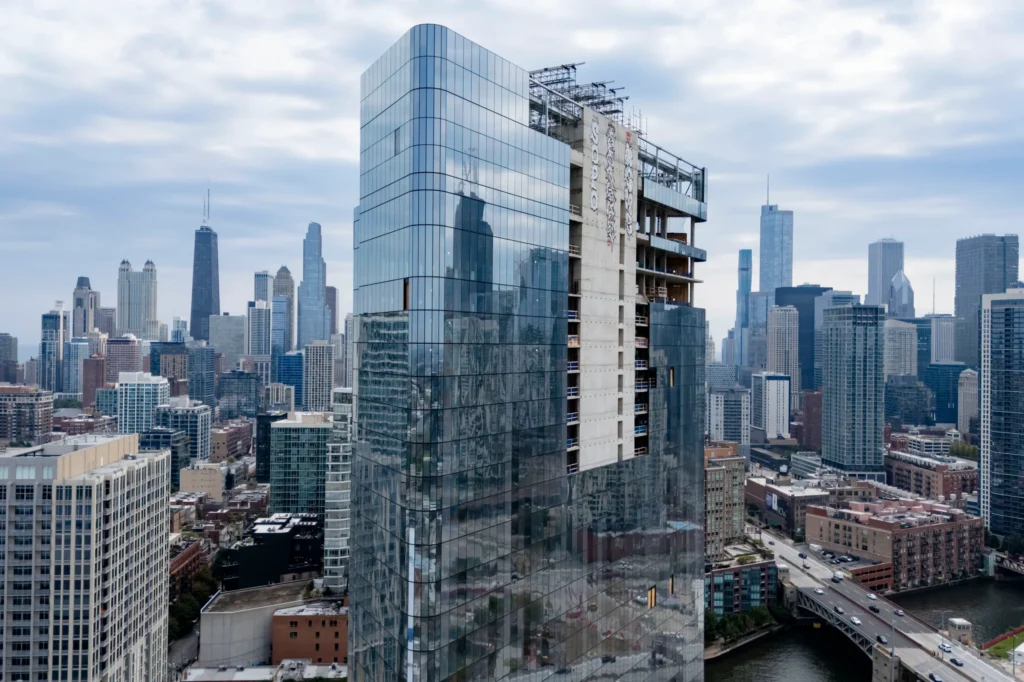
Bally’s held an investor call on 15 September that lasted eight minutes. Executive Chairman Soo Kim spent most of that time repeating one message: construction on the company’s $1.7 billion Chicago casino had not stopped. The brevity of the call was itself worth noting.
“There have been inaccurate reports suggesting that construction has stopped or paused,” Kim said. “It has not. Construction continues every day, and there are approximately 1,000 skilled tradespeople working on the construction of the permanent Bally’s Chicago resort.”
One figure complicates the reassurance. Before Bally’s issued its August construction notice, the site had roughly 1,500 trade workers active. Senior Vice President Christopher Jewett had separately put the September count at between 1,100 and 1,150 before Kim’s call brought it to 1,000. Construction continued, as stated. The scope of what was being built had changed.
What Chicago Gets in 2027, and What It Does Not?
The gap between what the host community agreement promised and what Bally’s now plans to deliver is not small. At a Chicago City Council committee hearing the week before the investor call, President and interim CFO George Papanier confirmed the company would open the casino floor, an events centre, 100 hotel rooms from the planned 500-room total, and required food and beverage space in early 2027. Papanier said Bally’s was reevaluating roughly 12% of the project’s other planned amenities, a category that includes non-gaming elements such as the entertainment theatre, convention space, additional hotel rooms, and public greenspace, though the source reporting does not establish that those listed items collectively account for exactly that share.
Papanier called continued construction of the affected components “irresponsible” until the VGT landscape becomes clearer. Bally’s still maintains it will satisfy the $1.34 billion minimum capital commitment required under the HCA, a figure confirmed in the company’s Q2 2026 SEC filing, which notes approximately $400 million remained outstanding against that commitment as of June 30.
Twenty-seven Chicago alderpersons did not find the reassurances sufficient. In a letter dated August 2026, they called for a public hearing and warned that the slowdown “could jeopardise thousands of union jobs, economic activity and other public benefits Chicago was promised.” The letter was pointed on contract terms, noting that the HCA covers the full development, not just the casino floor, and that deleting any component constitutes a material change requiring city approval.
The VGT Argument Meets Contested Testimony
Bally’s says video gaming terminals, legalised through Chicago’s 2026 budget after the City Council overruled Mayor Brandon Johnson, could reduce the casino’s top-line revenue by 30% to 50%. That figure came directly from Papanier in council testimony, cited as Bally’s own projection rather than an independently established forecast.
Sixty-five applications for the VGT licences have been approved by the state in the city. There hasn’t been a municipal permit issued by the city. As pointed out by Alderman Anthony Beale in the August proceedings, as quoted by CBS Chicago’s report on the hearing of September 10, there were thousands of sweepstakes machines operating illegally near the construction site before Bally’s brought it up.
Testimony by Rick Heidner, a casino owner in Illinois, presented yet another twist in this case at the hearing. According to Heidner, Bally’s had seemed interested in VGTs in those meetings, which he claimed were acquisition talks. However, a Bally’s representative at the hearing refused to confirm the existence of such talks. His statement is an allegation, not a confirmed fact.
Illinois VGT data offers context the company chose not to highlight. Between January and July 2026, terminals generated approximately $532 million in state revenue, compared to roughly $222 million from casinos during the same period. VGTs outperform land-based casinos across Illinois by a wide margin, something Bally’s would have known when it modelled Chicago’s gaming market.
A Going-Concern Filing, a CFO Exit, and a Mob-Linked Dumpster
The VGT situation was presented to Bally in a particular phase of its financial cycle, and this is crucial. According to its SEC filing for Q2 2026, conditions and events cast significant doubt regarding the ability of the company to continue as a going concern. The filing reveals that, given the projections available to the company and excluding the financing options that it was considering, Bally’s did not expect to meet the liquidity maintenance test under its revolving credit facility within twelve months from the date of filing. The resignation of the CFO, Mira Mircheva, took effect on September 4, for personal reasons, as stated by the company. The new interim CFO, Papanier, started in that position on that very date.
The Bally stock had dropped roughly 30% in one month prior to the call on September 15. It went up by 7% to $9.84 on the day, according to the market information from Gaming America, but this does not say whether it was related to the Chicago announcement, the Bronx financing, or both.
Additional regulatory history of the project is available. In May 2025, the Illinois Gaming Board served a stop-work order due to an investigation of an unlicensed waste haulier called D&P Construction working at the site. The FBI accused D&P of having connections with an organised crime group from Chicago. The same contractor was used for a licensing issue at a casino in Rosemont 20 years ago when $50 million of public money was invested in the project but then the licence was revoked. The construction at Bally’s Chicago was resumed in May 2025 after the IGB found no regulatory issues.
Bronx Gets $560m While Chicago Waits
Bally’s confirmed $560 million in new financing for its planned $4 billion Bronx resort at Ferry Point Park on the same day as the Chicago update. WhiteHawk Capital Partners is leading the package: $400 million in term loan commitments at close, $160 million on a delayed draw basis. The company expects the financing to close in Q3 2026, subject to regulatory approval.
The almost 20-acre land parcel is owned by Bally’s after purchasing it from New York City in March 2026 at a price of $156.6 million, according to NEXT.io. The condition under the acquisition states that construction should start in eighteen months. According to the documents for New York’s licence application, Bally’s intends to start construction eight to nine months after getting the licence which was issued in December 2025. The complex includes 3,500 slot machines, 210 table games, 40 poker tables, 500 rooms, 2,000 people seating events centre, a nightclub, and a spa with the target opening date in 2030.
WhiteHawk Managing Partner Bob Louzan said the financing “reflects our ability to structure flexible capital solutions for complex transactions.”
Expert Analysis: The Reset Deserves More Scrutiny Than It Is Getting
We think the September 15 call raised more questions than it answered. Framing the session as a response to “inaccurate reports” when the site workforce had measurably declined, and when non-gaming construction had been formally rephased, is a public communications position, not a full account of what changed.
The financial picture is documented, not inferred. Bally’s own SEC filing discloses substantial doubt about going-concern status, a covenant waiver on its revolving credit facility, and a projection that liquidity maintenance requirements may not be met within twelve months. This is the balance sheet context in which both the Chicago reset and the Bronx financing are taking place simultaneously.
Our view is that the 30% to 50% revenue impact figure Bally’s attributed to VGT proliferation deserves more scrutiny than it has received. Not a single VGT terminal is currently permitted and operating in Chicago. Projecting that level of cannibalisation from terminals without a city permit, in a market where the temporary Medinah Temple casino had already underperformed revenue projections before any VGT appeared, is a figure that raises legitimate questions about what it is based on. Alderman Walter Burnett, whose ward includes the Bally’s site, has himself acknowledged a roughly 30% reduction pattern in casino revenues wherever VGTs are introduced in Illinois municipalities, which lends partial credibility to Bally’s concern. But whether that justifies rephrasing 400 hotel rooms and a 3,000-seat theatre is the question neither the company nor its critics have fully answered in public.
It is obvious that the HCA legal case, VGT issue, and the going concern disclosure happened to be concurrent. It could either have been a matter of coincidence or the company was dealing with several pressures using one public discourse. The reader has to come up with his/her own conclusions based on the facts provided.
Explore more:
 Share
Share


 19 views