

Key Points
- Altenar says Sportradar stopped its US entry by blocking access to sports data.
- Cases filed in the US and UK ask for damages and regulatory action.
- The issue raises concern on control, access, and competition in sports betting.
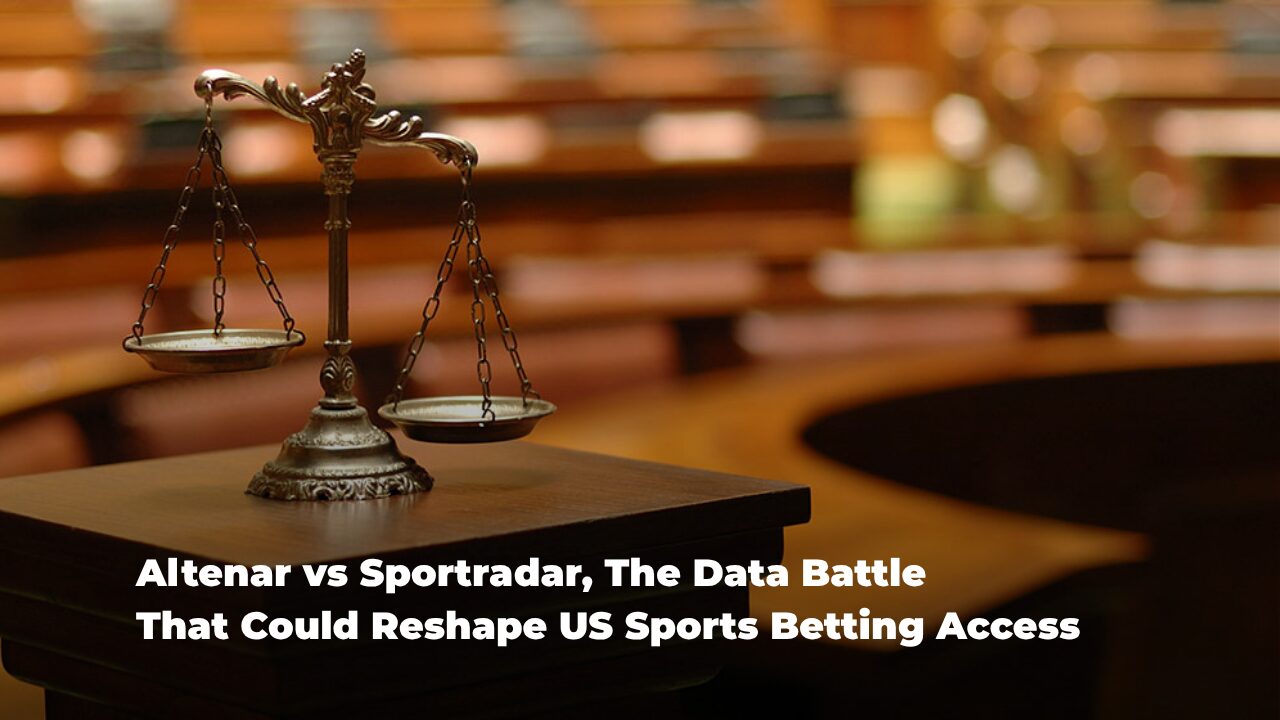
The US sports betting market has been open since 2018, at least on paper. One barrier remains largely invisible, and it is access to official league data. That gap now sits right at the centre of a high-stakes legal battle. Altenar, a sportsbook technology provider with global operations, says it has been locked out of the United States entirely, and not because its product falls short, but because the data it needs to compete sits out of reach. Altenar filed the lawsuit on March 31, 2026, in the District Court of New Jersey, and also brought a parallel case in the UK High Court. The case challenges what Altenar calls a structural imbalance, a setup where control over data decides who gets to participate in the market at all.
Why Has Sports Data Become the “Lifeblood” of Betting?
The role of real-time data sits at the heart of this dispute, and it needs to be understood clearly. Modern sports betting, and in-play wagering in particular, runs on data that arrives fast and is accurate every time. Live betting accounts for up to 75% of total betting handled across Sportradar’s operator network on its own. That number makes the point clearly: official league data is not something a sportsbook can go without; it forms the base of everything. A sportsbook without that data cannot set reliable odds, hold its risk position, or go up against platforms that already have what they need. Altenar frames official data as an “essential input” for any B2B sportsbook platform, and that framing sits at the centre of its entire argument. One implication follows from this. Whoever controls that input holds a hand in deciding who enters the market.
The Core Allegation, Control Used as a Competitive Weapon
Sportradar holds a position as both a data provider and a direct competitor, and that dual role sits at the centre of the case. The company carries long-term agreements with major leagues that include the NBA, MLB, NHL, and ATP. Those deals hand it access to the official data streams that drive betting markets forward. Altenar’s position is that this control has served a strategic purpose, not just a commercial one.
According to the complaint: “Altenar has one of the premier turnkey platforms in the world… but it has been foreclosed entirely from entering the United States market by Sportradar’s abuse of its monopoly power over the critical input for Altenar’s product, live official league sports data.”
A second statement from the complaint makes the accusation harder to ignore: “Sportradar wanted to take as much of the United States turnkey market for itself as it could… [it] decided to choke off Altenar’s access to the lifeblood of its business and attempt to capture market share for its own turnkey product.”
The case does not stop at denied access. It pushes into the question of whether that denial was a deliberate move to wipe out a rival.
From Longstanding Partner to Direct Rival
The two companies did not start out as rivals. Altenar relied on Sportradar for official data across international markets for years, and it paid more than $6 million each year under an arrangement that held value on both sides. Everything shifted after PASPA fell in 2018 and the US market came alive. When contract negotiations ran in 2020, Altenar came to the table asking for US data rights to be included. Sportradar reportedly pushed for a deal that left the US out, with a suggestion that those rights would come through a different process. Altenar put its name to that agreement, and it waited. The US access is expected to never arrive. Sportradar launched its ORAKO sportsbook technology platform in 2022, and that move turned a supplier into a competitor overnight. For Altenar, that shift marked a turning point, because data access narrowed and the US expansion it had put real money into went nowhere.
The Hidden Gatekeeper Problem
What the lawsuit brings into view reaches beyond the dispute between the two companies. US market operators hold official data integration as a standard requirement before they will work with a platform. That position sets off a chain, and a supplier that cannot bring that data to the table will not get operator contracts, whatever the quality of its technology. Altenar says that the chain is exactly what stopped it. It did not lose operator deals because its platform was weak. It lost them because the data access that operators needed was not there. Data providers take on a gatekeeper role through that dynamic. No rule says so directly, but the effect runs through the whole market.
Expansion, Acquisition, and Rising Competition Concerns
Sportradar’s growth path also featured in the dispute. The company has moved into media services, betting technology, iGaming, and prediction products alongside its data business. Its ORAKO platform puts it in a position to hand operators a single solution that covers the full range. After it acquired IMG Arena, Altenar claims Sportradar pulled more control over betting data toward itself and began to shape how commercial relationships developed, including stepping into contract renewals that involved IMG. Regulators looked at that acquisition and raised concerns about market concentration before they let it go ahead. Those same concerns now come back through a legal case. Altenar’s argument is that this set-up creates a direct conflict, because the same company holds the inputs and runs a competing product that relies on them.
Legal Claims Across Two Continents
The case runs in parallel across the US and UK, with each jurisdiction carrying its own legal frame but the same core issue underneath. Altenar’s US claims rest on antitrust law, and they centre on monopoly power and exclusion from the market. Its UK claims focus on the Competition Act, and they examine how Sportradar used its position after the IMG Arena acquisition to close off access and direct commercial relationships. The scale of what Altenar wants in return reflects how far this dispute reaches. It is asking for:
- Financial damages worth millions.
- Court-ordered access to official data on fair, reasonable, and non-discriminatory terms.
Sportradar’s Response
Sportradar has pushed back against all of it. A spokesperson for the company said: “While we prefer not to comment on pending litigation, we strongly disagree with the claims made by Altenar, which we believe are without merit and contain numerous inaccuracies. Sportradar will address these through the legal process. We encourage stakeholders to rely on our public disclosures and SEC filings for a complete and accurate view of our business.”
That statement puts Sportradar on a path of legal defence rather than any kind of early resolution.
What This Case Really Decides?
Two companies in a commercial dispute is what this looks like from a distance. From closer in, it reads as a test of the conditions that allow modern betting markets to function. Data that sits under the control of one company shapes the whole ecosystem, the entry points, the growth paths, and the exits that happen before anyone even gets started. What the court decides will not only settle whether Altenar gets in. It will set out whether critical sports data can be held as a restricted commercial asset, or whether it has to be available as infrastructure that the market can build on. That line, drawn quietly by whatever ruling comes, decides whether the market is genuinely open or whether it only carries that appearance.
Explore more:
 Share
Share


 30 views







 Analysis
  Business
  Companies
  Crime
Crime  Finance
  M&A
M&A  Prediction Markets
  Regulation
  Reports