Key Points
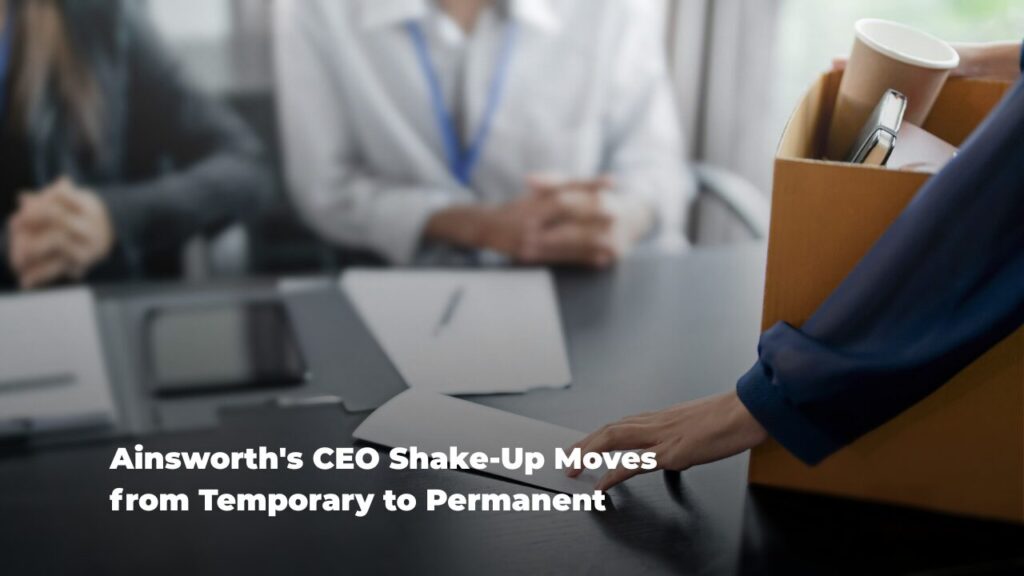
- Following a six-month evaluation process of Ryan Comstock’s tenure as acting CEO of the firm, Ainsworth officially confirmed him as CEO following the resignation of former CEO Harald Neumann in October 2025.
- The leader confirmation announcement is made during a dispute between two parties: the son of the firm’s founder Len Ainsworth and its majority shareholder Novomatic AG. Both parties had been trying to exert greater influence in the organisation.
- The organisation generated AUD290.8 million in revenues during 2025 due to solid growth in Asia-Pacific owing to its new products, although the organisation continued recording losses on account of impairment losses in North America.
What does a gaming company do when shareholder pressure, takeover tensions, and financial uncertainty land at the same time? Ainsworth Game Technology has resolved at least one of those challenges. Permanently confirming Ryan Comstock as CEO removes one layer of uncertainty while investors continue to watch the ownership contest building around the company.
Months of Leadership Uncertainty Come to an End
Leadership changes inside the gaming industry tend to stay quiet. This one did not.
With shareholders tracking ownership developments, Ainsworth Game Technology confirmed Ryan Comstock as permanent chief executive officer, ending the period of uncertainty that had followed Harald Neumann’s resignation in October 2025. The board spent six months reviewing his leadership, operational direction, and overall performance during his time as acting CEO before reaching that decision.
The appointment took effect immediately.
Rather than opening an external search for a new executive, the board held continuity in place and gave the business time to perform under Comstock’s direction. That period has now ended with a permanent appointment rather than another round of transition.
Comstock had already spent years embedded in Ainsworth’s operations before reaching the top role. He joined in 2012 and took on the chief operating officer role in 2018, building exposure across manufacturing, product strategy, compliance, and market operations, all of which remain important for gaming suppliers across multiple regulated markets.
Leadership instability inside gaming technology companies tends to create disruption well beyond the management level. Licensing relationships, regulatory approvals, and product roadmaps can all face delays when executive transitions drag on. Ainsworth moved to avoid that outcome.
The board stated it reviewed Comstock’s performance during the acting period and concluded he held “the necessary attributes and experience gained across all operational areas of the company to undertake the role of CEO.”
That language carried meaning beyond formality. The board was pointing directly to operational depth as the quality that mattered most during a period shaped by shareholder tension, patchy financial results, and market conditions that leave no room for slow decisions.
Comstock also already held the gaming regulatory approvals needed from his prior executive positions inside the company, which meant the transition could proceed without delays on the licensing side.
The Timing of This Announcement Carries Real Strategic Weight
Ainsworth released the news at a moment that carried significance well beyond a routine executive announcement. Recent months have placed Ainsworth at the centre of escalating positioning from founder-family interests and majority shareholder Novomatic AG. In that context, the market has read the CEO confirmation as something far more loaded than a standard leadership update.
Kjerulf Ainsworth, son of founder Len Ainsworth, pushed his stake to 8.35 per cent following the close of a proportional takeover offer that targeted 5.5 per cent of each shareholder’s ordinary shares.
That build happened in stages.
His voting power stood at 8.24 per cent before the offer closed on 27 April. When the off-market offer launched in March at AUD1.30 per share, his holding was 8.17 per cent. Those incremental movements point to a strategy built around gradual influence rather than an outright takeover.
Novomatic, meanwhile, held 67.39 per cent ownership as of 4 May, maintaining firm control of the company. The Austrian gaming technology group had previously pushed to strengthen that position further through an unconditional AUD1.00 per share offer launched in August 2025 for shares not already in its possession. That offer closed in February 2026 without collecting enough acceptances to lift Novomatic’s stake to 75 per cent. Kjerulf Ainsworth had opposed that offer publicly, arguing it placed too low a value on the company.
All of that combined to create an environment in which leadership uncertainty carried cost. Keeping the company under temporary leadership while ownership tensions ran high would have made it harder to execute strategy and harder to hold investor confidence. Confirming Comstock now appears to signal that the board wants stability in place before shareholder activity escalates further.
The Compensation Structure Points Toward Long-Term Intent
Executive contracts carry messages of their own, often as revealing as the announcement attached to them.
Comstock’s agreement has no fixed term and remains under ongoing board review. That design gives directors room to move while removing any sense that the appointment is a short-term measure. The contract sets Comstock’s base salary at US$625,000 per year. He will also participate in Ainsworth’s 2026 Short-Term Incentive Plan, which ties to group financial performance targets and foreign exchange conditions for the year ending 31 December 2026.
The long-term incentive structure stays consistent with earlier disclosures. It includes 400,000 cash-settled performance rights connected to both service conditions and performance hurdles. That framework connects executive reward to what the business actually delivers rather than time served in the role. Across gaming technology, investors have increasingly pushed for compensation that reflects commercial outcomes, particularly when margins face pressure and competition keeps rising.
The contract also covers six months’ notice for termination by either party, plus non-compete and non-solicitation restrictions running up to six months after the employment relationship ends. Such provisions remain broadly standard across the gaming technology leadership space, but they carry extra weight inside Ainsworth given the ownership dynamics at play and the level of competition in its product markets.
Ainsworth’s 2025 Results Tell Two Different Stories
The 2025 financial results presented a picture that contained two separate realities sitting side by side. Revenue landed at AUD290.8 million, with underlying profit before tax of AUD21.1 million. At first glance, those numbers point to a company still delivering real operational output across its key markets.
But the company also reported a net loss after one-off items and goodwill impairment charges connected to its North American business. That distinction carries more weight than it might appear. Impairment charges tend to reflect concerns about future earnings expectations, asset valuations, or assumptions around long-term regional performance rather than a sign that operations have broken down immediately.
North America contributed 52 per cent of total company revenue during the year, keeping it as Ainsworth’s largest region. Strain inside that part of the business therefore holds real importance for anyone watching the company’s numbers.
The Asia-Pacific segment, however, moved in the opposite direction.
Revenue there rose 52 per cent year-on-year to AUD65 million, driven by product launches including the A-Star Raptor cabinet alongside higher unit sales and stronger average selling prices. That divide now sits at the centre of the challenge Comstock takes on as permanent CEO. The company shows product momentum and growth opportunity, most visibly in Asia-Pacific. But profitability needs stabilising, particularly in North America, where impairment charges have raised questions about what the region’s performance looks like going forward.
Casino operators and gaming partners value consistency as much as they value new products. Gaming manufacturers build long-term relationships through reliable product pipelines, platform support, and technology roadmaps that hold, not through product wins that arrive without follow-through.
What Continuity in Leadership Could Do for Ainsworth’s Competitive Position?
The decision Ainsworth made reflects a wider pattern emerging across gaming suppliers during periods of market uncertainty. Continuity over change seems to be the motto that a lot of companies are adopting when the going gets tough and execution becomes the priority. Hiring an external CEO might have brought some much-needed fresh thinking to the table, but it would also have come with all sorts of risks – from slowing down product delivery to straining key relationships with regulators or upsetting delicate ownership negotiations that were already underway.
Comstock takes the other road.
His confirmation reinforces operational familiarity, internal discipline, and continuity of execution across the business. That profile may provide reassurance to casino operators who depend on supplier stability and technology support across jurisdictions.
It may also help Ainsworth hold internal momentum while the pressure from both Novomatic and the Ainsworth family side of the ownership picture continues.
Continuity, though, will not remove the company’s larger operational problems on its own. Gaming technology has grown more competitive across cabinet design, digital integration, recurring revenue approaches, and regional market development. Investors will now look for measurable progress under Comstock, especially in North America, where impairments.
Expert View: Why This Appointment Carries Industry-Wide Significance
For gaming equipment manufacturers, stable leadership extends its effects well beyond governance.
Licensing continuity, operator trust, product rollout schedules, and investor confidence all connect directly to who leads the company and how settled that position looks. By confirming Ryan Comstock now, Ainsworth has removed a layer of uncertainty at a point where delay could have produced consequences that stretched well beyond the executive announcement itself. From an operational standpoint, the move suggests Ainsworth has chosen execution focus over reinvention. That likely translates into emphasis on product commercialisation, sales efficiency across regions, and margin improvement rather than sweeping structural change.
Casino operators on Ainsworth platforms tend to value continuity because it reduces risks across servicing, cabinet deployment, and compliance-related relationships. The industry also keeps a close watch on the ownership dynamics circling the company. Novomatic’s failure to push its stake to 75 per cent, alongside Kjerulf Ainsworth’s step-by-step accumulation, signals that the market still sees value in Ainsworth despite the financial pressure it has faced. That has created a situation where operational results and shareholder strategy have grown increasingly connected.
The most immediate opportunity looks to sit in the Asia-Pacific. A 52 per cent revenue increase in the region showed what a well-executed product launch can deliver when demand and pricing strength align with cabinet innovation. If management can carry that momentum while bringing North American profitability back to a steadier position, Ainsworth may improve its competitive standing faster than current market views reflect.
But risks have not gone away.
Further weakness in North America would press harder on earnings quality, while shareholder tensions that drag on could make future strategic decisions and any acquisition conversations more complicated. The market will also watch closely to see whether product momentum converts into results that hold over time rather than appearing in isolated sales periods.
Ainsworth has settled the CEO question.
Everything that follows now depends on whether Ryan Comstock can translate operational continuity into commercial performance that runs deep and lasts.
Explore more:
 Share
Share


 354 views